mAh to Amps Calculator
Find the current a battery supplies from its mAh rating and runtime or C-rate, and see why mAh and amps differ.
Quick answer
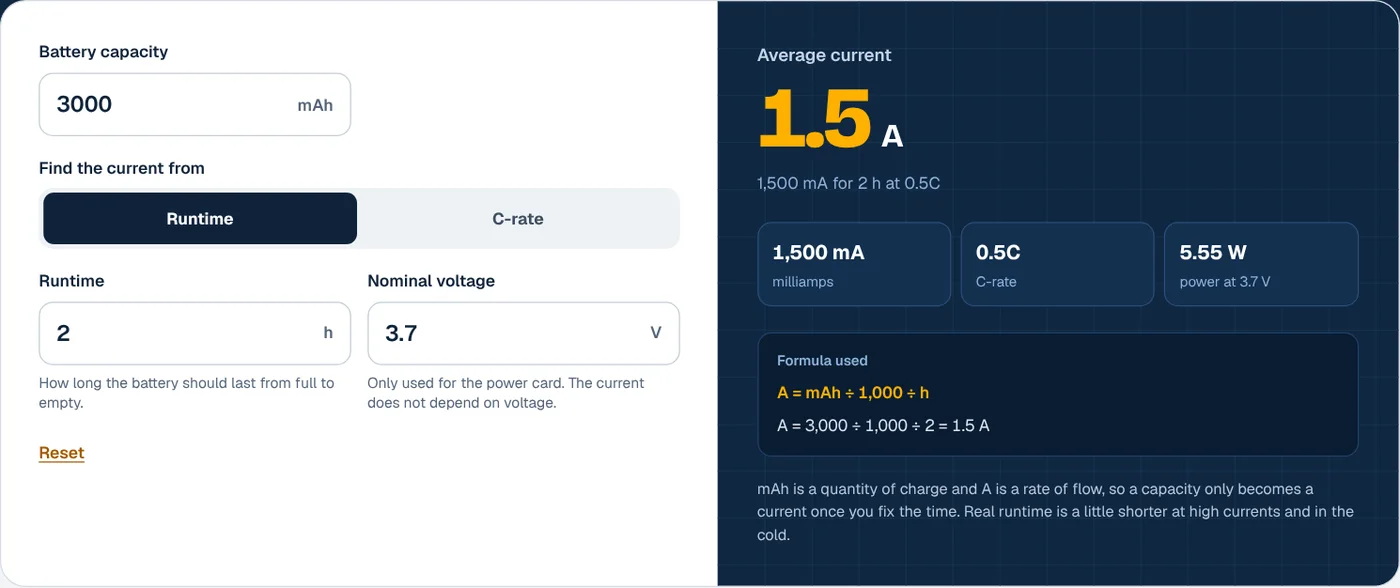
mAh and amps are different units, so you cannot convert one to the other without a time. Average current in amps = mAh ÷ 1,000 ÷ hours. A 3,000 mAh battery that runs for 2 hours supplies 3,000 ÷ 1,000 ÷ 2 = 1.5 A. Using the C-rate instead, amps = mAh ÷ 1,000 × C, so the same battery at 1C delivers 3 A.
How to use the mAh to amps calculator
- Enter the battery capacity. Type the mAh rating from the battery label, such as 3,000 mAh for an 18650 cell, 5,000 mAh for a phone or 14,000 mAh for an e-bike pack (14 Ah).

- Choose runtime or C-rate. Pick Runtime if you know how long the battery should last. Pick C-rate if you have a discharge rating from a datasheet, such as 0.5C, 1C or 25C for a drone LiPo.

- Enter the runtime or the C-rate. Type the hours from full to empty, or the C multiple. 2 hours is the same as 0.5C, and 30 minutes is the same as 2C.

- Enter the nominal voltage. This only feeds the power card. The current depends on the mAh and the time, not on the voltage.

- Read the average current. The large number is the current in amps. The cards show it in milliamps, the matching C-rate or runtime, and the power in watts at your voltage.

Why mAh is not the same as amps
An amp is a rate: NIST defines one ampere as one coulomb of charge passing a point each second. A milliamp-hour is an amount: the charge moved by 1 mA flowing for one hour, which is 3.6 coulombs. Asking how many amps a 3,000 mAh battery is resembles asking how many miles per hour a 300 mile fuel tank is. The answer depends on how fast you use it.
What a mAh rating does tell you is the trade-off between current and time. A 3,000 mAh battery can supply 3 A for 1 hour, 1.5 A for 2 hours or 0.3 A for 10 hours, in theory. Its maximum safe current is a separate rating set by the cell maker.
mAh to amps formula
Where:
- A is the average current in amps. Multiply by 1,000 for milliamps.
- mAh is the rated capacity in milliamp-hours. Dividing by 1,000 gives Ah.
- h is the runtime in hours from full to empty.
- C is the C-rate, the current as a multiple of the capacity in Ah.
- V and W are the nominal voltage and the power drawn.
To go from a known current and runtime back to capacity, use the amps to Ah calculator.
Worked examples
Example 1: phone on standby
A phone with a 5,000 mAh battery lasts 20 hours of mixed light use.
That is an average of 250 mA, about 0.96 W at 3.85 V. The C-rate is 0.05C. Peaks during gaming or video calls are several times higher, so the average hides a lot of variation.
Example 2: e-bike ride
A 36 V e-bike battery rated 14,000 mAh (14 Ah) runs flat in 1.5 hours of hard riding.
At 36 V that is about 336 W on average, and the battery is working at 0.67C. If the controller is rated for 20 A peaks, the pack sees about 1.4C on hills.
Example 3: drone LiPo by C-rate
A 1,500 mAh LiPo pack is rated 45C continuous. Choose C-rate mode:
That is the maximum continuous current the maker claims, and at that rate the pack would empty in 60 ÷ 45 = 1.3 minutes. Many hobbyists treat high C ratings as optimistic and plan well below them.
Current for common capacities and runtimes
Average current in amps, calculated as mAh ÷ 1,000 ÷ hours. The column headings also show the matching C-rate.
| Capacity (mAh) | 0.5 h (2C) | 1 h (1C) | 2 h (0.5C) | 5 h (0.2C) | 10 h (0.1C) | 20 h (0.05C) |
|---|---|---|---|---|---|---|
| 500 | 1 | 0.5 | 0.25 | 0.1 | 0.05 | 0.025 |
| 1,000 | 2 | 1 | 0.5 | 0.2 | 0.1 | 0.05 |
| 2,000 | 4 | 2 | 1 | 0.4 | 0.2 | 0.1 |
| 3,000 | 6 | 3 | 1.5 | 0.6 | 0.3 | 0.15 |
| 5,000 | 10 | 5 | 2.5 | 1 | 0.5 | 0.25 |
| 10,000 | 20 | 10 | 5 | 2 | 1 | 0.5 |
| 20,000 | 40 | 20 | 10 | 4 | 2 | 1 |
What affects the result
The C-rate and the cell’s limit
Every cell has a maximum continuous discharge current, usually written as a C-rate or in amps on the datasheet. Phone and laptop cells are often limited to around 1C, power tool cells to 5C or more, and racing LiPos claim 25C to 100C. A current above the rating heats the cell and shortens its life. The C-rate calculator explores this in more detail.
Capacity drops at high current
The mAh on the label is measured at a gentle rate, often 0.2C. Drain the battery faster and internal resistance wastes more as heat, so you get fewer usable mAh and a shorter runtime than the formula predicts. Lead-acid batteries show this effect much more strongly than lithium.
Average versus peak current
The calculator gives the average current that would empty the battery in the time you enter. Real devices pull bursts: a phone radio, a motor on a hill, a camera flash. Size wires and fuses for the peaks, not the average.
Voltage changes power, not current
For the same mAh and runtime, the current is identical at 3.7 V or 48 V. The power is not: 1.5 A is 5.55 W at 3.7 V but 72 W at 48 V. To turn a load in watts into runtime, use the battery life calculator, and for energy in Wh see the mAh to Wh calculator.
Frequently asked questions
How many amps is 1,000 mAh?
1,000 mAh is not a current, it is a capacity of 1 Ah. It can supply 1 A for one hour, 0.5 A for two hours or 2 A for half an hour. To get an actual current, divide the mAh by 1,000 and then by the runtime in hours, or multiply by the C-rate.
How many amps can a 5,000 mAh battery deliver?
That depends on its maximum discharge rating, not its mAh. A 5,000 mAh phone cell rated around 1C can deliver about 5 A, while a 5,000 mAh drone LiPo rated 50C claims up to 250 A. Check the datasheet. At a modest 0.2C, either one supplies 1 A for five hours.
What does 1C mean for a battery?
1C is the current that would fully discharge the battery in one hour. For a 3,000 mAh battery, 1C is 3 A. 0.5C is 1.5 A over two hours, and 2C is 6 A over 30 minutes. Chargers use the same idea, so a 0.5C charge on that battery is 1.5 A.
Are mA and mAh the same thing?
No. mA, milliamps, is current, the rate charge flows at any moment. mAh, milliamp-hours, is charge, the total stored. A device drawing 200 mA from a 2,000 mAh battery runs for about 10 hours. Mixing the two up is the most common mistake in battery math.
How long will a 10,000 mAh power bank last at 2 A?
On paper, 10,000 mAh ÷ 2,000 mA = 5 hours at the cell voltage. But a power bank boosts 3.7 V to 5 V, so 2 A at the USB port draws about 3 A from the cells after losses. Expect roughly 3 hours of 2 A output instead.