Battery Charging Time Calculator
Estimate how long a LiFePO4, AGM or flooded battery takes to charge, with efficiency and absorption time included.
Quick answer
Battery charging time is the charge you need to add divided by the charger current times the charge efficiency: t = Ah × (SoC end − SoC start) ÷ (A × η). A 100 Ah LiFePO4 battery charged from 20% to 100% with a 20 A charger at 97% efficiency takes 80 ÷ 19.4 = 4.12 hours. A 100 Ah AGM battery on the same charger takes about 7.5 hours, because of absorption.

How to use the battery charging time calculator
- Choose the battery chemistry. Pick LiFePO4, AGM or gel, or flooded lead-acid. The choice loads a typical charge efficiency and decides whether an absorption stage is added near full charge.
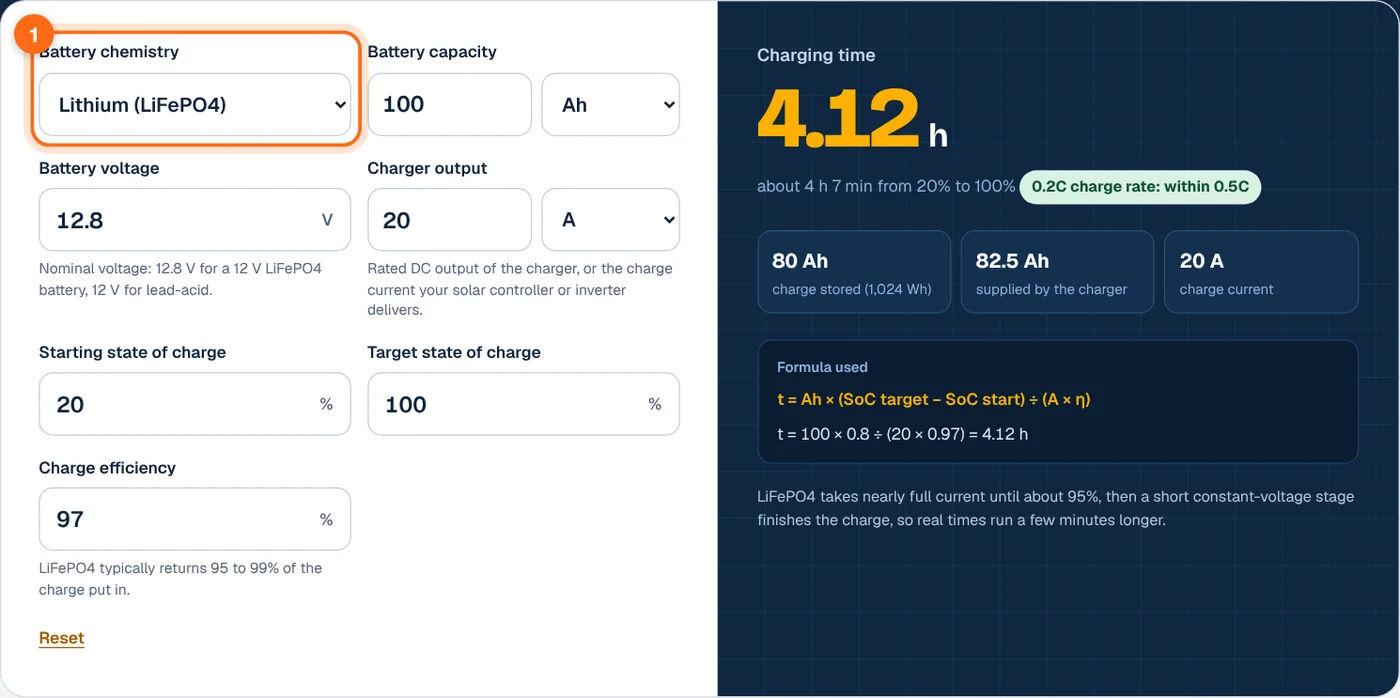
- Enter the battery capacity and voltage. Type the rating in Ah or Wh, and the nominal voltage: 12.8 V for 12 V LiFePO4, 12 V for lead-acid.
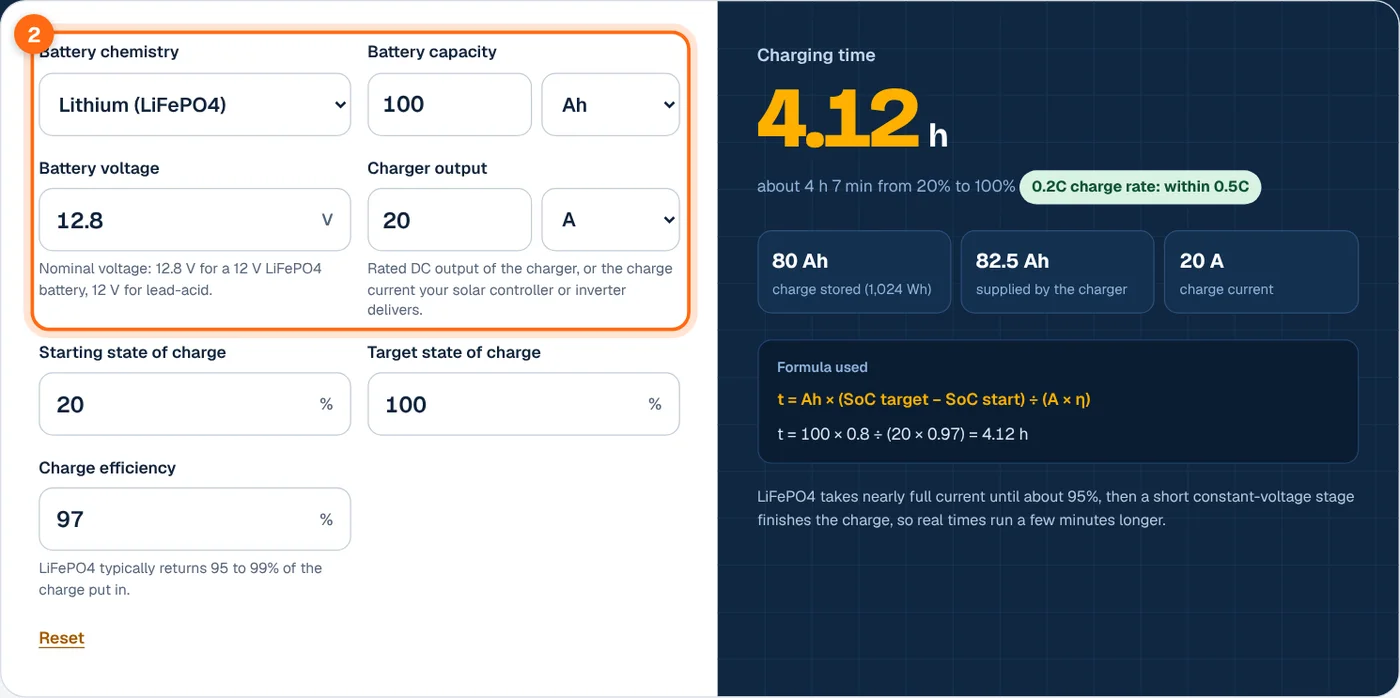
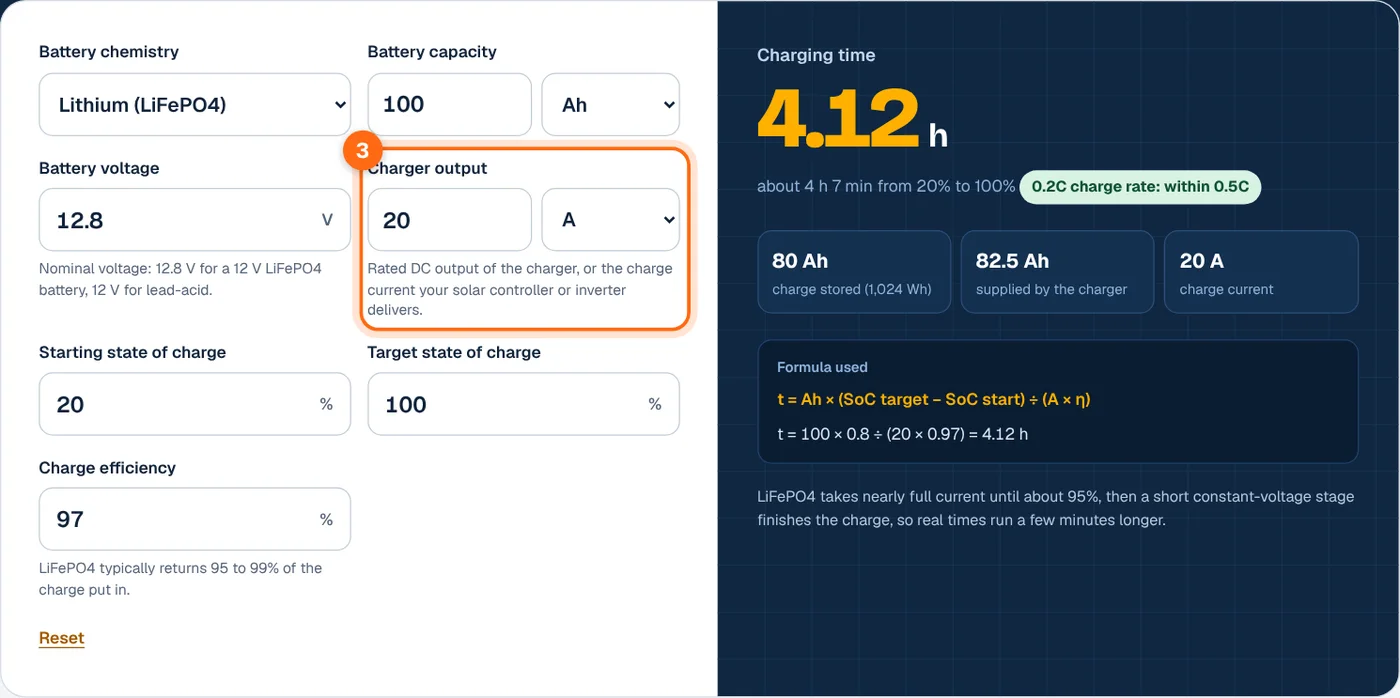
- Enter the charger output. Type the charger’s rated output in amps or watts. For solar, use the current your charge controller actually delivers, not the panel rating.
- Set the start and target state of charge. Enter where the battery is now and where you want it. Charging LiFePO4 to 90% instead of 100% saves time and is gentle on the cells.

- Read the result. The large number is the charging time in hours. The chip shows the charge rate against the usual limit for that chemistry, and the cards break the time into stored charge, charger output and, for lead-acid, bulk and absorption.

Battery charging time formula
Charging time is the charge you need to put back, divided by the effective current reaching the battery. Lead-acid adds a second stage near full charge.
Where:
- t is the charging time in hours.
- Ah is the battery capacity in amp-hours. A Wh rating is divided by the voltage first.
- SoC is the state of charge as a fraction, such as 0.2 for 20%.
- A is the charger output current, and W its output in watts.
- η (eta) is the charge efficiency, the share of input charge stored in the battery.
For lead-acid, the calculator charges at full current up to 80% and then uses the longer of two figures for the last 20%: the charge itself at full current, or an absorption time of 4 hours for AGM and gel and 6 hours for flooded batteries, scaled to how far above 80% you charge. Victron’s Energy Unlimited guide gives absorption times of 4 to 16 hours after a 50% discharge, depending on battery type and charge voltage, and puts lead-acid charge efficiency between 80% and 95%, with 85% as a sensible starting value.
Worked examples
Example 1: 100 Ah LiFePO4 on a 20 A charger
About 4 hours 7 minutes. The charger supplies 82.5 Ah to store 80 Ah. A 20 A charger is a 0.2C rate for this battery, well inside the usual 0.5C recommended for LiFePO4.
Example 2: 100 Ah AGM on the same charger
Charged from 20% to 100% at 85% efficiency on 12 V:
Nearly twice as long as LiFePO4 with the same charger. The last 20% takes more time than the first 60% because the battery accepts less and less current as it fills.
Example 3: LiFePO4 to 90% on a 50 A charger
About 1 hour 27 minutes. A 50 A charger is 0.5C on a 100 Ah battery, the recommended maximum in the Victron LiFePO4 Smart datasheet.
Charging time by charger size
Hours to charge a 100 Ah battery from 20% to 100%. LiFePO4 at 12.8 V and 97% efficiency; AGM at 12 V and 85% efficiency with 4 hours of absorption.
| Charger (A) | Charge rate | 100 Ah LiFePO4, 20 to 100% (h) | 100 Ah AGM, 20 to 100% (h) |
|---|---|---|---|
| 5 | 0.05C | 16.49 | 18.82 |
| 10 | 0.1C | 8.25 | 11.06 |
| 20 | 0.2C | 4.12 | 7.53 |
| 30 | 0.3C | 2.75 | 6.35 |
| 50 | 0.5C | 1.65 | 5.41 |
Bigger chargers shorten the bulk stage but not the absorption stage, which is why AGM time barely drops above 30 A. For a 100 Ah AGM battery, Victron recommends no more than 0.2C, or 20 A.
What affects the result
Charge efficiency
LiFePO4 stores nearly all the charge put into it, typically 95 to 99%. Lead-acid loses more to heat and, near full charge, to gassing. Older lead-acid batteries and flooded batteries at high voltage sit at the low end of the range.
Absorption and the last 20%
Lead-acid chargers switch from constant current to constant voltage at around 80% charge. The current then tapers, and the final stretch takes hours. Regular full charges still matter for lead-acid, because batteries left partly charged sulfate and lose capacity.
Charge current limits
A bigger charger only helps up to the battery’s limit. LiFePO4 is commonly limited to 0.5C, and lead-acid is best at 0.1C to 0.2C. Above that, batteries heat up, and a BMS may cut the current back. The C-rate calculator checks a current against these limits.
Solar and temperature
Solar charge current changes through the day, so use an average, not the controller’s rating. Cold also slows charging. Most LiFePO4 batteries must not be charged below 32 °F (0 °C), and lead-acid needs a higher voltage in the cold. The solar panel charging time calculator starts from panel watts and sun hours instead.
Frequently asked questions
How long does it take to charge a 100 Ah battery?
With a 20 A charger, a 100 Ah LiFePO4 battery charges from 20% to 100% in about 4.1 hours. A 100 Ah AGM battery takes about 7.5 hours on the same charger because of the absorption stage. With a 10 A charger, expect about 8.2 hours for LiFePO4 and 11 hours for AGM.
What size charger do I need for a 100 Ah battery?
For LiFePO4, 20 to 50 A works well, with 50 A (0.5C) as a common recommended maximum. For AGM or flooded lead-acid, 10 to 20 A (0.1C to 0.2C) is ideal. A larger charger shortens bulk charging but not lead-acid absorption, so going much bigger rarely helps.
Why does the last 20% take so long?
Lead-acid batteries cannot accept full current as they approach full charge. The charger holds a constant absorption voltage and the current tapers off, so the final 20% can take several hours. LiFePO4 accepts nearly full current until about 95%, so its last stretch is short.
How do I calculate charging time with a charger rated in watts?
Divide the charger watts by the battery voltage to get amps. A 300 W charger on a 12.8 V battery gives about 23.4 A. Choose W in the charger dropdown and the calculator does this for you, then applies the same efficiency and absorption logic.
Is it better to charge LiFePO4 to 90% or 100%?
Charging to 90% is faster and slightly gentler on the cells, and it is a common choice for daily solar cycling. Charge to 100% now and then so the BMS can balance the cells. Lead-acid is different: it should reach a full charge regularly to avoid sulfation.