Solar Cable Size Calculator
Size DC solar and battery cables in AWG and mm² from current, length, voltage and allowed voltage drop.
Quick answer
A DC solar cable must pass two checks: ampacity of at least Isc × 1.56 (NEC 690.8) and a voltage drop within your limit, A ≥ 2 × L × I × ρ ÷ (Vd% × V). A PV string with 11.14 A Isc at 111 V over 60 ft needs 10 AWG copper (6 mm²) for a 2% drop. A 100 A, 12 V battery run of 10 ft needs 1/0 AWG.

How to use the solar cable size calculator
- Choose the circuit. Pick PV array for panel strings and combiner outputs. Pick Battery or DC load for battery, inverter, charge controller output and 12, 24 or 48 V DC runs.
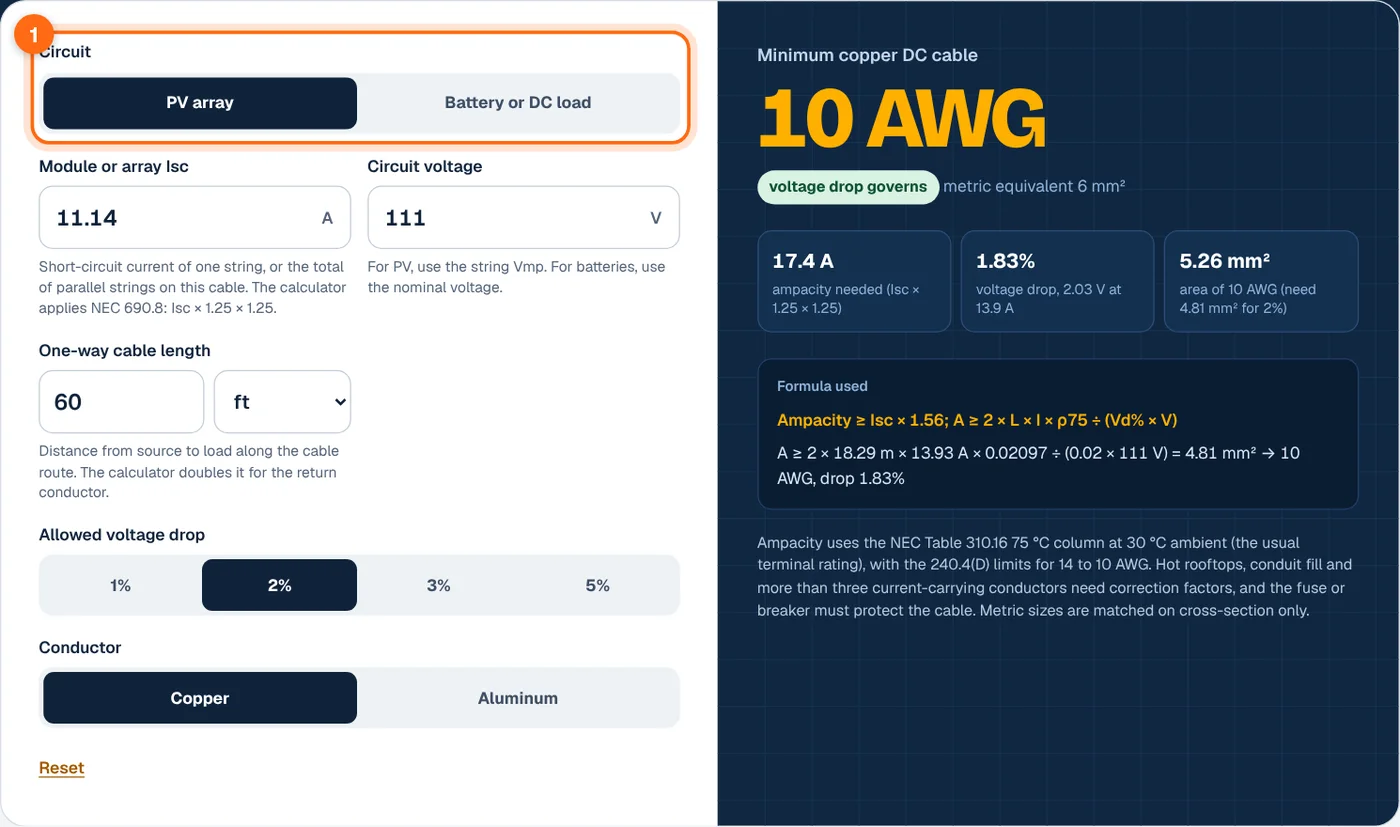
- Enter the current. For PV, enter the Isc of the string or the combined Isc of parallel strings; the calculator applies the NEC factors. For batteries, enter the maximum current the load draws.

- Enter the circuit voltage. Use the string Vmp for PV, or the nominal battery voltage.

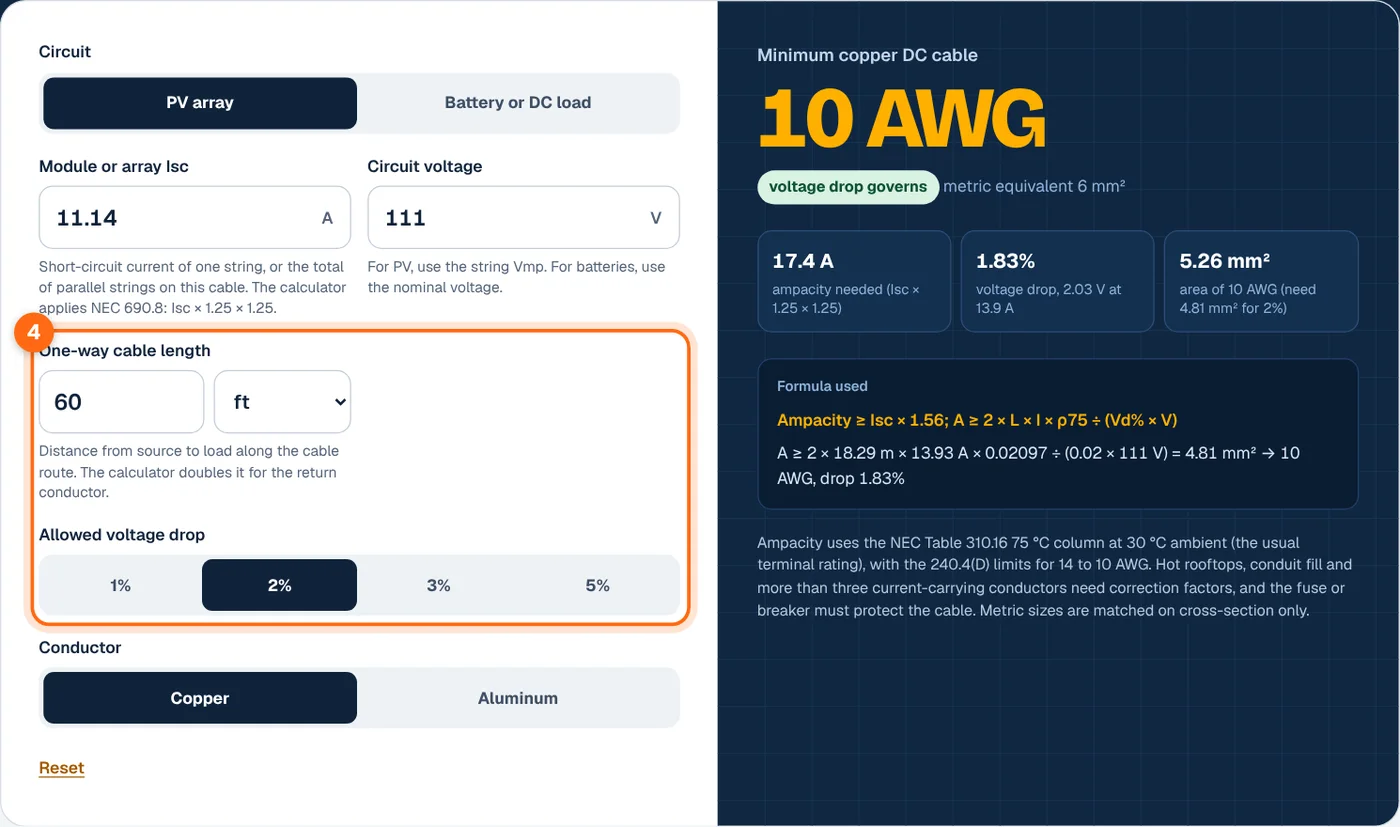
- Enter the one-way length and drop limit. Measure the cable route from source to load. 2% is a sensible target for DC; use 1% for short battery-to-inverter cables if you want minimal loss.
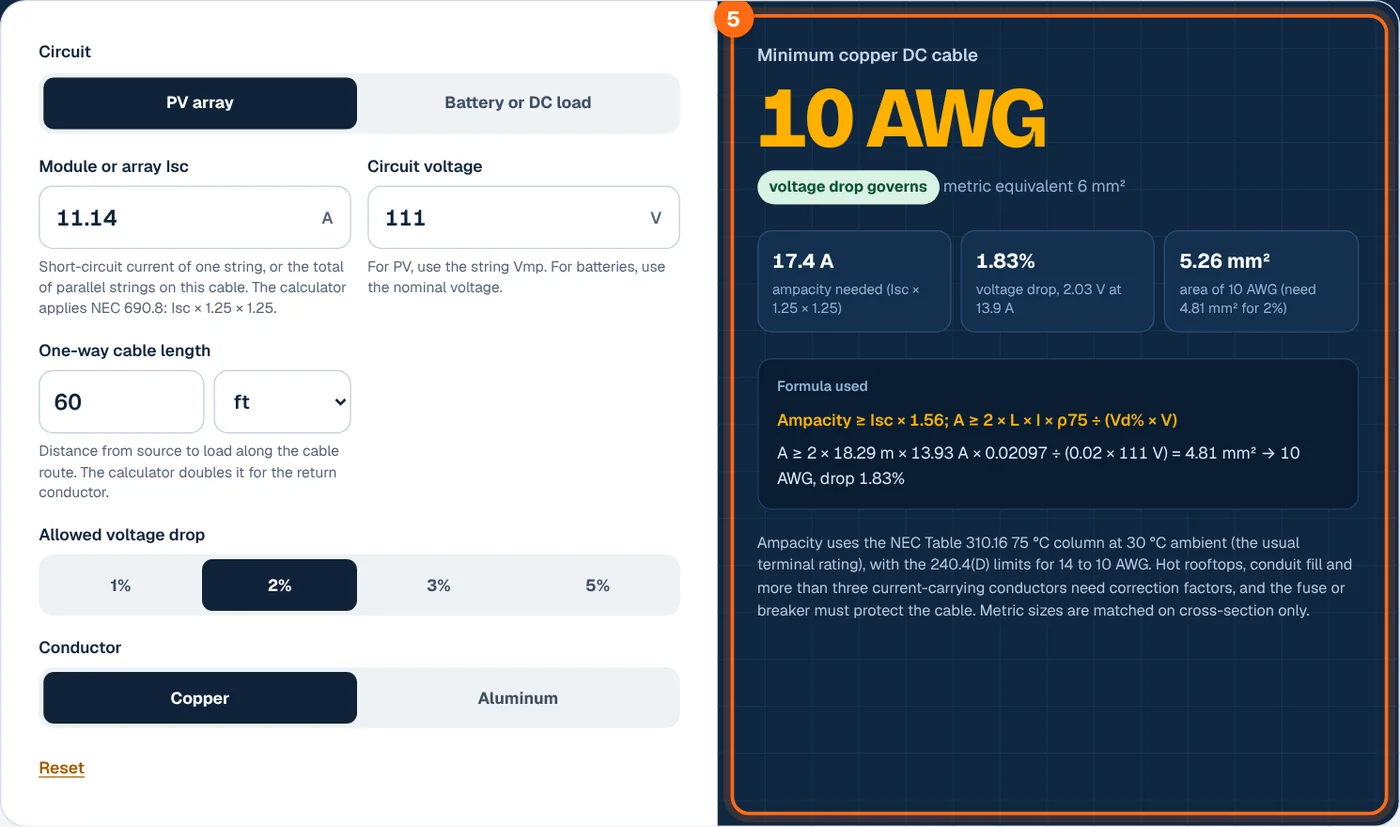
- Read the minimum cable size. The big result is the smallest AWG size that passes both checks, with the metric mm² equivalent beside it. The cards show the required ampacity, the actual drop and the conductor area.
DC cable size formula
The calculator takes the larger of two sizes: the one that carries the current safely, and the one that keeps voltage drop within your limit.
1. Ampacity check
2. Voltage drop check
Where:
- Isc is the module or combined string short-circuit current. The first 1.25 is the NEC 690.8(A) maximum circuit current, and the second is the 690.8(B) continuous-duty factor.
- I in the drop check is the maximum circuit current: Isc × 1.25 for PV, or the load current for batteries.
- L is the one-way length in meters; the 2 accounts for the positive and negative conductors.
- ρ75 is resistivity at 75 °C: 0.02097 Ω·mm²/m for copper and 0.03453 Ω·mm²/m for aluminum.
- A is the conductor cross-section in mm², V the circuit voltage and Vd% the allowed drop as a decimal.
Ampacity comes from the 75 °C column of NEC Table 310.16, with the 240.4(D) limits for 14 to 10 AWG. You can find the code text through the NFPA 70 (National Electrical Code) page.
Worked examples
Example 1: a PV string run of 60 ft
Three 400 W panels in series give 111 V Vmp with 11.14 A Isc.
12 AWG is only 3.31 mm², so voltage drop governs and the answer is 10 AWG (5.26 mm²), with a 1.83% drop. In metric, use 6 mm² PV cable.
Example 2: 100 A at 12 V over 10 ft
A 1,000 W inverter on a 12 V battery draws about 100 A.
The drop check calls for 1/0 AWG (53.48 mm²), which gives a 1.99% drop. In metric, 70 mm² is the next size up.
Example 3: the same 100 A at 48 V
Now ampacity governs: 125 A still needs 1 AWG, and the drop is just 0.63%. In practice the same inverter at 48 V draws only a quarter of the current, about 25 A, which needs only 8 AWG. This is why larger off-grid systems move to 48 V.
12 V DC wire size chart
Maximum one-way length in feet for a 2% drop at 12 V, copper at 75 °C. For 24 V double the length, and for 48 V multiply it by four. Always check ampacity too.
| Wire size | Area | 10 A | 20 A | 30 A | 50 A | 100 A |
|---|---|---|---|---|---|---|
| 14 AWG | 2.08 mm² | 3.9 ft | 2.0 ft | 1.3 ft | 0.8 ft | 0.4 ft |
| 12 AWG | 3.31 mm² | 6.2 ft | 3.1 ft | 2.1 ft | 1.2 ft | 0.6 ft |
| 10 AWG | 5.26 mm² | 9.9 ft | 4.9 ft | 3.3 ft | 2.0 ft | 1.0 ft |
| 8 AWG | 8.37 mm² | 15.7 ft | 7.9 ft | 5.2 ft | 3.1 ft | 1.6 ft |
| 6 AWG | 13.30 mm² | 25.0 ft | 12.5 ft | 8.3 ft | 5.0 ft | 2.5 ft |
| 4 AWG | 21.15 mm² | 39.7 ft | 19.9 ft | 13.2 ft | 7.9 ft | 4.0 ft |
| 2 AWG | 33.63 mm² | 63.1 ft | 31.6 ft | 21.0 ft | 12.6 ft | 6.3 ft |
| 1/0 AWG | 53.48 mm² | 100.4 ft | 50.2 ft | 33.5 ft | 20.1 ft | 10.0 ft |
| 2/0 AWG | 67.43 mm² | 126.6 ft | 63.3 ft | 42.2 ft | 25.3 ft | 12.7 ft |
| 4/0 AWG | 107.22 mm² | 201.3 ft | 100.7 ft | 67.1 ft | 40.3 ft | 20.1 ft |
The table shows how hard low voltage is on cables: at 12 V and 30 A, even 10 AWG only reaches 3.3 ft within 2%.
What affects DC cable size
System voltage
For the same power, doubling the voltage halves the current and cuts the percentage drop to a quarter. That is why PV strings run at 100 V to 500 V while battery cables at 12 V need very heavy gauges.
Length
Voltage drop grows in direct proportion to length. Put the charge controller close to the battery and run the higher-voltage PV cable the longer distance.
Temperature and installation
The table ampacity assumes 30 °C (86 °F) ambient and no more than three current-carrying conductors together. Conduit on a sunny roof and bundled cables need derating, which can add one or two sizes. Outdoor PV runs need sunlight-resistant PV wire or USE-2.
Copper versus aluminum
Aluminum has about 1.64 times the resistance of copper, so it needs larger sizes. It is used for long feeders, not for short battery cables or panel leads. For AC branch circuits and feeders, use the wire size calculator instead.
Overcurrent protection
Every DC cable must be protected by a fuse or breaker no larger than its ampacity. The solar fuse size calculator sizes string, controller and battery fuses to match.
Frequently asked questions
What size wire do I need for solar panels?
Most single strings of residential panels use 10 AWG copper PV wire, which handles Isc up to about 19 A by the 1.56 rule. Long runs at low voltage may need 8 AWG or larger to stay within a 2% drop. Combined outputs of several strings need larger cable based on their summed Isc.
What size cable from solar panel to charge controller?
Size it from the array Isc × 1.56 for ampacity and from Isc × 1.25 for voltage drop at the array Vmp. A 400 W 12 V array of four 100 W panels in parallel, 20.84 A Isc at 20.4 V, needs 8 AWG for 10 ft at 2%, or 4 AWG for 25 ft.
What size wire for a 12 V 2000 W inverter?
A 2,000 W inverter at 12 V draws about 185 A at nominal voltage and more as the battery sags. With the 1.25 factor that needs at least 250 kcmil by NEC 75 °C ampacity, though cable with a higher temperature rating and listed terminals can allow a smaller size. A 24 V or 48 V system is far easier to wire.
Is voltage drop or ampacity more important?
Both must pass. Ampacity is the safety limit that keeps the cable from overheating. Voltage drop is about performance: too much drop wastes energy and can make inverters cut out at low battery. In low-voltage DC systems, voltage drop usually sets the size; in PV strings at higher voltage, ampacity often does.
What is the difference between AWG and mm² solar cable?
AWG is the US gauge where a smaller number is thicker, while metric cable is sold by cross-section in mm². 10 AWG is about 5.26 mm², close to 6 mm² PV cable, and 12 AWG matches 4 mm². Metric PV cable is rated under IEC and EN rules rather than the NEC table.