Shed Solar Calculator
Size a 12 V solar setup for a shed or workshop: panel watts, battery Ah, charge controller and inverter for lights, tools and chargers.
Quick answer
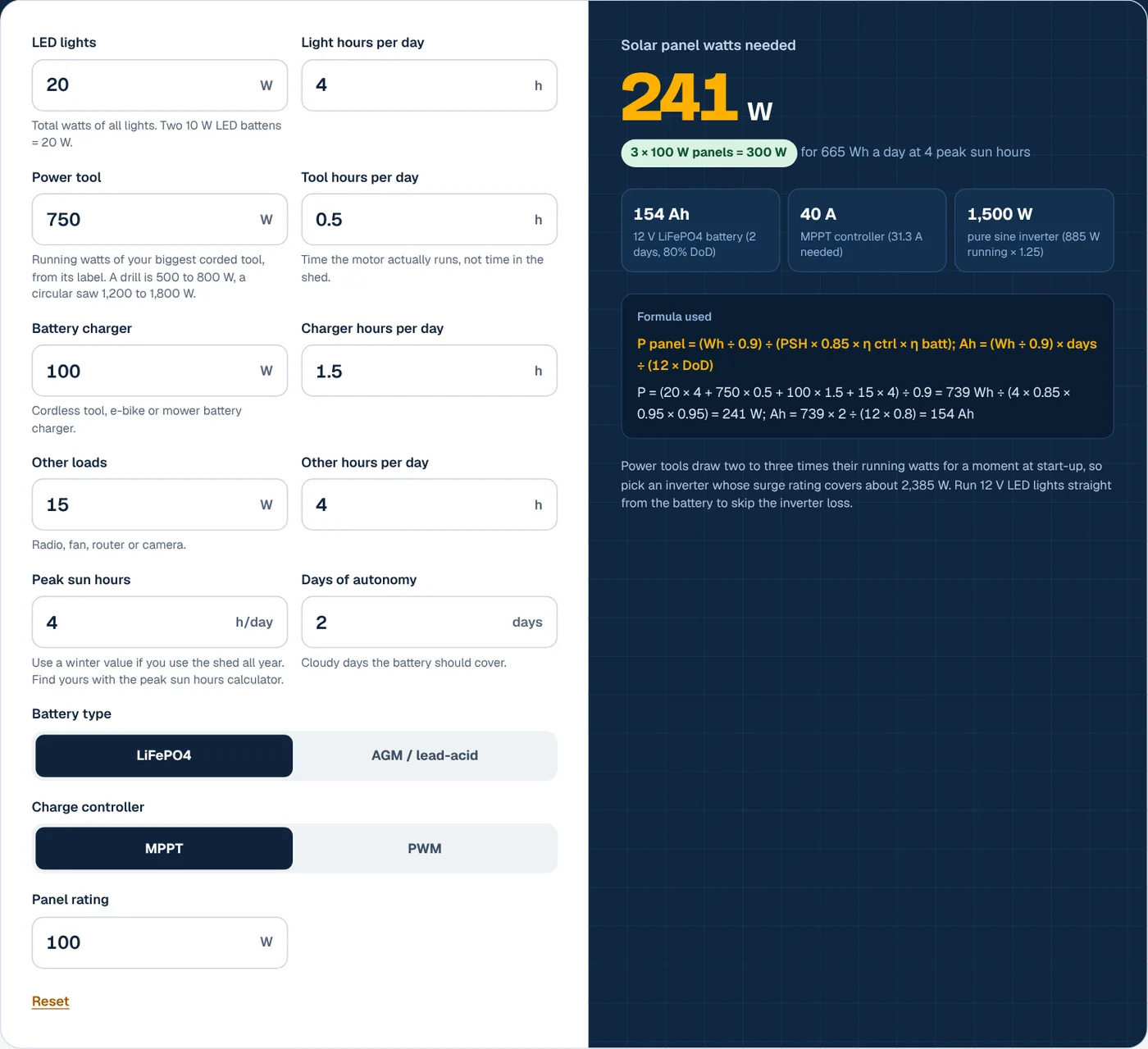
A shed with LED lights, a power tool, a battery charger and a radio uses about 665 Wh a day. At 4 peak sun hours that needs about 241 W of solar panel (three 100 W panels), a 154 Ah 12 V LiFePO4 battery for 2 days, a 40 A MPPT charge controller and a 1,500 W pure sine inverter. Lights alone need only about 30 W of panel.
How to use the shed solar calculator
- Enter your loads. Fill in the watts and daily hours for lights, your biggest power tool, a battery charger and any other small loads. For the tool, count only the minutes the motor actually runs. Set any load you do not have to 0.

- Enter your peak sun hours. Use a winter value if you work in the shed all year, or a summer value for seasonal use. The peak sun hours calculator gives monthly figures for your town.

- Set autonomy and battery type. Enter the cloudy days the battery should cover, then pick LiFePO4 or AGM. AGM is cheaper per Ah but only half of it is usable.

- Choose the controller and panel. MPPT harvests more energy than PWM in cool weather. Enter the rating of the panels you plan to buy.

- Read the result. The big number is the panel watts needed, with the panel count below. The cards show the 12 V battery size, the controller current and the inverter rating.

Shed solar formula
The calculator adds up your loads, allows for the inverter, panel and battery losses, and sizes a 12 V system to replace the energy each day.
Where:
- W × h is each load’s watts times its hours per day.
- 0.9 is the assumed inverter efficiency, applied to every load to keep the estimate on the safe side.
- PSH is peak sun hours per day, and 0.85 covers heat, dirt and wiring losses at the panel.
- ηctrl is 0.95 for MPPT and 0.80 for PWM. ηbatt is 0.95 for LiFePO4 and 0.85 for AGM.
- D is days of autonomy, and DoD is 0.8 for LiFePO4 and 0.5 for AGM.
The PWM figure reflects Victron’s PWM or MPPT white paper, which shows a PWM controller harvesting about 19% less than MPPT from a 12 V panel at 25 °C, with the gap shrinking as panels heat up.
Worked examples
Example 1: workshop with a drill, charger and lights
The default shed has 20 W of LED lights for 4 hours, a 750 W tool for 30 minutes, a 100 W charger for 1.5 hours and 15 W of other loads for 4 hours.
Three 100 W panels give 300 W, so the controller needs 300 ÷ 12 × 1.25 = 31.3 A, a 40 A MPPT unit. The running loads add up to 885 W, so a 1,500 W inverter fits, and its surge rating should cover about 2,385 W for the tool’s start-up.
Example 2: the same shed with AGM and PWM
Swap to an AGM battery and a PWM controller and the same 739 Wh needs more of everything.
The controller rises to 41.7 A, so a 50 A unit. The cheaper parts cost a fourth panel and a battery 60% larger.
Example 3: garden shed with no power tool
Without the tool, daily use drops to 290 Wh (322 Wh with the inverter allowance). At a winter value of 2 peak sun hours, that needs 210 W of panel, a 67 Ah LiFePO4 battery and only a 300 W inverter.
Panel watts per 100 Wh of daily use
Panel watts needed for each 100 Wh of daily appliance use. Multiply by your daily Wh ÷ 100.
| Peak sun hours | MPPT + LiFePO4 | PWM + AGM |
|---|---|---|
| 2 h | 72 W | 96 W |
| 3 h | 48 W | 64 W |
| 4 h | 36 W | 48 W |
| 5 h | 29 W | 38 W |
| 6 h | 24 W | 32 W |
A single 100 W panel covers about 275 Wh a day at 4 peak sun hours with MPPT and LiFePO4: enough for lights, a radio and a charger, but not much tool time.
What affects the result
Power tools
Tools draw a lot of power but for short bursts. A 1,800 W saw used for 15 minutes uses 450 Wh, about the same as a full evening of lights and radio. The bigger issue is the inverter: it must carry the running watts plus a start-up surge of two to three times the motor rating.
Season of use
A shed used in summer can be sized on 5 or 6 peak sun hours. Year-round use in the northern US or the UK may mean 1.5 to 2.5 hours in December, which more than doubles the panel size.
Battery type
LiFePO4 costs more up front but gives 80% usable capacity and loses less energy in charging. AGM is fine for light, occasional use, but it should be recharged fully and kept above 50% to last.
System voltage
12 V is the simplest choice for a shed and works directly with 12 V lights. Above about 800 W of panels or a 2,000 W inverter, currents get high, and a 24 V system from the off-grid solar calculator is the better fit.
Frequently asked questions
What size solar panel do I need for a shed?
For lights and a phone charger, a single 50 to 100 W panel is usually enough. For a workshop with a drill, a battery charger and a radio, plan on 250 to 400 W. The default example uses 665 Wh a day and needs about 241 W at 4 peak sun hours, so three 100 W panels.
Can a solar shed run power tools?
Yes, with a large enough inverter and battery. A 750 W drill or a 1,200 W saw runs on a 1,500 to 2,000 W pure sine inverter with a surge rating of two to three times the tool’s watts. Use a LiFePO4 battery of at least 100 Ah so it can supply the high current.
What size battery do I need for a solar shed?
Multiply the daily energy by the days of autonomy and divide by 12 V and the depth of discharge. The default shed needs 739 Wh a day, so 2 days on LiFePO4 at 80% gives 154 Ah. A lights-only shed often runs well on a 50 to 100 Ah battery.
Do I need an inverter for a shed solar system?
Only for 120 V or 230 V appliances such as corded tools and standard chargers. Lights, fans, USB chargers and radios that run on 12 V can connect straight to the battery through a fuse box. That saves the inverter’s standby draw and about 10% conversion loss.
MPPT or PWM for a shed?
PWM is fine for a single 100 W panel matched to a 12 V battery. For larger arrays, cold climates or panels with a higher voltage, MPPT harvests more energy and lets you wire panels in series with thinner cable. In the default example, switching to PWM and AGM raises the panel size from 241 W to 320 W.