Solar Panel Charging Time Calculator
Find how many hours and days a solar panel takes to charge a battery, with MPPT or PWM, battery type and any load running.
Quick answer
Charging time = energy to put back ÷ power reaching the battery. A 100 W solar panel with an MPPT controller delivers about 81 W in full sun, so it charges a 100Ah 12 V LiFePO4 battery from 20% to full (80% depth of discharge) in about 12.5 peak sun hours. At 5 peak sun hours a day, that is 2.5 days. With PWM it takes about 14.9 hours.

How to use the solar panel charging time calculator
- Enter the panel and the sun. Enter the total rated watts of the panels and the peak sun hours per day where you are. Peak sun hours are not hours of daylight; the peak sun hours calculator gives them for your location.

- Choose the charge controller. MPPT converts the panel’s higher voltage into extra current. PWM ties the panel to battery voltage and wastes part of its power.

- Describe the battery. Enter capacity in Ah, the battery voltage, the chemistry and how deeply it is discharged. 80% means charging from 20% back to full.
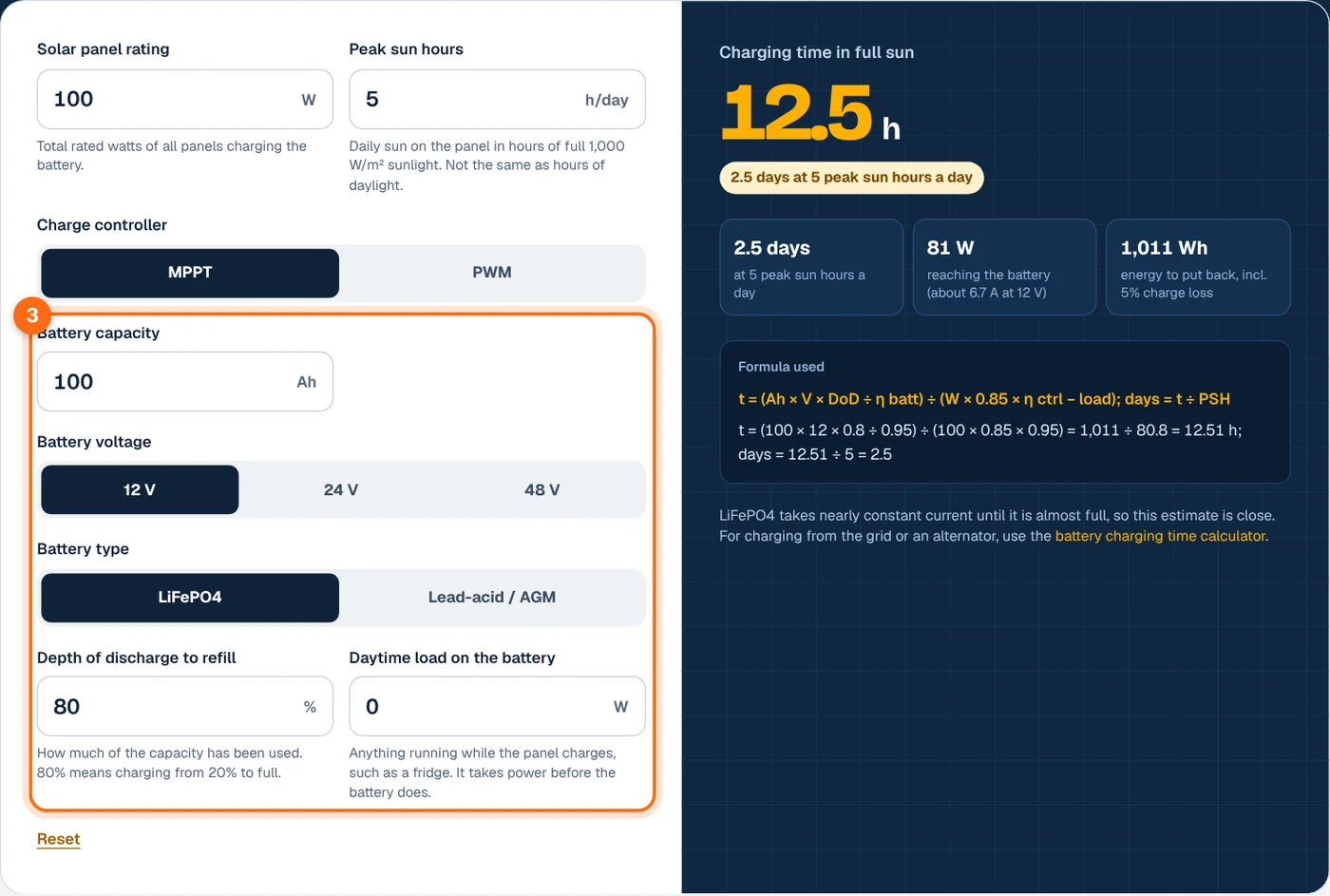
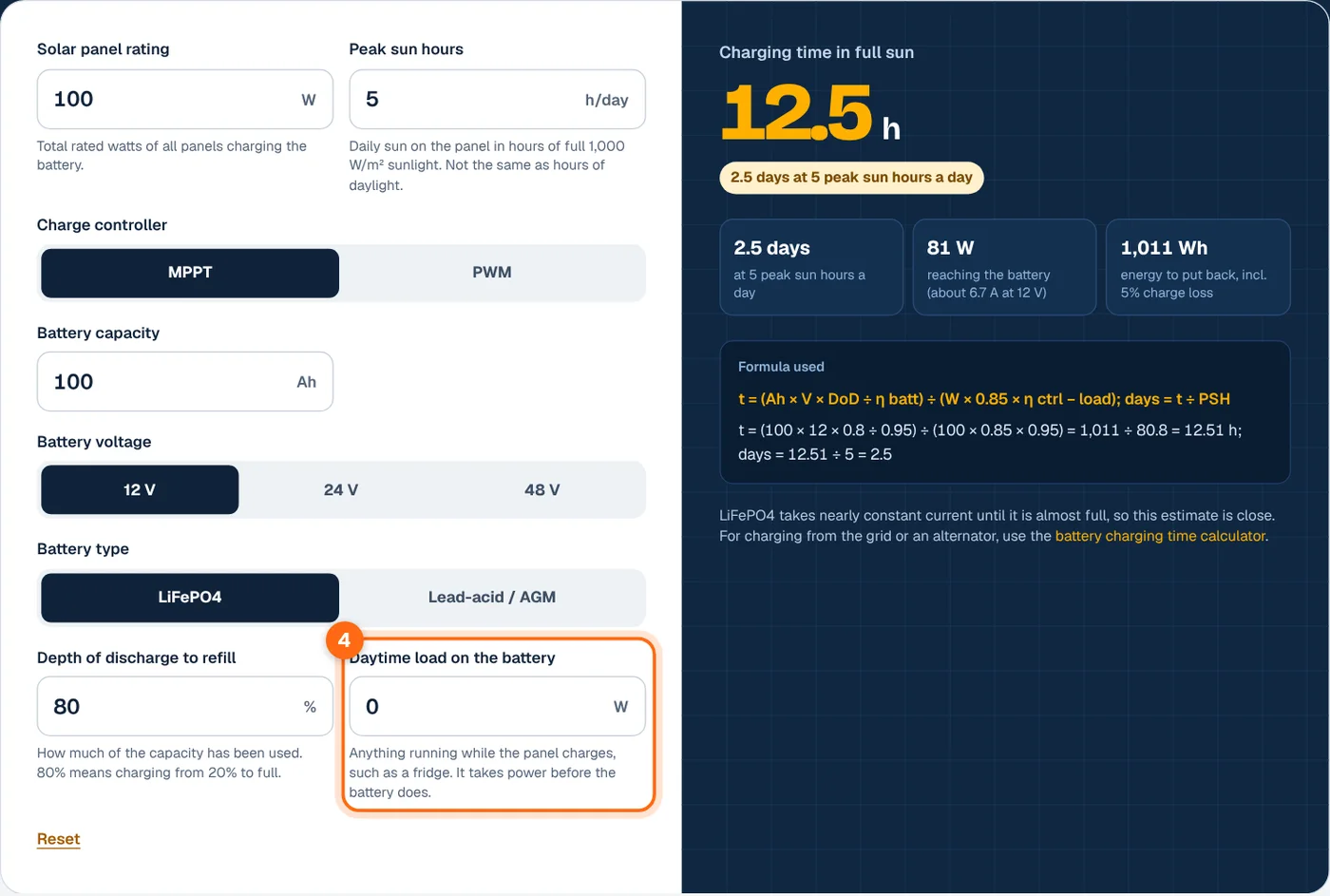
- Add any daytime load. A fridge or other device running while the panel charges takes power first. Leave 0 if nothing runs.
- Read the charging time. The big number is hours of full sun. The cards show days at your peak sun hours, the power and current reaching the battery, and the energy to put back.

Solar panel charging time formula
Where:
- Ah × V × DoD is the energy that was used, in Wh.
- ηbatt is the charge efficiency: 0.95 for LiFePO4 and 0.85 for lead-acid, so extra energy must go in to cover losses.
- 0.85 derates the panel for heat, dirt, angle and wiring. A panel almost never delivers its label rating.
- ηctrl is 0.95 for MPPT and 0.80 for PWM.
- t is in peak sun hours, so dividing by PSH per day gives days.
The PWM factor follows Victron’s PWM or MPPT white paper: a 100 W, 36-cell panel on a 13 V battery delivers about 81 W through PWM against the full 100 W through MPPT at 25 °C. On hot panels the gap shrinks to a few percent.
Worked examples
Example 1: 100Ah battery with a 100 W panel
A 12 V 100Ah LiFePO4 battery is at 20% and charges from a 100 W panel through an MPPT controller at 5 peak sun hours a day.
So the common answer of “10 hours” (100Ah × 12 V ÷ 100 W ÷ 1.2) is optimistic. Real panels lose power to heat, angle and wiring.
Example 2: 200Ah battery, half discharged, 200 W panel
At 5 peak sun hours that is 1.56 days.
Example 3: with a fridge running
Back to Example 1, but a 20 W fridge runs while the panel charges. Net power drops to 80.8 − 20 = 60.8 W, and charging takes 1,011 ÷ 60.8 = 16.6 hours, or 3.3 days. A 90 W load would take all the panel’s output, and the battery would never fill.
Charging time for a 100Ah 12 V battery
Hours of full sun to refill a 12 V 100Ah LiFePO4 battery from 20% (80% DoD), with no load running.
| Panel | MPPT | PWM | Days at 5 PSH (MPPT) |
|---|---|---|---|
| 50 W | 25.0 h | 29.7 h | 5.0 |
| 100 W | 12.5 h | 14.9 h | 2.5 |
| 200 W | 6.3 h | 7.4 h | 1.3 |
| 300 W | 4.2 h | 5.0 h | 0.8 |
| 400 W | 3.1 h | 3.7 h | 0.6 |
To refill a 100Ah battery in one day at 5 peak sun hours, plan on at least 250 W with MPPT.
What affects the result
Peak sun hours
A panel charges at its full output only around midday on clear days. Peak sun hours fold the whole day’s sunlight into hours at 1,000 W/m², so 5 PSH can come from 12 hours of daylight. In winter or under cloud, PSH can fall to 1 or 2, and charging takes several times longer.
Controller type
MPPT makes the biggest difference with cool panels and when panel voltage is well above battery voltage. PWM is cheaper and works for a small panel matched to a 12 V battery, especially in hot climates.
Battery chemistry
LiFePO4 accepts nearly full current until it is almost charged. Lead-acid slows down in the absorption stage above about 80%, so the last 20% can take several extra hours. Victron’s guide puts lead-acid charge efficiency between 80% and 95%.
Charge rate limits
Very large panels on a small battery can exceed the battery’s safe charge current. The calculator flags a rate above 1C for LiFePO4 or 0.3C for lead-acid. For grid or alternator charging, use the battery charging time calculator.
Frequently asked questions
How long does it take to charge a 100Ah battery with a 100 W solar panel?
About 12.5 hours of full sun to refill a 12 V LiFePO4 battery from 20%, with an MPPT controller. That is about 2.5 days at 5 peak sun hours. With a PWM controller it is about 15 hours. A fully flat lead-acid battery takes longer, because of charge losses and the slow absorption stage.
Can a 100 W solar panel charge a 200Ah battery?
Yes, but slowly. Refilling 80% of a 12 V 200Ah LiFePO4 battery takes about 25 hours of full sun, or 5 days at 5 peak sun hours, if nothing else draws power. It works for topping up a battery in storage. For daily use you need 300 to 400 W.
How many amps does a 100 W solar panel produce?
At its rated point a 100 W panel produces about 5.5 A at 18 V. Through an MPPT controller into a 12 V battery, the real output in sun is about 81 W, or 6.7 A at 12 V. Through PWM, the current stays at the panel’s current, about 5.5 A, so less power reaches the battery.
Why is solar charging slower than the panel rating suggests?
Panel ratings are measured at 25 °C cell temperature and 1,000 W/m² of light. Real panels run hotter, catch the sun at an angle and lose power in wiring and the controller. The calculator applies 0.85 for those losses and the controller and battery efficiencies on top.
Does charging time depend on battery voltage?
Only through the energy stored. A 24 V 100Ah battery holds twice the watt-hours of a 12 V 100Ah battery, so it takes twice as long from the same panel. Compare batteries in Wh to avoid confusion, using the Ah to Wh calculator.