Solar Finance Calculator
Work out your solar loan payment and total interest, then compare it with your monthly bill savings and a cash purchase.
Quick answer
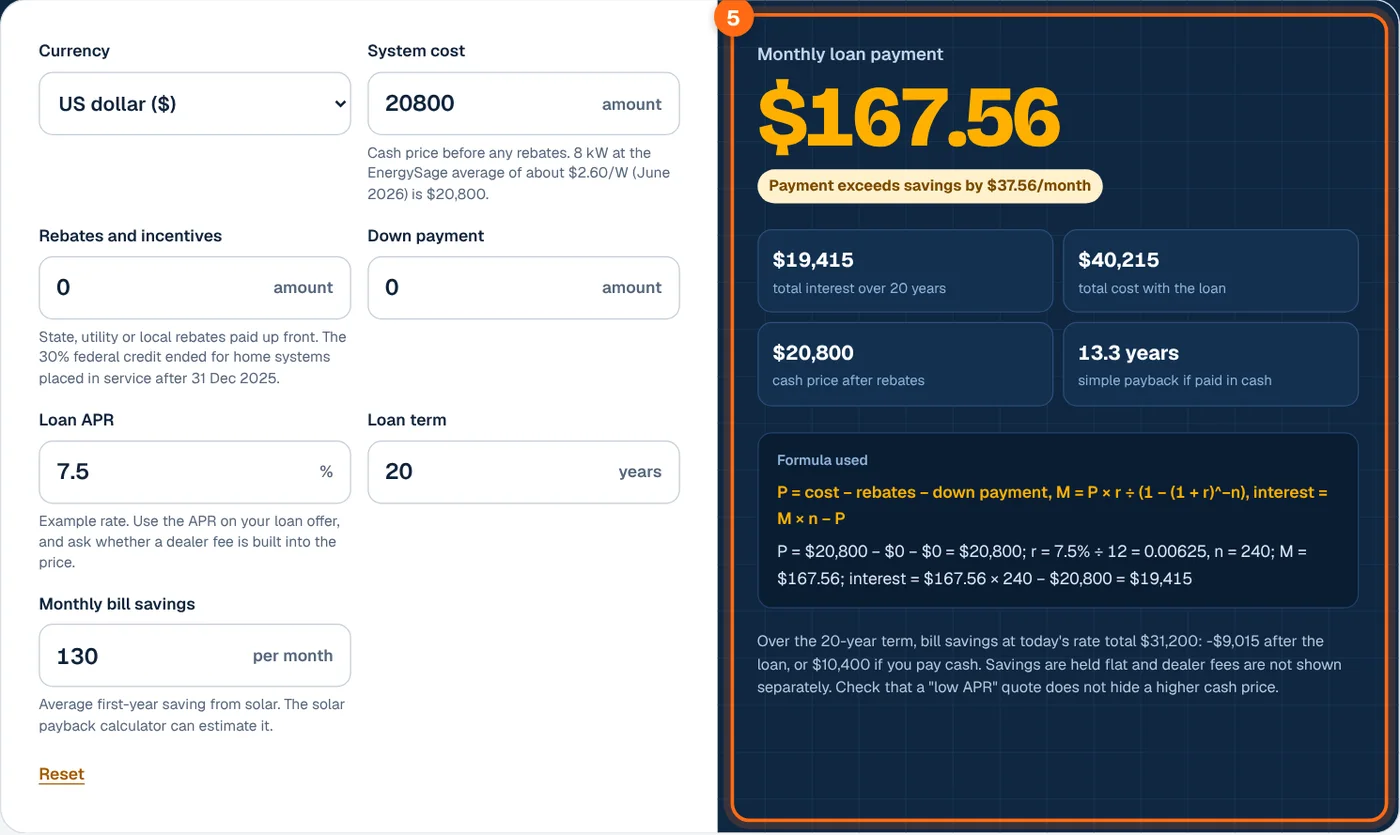
A solar loan payment is M = P × r ÷ (1 − (1 + r)−n), where P is the amount borrowed, r the monthly rate and n the number of payments. Financing a $20,800 system over 20 years at 7.5% APR costs $167.56 a month and $19,415 in interest. With $130 a month in bill savings, the loan costs $37.56 more each month than it saves.

How to use the solar finance calculator
- Enter the system cost. Use the cash price on your quote. The default is 8 kW at about $2.60 per watt. The solar panel cost calculator can estimate a price for your size.
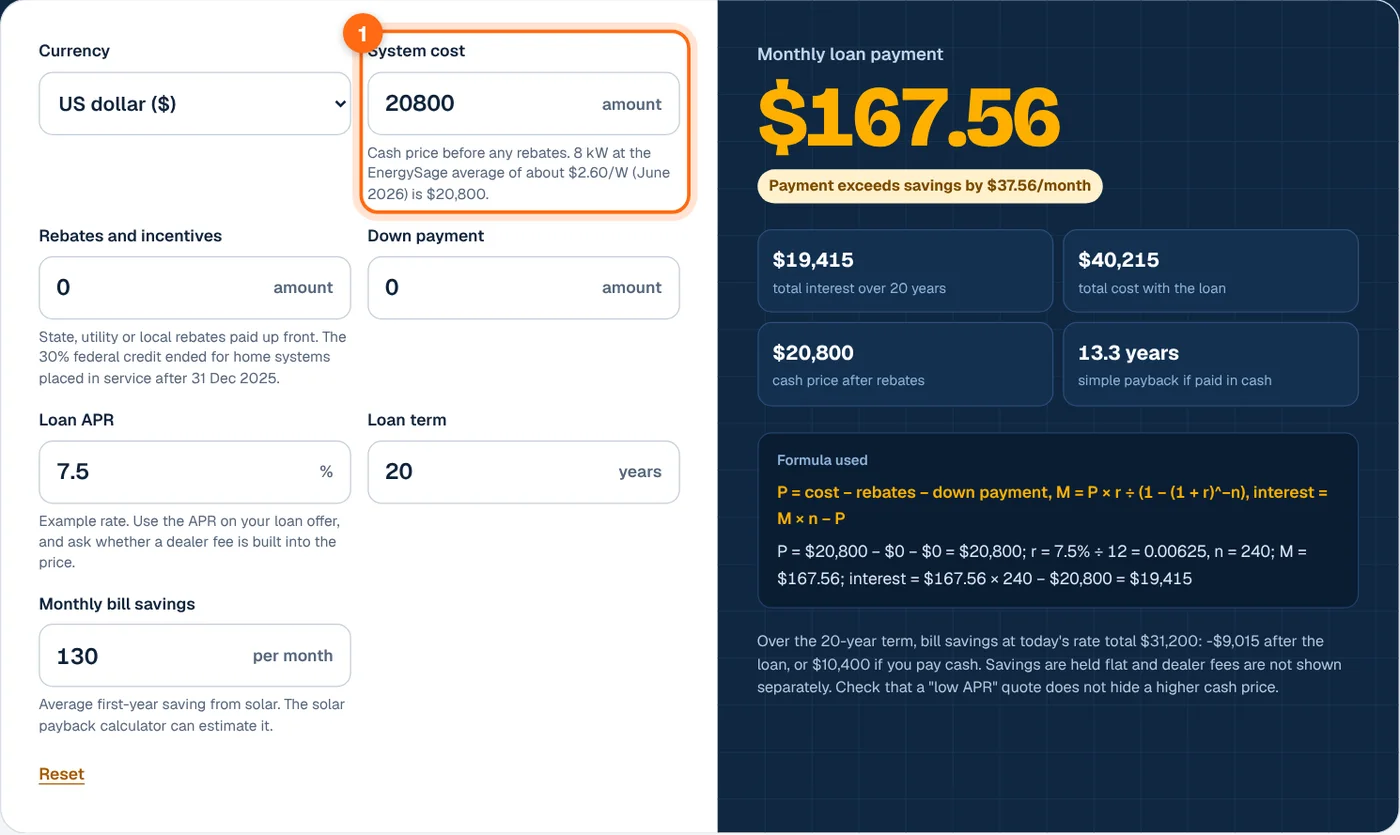
- Subtract rebates and add a down payment. Enter any state, utility or local rebate paid at signing, then the cash you will put down. Both reduce the amount you borrow.

- Enter the APR and term. Use the annual percentage rate and the loan length in years from your offer. Common terms are 10, 15, 20 and 25 years.

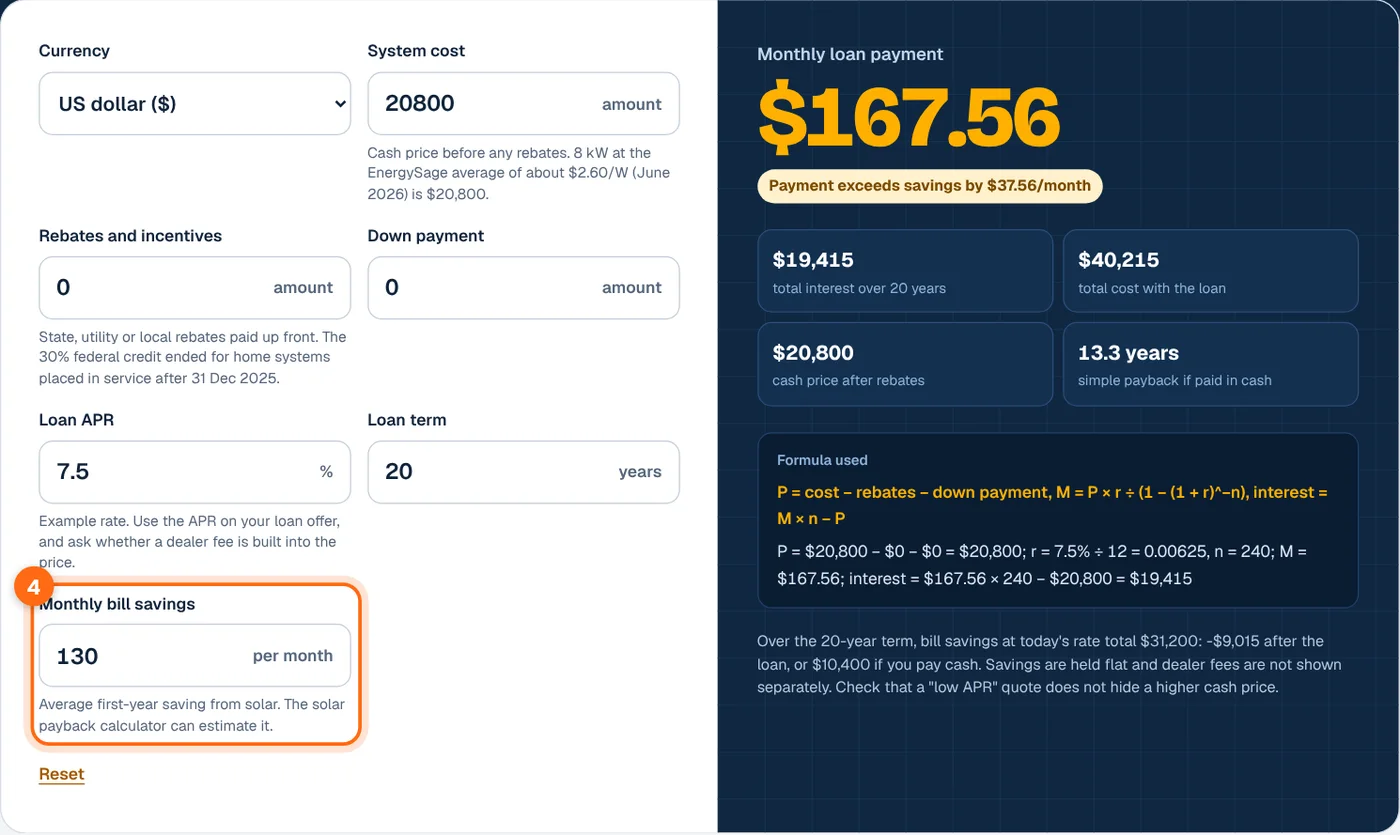
- Enter your monthly bill savings. This is the average amount solar will cut from your electric bill each month in the first year.
- Read the result. The large number is the monthly payment. The chip shows whether savings cover it, and the cards show total interest, total cost, cash price and cash payback.
Solar loan formula
Solar loans are standard amortizing loans: the payment stays the same each month, and each payment covers that month’s interest plus some principal.
Where:
- P is the principal, the amount you borrow.
- r is the monthly interest rate as a decimal. At 0% APR the payment is simply P ÷ n.
- n is the number of monthly payments.
- M is the fixed monthly payment.
- Cash payback = (cost − rebates) ÷ (monthly savings × 12).
Worked examples
Example 1: $20,800 over 20 years at 7.5%
No rebate and no down payment, so P = $20,800. The monthly rate is 0.075 ÷ 12 = 0.00625 and there are 240 payments.
The loan costs $40,215 in total. Savings of $130 a month add up to $31,200 over 20 years at today’s rate, so the loan ends $9,015 behind, while a cash purchase ends $10,400 ahead with a 13.3-year payback. Rising power prices would narrow the gap.
Example 2: rebate, down payment and a 25-year term at 5.99%
A $2,000 state rebate and $3,000 down leave P = 20,800 − 2,000 − 3,000 = $15,800 over 300 payments.
Total interest is $14,711. Now $130 in savings exceeds the payment by $28.30 a month, so the system is cash-flow positive from the first bill.
Example 3: shorter term, higher payment
The same $20,800 over 10 years at 8.99% costs $263.37 a month. Interest drops to $10,805, about $8,600 less than Example 1, but the payment is roughly double the bill savings during the loan.
Monthly payment and total interest per $20,000 borrowed
Computed with the formula above. Each cell shows the monthly payment, then total interest.
| APR | 10 years | 15 years | 20 years | 25 years |
|---|---|---|---|---|
| 0% | $166.67 / $0 | $111.11 / $0 | $83.33 / $0 | $66.67 / $0 |
| 3.99% | $202.40 / $4,287 | $147.84 / $6,611 | $121.09 / $9,062 | $105.46 / $11,637 |
| 5.99% | $221.94 / $6,633 | $168.66 / $10,359 | $143.17 / $14,361 | $128.74 / $18,621 |
| 7.5% | $237.40 / $8,488 | $185.40 / $13,372 | $161.12 / $18,668 | $147.80 / $24,339 |
| 9.99% | $264.19 / $11,703 | $214.80 / $18,664 | $192.87 / $26,289 | $181.60 / $34,480 |
| 12.99% | $298.50 / $15,820 | $252.92 / $25,525 | $234.17 / $36,201 | $225.42 / $47,625 |
Scale linearly for other amounts: $30,000 borrowed costs 1.5 times each figure.
What affects the result
The federal tax credit is gone for homeowners
The 30% Residential Clean Energy Credit no longer applies to systems a homeowner buys. The IRS states that the credit is not available for property placed in service after December 31, 2025. Many older solar loans assumed you would pay the credit toward the loan around month 18 to keep the payment low. Do not plan on that for a 2026 installation. Enter only rebates you will actually receive.
Dealer fees hidden in the price
Many installer-arranged loans advertise a low APR but add a dealer fee, often 20% or more, to the system price. Ask for the cash price and the financed price side by side. Enter the financed price as the system cost to see the real payment.
APR and term together
A longer term lowers the payment but raises total interest. At 7.5%, stretching $20,000 from 10 to 25 years cuts the payment by $89.60 but adds $15,851 in interest.
Your real bill savings
Savings depend on production, how much solar you use yourself and your utility’s export credit. Use the solar payback calculator for a year-by-year estimate, then enter the first-year figure divided by 12 here.
Frequently asked questions
How is a solar loan payment calculated?
Subtract rebates and your down payment from the system cost to get the principal. Divide the APR by 1,200 for the monthly rate and multiply the years by 12. The payment is principal × rate ÷ (1 − (1 + rate)^−months). At 7.5% over 20 years, $20,800 costs $167.56 a month.
Is it better to pay cash or finance solar?
Cash avoids interest, so it gives the largest lifetime savings and the shortest payback. A loan makes sense when you lack the cash, or when the payment is at or below your monthly bill savings. In the default example, cash ends $10,400 ahead after 20 years while the loan ends $9,015 behind at flat power prices.
Can I still use the 30% federal tax credit to pay down a solar loan?
Not for a system you own that is placed in service in 2026 or later. The IRS says the Residential Clean Energy Credit is not available for property placed in service after December 31, 2025. Credits earned on 2025 installations can still carry forward. Check any loan that assumes a lump-sum paydown.
What is a typical solar loan term?
Most solar loans run 10 to 25 years, with 20 and 25 years common for installer-arranged loans. Longer terms bring the payment closer to your bill savings but add interest. Compare total cost, not just the monthly payment, and check that the term does not exceed the panel and inverter warranties.
Should my solar loan payment be lower than my savings?
Ideally yes, or close to it. When the payment is below your monthly bill savings, the system pays for itself from day one. If the payment is higher, you are paying extra each month in the early years and relying on future price rises or loan payoff to come out ahead.