EV Charging Cost Calculator
Find what it costs to charge an electric car at home or on a public charger, and compare the cost per mile with gas.
Quick answer
EV charging cost = kWh added to the battery ÷ (1 − charging losses) × your price per kWh. Charging a 75 kWh battery from 10% to 90% adds 60 kWh, which draws 66.7 kWh from the grid at 10% loss. At the US average of $0.1831/kWh that costs $12.21 at home, versus $35.87 at a DC fast charger and $33.74 in gas for the same 210 miles.

How to use the EV charging cost calculator
- Choose your country. US uses dollars, gallons and EIA or AAA averages. UK uses pounds, pence per kWh, the Ofgem price cap and petrol in pence per litre.
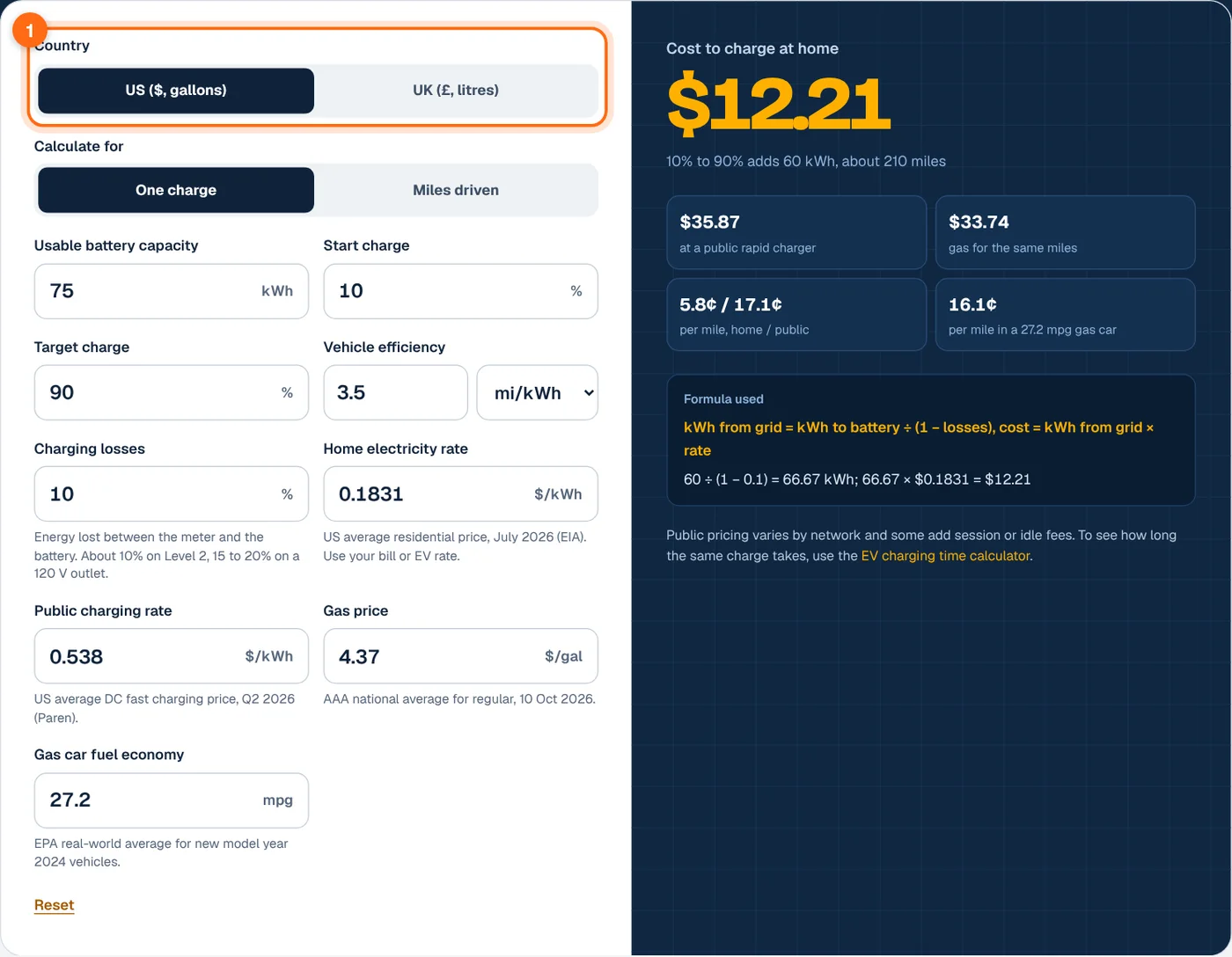
- Choose one charge or miles driven. For one charge, enter usable battery size plus start and target charge. For a monthly figure, enter the miles you drive.

- Enter efficiency and charging losses. Type your car’s efficiency in mi/kWh, kWh/100 mi or kWh/100 km. Losses are about 10% on a Level 2 or 7 kW wallbox and 15 to 20% on a standard outlet.
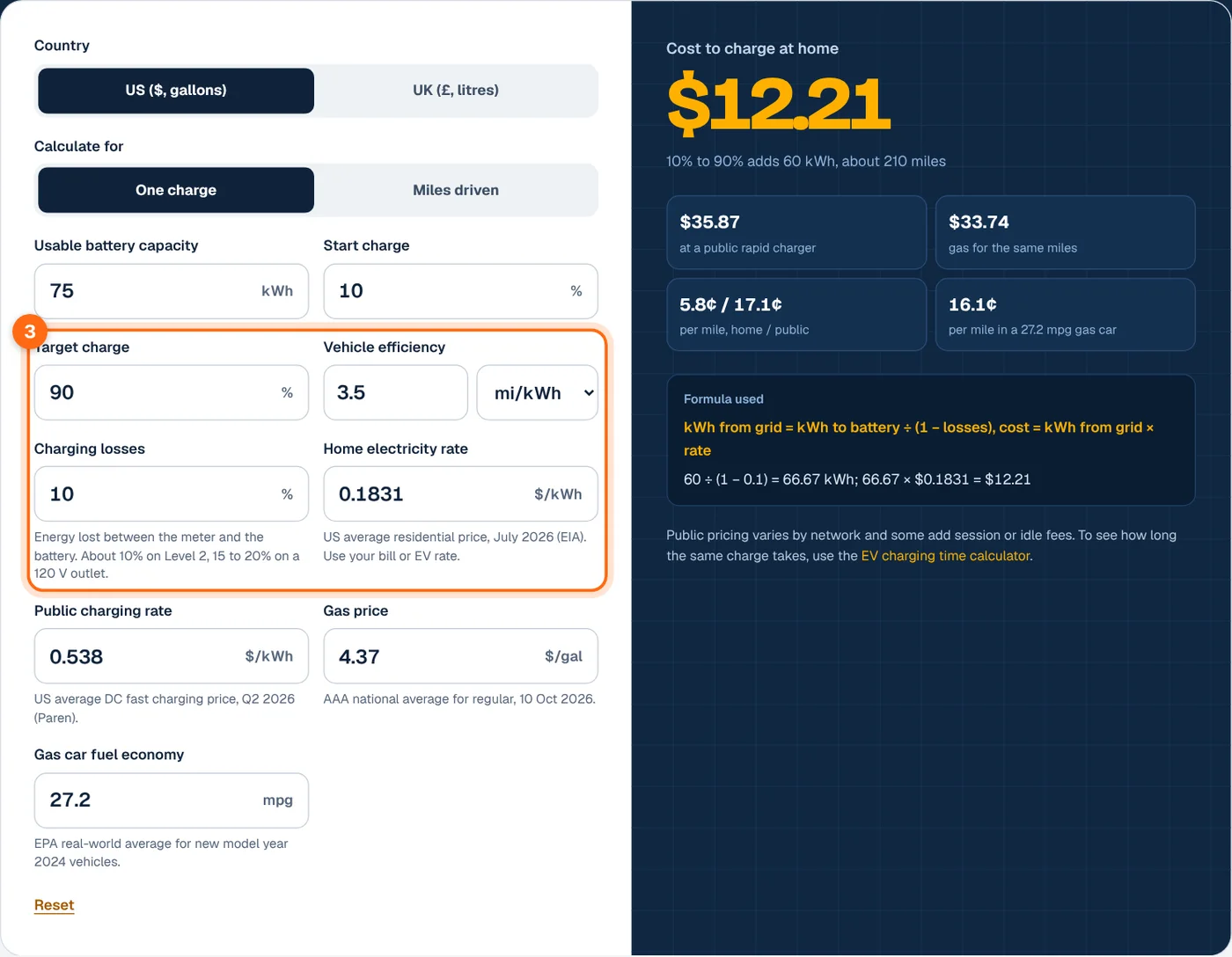
- Check the rates. Replace the default home rate with your tariff, set a public charging price, and enter fuel price and economy for the comparison car.

- Read the result. The large number is the home charging cost. The cards show the same charge at a public rapid charger, the fuel cost for the same miles and the cost per mile of each.

EV charging cost formula
The calculator works out the energy that has to come from the meter, then prices it. Losses matter because the meter counts the energy the charger draws, not the energy that reaches the battery.
Where:
- C is usable battery capacity in kWh and SoC is state of charge in percent.
- η is efficiency in miles per kWh. kWh/100 mi converts as 100 ÷ value.
- L is the charging loss as a decimal.
- R is the electricity price per kWh.
- For the UK, petrol in pence per litre is multiplied by 4.546 litres per imperial gallon before dividing by UK mpg.
Worked examples
Example 1: one 10% to 90% charge in the US
A 75 kWh battery rated at 3.5 mi/kWh charges on Level 2 with 10% loss.
The charge adds about 210 miles. The same energy at the Q2 2026 US average DC fast price of $0.538/kWh costs $35.87. A 27.2 mpg gas car needs 7.72 gallons for 210 miles, or $33.74 at $4.37 a gallon. Per mile: 5.8¢ at home, 17.1¢ public and 16.1¢ for gas.
Example 2: a month of driving
US drivers average 11,026 miles a year per car, according to Alternative Fuels Data Center figures from FHWA, or about 920 miles a month. At 3.5 mi/kWh that is 262.9 kWh into the battery and 292.1 kWh from the grid.
All-public charging would cost $157.13 and gas $147.81 for the same miles, so home charging saves about $94 a month against gas.
Example 3: UK, off-peak versus the price cap
The same 60 kWh charge at the 26.32p Ofgem cap rate costs 66.67 × 0.2632 = £17.55, or 8.4p a mile. A 45 mpg petrol car at 174.9p per litre costs 17.7p a mile, so £37.11 for 210 miles. On a 7p off-peak EV tariff the charge costs just £4.67, about 2.2p a mile. Rapid charging at the Zapmap September 2026 average of 79p costs £52.67, which is more than petrol.
Cost per mile by efficiency and electricity rate
Calculated with 10% charging losses. US rates in cents per mile, UK rates in pence per mile.
| Efficiency | 10¢/kWh | 18.31¢ (US avg.) | 25¢/kWh | 53.8¢ (US DC fast) | 7p (UK off-peak) | 26.32p (UK cap) | 79p (UK rapid) |
|---|---|---|---|---|---|---|---|
| 2.5 mi/kWh | 4.4¢ | 8.1¢ | 11.1¢ | 23.9¢ | 3.1p | 11.7p | 35.1p |
| 3.0 mi/kWh | 3.7¢ | 6.8¢ | 9.3¢ | 19.9¢ | 2.6p | 9.7p | 29.3p |
| 3.5 mi/kWh | 3.2¢ | 5.8¢ | 7.9¢ | 17.1¢ | 2.2p | 8.4p | 25.1p |
| 4.0 mi/kWh | 2.8¢ | 5.1¢ | 6.9¢ | 14.9¢ | 1.9p | 7.3p | 21.9p |
| 4.5 mi/kWh | 2.5¢ | 4.5¢ | 6.2¢ | 13.3¢ | 1.7p | 6.5p | 19.5p |
For comparison, gas at $4.37 costs 21.9¢ a mile at 20 mpg, 16.1¢ at 27.2 mpg and 8.7¢ at 50 mpg. UK petrol at 174.9p costs 22.7p a mile at 35 mpg and 14.5p at 55 mpg.
What affects the result
Your electricity tariff
The rate is the biggest lever. US averages range widely by state, and many utilities offer overnight EV rates well below the standard price. In the UK, off-peak EV tariffs can be a quarter of the price cap rate. The electricity cost calculator shows the same pricing for any appliance.
Home versus public charging
Public DC fast charging averaged $0.538/kWh in the US in Q2 2026 (Paren) and 79p/kWh in the UK in September 2026 for rapid and ultra-rapid pay-as-you-go (Zapmap price index). Subscriptions, idle fees and per-minute pricing change the real figure.
Charging losses
Field studies show grid-to-battery efficiency of roughly 80 to 85% on 120 V Level 1 and about 90% on 240 V Level 2. Losses rise in cold weather when the car heats its battery during charging.
Efficiency and weather
A car that manages 4 mi/kWh in summer may drop below 3 in freezing weather with the heater on, raising cost per mile. The EV range calculator shows how temperature and speed change efficiency.
Frequently asked questions
How much does it cost to charge an electric car at home?
Multiply the kWh you add by about 1.1 to cover losses, then by your rate. A 60 kWh top-up costs about $12.21 at the US average of 18.31¢ and £17.55 at the UK cap rate of 26.32p. A full year of average US driving costs roughly $640 at home.
Is charging an EV cheaper than buying gas?
At home, almost always. At average rates an EV costs about 5.8¢ a mile against 16.1¢ for a 27.2 mpg car, roughly a third. Public DC fast charging at $0.538/kWh costs about 17.1¢ a mile, similar to gas, so the savings depend on charging mostly at home.
Why does the meter show more kWh than my car added?
Energy is lost as heat in the charger, cables and battery, and some powers the car’s electronics and battery heating while it charges. On Level 2 about 10% is typical. On a 120 V outlet losses can reach 15 to 20% because the car’s fixed overhead runs for many more hours.
How much does it cost to charge an EV per month?
Divide your monthly miles by your car’s mi/kWh, add losses, and multiply by your rate. At 920 miles a month, 3.5 mi/kWh and 10% loss you need about 292 kWh, which costs $53.48 at 18.31¢. Switch the calculator to Miles driven to run your own numbers.
Should I charge to 100% to save money?
Charging to 100% does not lower the price per kWh, and many manufacturers recommend 80 to 90% for daily use to reduce battery wear. Charge to 100% only before long trips. If your car uses an LFP battery, the manufacturer may recommend a regular full charge for calibration.