EV Charging Time Calculator
Work out how long an electric car takes to charge on Level 1, Level 2 or DC fast chargers, including the slowdown above 80%.
Quick answer
EV charging time = kWh needed ÷ charging power. The power is the lower of the charger’s rating and the car’s limit, minus losses. Taking a 75 kWh battery from 20% to 80% on a 9.6 kW Level 2 charger takes about 5 h 13 min. A 150 kW DC fast charger does 10% to 80% in about 21 minutes, and 80% to 100% adds another 12 minutes as charging slows.

How to use the EV charging time calculator
- Enter the usable battery capacity. Use the usable kWh from the spec sheet, not the gross figure. Common sizes run from 40 kWh in small cars to over 130 kWh in trucks.

- Set the start and target charge. Enter the current state of charge and where you want to stop. Most drivers charge to 80% or 90% day to day.
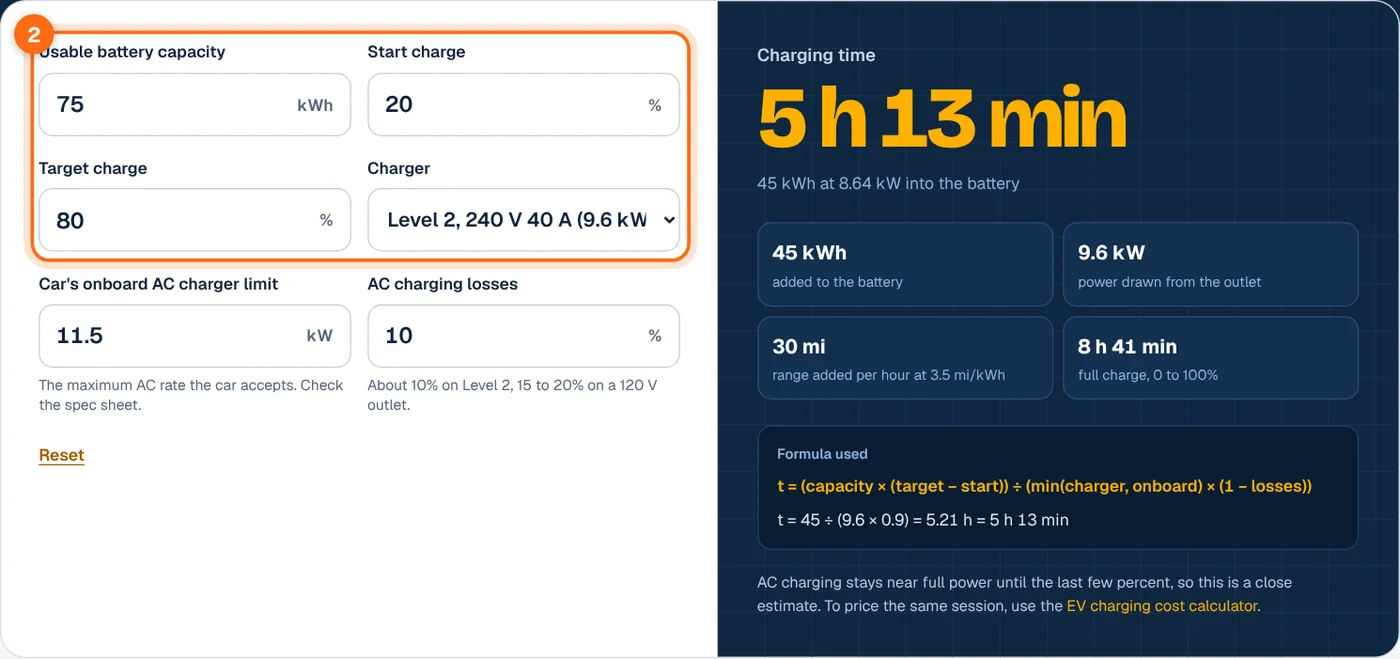
- Choose the charger. Pick a Level 1 outlet, a Level 2 or UK wallbox, or a DC fast charger. Pick a custom option to type any power in kW.
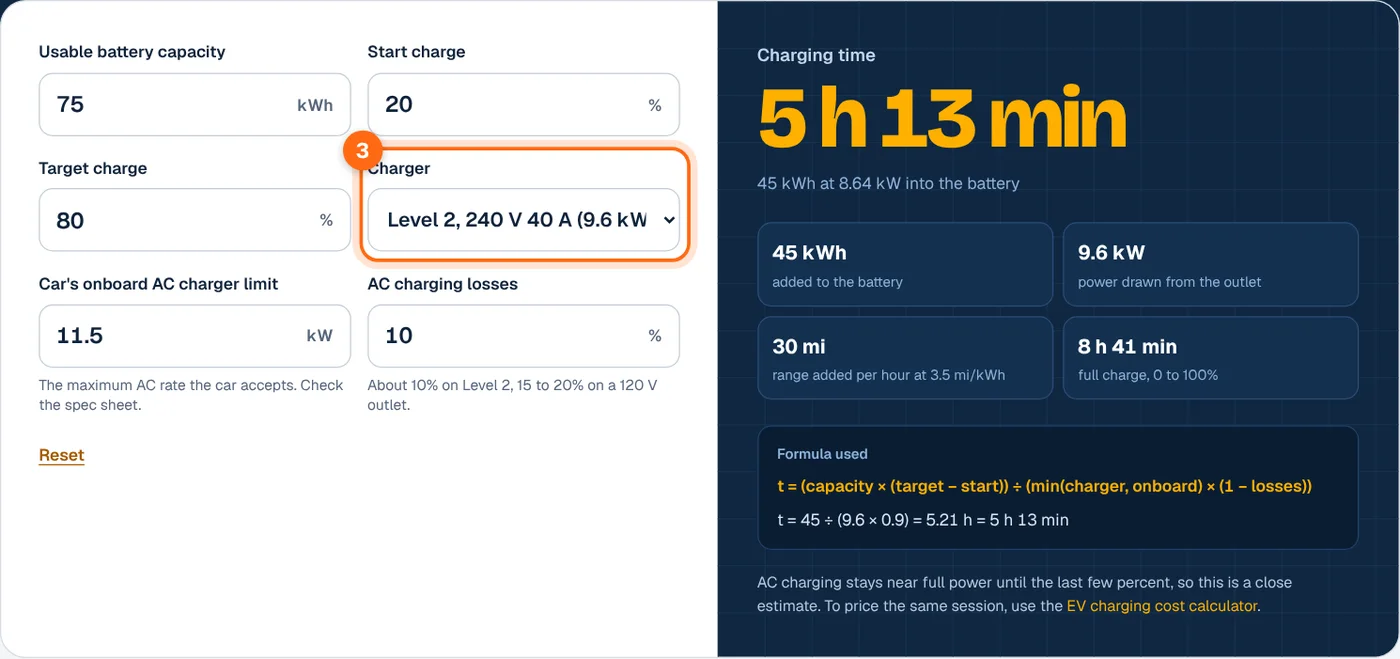
- Enter the car’s limit. For AC charging, enter the onboard charger rating and the charging loss. For DC, enter the car’s peak DC rate.

- Read the result. The large number is the charging time. The cards show the energy added, the charging power, and either range per hour (AC) or time to 80% (DC).

EV charging time formula
AC and DC charging behave differently, so the calculator uses a separate method for each.
Where:
- C is usable battery capacity in kWh and E is the energy added.
- Pcharger is the charger’s rated power. A Level 2 unit on 240 V at 40 A delivers 9.6 kW.
- Ponboard is the maximum AC power the car accepts. A car with a 7.2 kW onboard charger takes no more than that from a 19.2 kW unit.
- L is the AC charging loss, about 10% on Level 2.
- The DC taper is integrated across the 80 to 100% band, which gives a realistic shape. Real curves vary by car, so treat DC times as estimates.
Worked examples
Example 1: Level 2 at home
A 75 kWh battery charges from 20% to 80% on a 40 A Level 2 unit. The car accepts 11.5 kW, so the 9.6 kW charger is the limit.
That adds about 30 miles of range per hour at 3.5 mi/kWh. A full 0 to 100% charge would take about 8 h 41 min, so an overnight session covers almost any day’s driving.
Example 2: Level 1 from a household outlet
The same 45 kWh on a 120 V, 16 A cord (1.92 kW) with 10% loss takes 45 ÷ (1.92 × 0.90) = 26.04 h, or 26 h 3 min. Level 1 adds only about 6 miles per hour. The Alternative Fuels Data Center gives the same rule of thumb of about 5 miles per hour for Level 1 and 25 for Level 2.
Example 3: DC fast charging on a road trip
The 75 kWh car charges from 10% to 100% on a 150 kW charger, and the car can take 150 kW.
Total time is about 33 minutes with an average of 122 kW. The last 20% takes more than half as long as the first 70%, which is why stopping at 80% is quicker on long drives.
Charging time from 10% to 80% by battery size
AC times include 10% loss and assume the car’s onboard charger can take the full rating. DC times assume the car accepts the charger’s full power up to 80%.
| Usable battery | Level 1, 1.4 kW | Level 2, 7.7 kW | Level 2, 11.5 kW | DC 50 kW | DC 150 kW |
|---|---|---|---|---|---|
| 40 kWh | 21 h 36 min | 4 h 3 min | 2 h 42 min | 34 min | 11 min |
| 60 kWh | 32 h 24 min | 6 h 5 min | 4 h 3 min | 50 min | 17 min |
| 75 kWh | 40 h 31 min | 7 h 36 min | 5 h 4 min | 1 h 3 min | 21 min |
| 100 kWh | 54 h 1 min | 10 h 8 min | 6 h 45 min | 1 h 24 min | 28 min |
| 131 kWh | 70 h 45 min | 13 h 16 min | 8 h 51 min | 1 h 50 min | 37 min |
What affects the result
The car’s onboard charger
On AC, the car converts power to DC with its own onboard charger. Many cars accept 7.2 to 11.5 kW, so a 19.2 kW Level 2 unit charges them no faster than a 48 A unit. Check the onboard rating before you pay for a larger charger or panel upgrade.
DC charging curve and battery temperature
Fast charging peaks only when the battery is warm and at a low state of charge. A cold battery can charge at a fraction of its peak rate until it warms up. Many cars precondition the battery when you navigate to a charger.
Supply voltage and circuit size
Level 2 power equals volts times amps. A 40 A charger on a 50 A circuit at 240 V gives 9.6 kW, but on 208 V commercial supply it gives about 8.3 kW. In the UK a single-phase 32 A wallbox is limited to about 7.4 kW. For circuit sizing, see the wire size calculator.
Charging losses
Losses lengthen AC charging time because the car receives less than the outlet supplies. Level 1 is the least efficient, since fixed overheads run for many hours. Use the EV charging cost calculator to price the same session.
Frequently asked questions
How long does it take to charge an EV at home?
On a typical 9.6 kW Level 2 charger, a 75 kWh battery goes from 20% to 80% in about 5 hours and from empty to full in under 9 hours. On a 120 V outlet the same 60% top-up takes over 26 hours, so Level 1 suits only low daily mileage.
Why does DC fast charging slow down after 80%?
As a lithium-ion battery fills, its voltage rises and the cells can accept less current without stress or lithium plating. The car’s battery management system cuts power to protect the cells. In this calculator the rate falls steadily from full power at 80% to one fifth of it at 100%.
Does a bigger Level 2 charger always charge faster?
Only up to the car’s onboard charger limit. If the car accepts 7.2 kW, a 9.6 kW or 19.2 kW unit gives the same 7.2 kW. The calculator uses the lower of the two numbers and shows a chip when the car is the limit.
How many miles of range does an hour of charging add?
Multiply the power reaching the battery by your efficiency. At 9.6 kW with 10% loss, 8.64 kW reaches the battery, which is about 30 miles per hour at 3.5 mi/kWh. Level 1 adds about 6 miles per hour, and a 150 kW DC charger can add over 400 miles per hour below 80%.
How long does it take to charge on a UK 7 kW wallbox?
A 7.4 kW single-phase wallbox delivers about 6.6 kW to the battery after 10% loss. A 64 kWh battery from 10% to 80% needs 44.8 kWh, which takes about 6 h 46 min. Most UK homes have single-phase supply, so 7.4 kW is the usual home maximum.