Storage Heater Running Cost Calculator
Find what your storage heaters cost a month on Economy 7, from heater size, charge hours and setting, plus any day-rate boost.
Quick answer
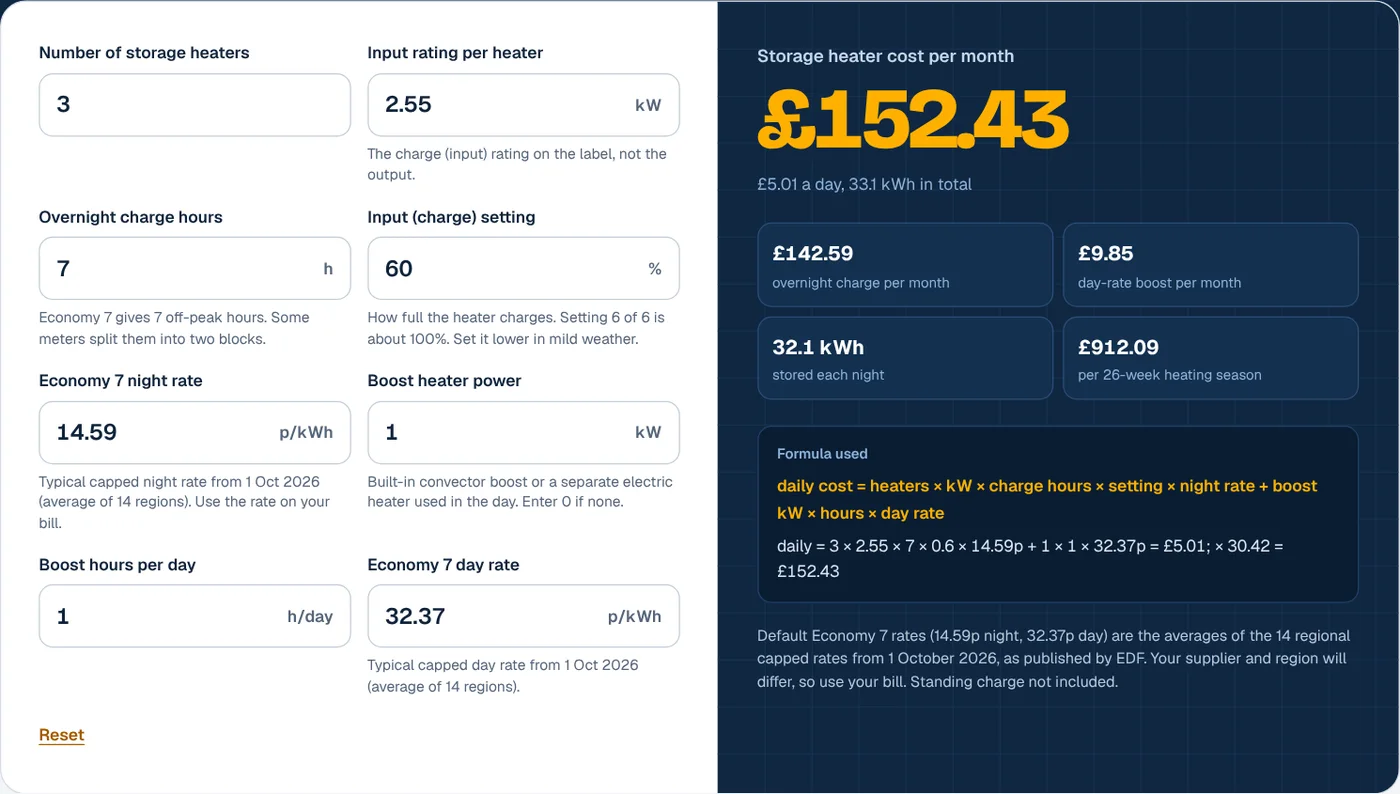
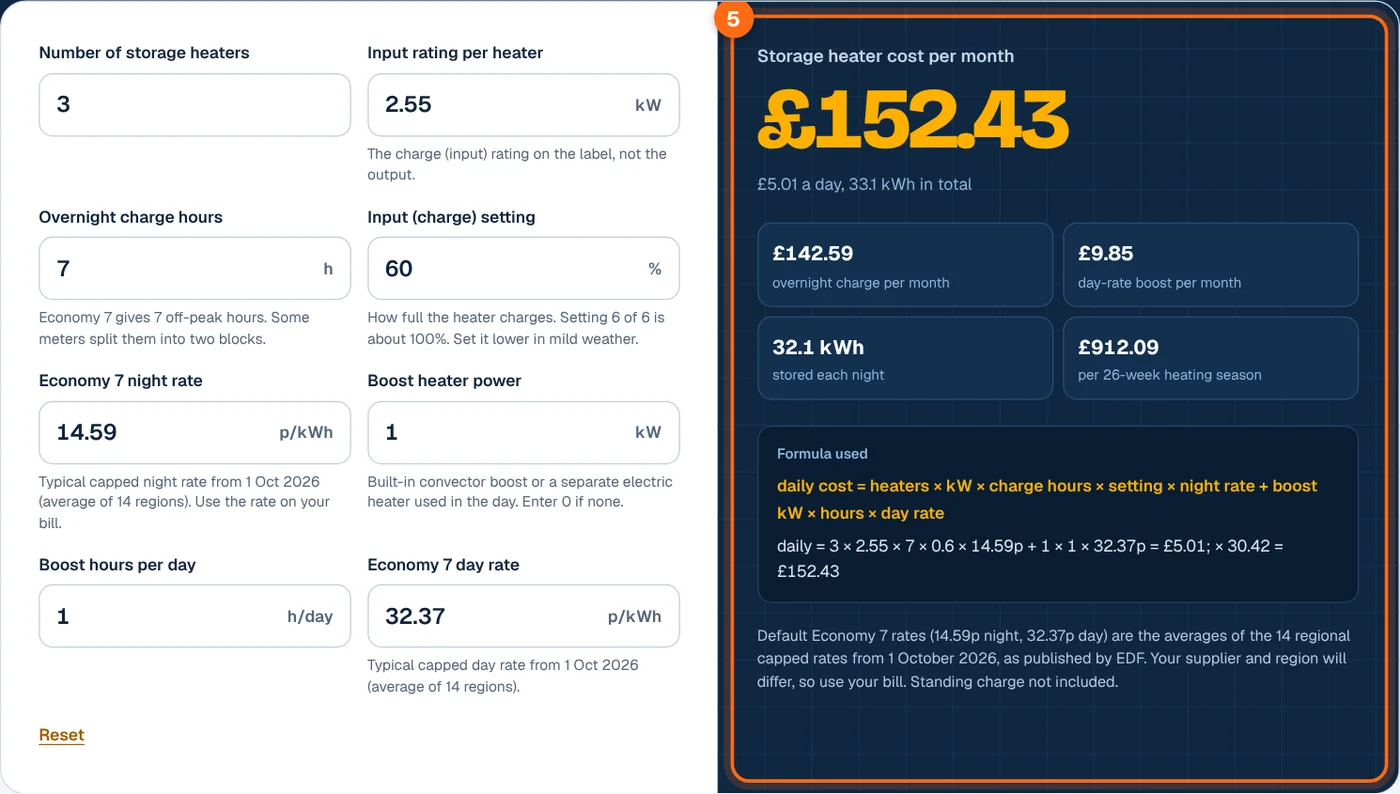
A storage heater’s running cost is its input rating in kW × the off-peak charge hours × the charge setting × your Economy 7 night rate, plus any daytime boost at the day rate. Three 2.55 kW heaters charging for 7 hours at 60%, with 1 hour of 1 kW boost a day, cost about £5.01 a day, or £152.43 a month, at typical capped rates of 14.59p night and 32.37p day.
How to use the storage heater running cost calculator
- Enter your heaters. Type the number of storage heaters and the input rating of each, shown on the label as the charge rating in kW. Common sizes are 1.7, 2.55 and 3.4 kW. If your heaters differ, enter the average.
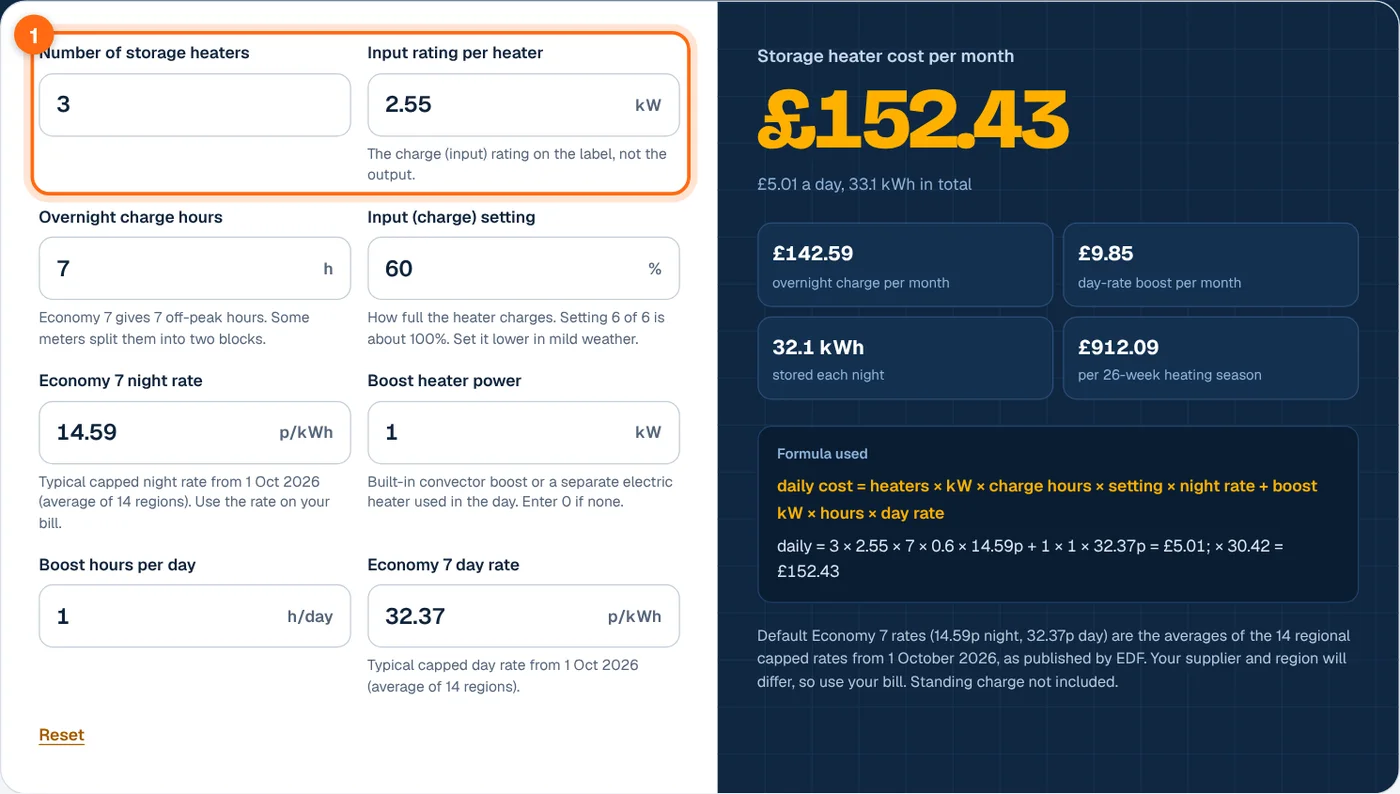
- Set the charge hours and input setting. Economy 7 gives 7 off-peak hours a night. The input (charge) setting controls how full the core gets: setting 6 of 6 is about 100%, and setting 3 is roughly half.

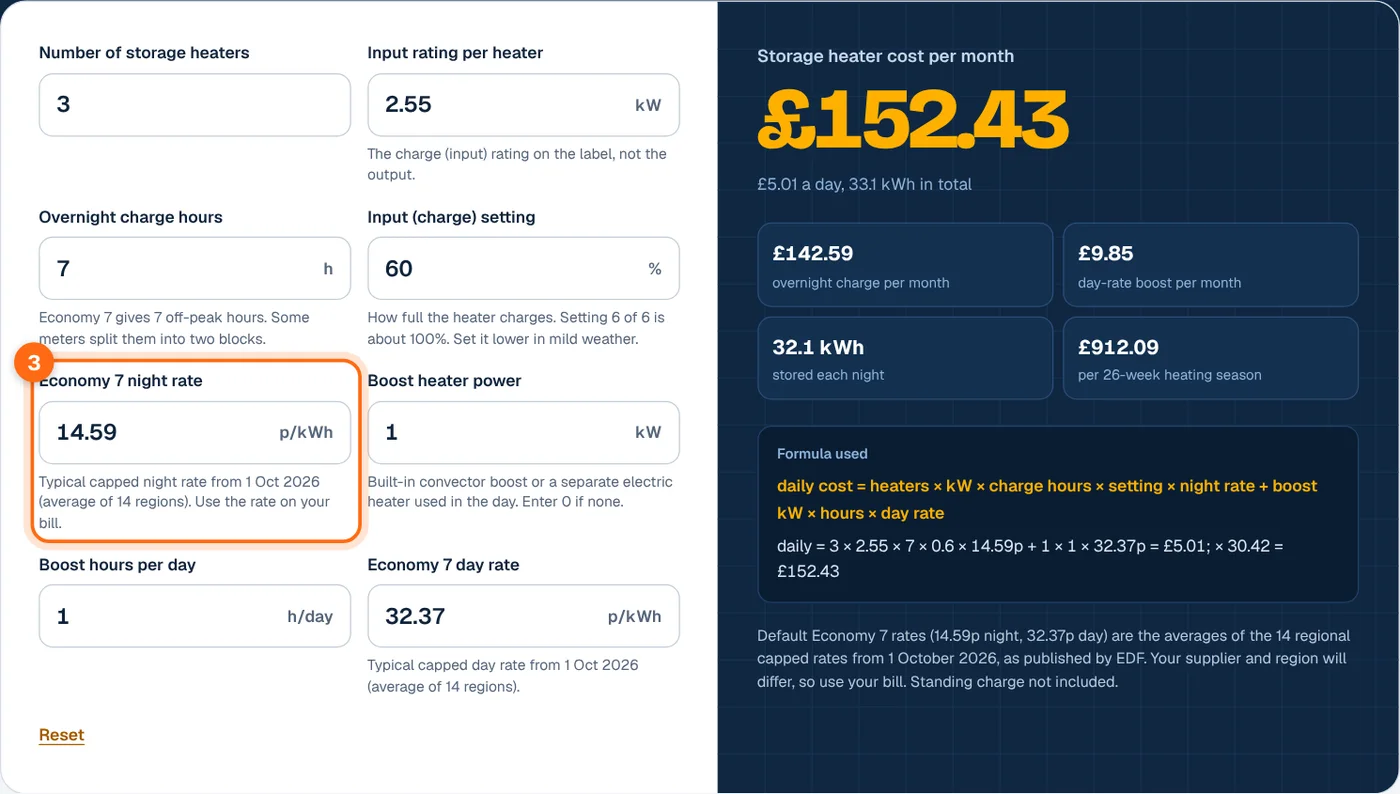
- Check the night rate. The default is a typical capped Economy 7 night rate from 1 October 2026. Replace it with the off-peak rate on your bill.
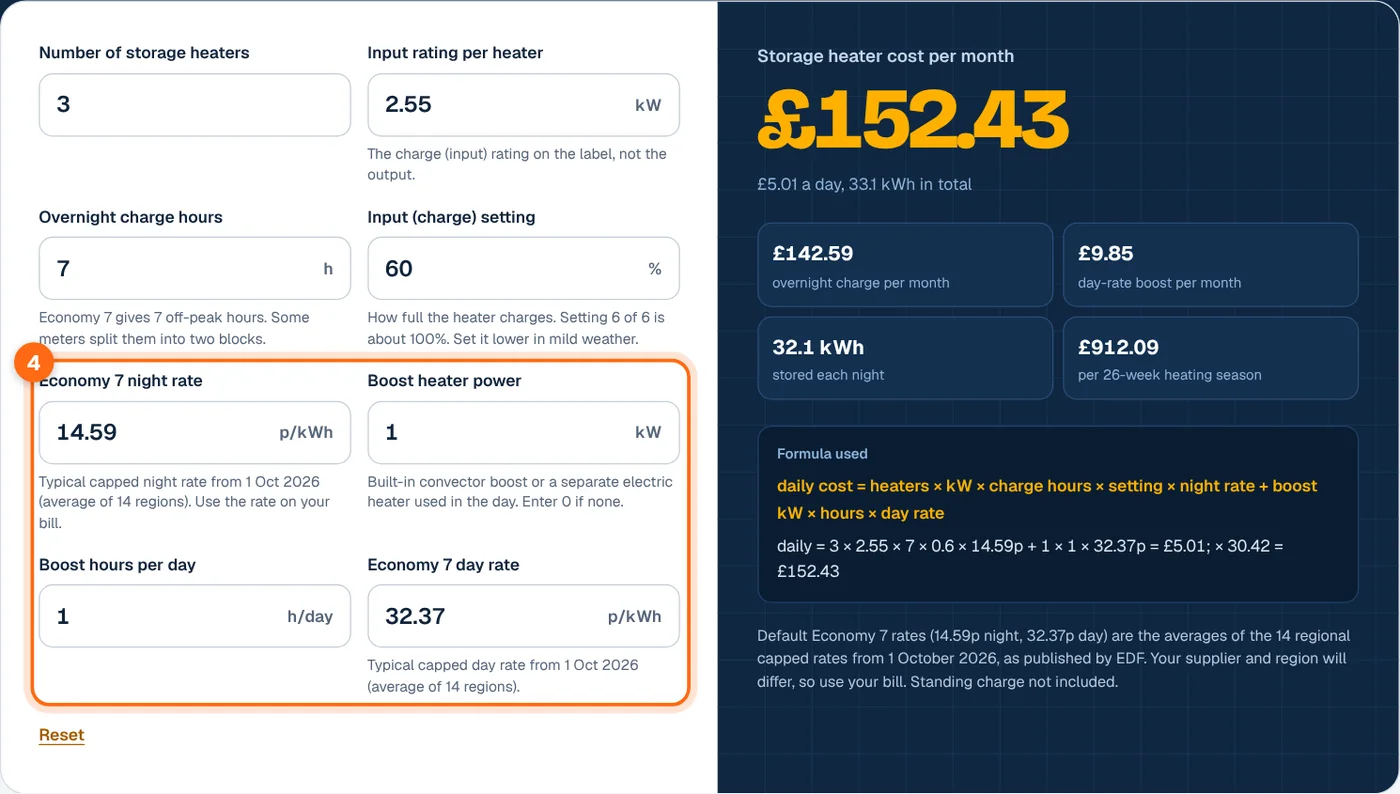
- Add any daytime boost. Enter the power of a built-in convector boost or any plug-in heater you use in the day, the hours per day, and your day rate. Enter 0 kW if you never boost.
- Read the result. The large number is the monthly cost. The cards split it into the overnight charge and the day-rate boost, and show the kWh stored each night and the cost of a 26-week heating season.
Storage heater running cost formula
A storage heater draws its full input rating while it charges, so the energy stored is simple to work out. The boost runs at the day rate.
Where:
- n is the number of storage heaters.
- P is the input rating of each heater in kW.
- t is the off-peak charge hours per night.
- s is the input setting as a decimal, such as 0.6 for 60%.
- Rn and Rd are the Economy 7 night and day rates in pounds per kWh.
- Pb and tb are the boost power in kW and the boost hours per day.
- 30.42 is the average number of days in a month. A 26-week heating season is 182 days.
Worked examples
Example 1: three heaters on a medium setting
Three 2.55 kW heaters charge for 7 hours at 60%, with 1 hour of 1 kW boost each day.
Per month that is £152.43: £142.59 for the overnight charge and £9.85 for the boost. Over a 26-week season it comes to about £912.
Example 2: flat with two large heaters on full
Two 3.4 kW heaters charge for 7 hours at 100% during a cold spell, with no boost.
That is 47.6 kWh stored a night and about £211.24 a month. Turning the input down to 75% on milder days would cut it by a quarter.
Example 3: four small heaters with a 2 hour evening boost
Four 1.7 kW heaters charge at 75%, and a 2 kW boost runs for 2 hours each evening.
The boost is only 4 kWh of the 39.7 kWh used, but at the day rate it adds £1.29 a day, about a fifth of the bill. Monthly total: £197.81.
Storage heater cost per night by size and setting
Overnight charge cost for one heater over 7 off-peak hours at 14.59p/kWh, with the day-rate cost of the same energy for comparison.
| Input rating | Max kWh (7 h) | 50% setting | 75% setting | 100% setting | 75%, per month | 75% at day rate |
|---|---|---|---|---|---|---|
| 1.7 kW | 11.9 | £0.87 | £1.30 | £1.74 | £39.61 | £2.89 |
| 2.55 kW | 17.85 | £1.30 | £1.95 | £2.60 | £59.41 | £4.33 |
| 3.4 kW | 23.8 | £1.74 | £2.60 | £3.47 | £79.21 | £5.78 |
The typical day rate is 2.2 times the night rate, which is why each kWh of boost costs so much more than stored heat.
What affects the result
Your Economy 7 rates
The Ofgem price cap limits the overall cost of a multi-rate tariff, but suppliers set the split between day and night. The defaults of 14.59p night and 32.37p day are the averages of the 14 regional capped Economy 7 rates published by EDF for Direct Debit from 1 October 2026, with no VAT on electricity this winter. Other suppliers’ splits differ, so the rates on your bill matter most. A cheap night rate with an expensive day rate rewards good charging habits and punishes boosting.
Input setting and the weather
The input dial decides how much heat goes in overnight. Many people leave it on high all winter. Turning it down on mild nights is the single easiest saving, because any heat left at bedtime is energy you paid for but did not need.
Output control and heat leakage
Older storage heaters leak heat through the casing all morning, so rooms can be warm when nobody is home and cold by evening. That pushes people to boost at the day rate, and a plug-in heater used as boost costs exactly what the electric heater running cost calculator shows at your day rate. Modern high heat retention heaters hold more heat until you call for it, which often cuts boost use.
Off-peak hours
Economy 7 meters give 7 hours of cheaper electricity, but the times vary by region and some split them into two blocks. Charging outside those hours is billed at the day rate. If you run a hot water cylinder on the same timer, the immersion heater running cost calculator shows its share of the night-rate bill.
Frequently asked questions
How much does a storage heater cost to run per night?
A 2.55 kW storage heater charging for 7 hours on full uses 17.85 kWh. At a typical October 2026 capped night rate of 14.59p/kWh, that costs about £2.60 a night. On a 60% setting it costs about £1.56, and on 50% about £1.30.
Are storage heaters cheaper than normal electric heaters?
Per kWh, yes, because they charge on the cheaper night rate. Typical capped Economy 7 night rates are less than half the day rate. Each kWh delivered still equals 1 kWh of electricity though, so a heat pump or gas central heating is usually cheaper again for whole-house heating.
What do the input and output dials do?
The input dial sets how much heat the heater stores overnight, which decides your night-rate cost. The output dial controls how quickly that stored heat is released during the day. Set input to match tomorrow’s weather, and keep output low until you need warmth so less heat escapes while the house is empty.
Why is my storage heater bill so high?
Common causes are leaving the input on maximum in mild weather, heavy use of the boost or plug-in heaters on the day rate, charging outside your off-peak window, and older heaters leaking heat before you need it. Check what share of your kWh is on the day register of your meter.
Does the calculator include the standing charge?
No. It covers the energy used by the heaters and boost. Your Economy 7 standing charge is paid every day regardless of use. It varies by region, and the EDF capped figures for October 2026 range from about 43p to 67p a day.