Immersion Heater Running Cost Calculator
See how long your immersion takes to heat the cylinder and what each heat-up costs on a single rate or Economy 7.
Quick answer
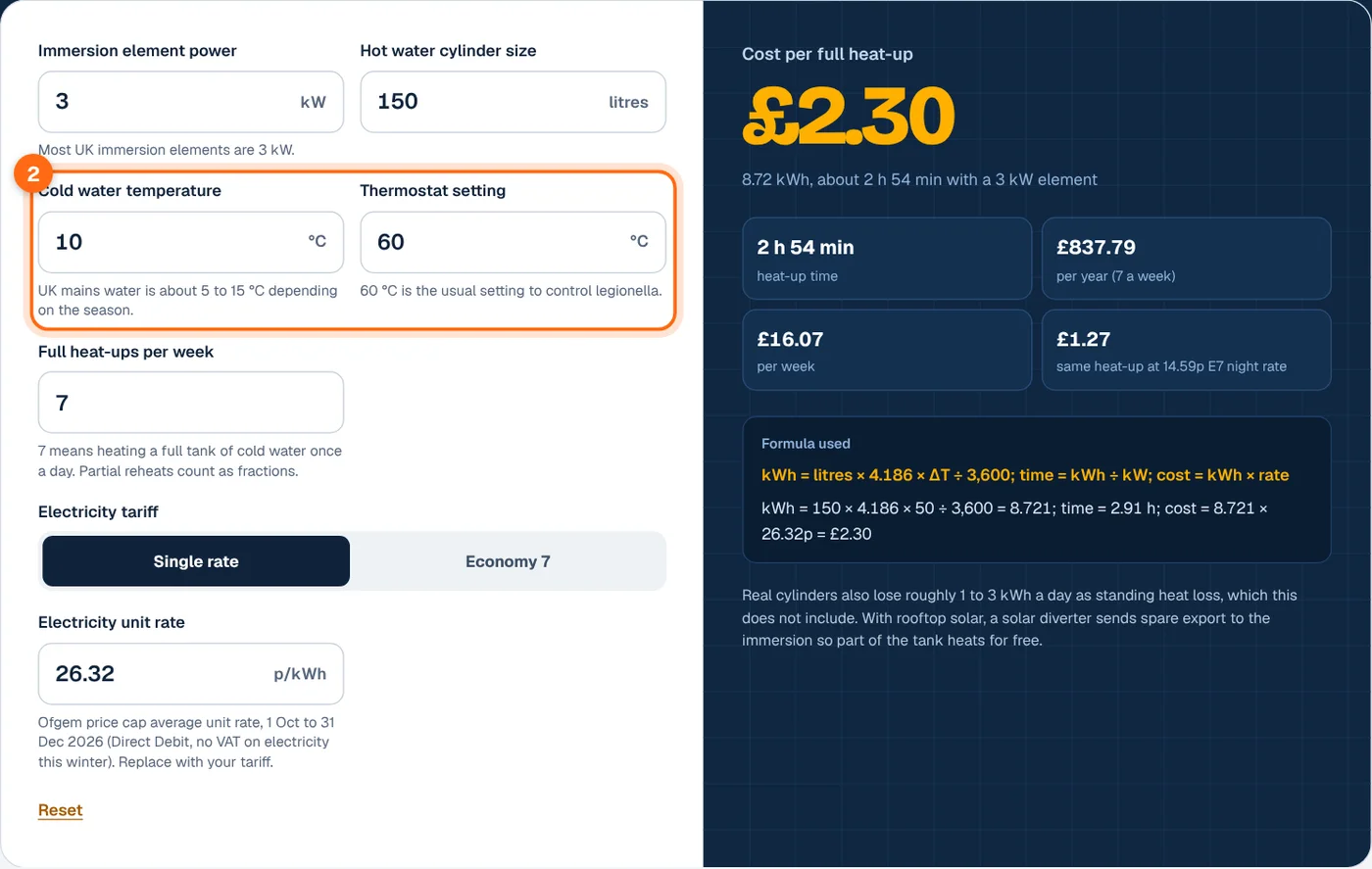
Heating water takes litres × 4.186 × temperature rise ÷ 3,600 kWh. A 150 litre cylinder heated from 10 °C to 60 °C needs 8.72 kWh, which a 3 kW immersion delivers in about 2 hours 54 minutes. At the Ofgem cap rate of 26.32p/kWh that costs £2.30 per full heat-up, or about £1.27 on a typical Economy 7 night rate of 14.59p.

How to use the immersion heater running cost calculator
- Enter the element power and cylinder size. Most UK immersion elements are 3 kW. The cylinder size in litres is usually on a label on the tank. Common sizes are 117, 150, 180 and 210 litres.

- Set the cold water and thermostat temperatures. UK mains water arrives at about 5 to 15 °C depending on the season. Most cylinder thermostats are set to 60 °C.
- Enter how many full heat-ups you do per week. 7 means heating a full tank of cold water once a day. If you only reheat half the tank each day, enter 3.5.

- Choose your tariff and rates. Pick single rate, or Economy 7 to enter your night and day rates and the share of heating done overnight.

- Read the result. The large number is the cost of one full heat-up. The cards show the heat-up time, the yearly and weekly cost, and the same heat-up priced on the other tariff.

Immersion heater energy and cost formula
Water needs 4.186 kJ of energy to warm each kilogram by 1 °C. One litre of water weighs about 1 kg, and 3,600 kJ equals 1 kWh.
Where:
- E is the energy needed in kWh.
- V is the cylinder volume in litres.
- 4.186 is the specific heat capacity of water in kJ per kg per °C.
- ΔT is the temperature rise: thermostat setting minus cold water temperature.
- P is the element power in kW, and t is the heat-up time in hours.
- R is the unit rate in pounds per kWh. On Economy 7, f is the share heated at the night rate Rn, and the rest is charged at the day rate Rd.
Worked examples
Example 1: 150 litre cylinder on a single rate
A full 150 litre tank is heated from 10 °C to 60 °C once a day with a 3 kW element.
The heat-up takes 8.72 ÷ 3 = 2.91 hours, about 2 hours 54 minutes. Daily, that is £16.07 a week and £837.79 a year.
Example 2: same tank on Economy 7, 80% overnight
The timer heats 80% of the water on the night rate, and a short evening boost covers the rest at the day rate.
About £577.61 a year, a saving of roughly £260 compared with the single rate. Heating 100% overnight brings it down to £1.27 per heat-up.
Example 3: 210 litre tank in summer
In summer the mains can arrive at around 15 °C, so heating a 210 litre tank to 60 °C needs a rise of only 45 °C.
That takes 3 hours 40 minutes with a 3 kW element and costs £2.89 on the single rate, or £1.60 at the night rate.
Immersion heater cost by cylinder size
One full heat-up from 10 °C to 60 °C (ΔT = 50 °C) with a 3 kW element.
| Cylinder | Energy | Heat-up time | At 26.32p (single rate) | At 14.59p (E7 night) |
|---|---|---|---|---|
| 90 litres | 5.23 kWh | 1 h 45 min | £1.38 | £0.76 |
| 117 litres | 6.80 kWh | 2 h 16 min | £1.79 | £0.99 |
| 150 litres | 8.72 kWh | 2 h 54 min | £2.30 | £1.27 |
| 180 litres | 10.46 kWh | 3 h 29 min | £2.75 | £1.53 |
| 210 litres | 12.21 kWh | 4 h 4 min | £3.21 | £1.78 |
| 250 litres | 14.53 kWh | 4 h 51 min | £3.83 | £2.12 |
What affects the result
Temperature rise and thermostat setting
Energy is directly proportional to the temperature rise. Cold mains water in winter can add 10 to 20% to each heat-up compared with summer. Do not set the thermostat too low to save money: the Health and Safety Executive advises storing hot water at 60 °C or higher to control legionella bacteria.
Tariff and timing
The single-rate default is 26.32p/kWh, the Ofgem cap average for 1 October to 31 December 2026 (Direct Debit). The Economy 7 defaults of 14.59p night and 32.37p day are the averages of the 14 regional capped rates published by EDF from 1 October 2026. Setting a timer to heat inside the off-peak window is the biggest saving available. Many cylinders have two elements: a bottom one for overnight heating and a top one for quick daytime boosts.
How much of the tank you actually use
A full heat-up from cold is the worst case. If the household only uses half the tank each day, the thermostat only has to reheat half, so enter 3.5 heat-ups a week instead of 7. A shower heated by the tank uses a lot of hot water. An electric shower heats water on demand instead.
Standing heat loss
Hot water cools while it sits in the cylinder. A modern factory-insulated cylinder loses roughly 1 to 3 kWh a day, more for older tanks with thin jackets. That loss is extra to the figures above. A well fitted insulating jacket and lagged pipes reduce it.
Solar diverters
If you have solar panels, a solar diverter sends surplus electricity that would otherwise be exported to the immersion element. On sunny days it can heat much of the tank for free, though you give up the export payment. Compare the two with the Smart Export Guarantee calculator.
Frequently asked questions
How much does it cost to run an immersion heater for an hour?
A 3 kW element uses 3 kWh per hour while it is heating. At the October to December 2026 Ofgem cap rate of 26.32p/kWh that is about 79p an hour, or about 44p on a typical Economy 7 night rate of 14.59p. The thermostat switches it off once the water reaches temperature.
How long does an immersion heater take to heat a tank?
Divide the energy needed by the element power. A 150 litre cylinder heated by 50 °C needs 8.72 kWh, so a 3 kW element takes about 2 hours 54 minutes. A 117 litre tank takes about 2 hours 16 minutes, and a 210 litre tank about 4 hours.
Should I leave the immersion heater on all the time?
Usually not. Leaving it on constantly keeps the tank hot around the clock and adds to standing heat loss. A timer that heats once or twice a day, ideally in your off-peak hours, costs less. Keep the stored water at 60 °C for legionella control.
Is it cheaper to heat water with gas or an immersion?
Gas is cheaper per unit. The October 2026 cap gas rate is 7.97p/kWh, so even at 85% boiler efficiency a kWh of hot water costs about 9.4p. An immersion on the 26.32p single rate costs about three times as much, though an Economy 7 night rate narrows the gap.
What does a solar diverter save?
A diverter heats the tank with solar power you would otherwise export. Each kWh diverted saves the import rate you would have paid but loses the export payment. With exports often paying far less than the 26.32p import rate, diverting usually makes sense in summer when hot water demand is steady.