mAh to Wh Calculator
Convert milliamp-hours to watt-hours for power banks, phone batteries and battery packs, and check the 100 Wh airline limit.
Quick answer
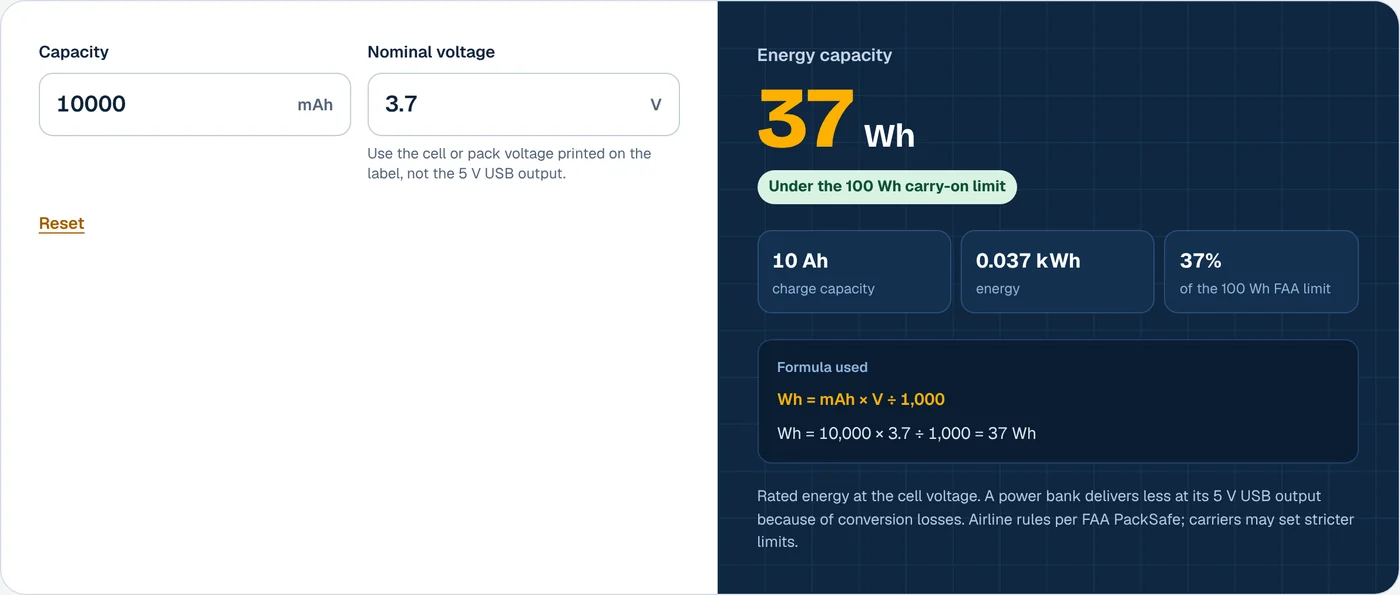
To convert mAh to Wh, multiply the milliamp-hours by the voltage and divide by 1,000. Wh = mAh × V ÷ 1,000. A 10,000 mAh power bank with 3.7 V cells holds 10,000 × 3.7 ÷ 1,000 = 37 Wh. Always use the nominal cell voltage, not the 5 V USB output.
How to use the mAh to Wh calculator
- Enter the capacity in mAh. Copy the milliamp-hour rating from the battery, power bank or device label, such as 5,000 or 20,000 mAh.
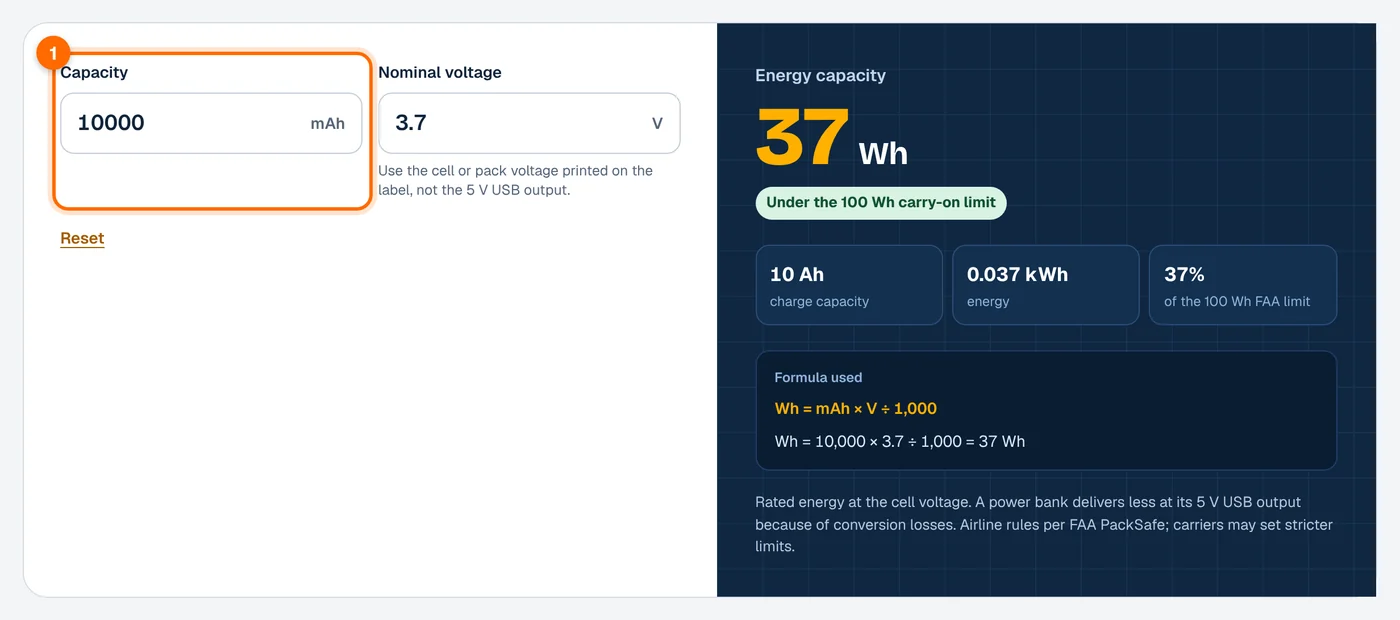
- Enter the nominal voltage. Use the cell or pack voltage printed next to the mAh rating, usually 3.6 V, 3.7 V or 3.85 V for a single lithium-ion cell. Packs with cells in series use multiples, such as 7.4 V, 11.1 V or 14.8 V.

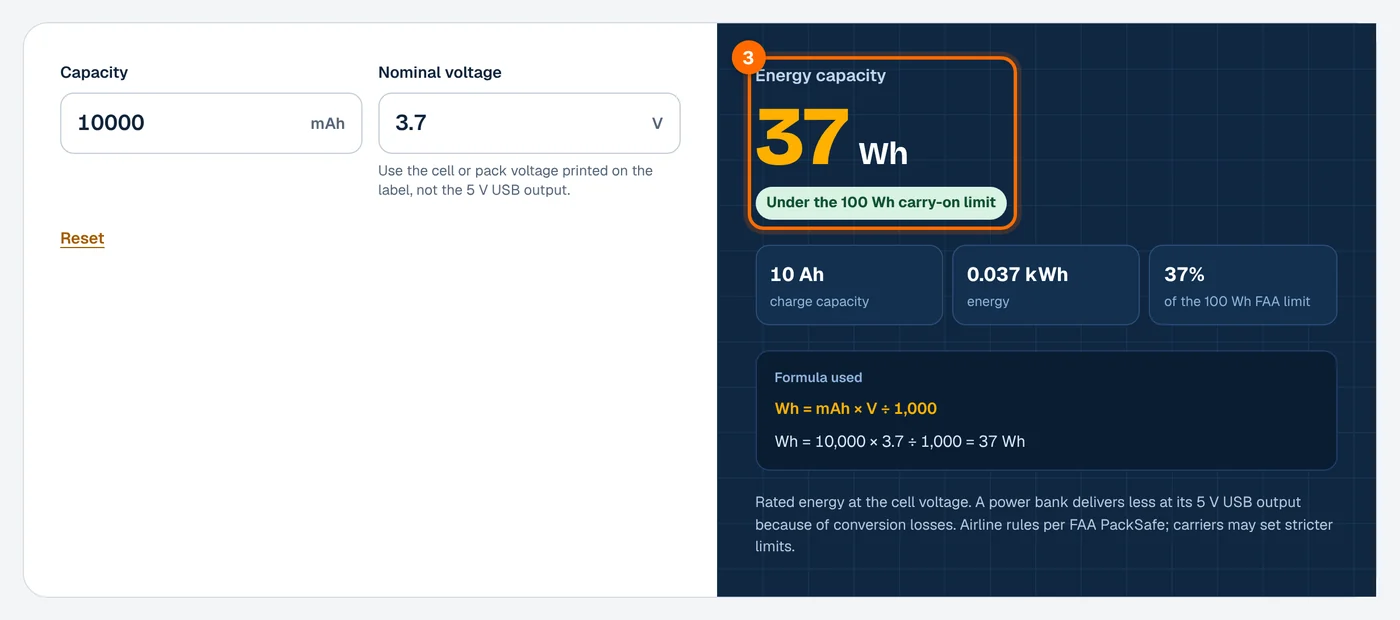
- Read the energy in Wh. The large number is the stored energy in watt-hours. The chip shows how it compares with the 100 Wh airline carry-on limit, and the cards give the same capacity in Ah and kWh.
mAh to Wh formula
Milliamp-hours measure electric charge. Watt-hours measure energy. Charge becomes energy once you multiply it by the voltage it is delivered at.
Where:
- Wh is the energy in watt-hours.
- mAh is the charge capacity in milliamp-hours. 1,000 mAh = 1 Ah.
- V is the nominal voltage of the cell or pack in volts.
- Ah is the charge capacity in amp-hours.
- kWh is the energy in kilowatt-hours. 1 kWh = 1,000 Wh.
To go the other way, mAh = Wh × 1,000 ÷ V.
Worked examples
Example 1: 20,000 mAh power bank
The label lists 20,000 mAh at 3.7 V.
At 74 Wh it is under the 100 Wh carry-on limit for US flights.
Example 2: 26,800 mAh power bank
Larger power banks are often sized to stay just under the airline limit.
That is just below 100 Wh. A 27,000 mAh bank at 3.7 V works out to 99.9 Wh.
Example 3: 4S drone battery
A drone pack has four lithium cells in series, rated 5,000 mAh at 14.8 V (4 × 3.7 V).
The pack has only a quarter of the mAh of the power bank in example 1 but stores the same 74 Wh, because its voltage is four times higher.
mAh to Wh conversion chart
Values in watt-hours. The 3.7 V column suits most power banks and single lithium-ion cells.
| Capacity (mAh) | At 3.7 V | At 7.4 V | At 11.1 V | At 14.8 V |
|---|---|---|---|---|
| 1,000 | 3.7 | 7.4 | 11.1 | 14.8 |
| 2,500 | 9.25 | 18.5 | 27.75 | 37 |
| 5,000 | 18.5 | 37 | 55.5 | 74 |
| 10,000 | 37 | 74 | 111 | 148 |
| 20,000 | 74 | 148 | 222 | 296 |
| 26,800 | 99.16 | 198.32 | 297.48 | 396.64 |
At 3.7 V, the 100 Wh line falls at about 27,027 mAh and the 160 Wh line at about 43,243 mAh.
What affects the result
Which voltage to use
Power banks list a cell voltage (often 3.6 V or 3.7 V) and a USB output voltage (5 V or higher). The mAh rating refers to the cells, so the cell voltage gives the correct Wh. Using 5 V would overstate the energy by about a third.
Conversion losses
The result is the energy stored in the cells. A power bank boosts the cell voltage up to its USB output, and the device being charged has its own charging losses. The energy that reaches your phone is less than the rated Wh, so do not divide the Wh ratings directly to count full charges.
Airline limits
The FAA PackSafe rules allow lithium-ion batteries and power banks up to 100 Wh in carry-on bags. Up to two spares of 101 to 160 Wh need airline approval, and spare lithium batteries must not go in checked bags. Airlines can apply stricter limits, so check before you fly.
Age and temperature
Lithium-ion cells lose capacity as they age and deliver less in the cold. The label shows the capacity when new. An older battery holds fewer real watt-hours than this calculator shows.
Frequently asked questions
How many Wh is 10,000 mAh?
At 3.7 V, 10,000 mAh is 37 Wh. At 3.6 V it is 36 Wh, and at 3.85 V it is 38.5 Wh. The voltage changes the answer, so check the label. For a pack with two cells in series at 7.4 V, 10,000 mAh is 74 Wh.
How many mAh is 100 Wh?
Rearrange the formula: mAh = Wh × 1,000 ÷ V. At 3.7 V, 100 Wh is about 27,027 mAh. At 3.6 V it is about 27,778 mAh. This is why many travel power banks are rated at around 26,800 mAh, just under the limit.
Why do I need the voltage to convert mAh to Wh?
mAh measures charge, not energy. The same 5,000 mAh stores 18.5 Wh at 3.7 V but 74 Wh at 14.8 V. Energy depends on both the charge and the voltage, so you cannot convert between them without knowing the voltage.
Can I take a 20,000 mAh power bank on a plane?
A 20,000 mAh power bank at 3.7 V is 74 Wh, under the FAA 100 Wh carry-on limit. Keep it in your carry-on bag, not checked luggage. Your airline may set its own limits on the number or size of spare batteries, so check its rules.
Why does my power bank charge my phone fewer times than expected?
The mAh rating is at the cell voltage, but energy is lost when the bank boosts it to USB voltage and again inside the phone while charging. Phone batteries also use their own voltage. Compare both batteries in Wh and allow for losses to get a realistic estimate.