Ah to Wh Calculator
Convert amp-hours to watt-hours, or watt-hours to amp-hours, for 12 V, 24 V and 48 V batteries.
Quick answer
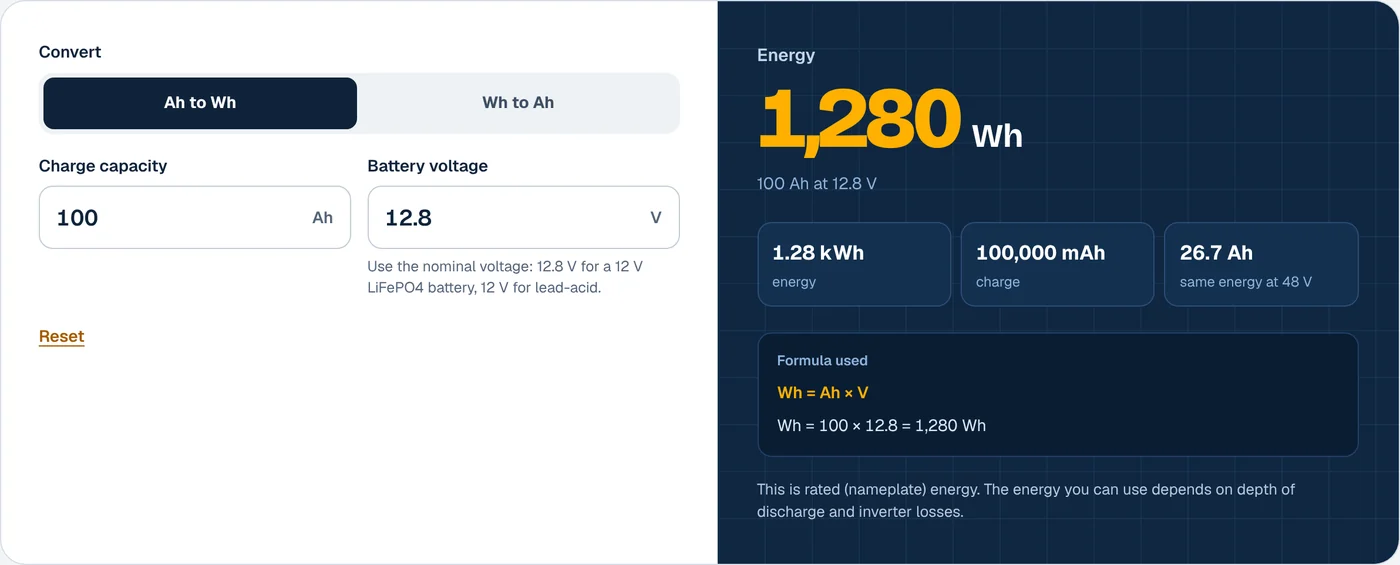
To convert Ah to Wh, multiply amp-hours by the battery voltage: Wh = Ah × V. A 100 Ah, 12.8 V LiFePO4 battery stores 100 × 12.8 = 1,280 Wh. To convert Wh to Ah, divide by the voltage: Ah = Wh ÷ V, so 1,280 Wh at 12.8 V is 100 Ah.
How to use the Ah to Wh calculator
- Choose the direction. Pick Ah to Wh to find the energy in a battery from its amp-hour rating. Pick Wh to Ah to find the amp-hours that match an energy figure.

- Enter the battery capacity. In Ah to Wh mode, type the amp-hour rating from the battery label. In Wh to Ah mode, the field changes to watt-hours, so type the Wh or kWh figure (1 kWh = 1,000 Wh).
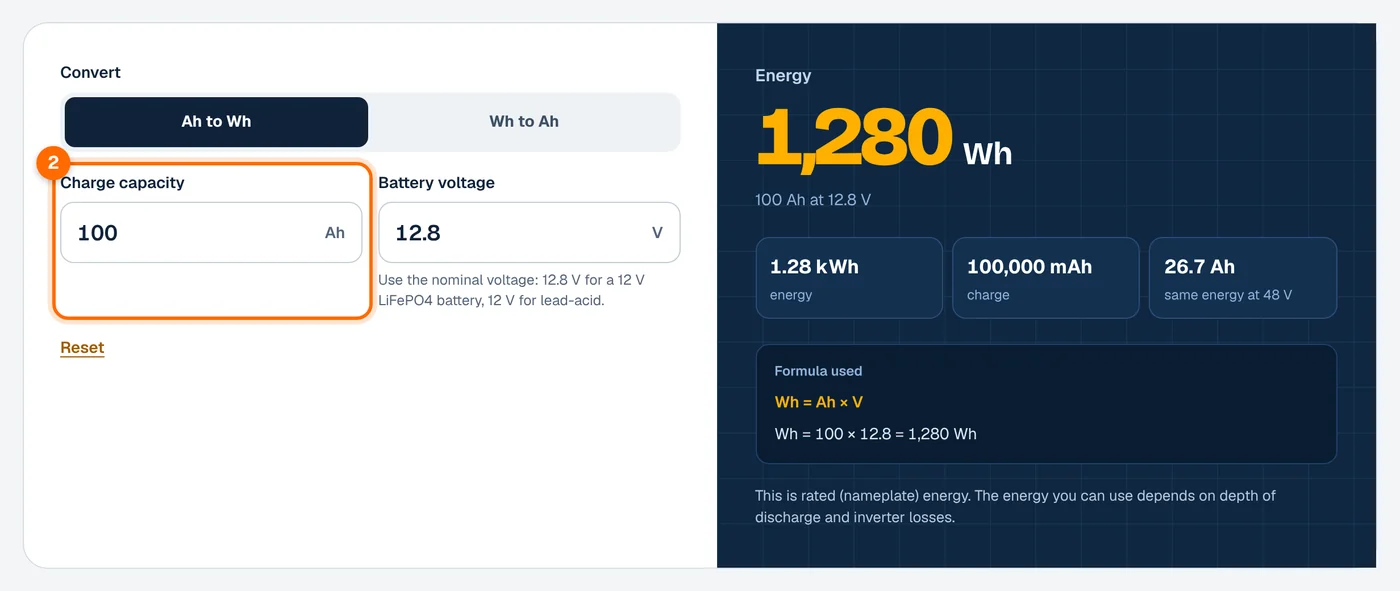
- Enter the battery voltage. Use the nominal voltage of the battery or bank: 12.8 V for a 12 V LiFePO4 battery, 12 V for lead-acid, or 25.6 V and 51.2 V for 24 V and 48 V LiFePO4 banks.

- Read the result. The large number is the energy in Wh, or the charge in Ah if you chose Wh to Ah. The cards show kWh, mAh and the amp-hours the same energy would need at 48 V.

Ah to Wh formula
Amp-hours tell you how much charge a battery holds. Watt-hours tell you how much energy. Voltage links the two.
Where:
- Wh is the energy in watt-hours. Divide by 1,000 for kilowatt-hours (kWh).
- Ah is the charge capacity in amp-hours. Multiply by 1,000 for milliamp-hours (mAh).
- V is the nominal battery voltage in volts.
A 12 V LiFePO4 battery is built from four cells in series and is usually rated at 12.8 V nominal, as in the Victron LiFePO4 battery datasheet. A 12 V lead-acid battery is rated at 12 V. Using the right nominal voltage keeps the Wh figure honest when you compare the two.
Worked examples
Example 1: 100 Ah LiFePO4 battery
This is the rated energy. How much of it you can use depends on depth of discharge and inverter losses.
Example 2: two 100 Ah lead-acid batteries in parallel
Parallel wiring adds the amp-hours and keeps the voltage at 12 V, so the bank is 200 Ah at 12 V.
Wiring the same two batteries in series gives 100 Ah at 24 V, which is also 2,400 Wh. Series or parallel changes the Ah and the volts, but not the stored energy.
Example 3: Wh to Ah for a 5.12 kWh server rack battery
A rack battery lists 5,120 Wh at 51.2 V.
If you wanted the same 5,120 Wh at 12.8 V, you would need 5,120 ÷ 12.8 = 400 Ah of batteries.
Ah to Wh chart for common battery voltages
Values in watt-hours. Use 12, 24 and 48 V for lead-acid and 12.8, 25.6 and 51.2 V for LiFePO4.
| Capacity (Ah) | 12 V | 12.8 V | 24 V | 25.6 V | 48 V | 51.2 V |
|---|---|---|---|---|---|---|
| 50 | 600 | 640 | 1,200 | 1,280 | 2,400 | 2,560 |
| 100 | 1,200 | 1,280 | 2,400 | 2,560 | 4,800 | 5,120 |
| 200 | 2,400 | 2,560 | 4,800 | 5,120 | 9,600 | 10,240 |
| 280 | 3,360 | 3,584 | 6,720 | 7,168 | 13,440 | 14,336 |
| 300 | 3,600 | 3,840 | 7,200 | 7,680 | 14,400 | 15,360 |
What affects the result
Nominal voltage
Battery voltage moves with state of charge. It sits higher when the battery is full and drops as it empties, and it also sags under heavy load. The nominal voltage is the average across the discharge, so it is the right figure for converting Ah to Wh.
Series and parallel wiring
Batteries in series add voltage and keep the Ah of one battery. Batteries in parallel add Ah and keep the voltage. In both cases the total Wh is the sum of the individual batteries, so Wh is the clearest way to compare banks.
Rated vs usable energy
The result is the nameplate energy. Lead-acid batteries are usually cycled to about half their capacity for good life, and inverters lose some energy turning DC into AC. Use the battery life calculator to find usable runtime.
Discharge rate
Lead-acid amp-hour ratings are tied to a specific discharge time, often 20 hours. Drawing current faster delivers fewer amp-hours. LiFePO4 capacity changes much less with load.
Frequently asked questions
How many Wh is 100 Ah?
It depends on the voltage. A 100 Ah battery holds 1,200 Wh at 12 V, 1,280 Wh at 12.8 V (12 V LiFePO4), 2,400 Wh at 24 V and 4,800 Wh at 48 V. Multiply the amp-hours by the nominal voltage of your battery.
How do I convert Wh to Ah?
Divide the watt-hours by the battery voltage. A 1,000 Wh battery at 12.8 V is 1,000 ÷ 12.8 = 78.1 Ah. The same 1,000 Wh at 24 V is 41.7 Ah. Choose Wh to Ah in the calculator to do this automatically.
Why is Wh a better way to compare batteries than Ah?
Ah ignores voltage. A 100 Ah 48 V battery stores four times the energy of a 100 Ah 12 V battery. Wh includes voltage, so two batteries with the same Wh hold the same energy whatever their voltage or wiring.
Should I use 12 V or 12.8 V for a LiFePO4 battery?
Use 12.8 V, the usual nominal rating for a four-cell LiFePO4 battery. Using 12 V understates its energy by about 6%. For lead-acid, use 12 V. If the label gives a Wh or kWh figure, you can enter that directly in Wh to Ah mode.
How many kWh is a 200 Ah battery?
At 12.8 V, a 200 Ah battery holds 200 × 12.8 = 2,560 Wh, which is 2.56 kWh. At 12 V it holds 2.4 kWh, and at 51.2 V it holds 10.24 kWh. Divide the Wh by 1,000 to get kWh.