Battery Life Calculator
Estimate how many hours a LiFePO4, AGM or flooded battery will run a load, with depth of discharge and inverter losses included.
Quick answer
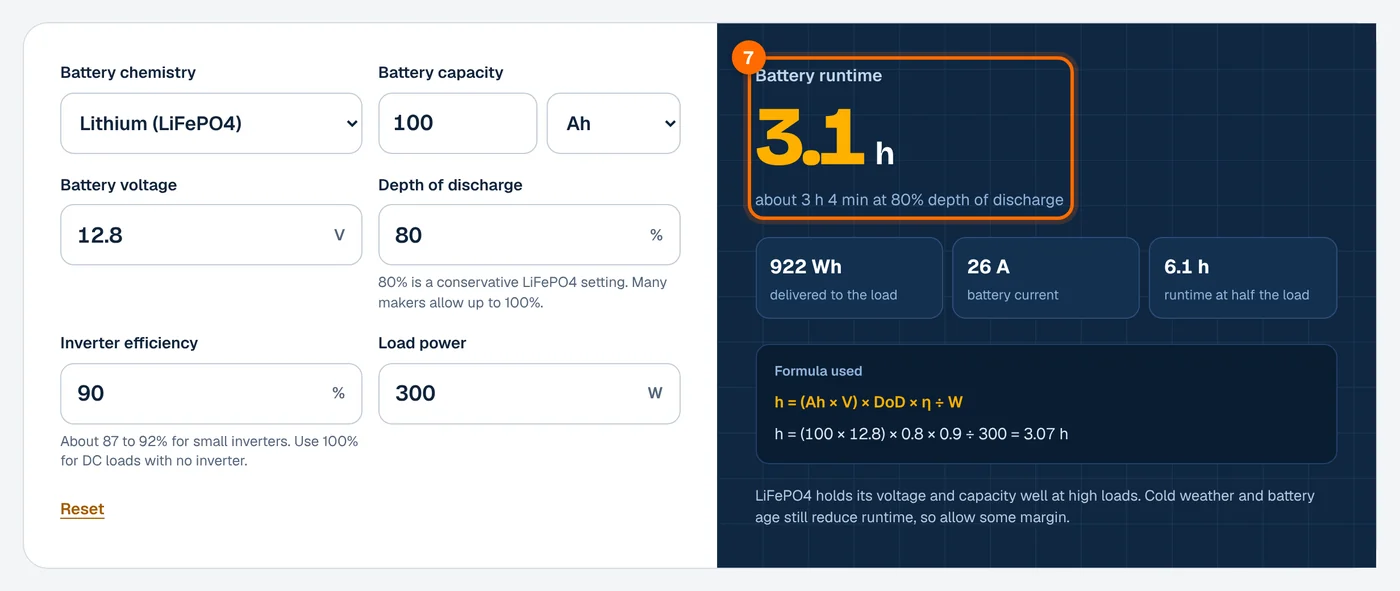
Battery runtime in hours equals battery energy times depth of discharge times inverter efficiency, divided by the load in watts. h = (Ah × V) × DoD × η ÷ W. A 100 Ah, 12.8 V LiFePO4 battery at 80% DoD and 90% efficiency runs a 300 W load for 1,280 × 0.8 × 0.9 ÷ 300 = 3.07 hours.
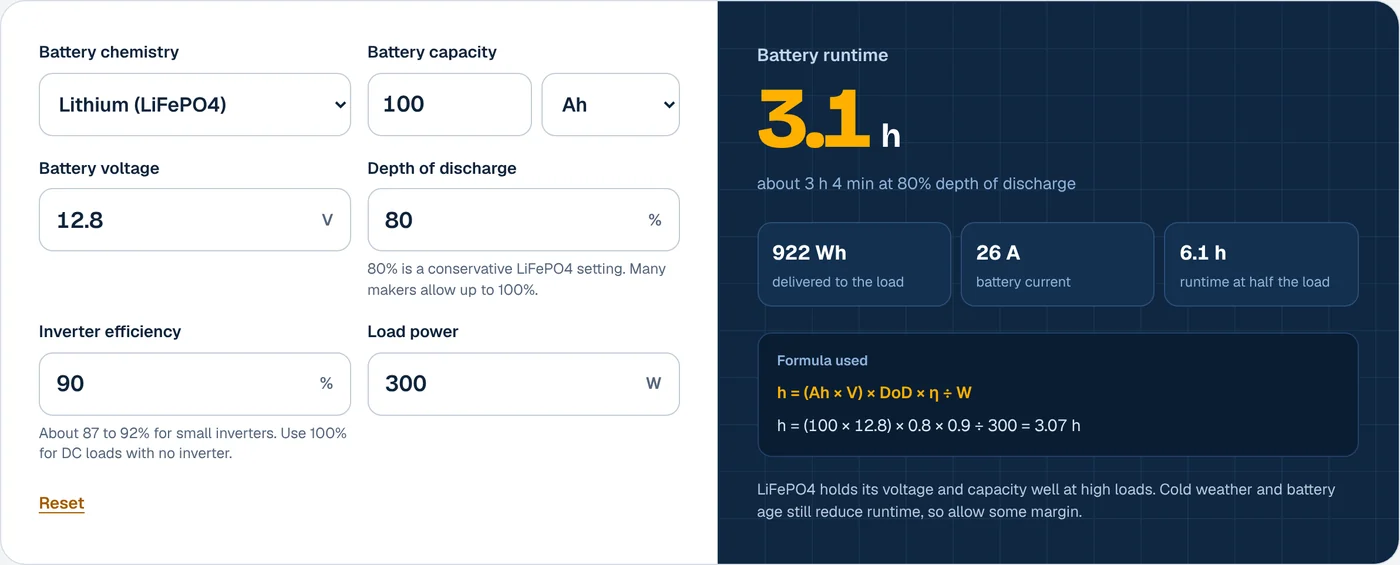
How to use the battery life calculator
- Choose the battery chemistry. Pick LiFePO4, AGM or flooded lead-acid. The choice loads a typical depth of discharge for that chemistry, which you can change.

- Enter the battery capacity. Type the rating and choose Ah or Wh from the dropdown. For a bank, enter the total: two 100 Ah 12 V batteries in parallel are 200 Ah.
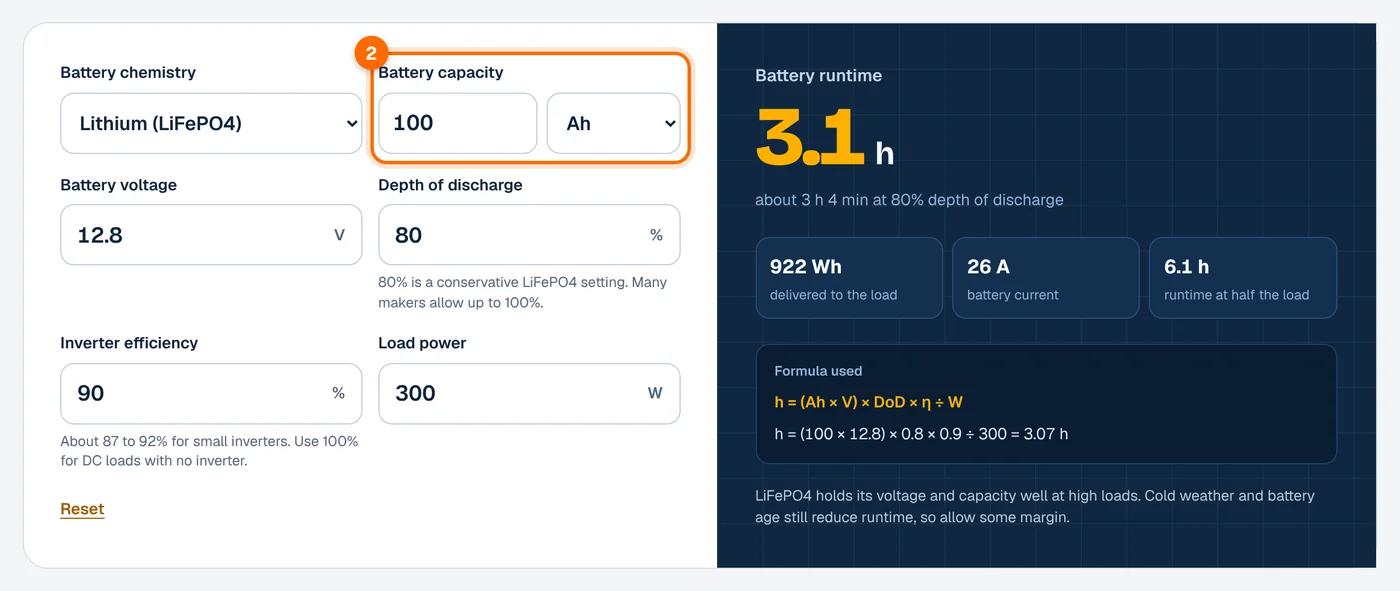
- Enter the battery voltage. Use the nominal voltage: 12.8 V for 12 V LiFePO4, 12 V for 12 V lead-acid, or 24 V and 48 V class banks. This field hides when you enter capacity in Wh.
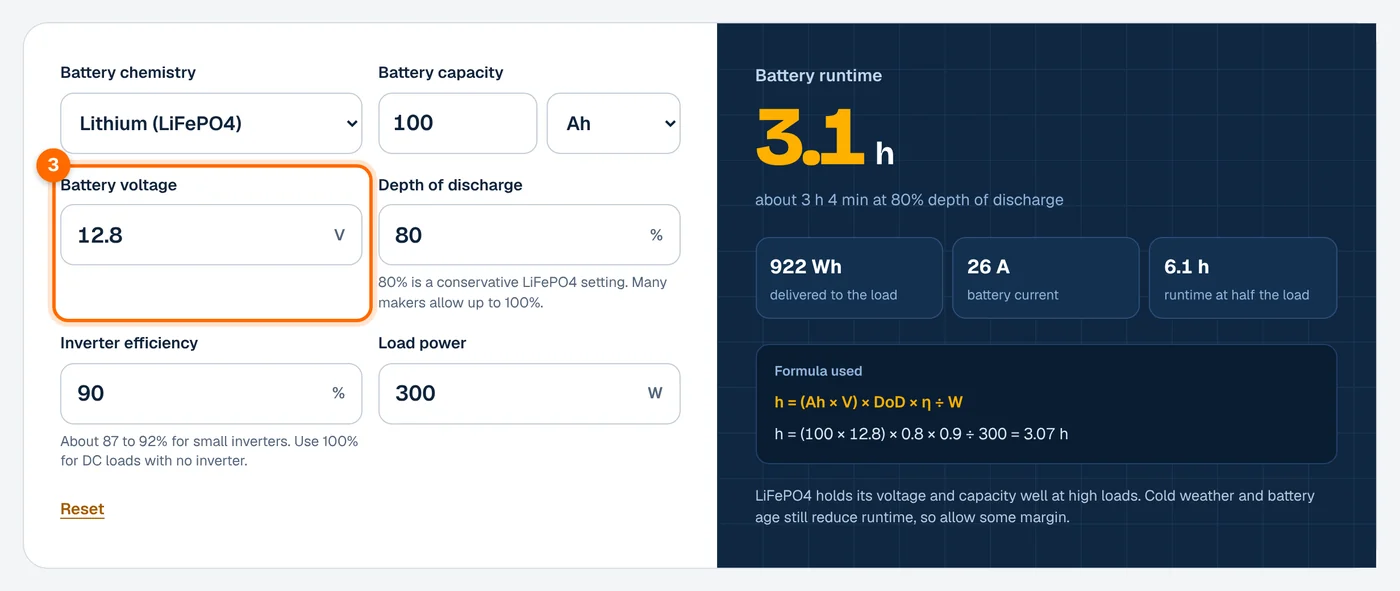
- Set the depth of discharge. This is how much of the battery you will use before recharging. The default is 80% for LiFePO4 and 50% for both lead-acid types.
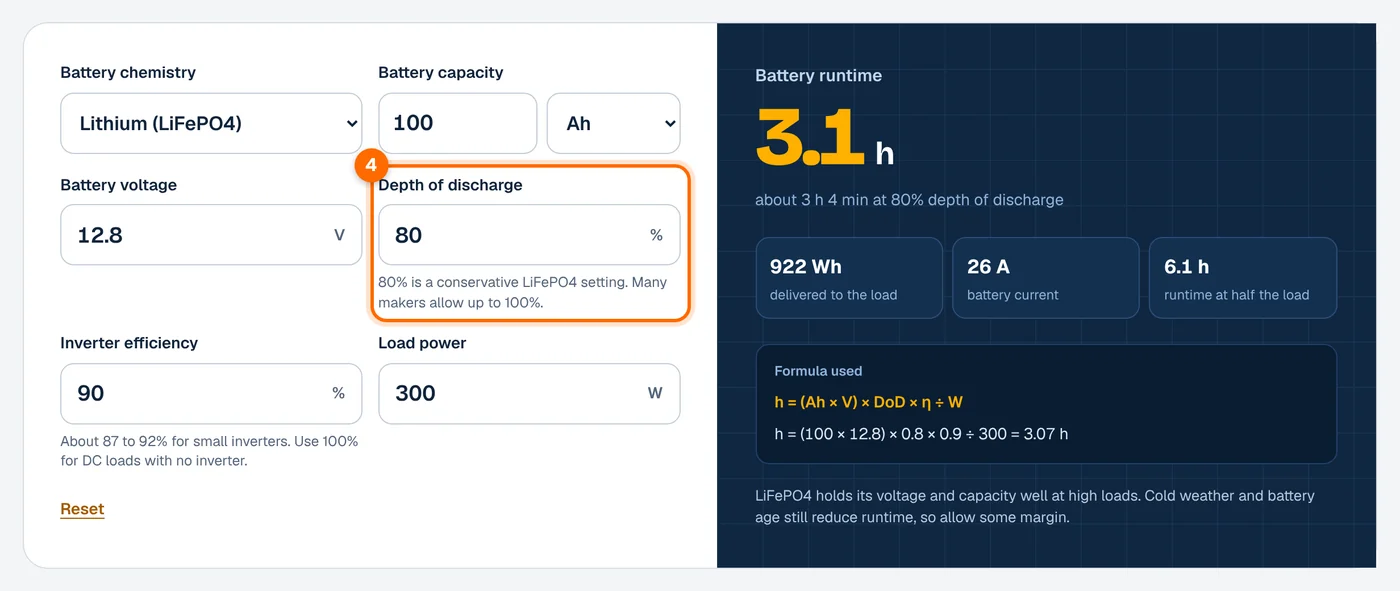
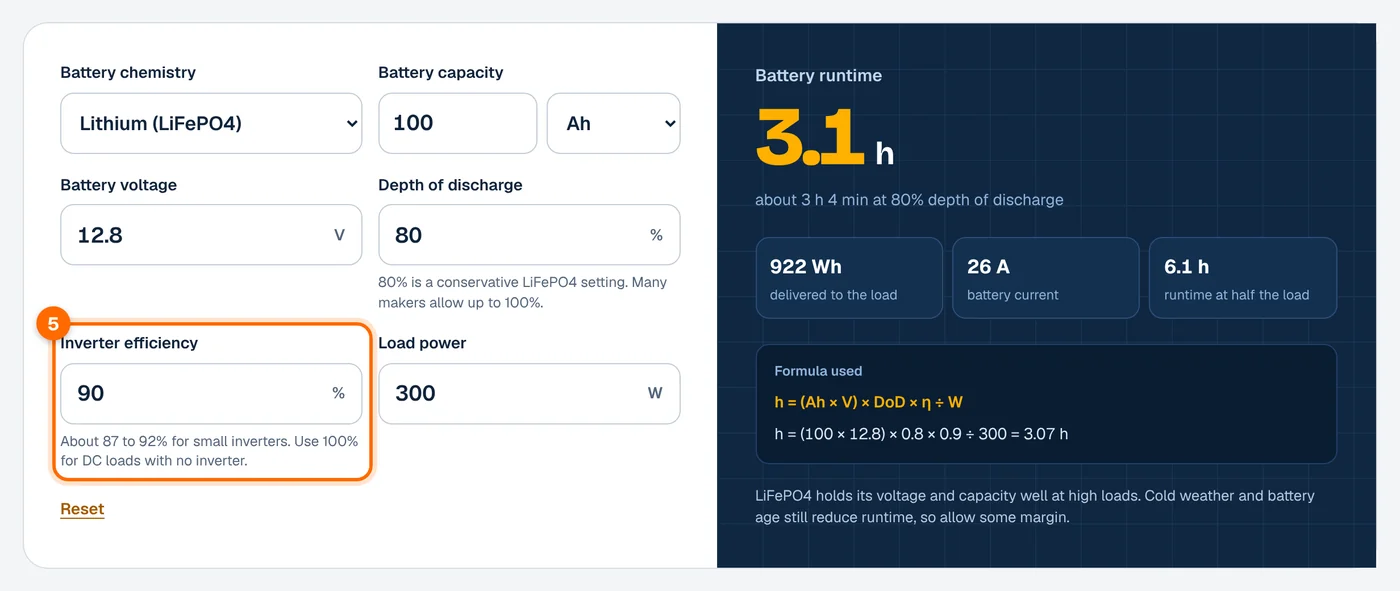
- Enter the inverter efficiency. Small inverters convert about 87% to 92% of battery energy into AC power at best. Enter 100% if the load runs directly on DC with no inverter.
- Enter the load power. Type the total watts of everything running at once. For loads that cycle, such as a fridge, use the average watts.

- Read the battery runtime. The large number is the runtime in hours. The cards show the energy delivered to the load, the current drawn from the battery and the runtime at half the load.
Battery life formula
Start with the stored energy, keep only the part you plan to use, take off inverter losses, then divide by the load.
Where:
- t is the runtime in hours.
- E is the rated battery energy in watt-hours (Wh). If you enter Wh directly, the calculator skips the first step.
- Ah is the battery capacity in amp-hours and V is its nominal voltage.
- DoD is the depth of discharge as a fraction, such as 0.8 for 80%.
- η (eta) is the inverter efficiency as a fraction, such as 0.9 for 90%.
- P is the load power in watts (W).
The battery current card is P ÷ η ÷ V. It shows how hard the battery is working, which matters for lead-acid and for sizing cables and fuses.
Worked examples
Example 1: 100 Ah LiFePO4 running a 300 W load
About 3 hours 4 minutes. The battery supplies roughly 300 ÷ 0.9 ÷ 12.8 = 26 A.
Example 2: same load on a 100 Ah AGM battery
A 12 V AGM battery used to 50% depth of discharge:
The lead-acid battery gives about 1 hour 48 minutes, and at about 28 A it is working well above its 20-hour rate, so the real figure will likely be lower.
Example 3: 12 V fridge on a 2,560 Wh battery
A DC fridge averages 50 W over a day and needs no inverter, so η = 1. The battery is listed at 2,560 Wh and used to 80%.
That is about 1.7 days without any charging.
Battery runtime by load
Runtime in hours with a 90% efficient inverter. LiFePO4 is 100 Ah at 12.8 V and 80% DoD. AGM is 100 Ah at 12 V and 50% DoD.
| Load (W) | 100 Ah LiFePO4 (h) | 100 Ah AGM (h) |
|---|---|---|
| 50 | 18.43 | 10.80 |
| 100 | 9.22 | 5.40 |
| 200 | 4.61 | 2.70 |
| 300 | 3.07 | 1.80 |
| 500 | 1.84 | 1.08 |
| 1,000 | 0.92 | 0.54 |
The AGM figures above 200 W are optimistic, because a 100 Ah lead-acid battery loses capacity at those currents.
What affects the result
Depth of discharge
Deeper cycles give more runtime today but fewer cycles over the battery’s life. The Victron AGM battery datasheet lists 400 cycles at 80% discharge, 600 at 50% and 1,500 at 30%. Victron’s LiFePO4 datasheet lists 2,500 cycles at 80% DoD and 5,000 at 50%. That gap is why lead-acid is usually sized for 50% and LiFePO4 for 80% or more.
Inverter efficiency and idle draw
Running AC appliances means converting DC to AC, which loses energy. The Victron Phoenix inverter datasheet lists maximum efficiencies of 87% to 92% across its 250 VA to 1,600 VA models, plus a zero-load draw of about 4 to 12 W. Efficiency is lower at very light loads, so a big inverter running a small load wastes more.
Discharge rate
Lead-acid batteries are usually rated at the 20-hour rate, which for a 100 Ah battery is 5 A. Draw 25 A or more and the usable amp-hours shrink. LiFePO4 holds its capacity much better at high current.
Temperature and age
Cold reduces available capacity, especially for lead-acid. All batteries lose capacity as they age, so a battery a few years old will run for less time than a new one with the same label.
Frequently asked questions
How long will a 100 Ah battery run a 300 W load?
A 100 Ah, 12.8 V LiFePO4 battery at 80% depth of discharge and 90% inverter efficiency runs a 300 W load for about 3.07 hours. A 100 Ah, 12 V AGM battery at 50% depth of discharge runs the same load for about 1.8 hours, and likely less at that current.
What depth of discharge should I use?
For flooded lead-acid, Trojan Battery recommends discharges of 50% or less. AGM is commonly sized for 50% too. LiFePO4 handles deeper cycles, and 80% is a conservative setting, though many makers allow more. Use the figure in your battery’s datasheet if it gives one.
Do I need to include inverter efficiency?
Yes, for any AC load run from a battery. The inverter loses part of the energy as heat, so the battery delivers more watts than the appliance uses. Enter 100% only when the load runs directly on the battery’s DC voltage, such as a 12 V fridge or LED lights.
Why does my battery run out sooner than the calculator says?
Common reasons are a load that draws more than its label suggests, inverter idle power, cold temperatures, battery age and, for lead-acid, a high discharge rate. Startup surges from motors and compressors also use extra energy. Measure the real load and allow some margin.
How do I calculate battery life in Wh?
Enter the capacity in Wh using the unit dropdown. The calculator then skips the voltage step and uses t = Wh × DoD × η ÷ W. A 1,000 Wh power station at 90% usable and 85% efficiency runs a 100 W load for about 7.65 hours.