Battery Backup Calculator
See how long a home battery, UPS or power station will keep your essential loads running during a power outage.
Quick answer
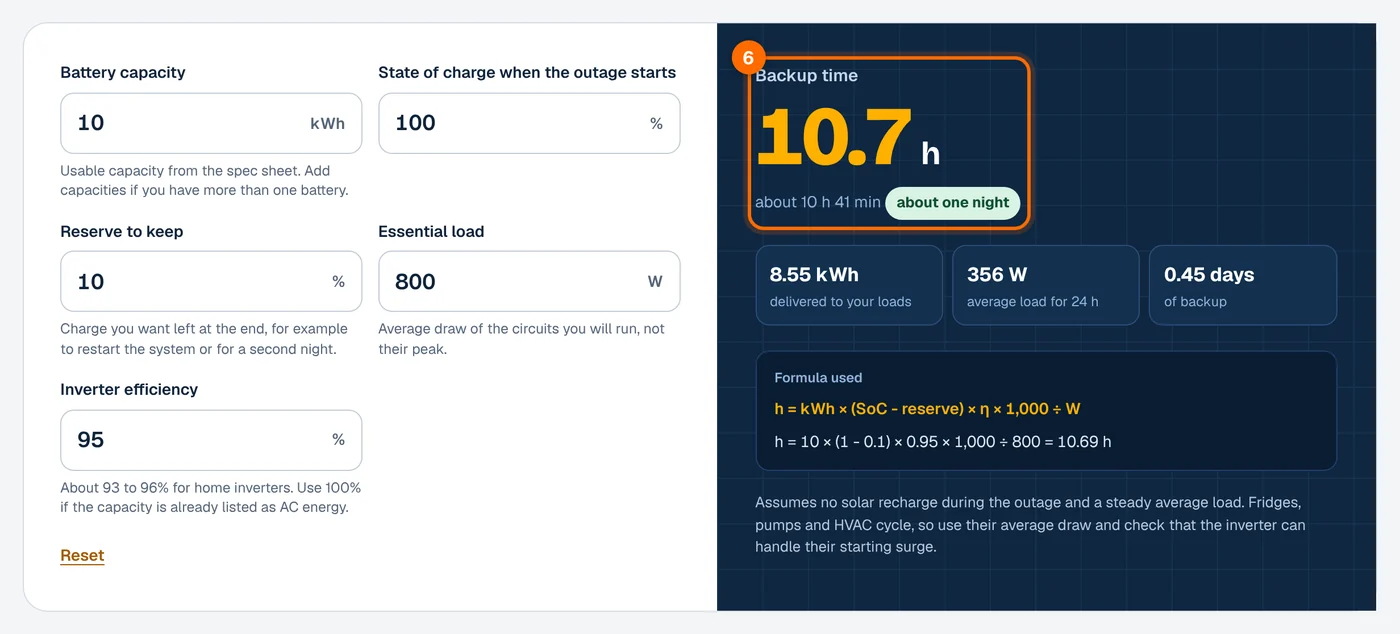
Backup time is the usable battery energy times inverter efficiency, divided by the load. Hours = kWh × (SoC – reserve) × η × 1,000 ÷ W. A 10 kWh home battery starting full, keeping a 10% reserve and running 800 W of essentials at 95% efficiency lasts 10 × 0.9 × 0.95 × 1,000 ÷ 800 = 10.7 hours.

How to use the battery backup calculator
- Enter the battery capacity. Type the usable capacity in kWh from the spec sheet of your home battery, UPS or portable power station. If you have several batteries, add their capacities together.
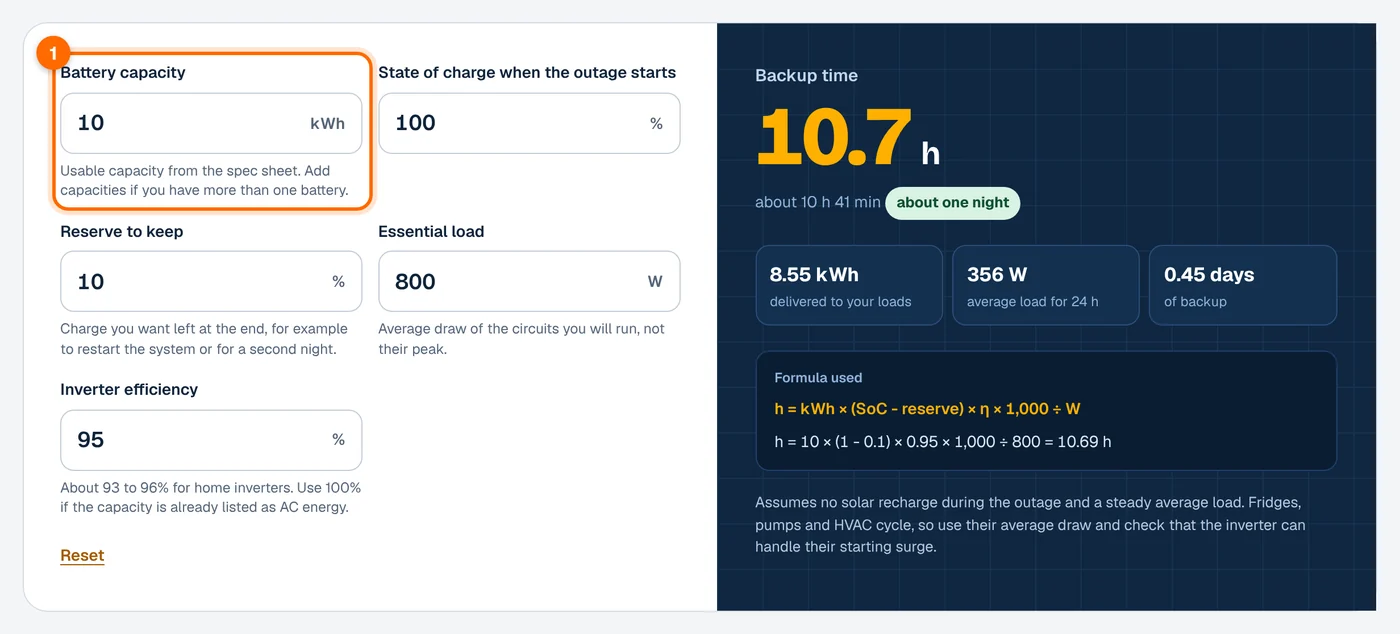
- Enter the state of charge when the outage starts. Use 100% if the battery is kept full for backup. If it also cycles daily for solar or time-of-use savings, enter the lowest level it is likely to be at when the power goes out.

- Enter the reserve to keep. This is the charge you want left at the end, for example to restart the system or to carry into a second night. Enter 0 to use the battery down to its own cutoff.
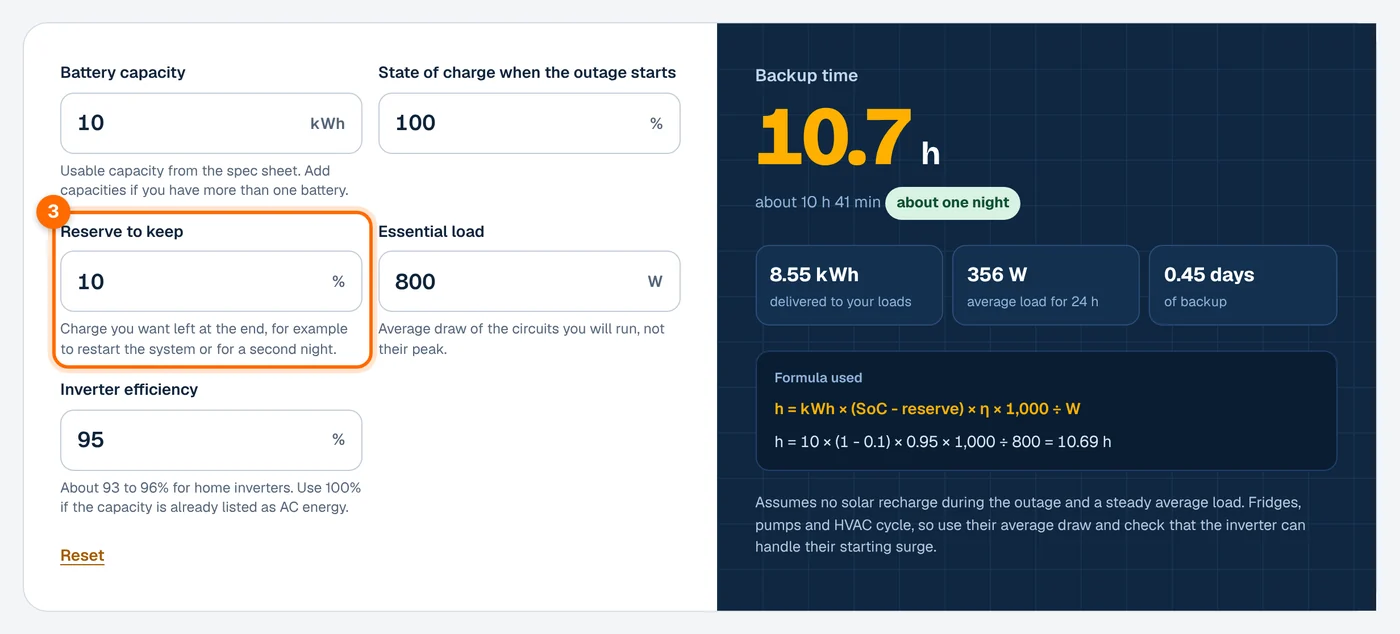
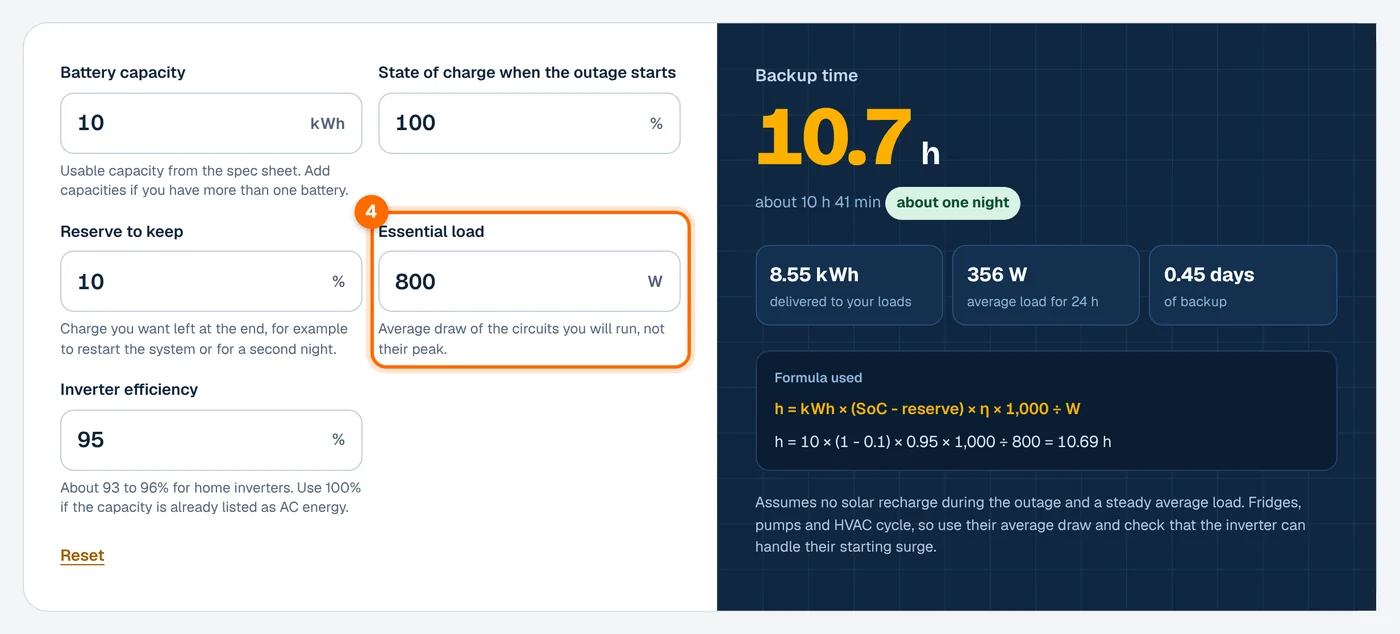
- Enter the essential load. Type the average watts of the circuits you will run during the outage, such as the fridge, lights, internet router and furnace fan.
- Enter the inverter efficiency. Home inverters typically convert about 93% to 96% of battery energy to AC at best. Enter 100% if the battery’s capacity is already listed as AC energy.

- Read the backup time. The large number is the hours of backup. The cards show the energy delivered to your loads, the average load that would last a full 24 hours and the backup time in days.
Battery backup formula
The calculator takes the slice of the battery between the starting charge and the reserve, removes inverter losses and divides by the load.
Where:
- t is the backup time in hours.
- Eout is the energy delivered to your loads in kWh.
- C is the usable battery capacity in kWh.
- SoC is the state of charge at the start of the outage, as a fraction (1.0 = full).
- R is the reserve you want to keep, as a fraction.
- η is the inverter efficiency as a fraction.
- P is the average essential load in watts. Multiplying by 1,000 turns kWh into Wh to match.
To find the load a battery can carry for a full day, rearrange: P24h = Eout × 1,000 ÷ 24.
Worked examples
Example 1: 10 kWh battery, 800 W of essentials
About 10 hours 41 minutes, enough for one night. To last 24 hours, the average load would need to drop to 8,550 ÷ 24 = 356 W.
Example 2: 13.5 kWh AC-rated battery at 80% charge
The battery’s 13.5 kWh is listed as usable AC energy, so η = 1. The outage starts at 80% charge, no reserve is kept and the home draws 1,200 W.
Example 3: 2 kWh portable power station
A power station runs a fridge averaging 150 W and a 15 W router, 165 W in total. In this example the inverter efficiency is 90% and the station is used down to empty.
Backup hours by battery size and load
Hours of backup starting from 100%, keeping a 10% reserve, at 95% inverter efficiency and a steady load.
| Battery (kWh) | 300 W | 500 W | 1,000 W | 2,000 W |
|---|---|---|---|---|
| 5 | 14.2 | 8.5 | 4.3 | 2.1 |
| 10 | 28.5 | 17.1 | 8.5 | 4.3 |
| 13.5 | 38.5 | 23.1 | 11.5 | 5.8 |
| 20 | 57.0 | 34.2 | 17.1 | 8.5 |
| 27 | 77.0 | 46.2 | 23.1 | 11.5 |
Halving the load doubles the backup time, so trimming nonessential circuits is the fastest way to stretch a battery.
What affects the result
AC or DC capacity rating
Some home batteries quote usable AC energy, which already includes inverter losses. The Tesla Powerwall 3 datasheet, for example, lists 13.5 kWh of usable AC energy as a minimum at the beginning of life. For a rating like that, enter 100% efficiency. For a battery rated in DC kWh, enter the inverter efficiency.
Inverter efficiency and standby draw
Inverters lose a few percent of the energy they convert and draw some power even with no load. The Victron MultiPlus-II datasheet lists maximum inverter efficiencies of 93% to 96% and a zero-load draw of 11 to 55 W, depending on the model. During a long outage with a light load, that idle draw adds up.
Cycling and surge loads
Fridges, well pumps, sump pumps and HVAC equipment switch on and off. Use their average draw over a day for runtime, and make sure the inverter can supply their starting surge, which is often much higher than the running watts.
Solar recharge
The calculator assumes no charging during the outage. If solar panels can recharge the battery during an outage, daytime production can extend backup well beyond one night. Check that your system is set up to keep solar running when the grid is down.
Frequently asked questions
How long will a home battery last during a power outage?
It depends on capacity, starting charge and load. A 10 kWh battery starting full, keeping a 10% reserve and running 800 W at 95% efficiency lasts about 10.7 hours. Running only 400 W of essentials would double that to about 21.4 hours.
What counts as an essential load?
Essentials are the circuits you need to stay safe and comfortable: the refrigerator, some lights, internet, phone charging, a furnace fan or well pump, and medical devices. Large loads such as electric heating, central air conditioning, ovens and EV charging drain a battery quickly.
Why keep a reserve?
A reserve leaves charge in the battery at the end of the run. It can carry you into a second night if solar output is low, keep the system ready to restart, and avoid draining the battery to its cutoff. Enter 0% if you want the full runtime.
Does this work for a UPS or a portable power station?
Yes. Enter the battery capacity in kWh (divide Wh by 1,000), the starting charge, the load in watts and the inverter efficiency. For a UPS rated only in VA, check the manual for the battery Wh or a runtime chart, since VA describes output capacity, not stored energy.
How big a battery do I need for 24 hours of backup?
Multiply your average essential load by 24 and divide by the usable fraction and efficiency. For 500 W, that is 500 × 24 = 12,000 Wh, and 12,000 ÷ 0.9 ÷ 0.95 = 14,035 Wh, so about 14 kWh starting full with a 10% reserve.