Inverter Size Calculator
Work out the continuous and surge rating your inverter needs, the DC current at 12, 24 or 48 V, or a grid-tie inverter size from your DC/AC ratio.
Quick answer
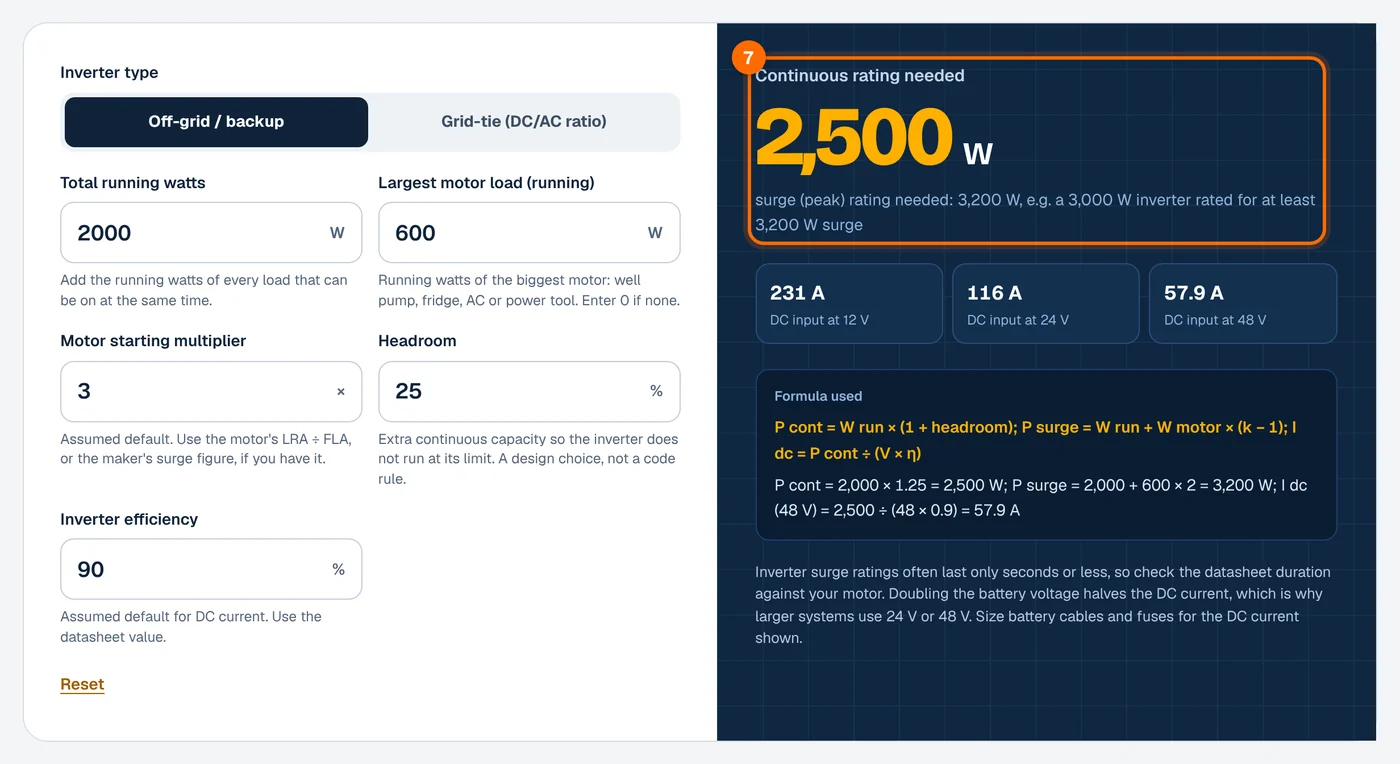
Size an off-grid or backup inverter for two numbers: continuous watts = total running watts × (1 + headroom), and surge watts = running watts + largest motor × (starting multiplier − 1). For 2,000 W of loads with a 600 W motor at 3× and 25% headroom, you need 2,500 W continuous and 3,200 W surge.

How to use the inverter size calculator
- Choose the inverter type. Pick off-grid / backup for a battery inverter that runs your appliances. Pick grid-tie to size a solar inverter from your array kW and a DC/AC ratio.

- Enter the total running watts. Add the running watts of every appliance that can be on at the same time. Use the nameplate figure or a plug-in watt meter reading.
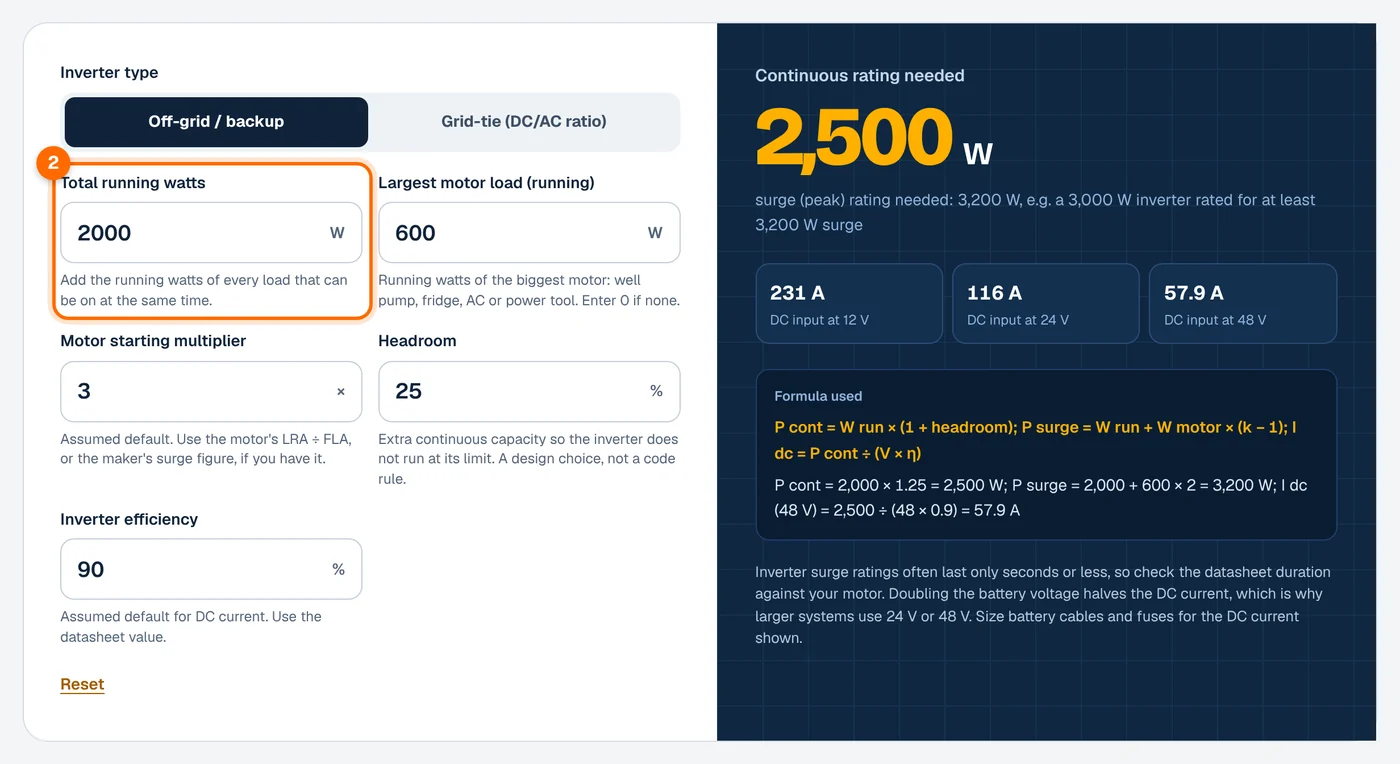
- Enter the largest motor load. This is the running watts of the biggest motor in the mix, such as a well pump, refrigerator compressor or air conditioner. Enter 0 if there is no motor.
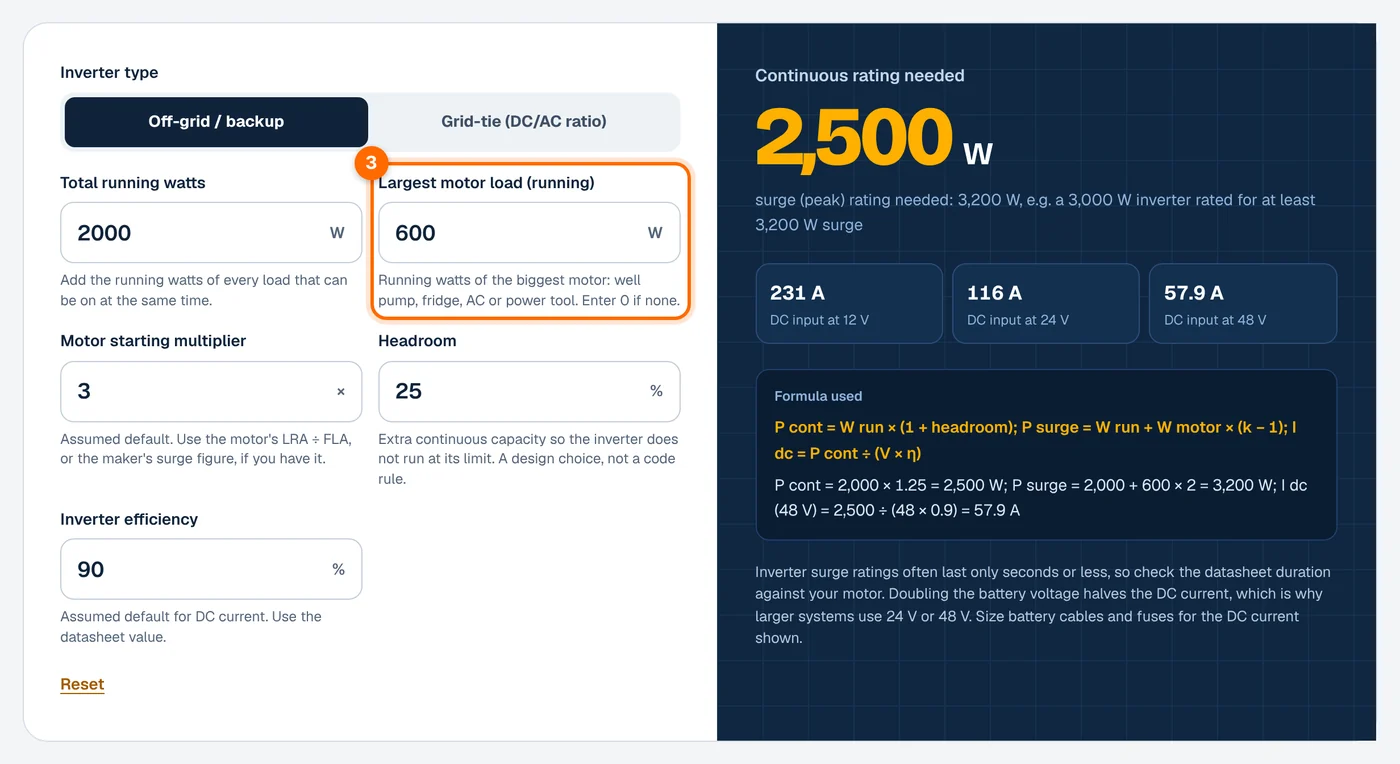
- Set the motor starting multiplier. Motors draw several times their running power for a moment at start. The default of 3 is an assumption; use the motor’s locked-rotor amps (LRA) ÷ full-load amps (FLA) when you know them.
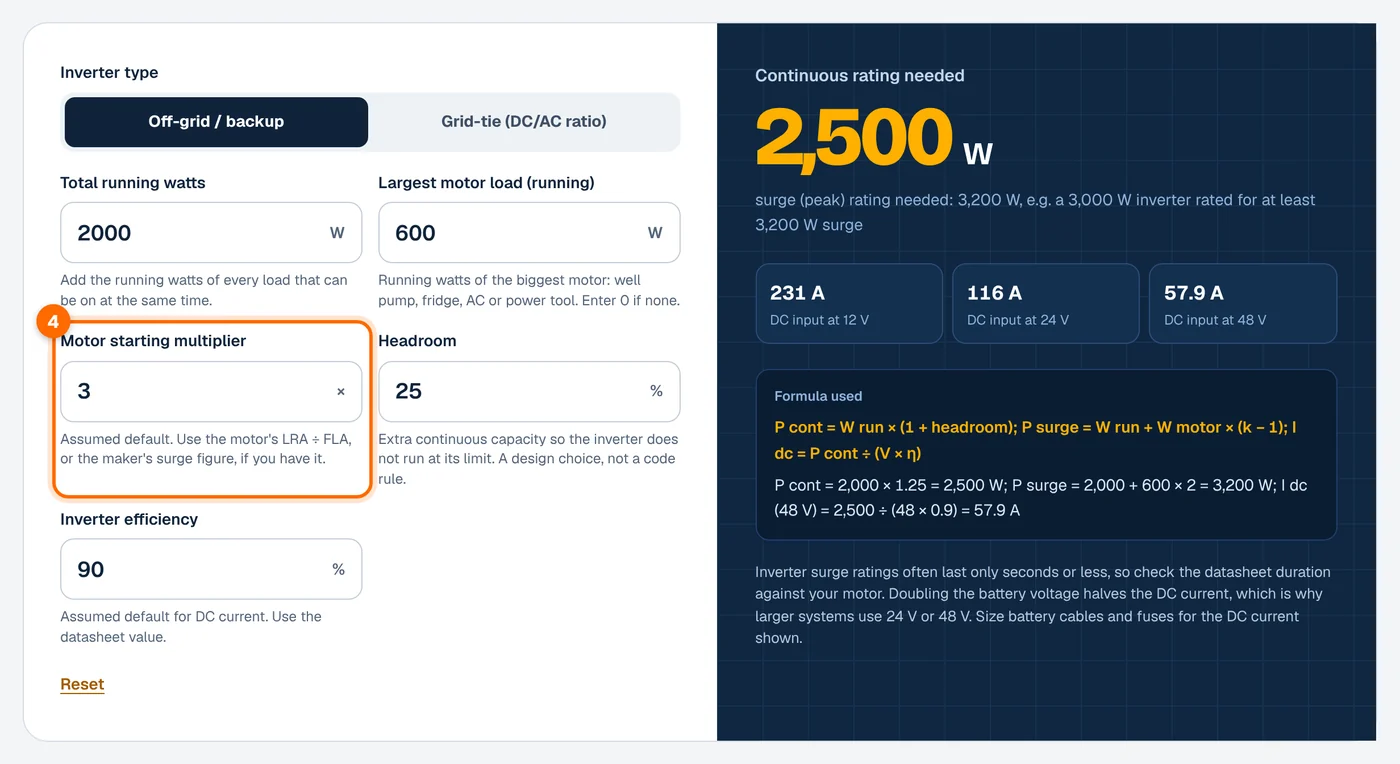
- Set the headroom. This adds spare continuous capacity so the inverter does not run at its limit all day. 25% is a common design choice, not a code requirement.

- Enter the inverter efficiency. It is used to find the DC current the inverter pulls from the battery. Use the datasheet value; 90% is the default.

- Read the continuous rating. The big number is the continuous watts you need. The line below shows the surge rating, and the cards show the battery-side current at 12 V, 24 V and 48 V.
Inverter size formula
Off-grid and backup inverters
Grid-tie inverters
Where:
- Wrun is the total running power of loads used together, in watts.
- h is the headroom as a decimal, so 25% = 0.25.
- Wmotor is the running power of the largest motor.
- k is the motor starting multiplier. The motor’s running watts are already in Wrun, so only the extra (k − 1) is added.
- Vbatt is the nominal battery voltage and η is inverter efficiency.
- PDC is the solar array rating in kW, PAC is the inverter AC rating, and R is the DC/AC ratio.
Worked examples
Example 1: home backup with a well pump
Example loads total 2,000 W running, including a 600 W pump that starts at about 3× its running power. With 25% headroom and a 90% efficient inverter:
A 3,000 W inverter with a surge rating of at least 3,200 W fits. On a 12 V battery the same load would pull 231.5 A, which is why this size usually runs at 48 V.
Example 2: RV inverter with no motor loads
An example RV runs a 1,000 W microwave and 200 W of electronics together, so Wrun = 1,200 W and Wmotor = 0.
A 1,500 W inverter covers it. The surge need is just the 1,200 W running load because nothing starts a motor.
Example 3: grid-tie inverter for an 8 kW array
At a DC/AC ratio of 1.2, an 8 kW DC array pairs with 8 ÷ 1.2 = 6.67 kW of AC inverter. At 1.15 it is 6.96 kW, and at 1.3 it is 6.15 kW. A 7.6 kW inverter would give a ratio of 8 ÷ 7.6 = 1.05, while a 6 kW unit gives 1.33.
DC input current by inverter size
Battery-side current at full continuous output with 90% inverter efficiency. Size battery cables and fuses for these currents.
| Inverter output | 12 V battery | 24 V battery | 48 V battery |
|---|---|---|---|
| 1,000 W | 92.6 A | 46.3 A | 23.1 A |
| 2,000 W | 185.2 A | 92.6 A | 46.3 A |
| 3,000 W | 277.8 A | 138.9 A | 69.4 A |
| 5,000 W | 463.0 A | 231.5 A | 115.7 A |
| 8,000 W | 740.7 A | 370.4 A | 185.2 A |
What affects the result
Which loads run at the same time
The running total should only include loads that can be on together. Adding every appliance in the house oversizes the inverter. Leaving out a dryer or water heater that you do run during outages undersizes it.
Motor starting surge
Pumps, compressors and power tools need a short burst of power to start. Inverter surge ratings are often only held for seconds or less, so compare the datasheet’s surge duration with your motor. Soft starters can lower the starting multiplier.
Battery voltage
The same AC output pulls half the DC current at 24 V as at 12 V, and a quarter at 48 V. Lower current means thinner cables, smaller fuses and lower losses.
DC/AC ratio for grid-tie systems
Solar panels rarely produce their full rating, so grid-tie arrays are usually larger than the inverter. NREL’s 2021 solar cost benchmark models residential systems at an inverter loading ratio of 1.15 and utility-scale systems near 1.3. A higher ratio clips some midday peaks but adds energy in the morning, evening and on cloudy days.
Inverter efficiency and idle draw
Efficiency changes with load and is often lower at very light loads. Most inverters also draw some power just being on, which matters for small off-grid systems that run 24 hours a day.
Frequently asked questions
What size inverter do I need to run a refrigerator?
Add the fridge’s running watts to everything else you run at the same time, then add headroom. For surge, multiply the fridge’s running watts by its starting multiplier minus 1 and add that to the total. Check the compressor’s datasheet or a meter reading, because starting power varies a lot between models.
What is the difference between continuous and surge rating?
The continuous rating is the power an inverter can deliver for hours without overheating. The surge or peak rating is a higher power it can hold for a short time, often seconds or less, to start motors. You need to meet both, and the datasheet should list the surge duration.
Can an inverter be too big?
An oversized inverter works, but it costs more, may draw more idle power and can be less efficient at light loads. For a small cabin that runs a few lights and a laptop most of the day, a right-sized inverter often wastes less energy than a large one.
What DC/AC ratio should a grid-tie system use?
Ratios from about 1.1 to 1.3 are common. NREL’s PVWatts calculator uses 1.1 as its default, and NREL’s cost benchmark models residential systems at 1.15. The best ratio depends on your climate, panel orientation and inverter price, so compare yields at a few ratios.
Why is the DC current so high at 12 V?
Power equals voltage times current, so at a low voltage you need more current for the same watts. A 3,000 W inverter at 90% efficiency pulls about 278 A from a 12 V battery but only about 69 A from a 48 V bank. That is why larger systems use 48 V.