Charge Controller Calculator
Size an MPPT or PWM solar charge controller in amps and check the cold-weather string voltage against its PV input limit.
Quick answer
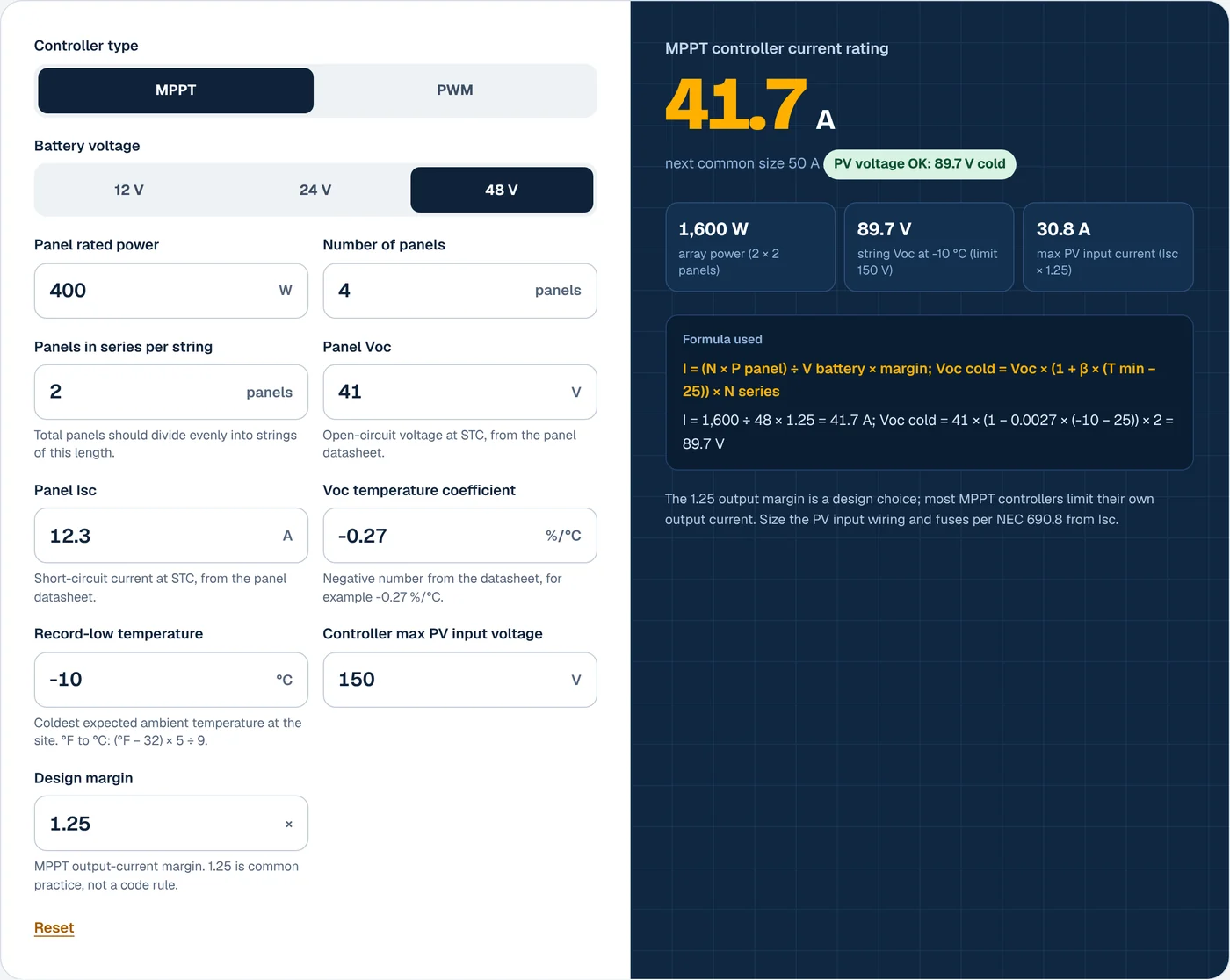
For an MPPT solar charge controller, divide the array watts by the battery voltage and add a design margin: I = P ÷ Vbatt × 1.25. Then check that the coldest-day string Voc stays below the controller’s PV input limit. Four 400 W panels on a 48 V battery need about 41.7 A, so a 50 A controller.
How to use the charge controller calculator
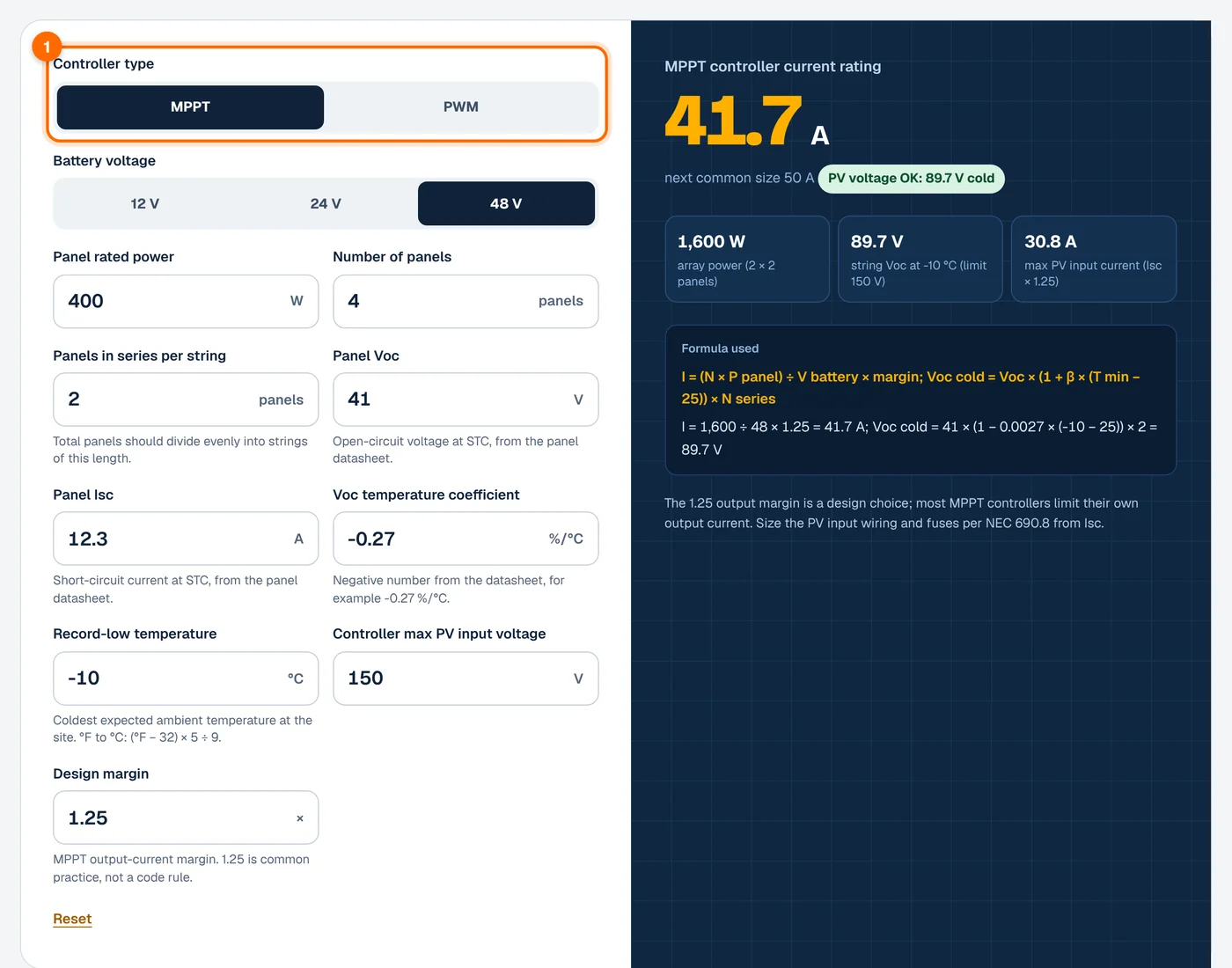
- Choose the controller type. MPPT controllers convert high panel voltage to battery voltage and suit most systems. PWM controllers connect the panels almost directly to the battery and suit small 12 V setups with matching panels.
- Pick the battery voltage. Choose the nominal bank voltage: 12 V, 24 V or 48 V. A lower voltage means more charging current for the same array.

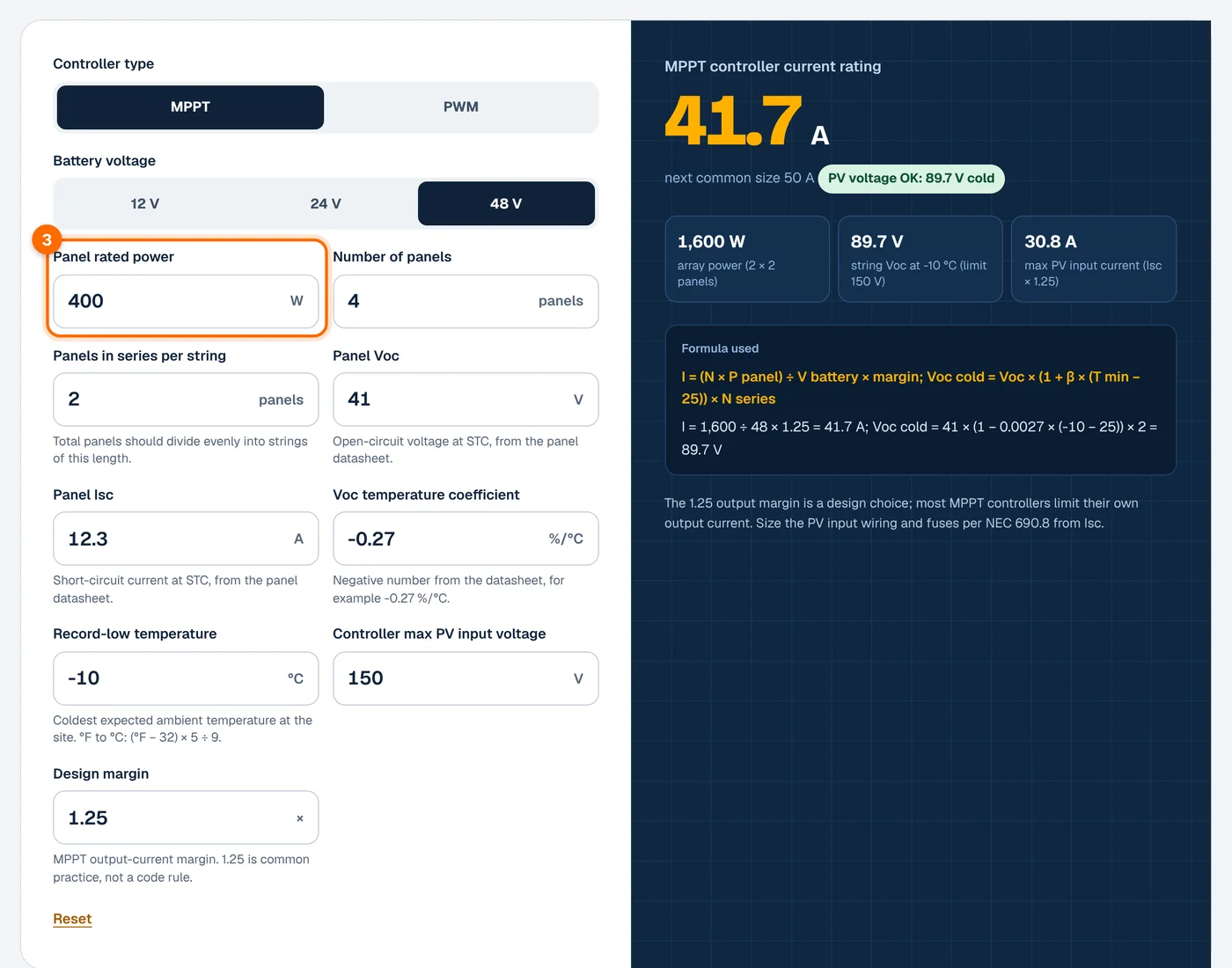
- Enter the panel rated power. Use the STC watt rating from the panel label, such as 400 W.
- Enter the number of panels. Count every panel that will feed this one controller.

- Enter the panels in series per string. More panels in series raise the voltage. The panel count should divide evenly into strings of this length.

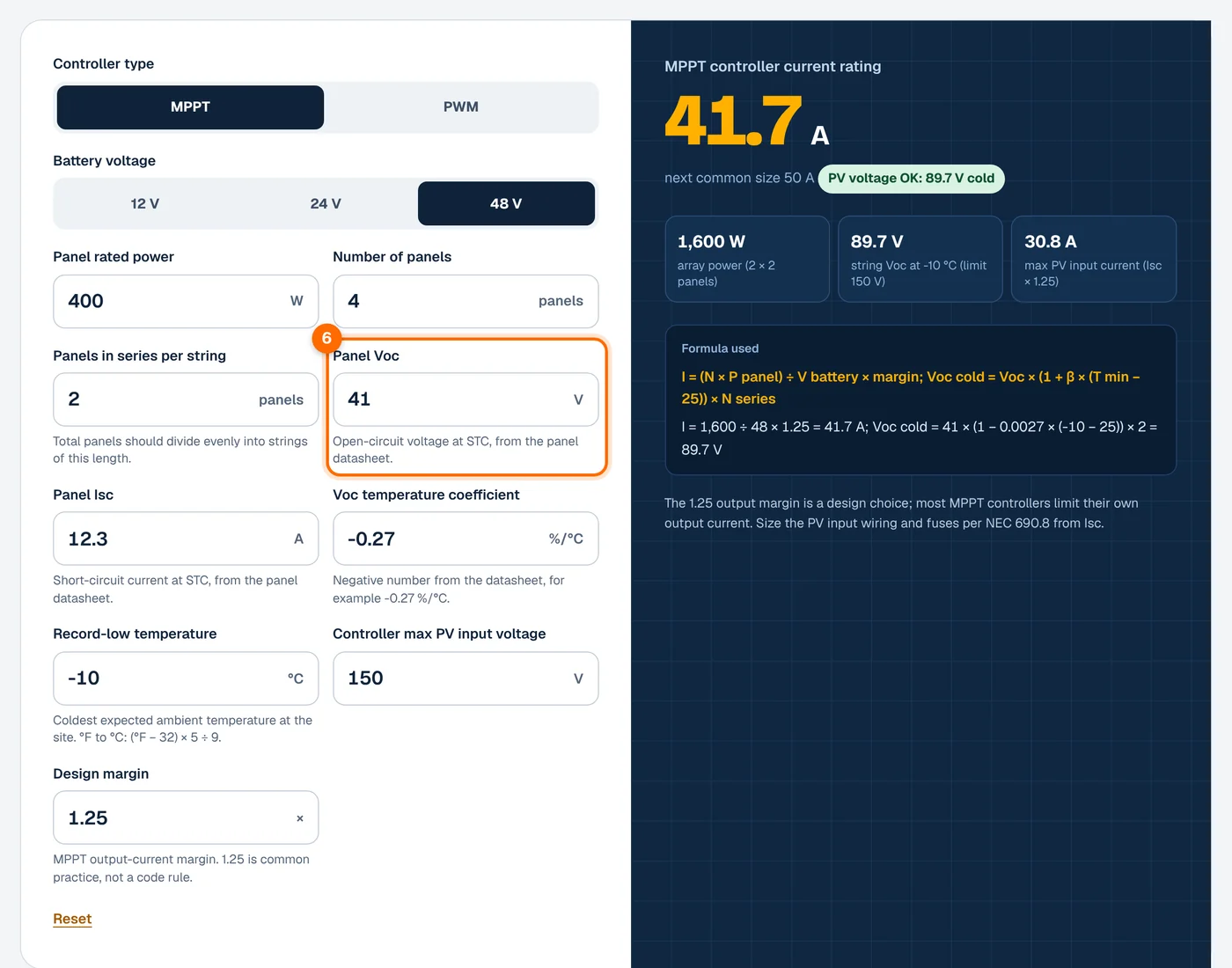
- Enter the panel Voc. This is the open-circuit voltage at standard test conditions (25 °C cell), from the datasheet.
- Enter the panel Isc. This is the short-circuit current from the datasheet. It sets the PV input current and the PWM rating.

- Enter the Voc temperature coefficient. Use the negative %/°C value from the datasheet, such as -0.27 %/°C. Voc rises as panels get colder.

- Enter the record-low temperature. Use the coldest temperature expected at the site, because that is when panel voltage peaks.

- Enter the controller’s max PV input voltage. This is the absolute limit printed on the controller, such as 100 V, 150 V or 250 V.
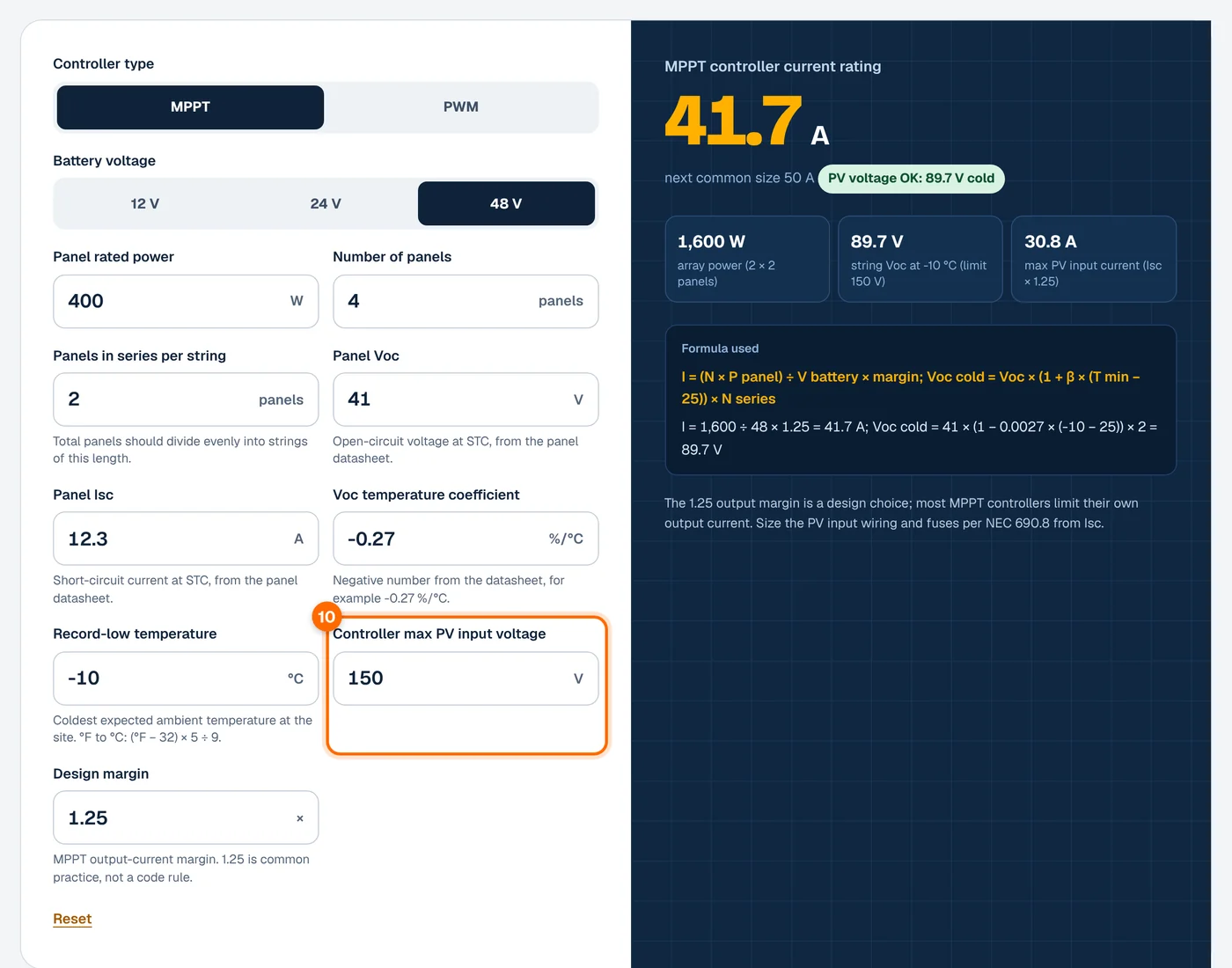
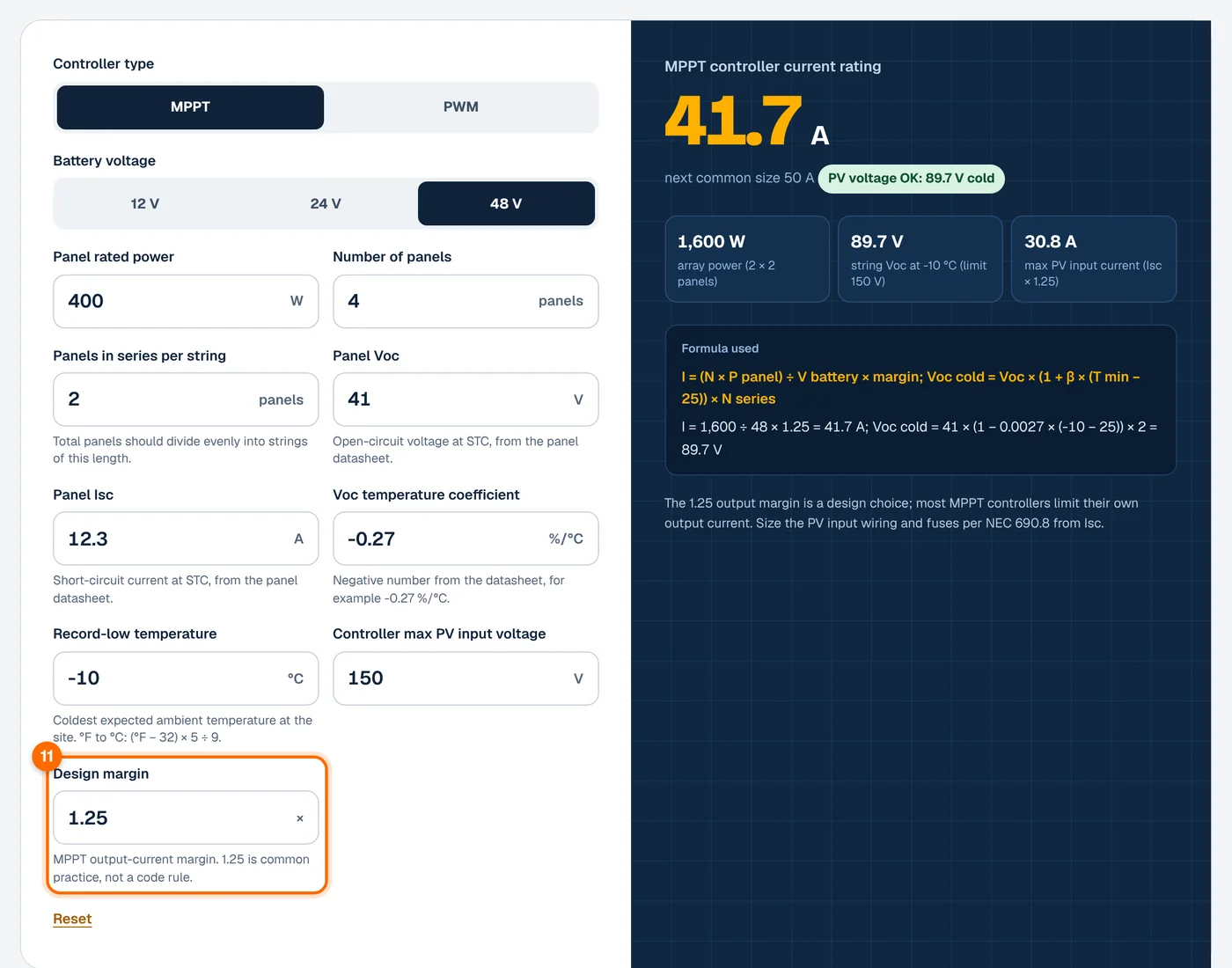
- Set the design margin. For MPPT, 1.25 adds 25% to the output current. It is a common design practice, not a code rule.
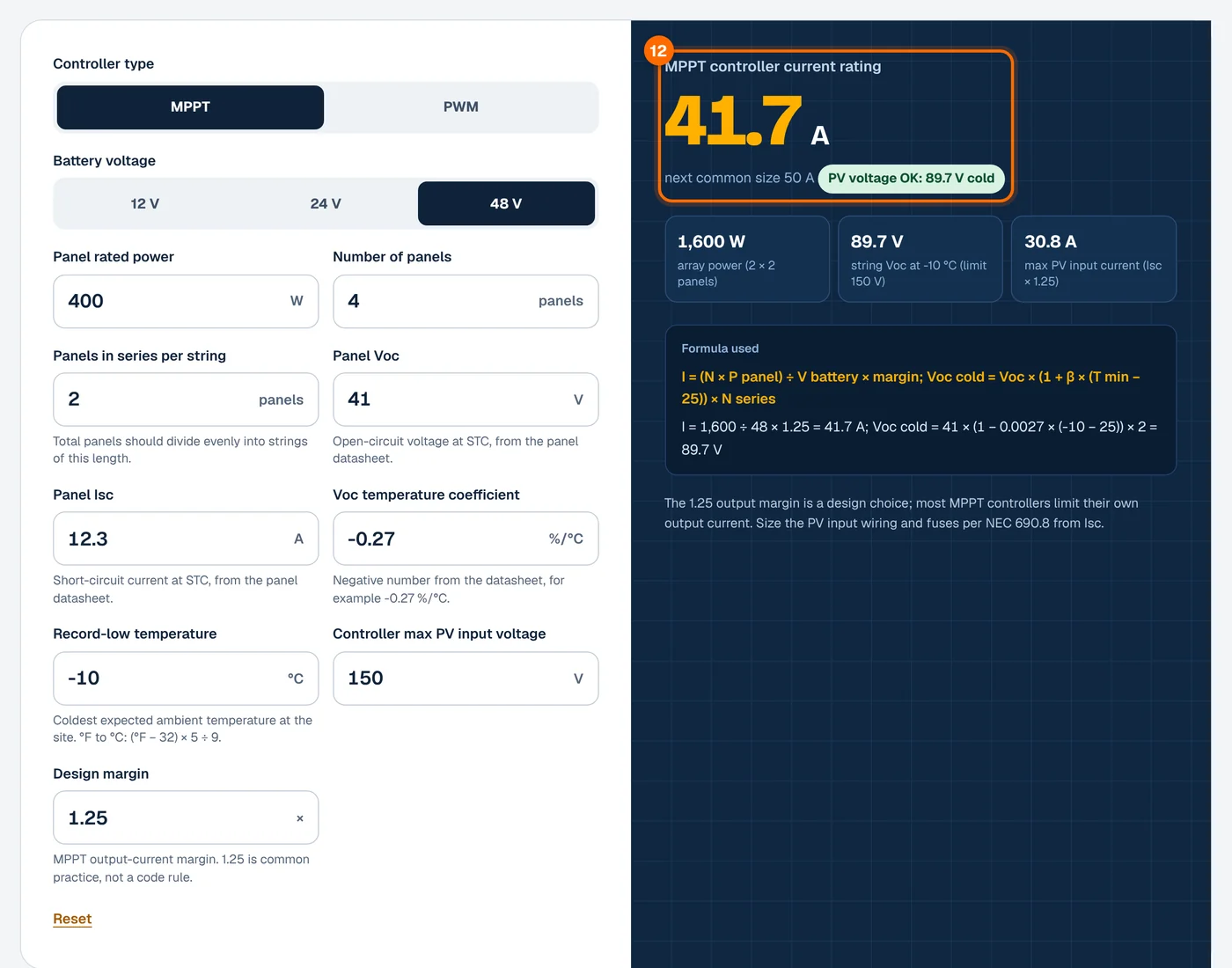
- Read the controller current rating. The big number is the minimum controller amps. The line below shows the next common size and whether the cold string voltage is safe.
Charge controller formula
MPPT output current
PWM current
Cold-weather voltage check
Where:
- N is the number of panels and Ppanel is the rated watts of one panel.
- Vbatt is the nominal battery voltage.
- m is the design margin, 1.25 by default.
- Isc is panel short-circuit current and Np is the number of strings in parallel.
- β is the Voc temperature coefficient as a decimal per °C, so -0.27 %/°C = -0.0027.
- Tmin is the record-low temperature in °C and Ns is panels in series.
- Vmax is the controller’s maximum PV input voltage.
The two 1.25 factors for PWM follow NEC 690.8: one for sunlight above the STC level and one for continuous current. The MPPT margin is a design choice, since MPPT controllers limit their own output.
Worked examples
Example 1: 1,600 W array on a 48 V battery
Four example 400 W panels with Voc 41 V and β = -0.27 %/°C are wired 2 in series × 2 in parallel. The record low is -10 °C.
A 50 A controller with a 150 V input works. Three panels in series would reach 134.6 V, still under 150 V, but four in series would hit 179.5 V and could damage it.
Example 2: 800 W on a 12 V battery
Two of the same 400 W panels in series charge a 12 V bank. The record low is -20 °C and the controller limit is 100 V.
That needs a 100 A controller, and the 92.0 V string is close to the 100 V limit. Moving the battery to 24 V would halve the current to 41.7 A.
Example 3: PWM for three 100 W panels
Three example 12 V class panels with Isc 5.8 A are wired in parallel to a 12 V battery.
A 30 A PWM controller fits.
Voc cold-temperature multipliers
Multiply the datasheet Voc by these factors to get Voc at the record-low temperature. Values come from the formula above.
| Record low | β = -0.27 %/°C | β = -0.30 %/°C | β = -0.35 %/°C |
|---|---|---|---|
| 10 °C (50 °F) | 1.041 | 1.045 | 1.053 |
| 0 °C (32 °F) | 1.068 | 1.075 | 1.088 |
| -10 °C (14 °F) | 1.095 | 1.105 | 1.123 |
| -20 °C (-4 °F) | 1.122 | 1.135 | 1.158 |
| -30 °C (-22 °F) | 1.149 | 1.165 | 1.193 |
| -40 °C (-40 °F) | 1.176 | 1.195 | 1.228 |
What affects the result
Battery voltage
The controller’s amp rating is on the battery side. The same 1,600 W array needs about 167 A at 12 V with the margin, but only 41.7 A at 48 V. Higher battery voltage often lets one controller do the job of several.
Cold weather and string voltage
Panel voltage rises as the temperature falls, and it peaks at sunrise on the coldest day. NEC 690.7 lets designers correct Voc with the maker’s temperature coefficient, as the IAEI explains in this guide to PV module calculations. Exceeding the controller’s PV input limit can destroy it.
MPPT vs PWM
An MPPT controller can take a high-voltage string and convert the extra voltage into charging current. A PWM controller pulls the panels down to battery voltage, so panels must match the battery and any extra voltage is lost.
Array oversizing
Many MPPT controllers accept more panel watts than their rating and simply cap the output current. Check the maker’s maximum PV array power and PV short-circuit current before relying on this.
Frequently asked questions
What size charge controller do I need for 400 watts?
On a 12 V battery, 400 W ÷ 12 V × 1.25 gives 41.7 A, so a 50 A MPPT controller. On 24 V it is 20.8 A, so a 30 A unit, and on 48 V it is 10.4 A. Always check the cold Voc against the controller’s input voltage limit too.
Is MPPT better than PWM?
MPPT converts surplus panel voltage into extra charging current, so it harvests more from the same panels, especially in cold weather or with high-voltage panels. PWM is simpler and cheaper and works well for small 12 V systems where the panel voltage is matched to the battery.
Why do I need the record-low temperature?
Solar panel voltage rises as cells get colder. The highest voltage happens on a clear, cold morning before the panels warm up. If that voltage exceeds the controller’s PV input rating, the controller can be damaged, so the check uses the coldest expected temperature.
Is the 1.25 factor required by code?
For MPPT output current, no. The 1.25 margin is a common design practice. The NEC 690.8 factors apply to PV circuit current from Isc, which is how the PWM rating and the PV input wiring are sized. Follow your controller’s manual and local code.
Can I connect two charge controllers to one battery?
Yes. Large arrays are often split across two or more controllers, each with its own set of strings, all charging the same battery bank. Size each controller for its own share of the array, and set every controller to the same battery charging profile so they work together.