Solar String Size Calculator
Find the minimum and maximum number of solar modules per string from temperature-corrected Voc and Vmp and your inverter voltage limits.
Quick answer
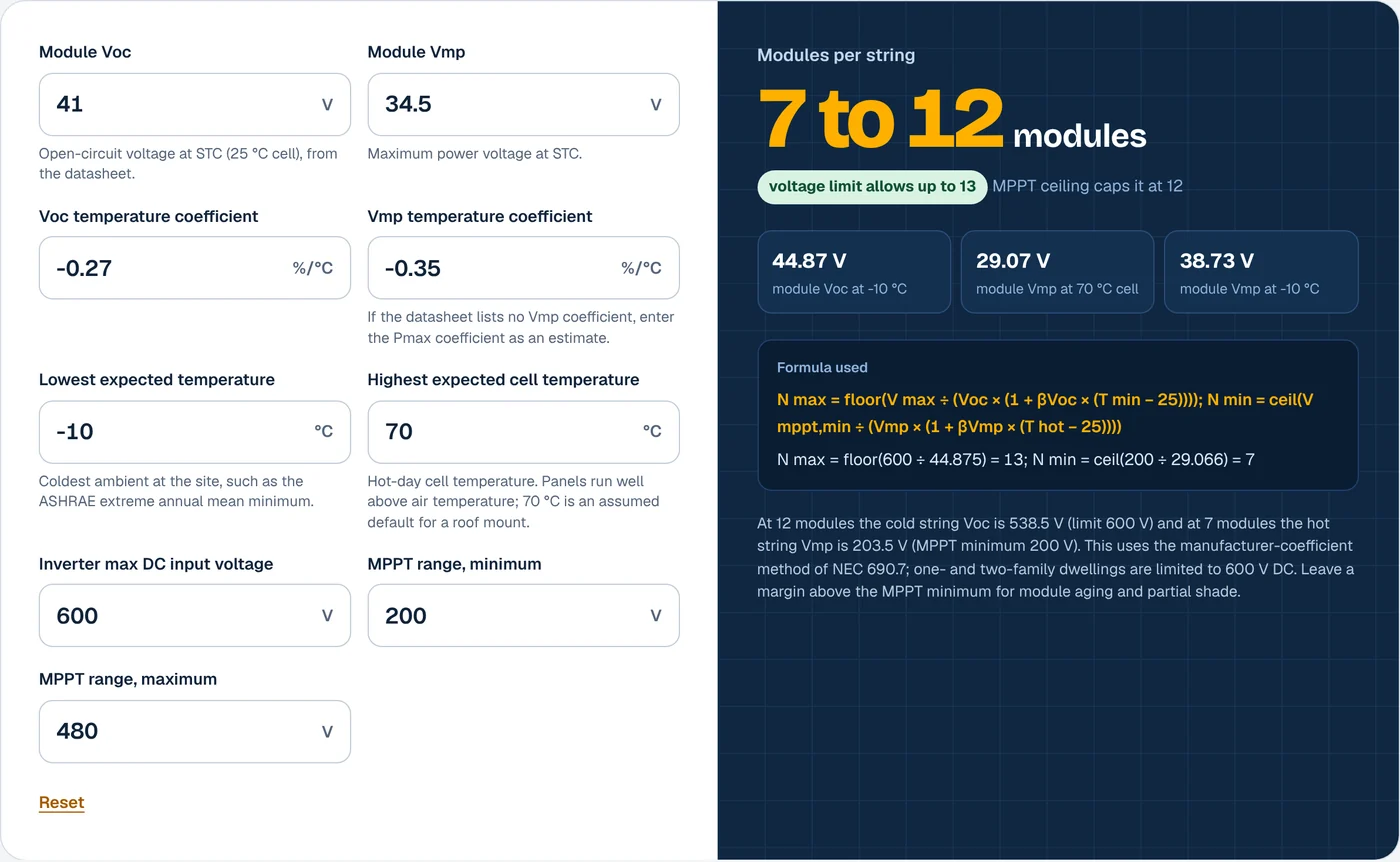
The maximum string length is the inverter’s max DC voltage ÷ module Voc corrected to the coldest temperature, rounded down. The minimum is the MPPT minimum voltage ÷ module Vmp at the hottest cell temperature, rounded up. A 41 V Voc module at -10 °C on a 600 V, 200 to 480 V MPPT inverter fits 7 to 12 modules.
How to use the solar string calculator
- Enter the module Voc. Use the open-circuit voltage at standard test conditions (STC, 25 °C cell) from the panel datasheet.

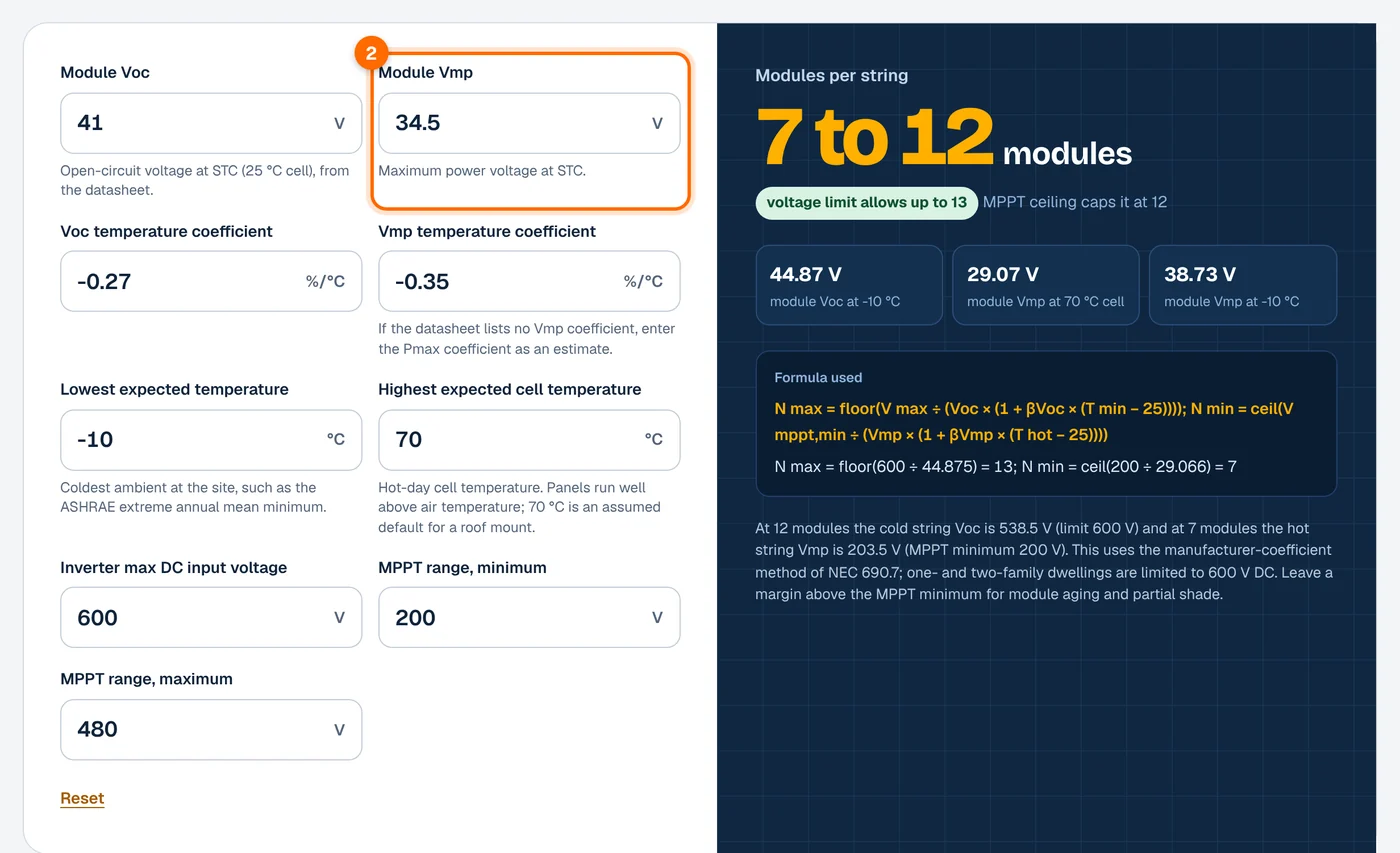
- Enter the module Vmp. This is the maximum power voltage at STC, also on the datasheet.
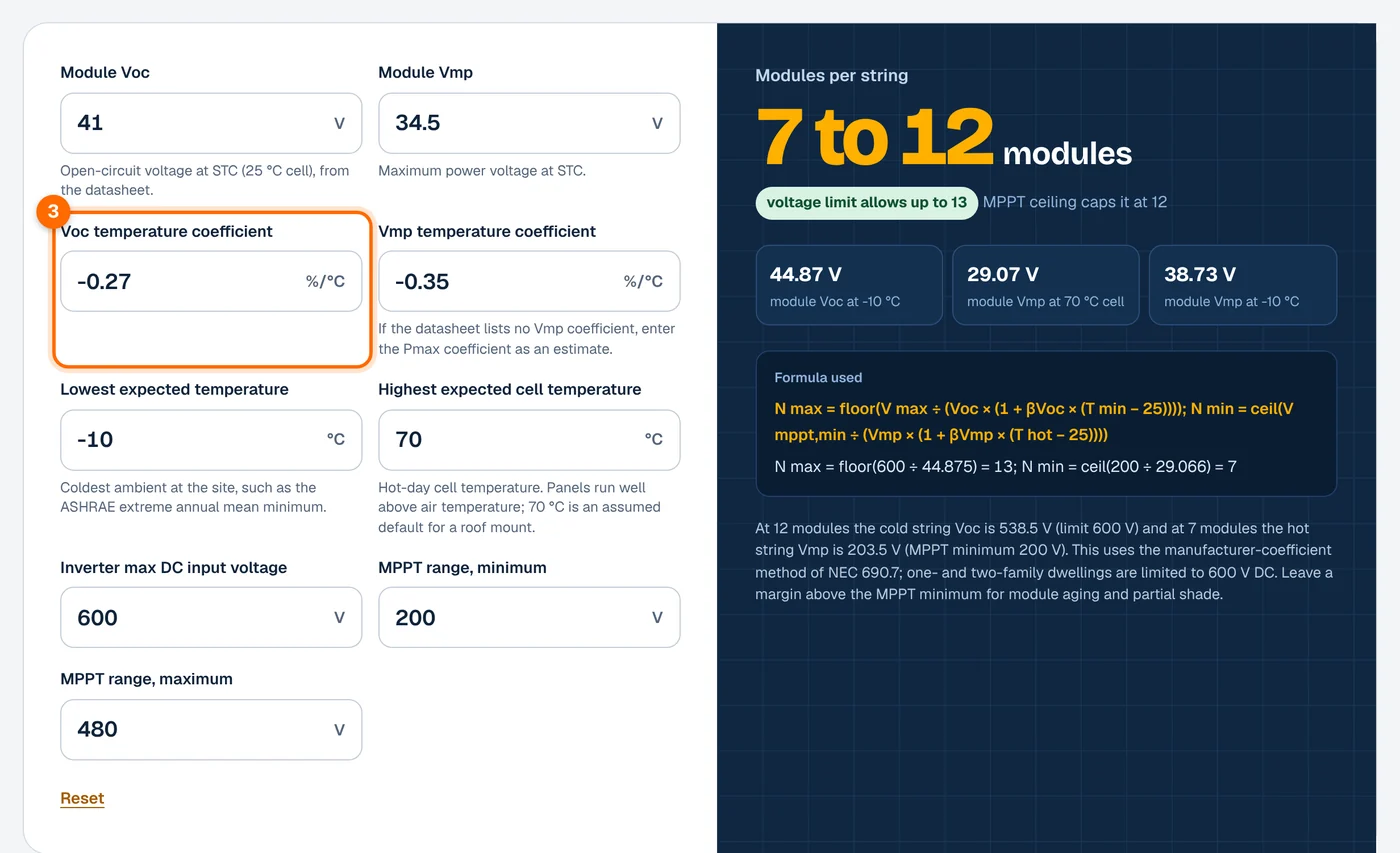
- Enter the Voc temperature coefficient. Use the negative %/°C value from the datasheet, such as -0.27 %/°C.
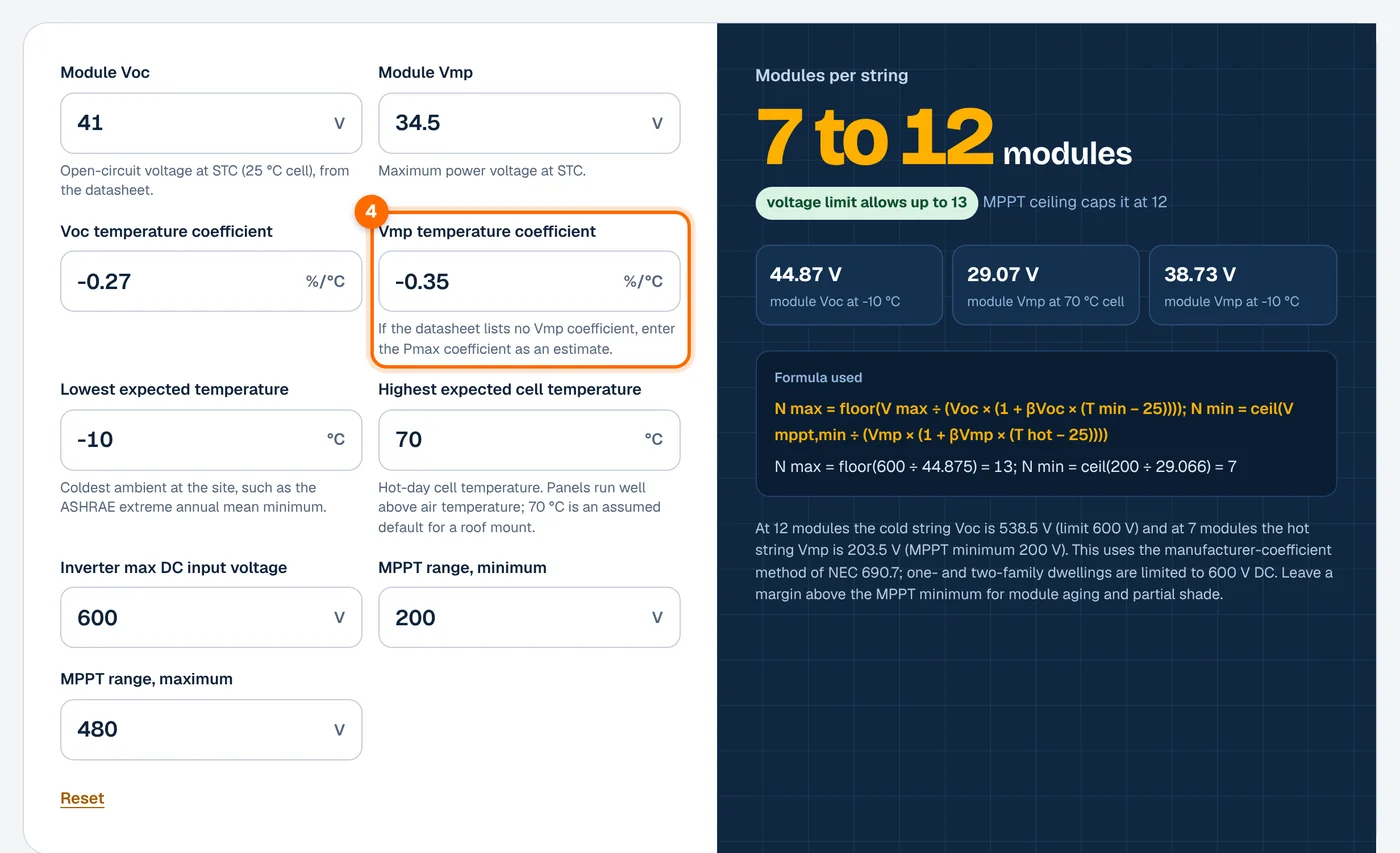
- Enter the Vmp temperature coefficient. If the datasheet does not list one, the Pmax coefficient is a reasonable estimate. The default is -0.35 %/°C.
- Enter the lowest expected temperature. Use the coldest ambient temperature at the site. Many designers use the ASHRAE extreme annual mean minimum design dry bulb temperature.

- Enter the highest expected cell temperature. Panels run well above air temperature in full sun. The 70 °C default is an assumption for a roof mount; open-rack arrays usually run cooler.
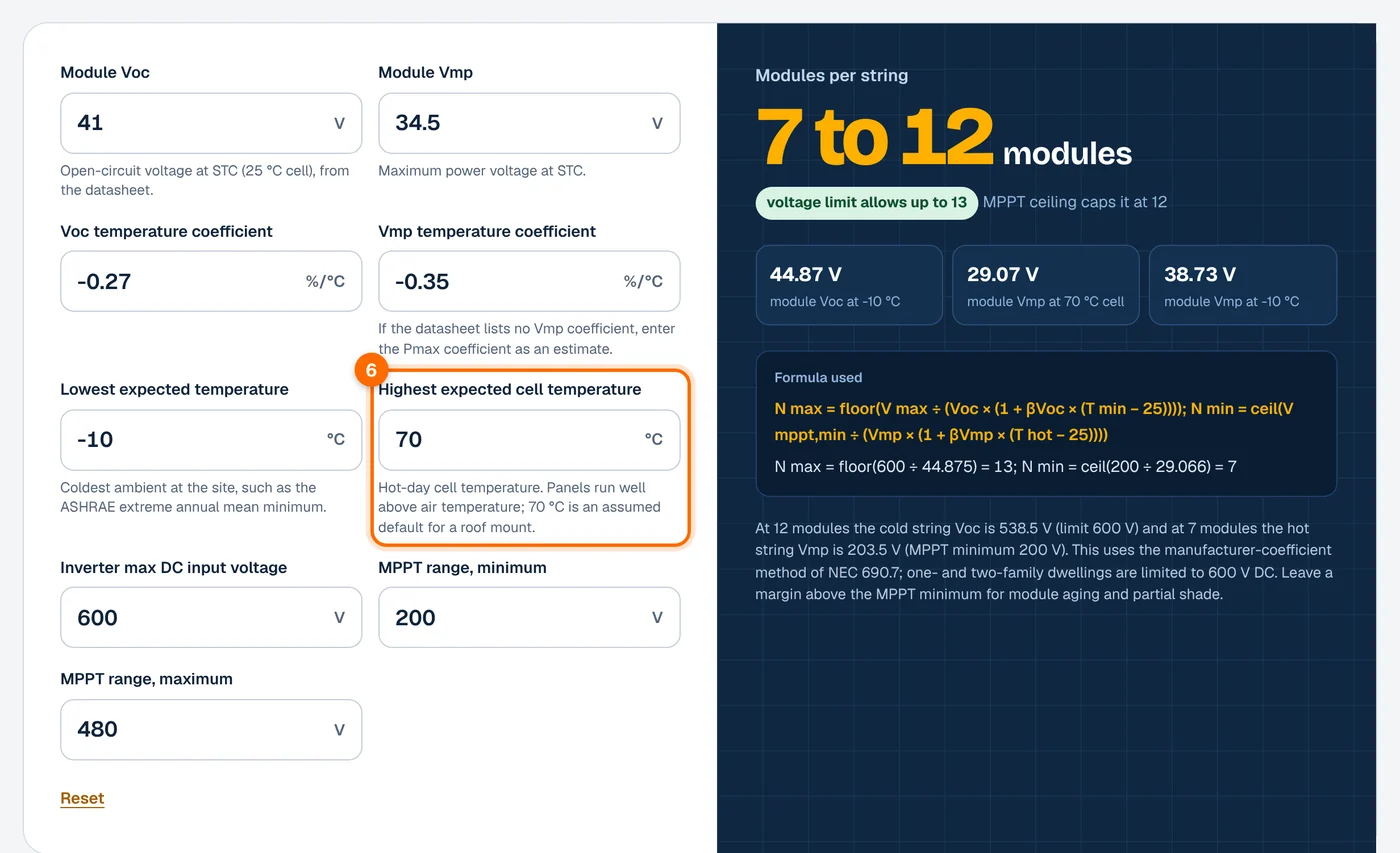
- Enter the inverter’s max DC input voltage. Use the absolute maximum from the inverter datasheet, such as 600 V or 1,000 V.
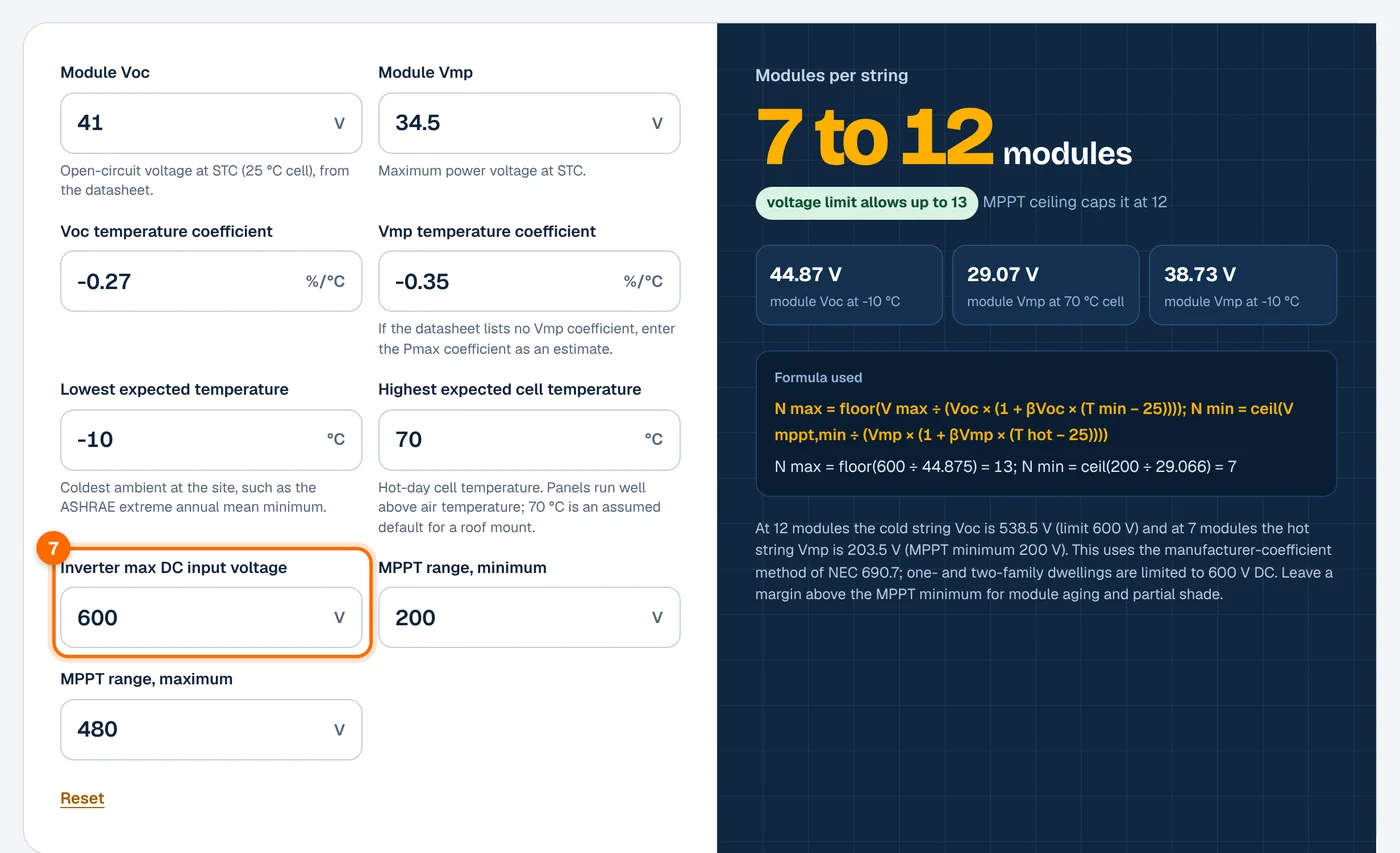
- Enter the MPPT range minimum. This is the lowest voltage at which the inverter tracks the maximum power point at full output.
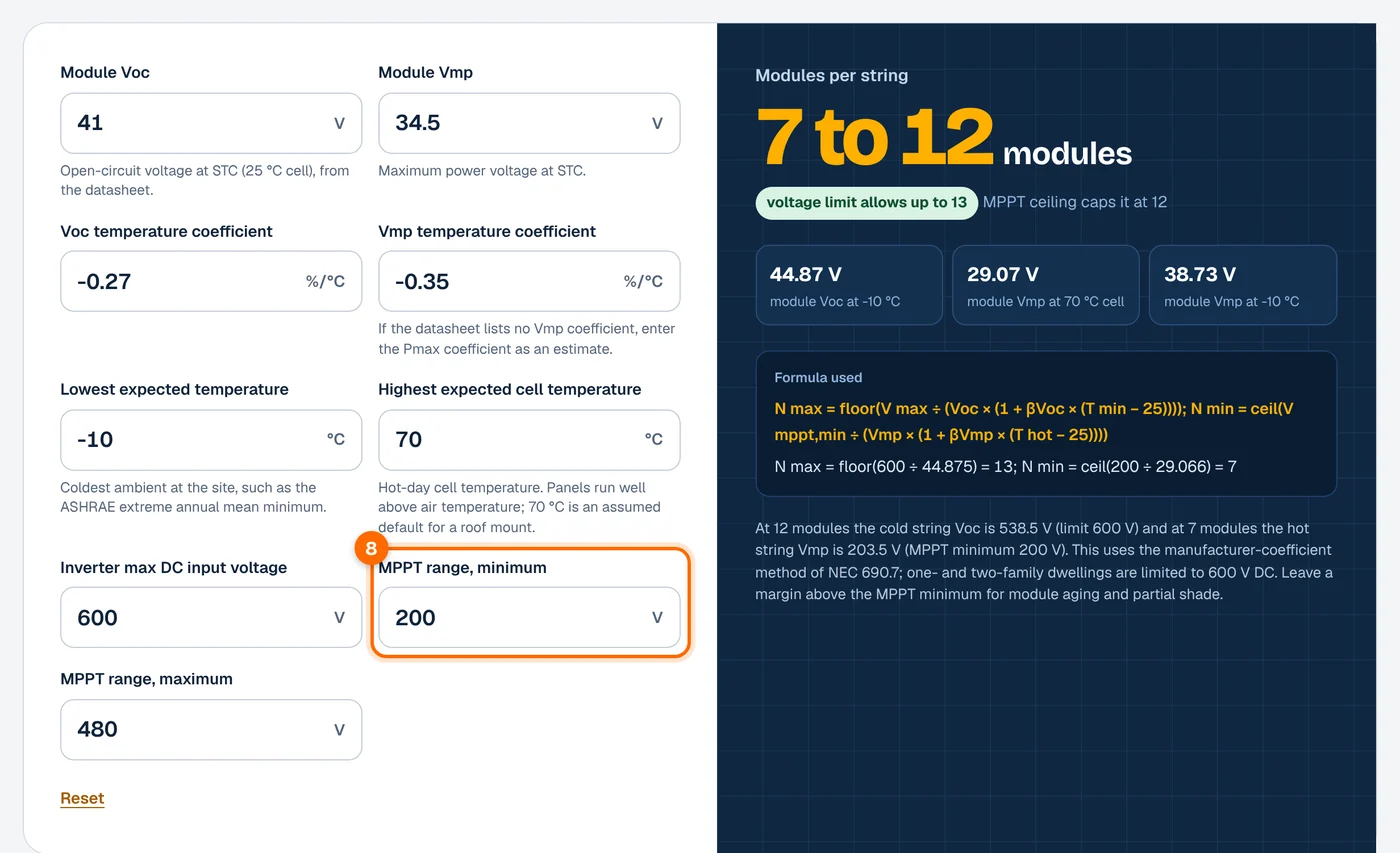
- Enter the MPPT range maximum. This is the highest voltage of the inverter’s MPPT window.
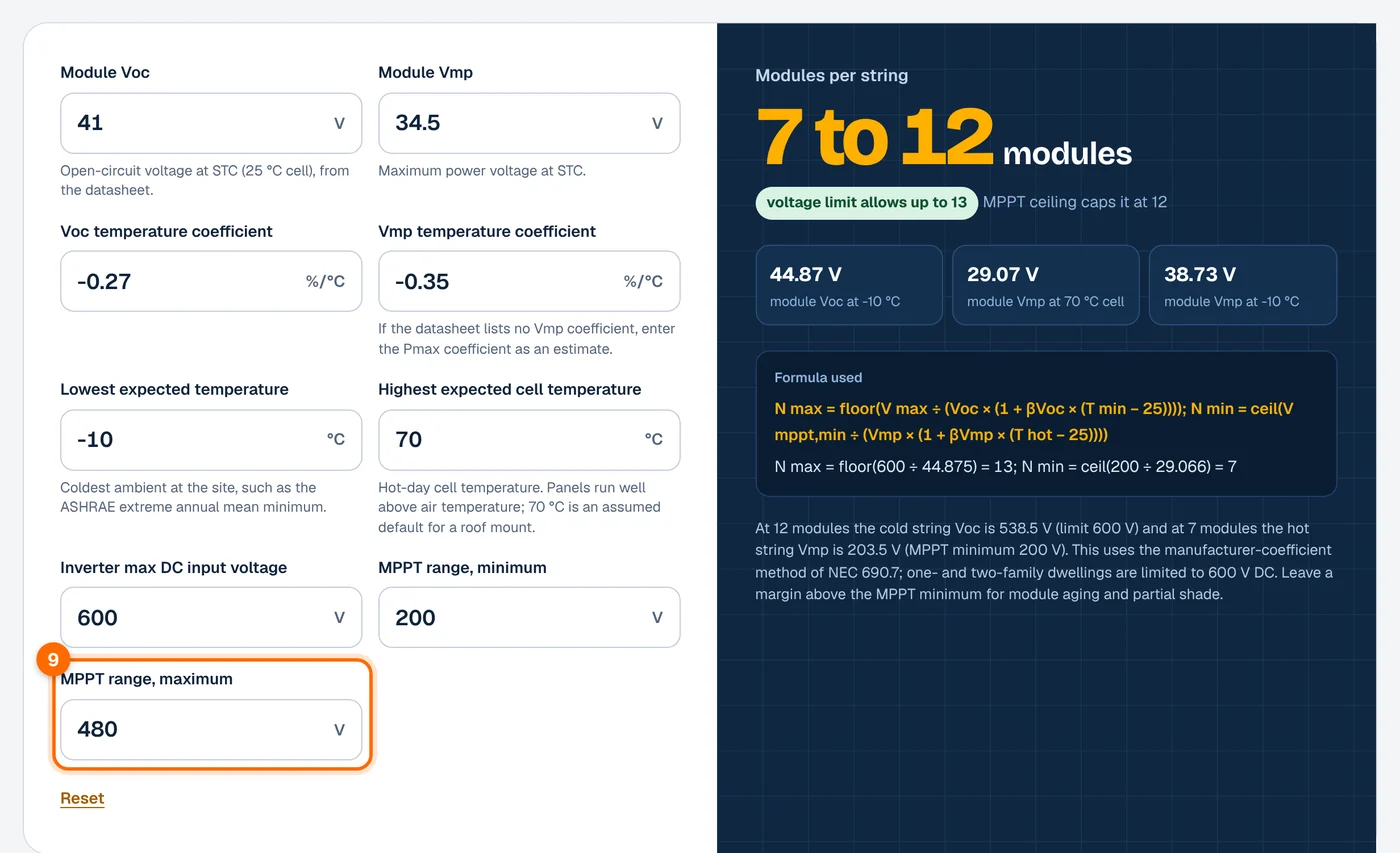
- Read the modules per string. The big result is the allowed range. The line below shows the voltage-limit maximum and whether the MPPT ceiling lowers it.
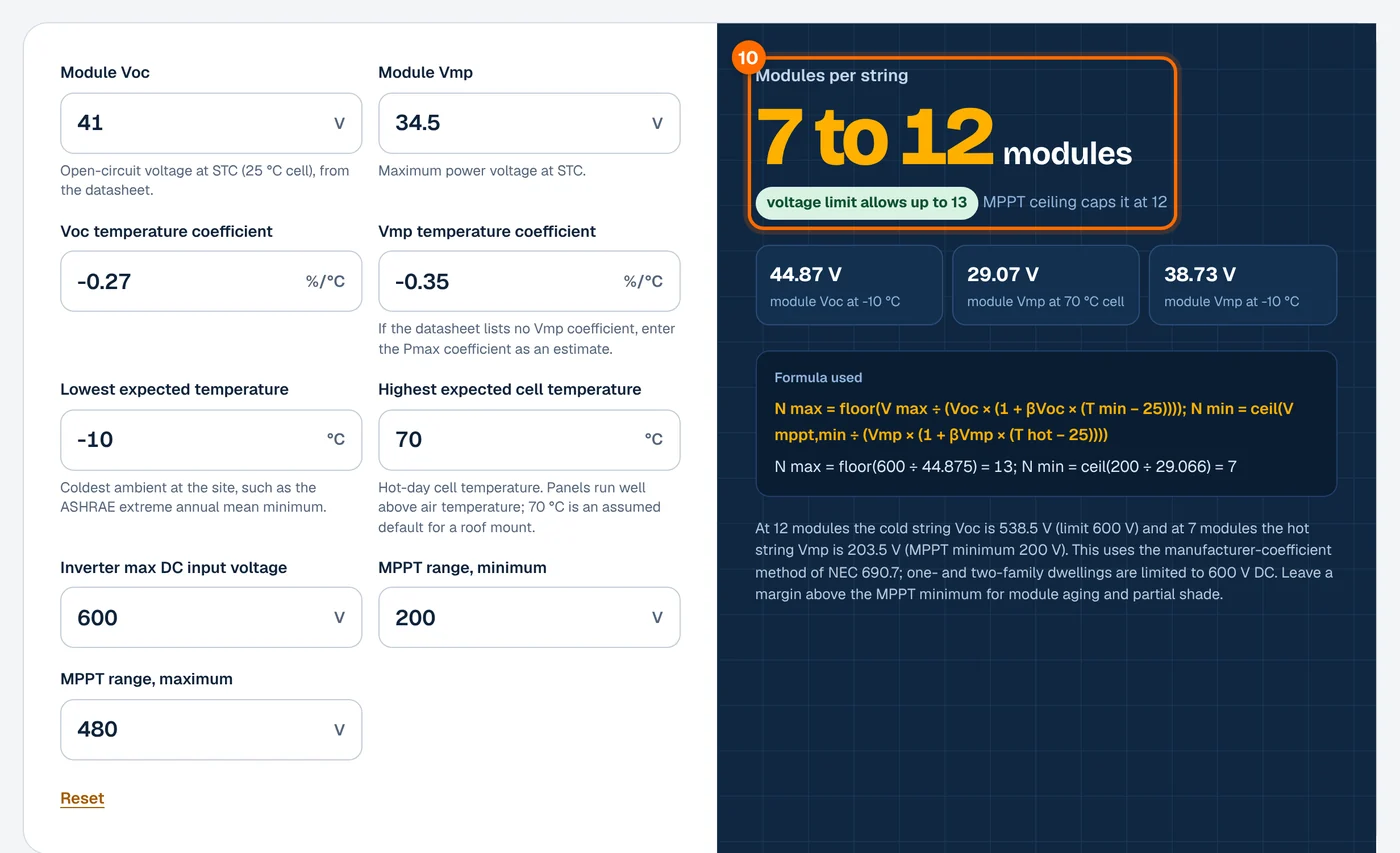
Solar string size formula
The calculator also checks that the cold Vmp of the longest string stays under the MPPT maximum, using Vmp,cold = Vmp × (1 + βVmp × (Tmin − 25)).
Where:
- Voc and Vmp are the module’s STC open-circuit and maximum power voltages.
- βVoc and βVmp are temperature coefficients as decimals per °C, so -0.27 %/°C = -0.0027.
- Tmin is the lowest expected temperature and Thot the highest cell temperature, both in °C. 25 °C is the STC reference.
- Vmax is the inverter’s maximum DC input voltage.
- VMPPT,min is the bottom of the MPPT window.
- floor rounds down and ceil rounds up to a whole module.
This is the manufacturer-coefficient method allowed by NEC 690.7. The IAEI walks through the same method in its guide to PV module calculations. For PV circuits on one- and two-family dwellings, the NEC limits DC voltage to 600 V.
Worked examples
Example 1: 600 V inverter, mild winter
An example module has Voc 41 V, Vmp 34.5 V, βVoc -0.27 %/°C and βVmp -0.35 %/°C. The site low is -10 °C and the hot cell temperature is 70 °C. The inverter allows 600 V with a 200 to 480 V MPPT window.
The safe range is 7 to 12 modules. Thirteen stays under 600 V but would push the cold Vmp past the MPPT maximum.
Example 2: same system in a -30 °C climate
The minimum is still 7, so the range narrows to 7 to 11 modules.
Example 3: hot site, narrow window
The same module on a 450 V inverter with a 250 to 400 V MPPT window, a 0 °C low and a 75 °C hot cell temperature:
Only 9 or 10 modules work, which leaves little room for shade or module aging.
Maximum modules per string by record low
For the example module above (Voc 41 V, -0.27 %/°C). Check your own datasheet values.
| Lowest temperature | Cold Voc per module | Max at 600 V | Max at 1,000 V |
|---|---|---|---|
| 10 °C (50 °F) | 42.66 V | 14 | 23 |
| 0 °C (32 °F) | 43.77 V | 13 | 22 |
| -10 °C (14 °F) | 44.87 V | 13 | 22 |
| -20 °C (-4 °F) | 45.98 V | 13 | 21 |
| -30 °C (-22 °F) | 47.09 V | 12 | 21 |
| -40 °C (-40 °F) | 48.20 V | 12 | 20 |
What affects the result
Design low temperature
Voc peaks on the coldest, clearest morning. A colder design temperature means fewer modules per string. Using a record low instead of the ASHRAE value is more conservative and may cost you a module per string.
Cell temperature in summer
Hot cells lower Vmp. If the string Vmp drops below the MPPT minimum, the inverter loses output or stops tracking. Flush roof mounts with little airflow run hotter than ground mounts.
Temperature coefficients
Modules with smaller (closer to zero) coefficients swing less with temperature, which widens the usable range. Always use the coefficient for your exact module.
Inverter voltage window
A wide MPPT window and a high max DC voltage give the most flexibility. Some inverters also have a separate start-up voltage and a full-power MPPT range; use the full-power range for the minimum.
Frequently asked questions
How many solar panels can I put in series?
Divide the inverter or controller’s maximum DC voltage by the panel Voc corrected for your coldest temperature, then round down. A 41 V Voc panel at -10 °C reaches about 44.9 V, so a 600 V inverter takes up to 13. The MPPT window may lower that number.
Why does cold weather raise panel voltage?
Silicon solar cells produce a higher voltage as they get colder. The temperature coefficient tells you how much. At -0.27 %/°C, a panel at -10 °C has about 9.5% more Voc than at 25 °C. That extra voltage is why string sizing uses the coldest temperature.
What happens if the string voltage is too high?
If the string Voc exceeds the inverter’s maximum DC input, the inverter can be damaged and the installation will not pass inspection. That is why the maximum string length is rounded down and why NEC 690.7 requires the temperature correction.
What happens if the string voltage is too low?
If the hot-weather Vmp falls below the MPPT minimum, the inverter cannot hold the array at its best operating point, so it produces less power on hot afternoons. Adding a module to each string or picking an inverter with a lower MPPT minimum fixes it.
Do all strings need the same number of panels?
Strings on the same MPPT input should normally match in length and orientation, because they share one operating voltage. Inverters with several MPPT inputs let you use different string lengths or roof faces on separate inputs. Check the inverter manual for its rules.