Solar Generator Calculator
Pick the right solar generator or portable power station size from your appliances, and see how long your panels take to recharge it.
Quick answer
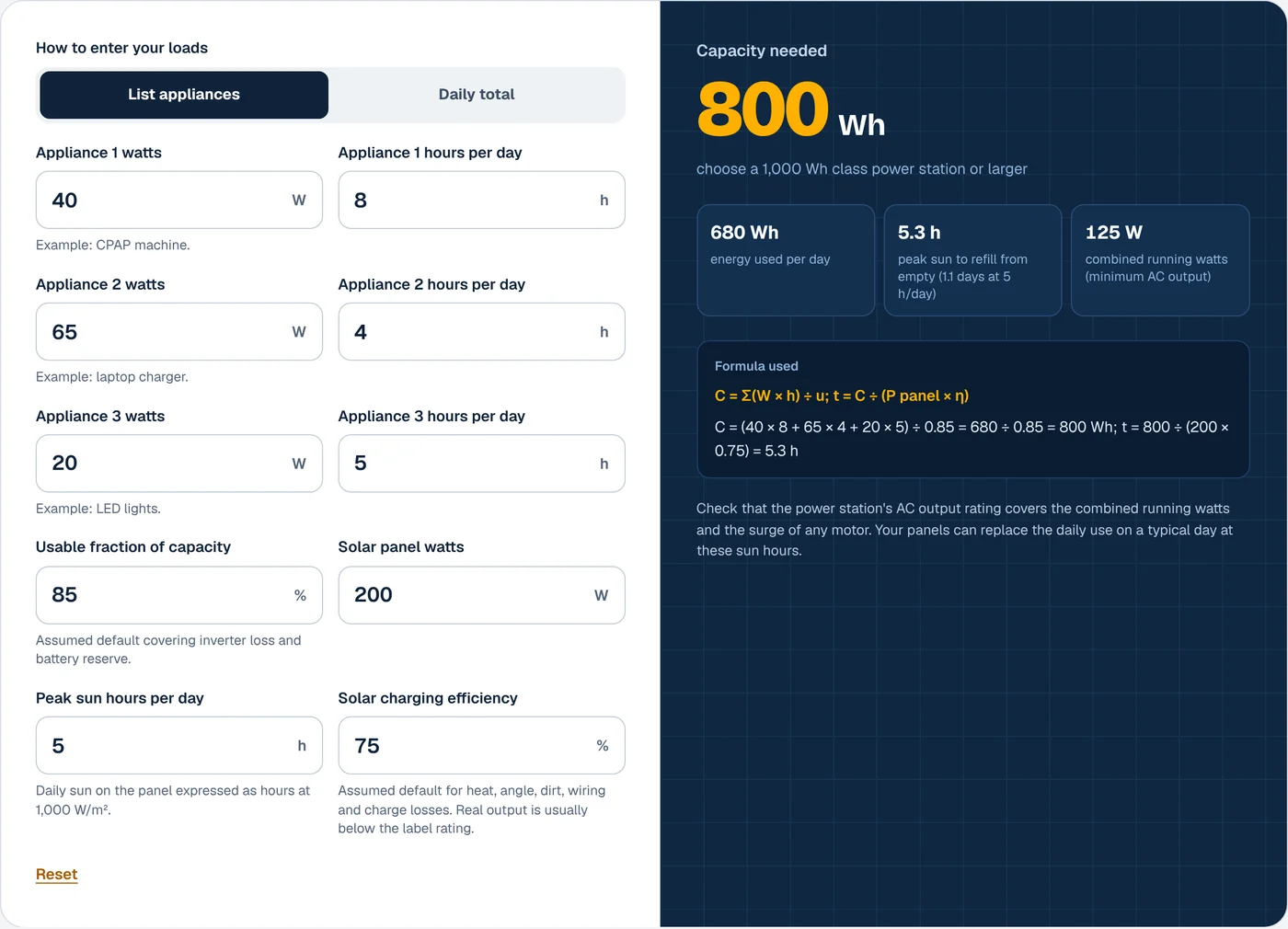
To size a solar generator, add up watts × hours for each appliance, then divide by the usable fraction of the battery: Wh = Σ(W × h) ÷ 0.85. Recharge time is that capacity ÷ (panel watts × charging efficiency). A CPAP, laptop and lights using 680 Wh a day need about 800 Wh, so a 1,000 Wh class unit.
How to use the solar generator calculator
- Choose how to enter your loads. Pick “List appliances” to add up to three devices, or “Daily total” if you already know your watt-hours per day.
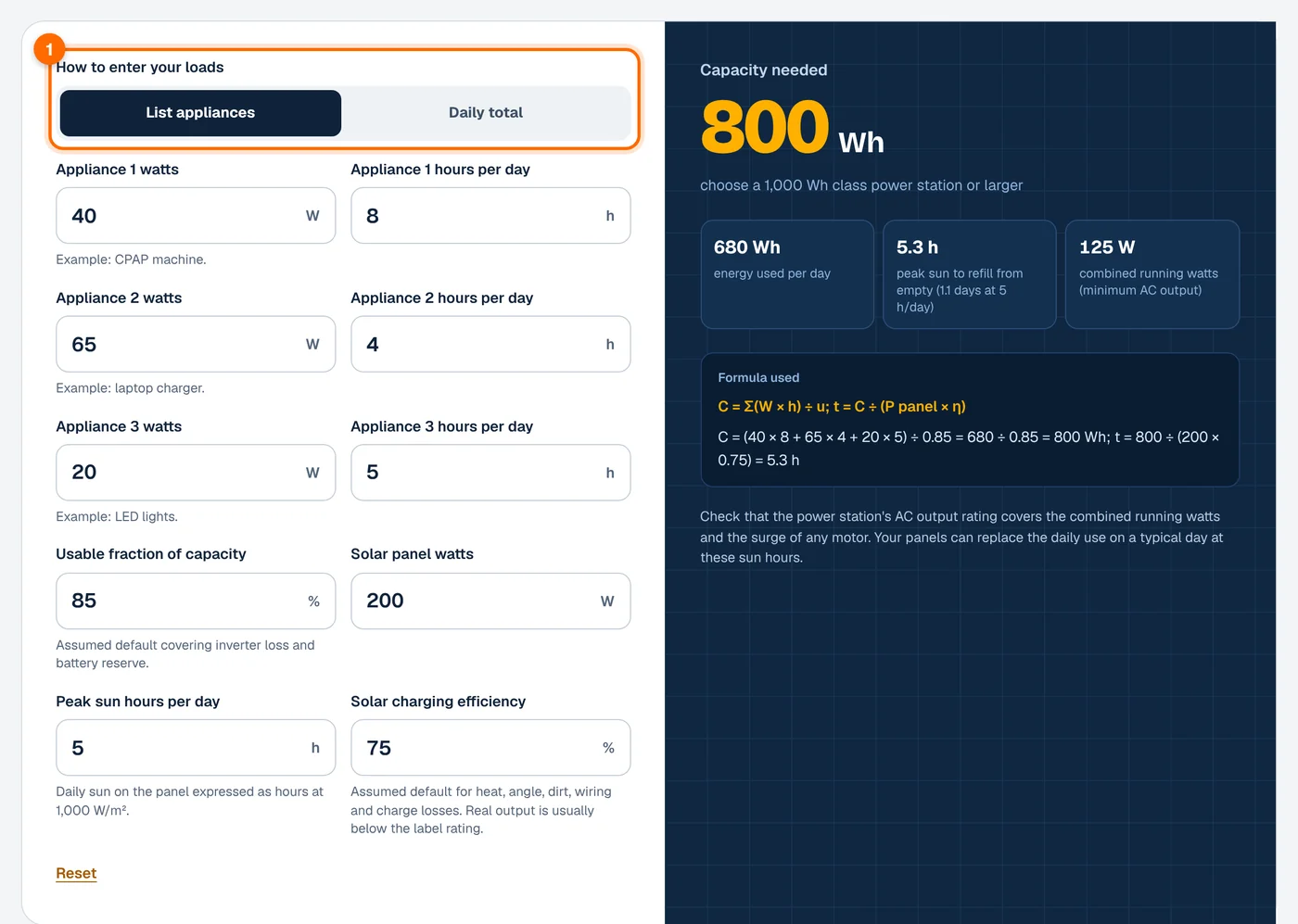
- Enter appliance 1 watts. Use the running watts from the label or charger brick. The default is an example CPAP machine at 40 W.
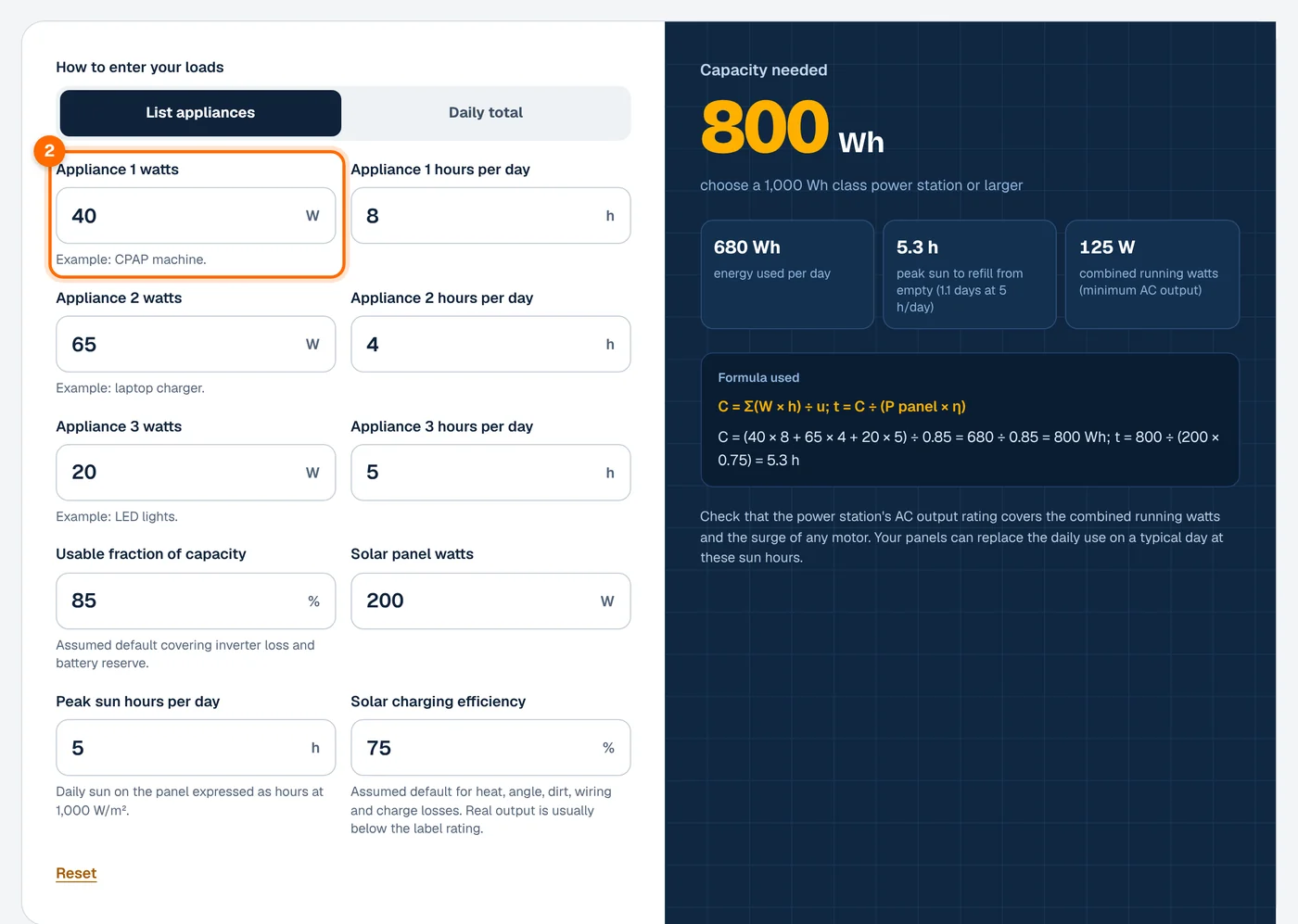
- Enter appliance 1 hours per day. Use the hours it actually runs, for example 8 hours overnight.
- Enter appliance 2 watts. The default is an example laptop charger at 65 W.
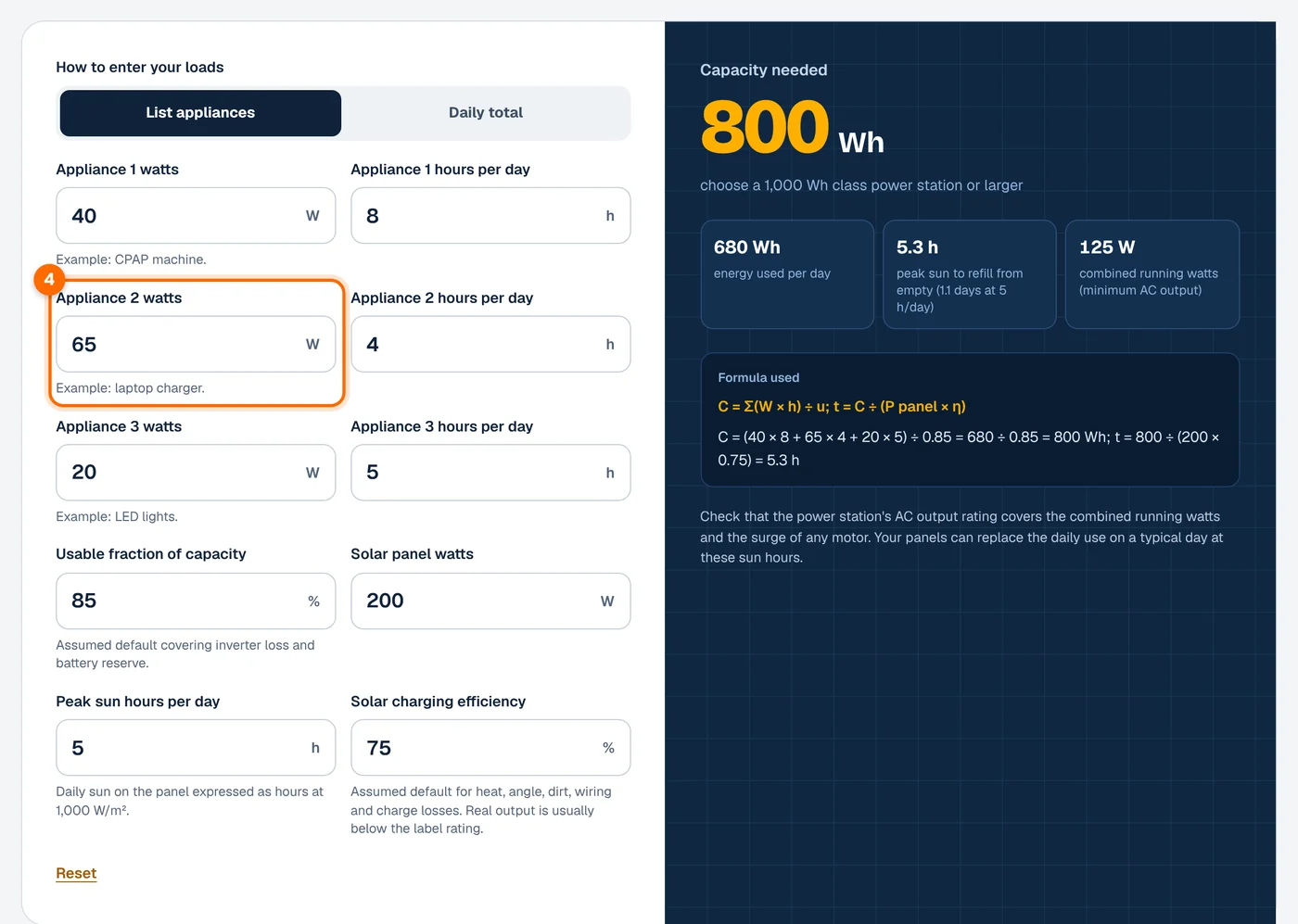
- Enter appliance 2 hours per day. Count only the hours it is plugged in and charging or running.
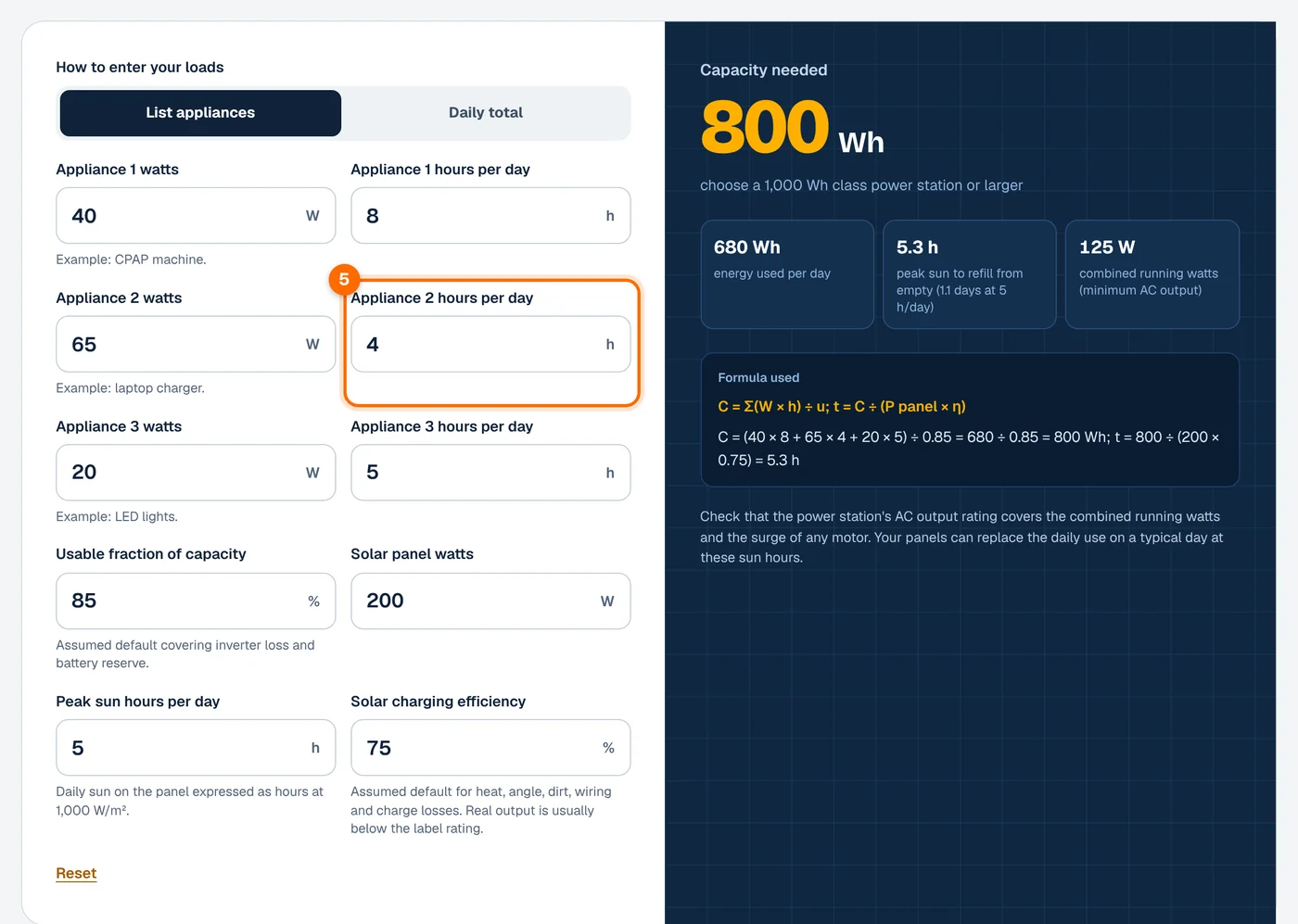
- Enter appliance 3 watts. The default is an example set of LED lights at 20 W.
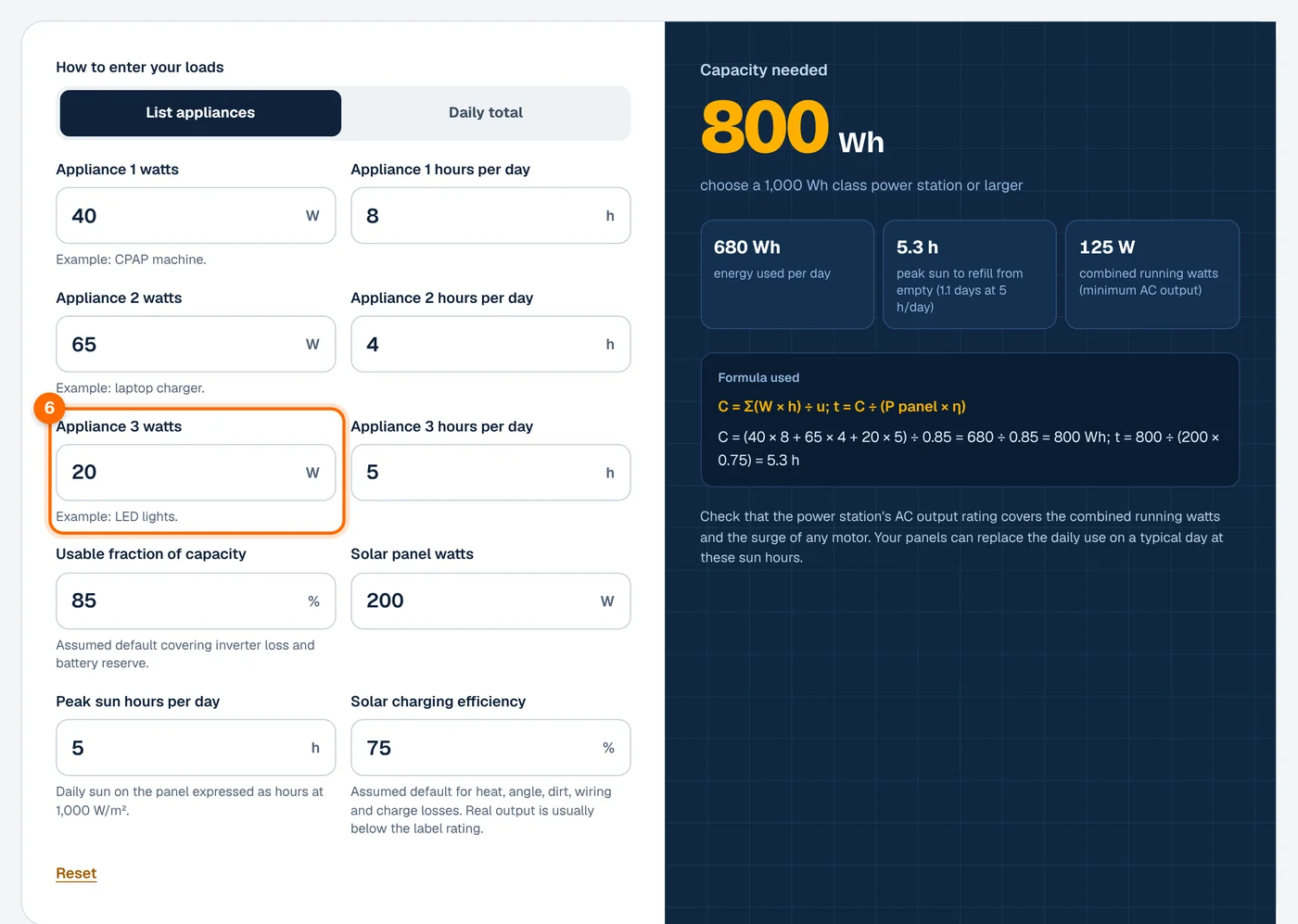
- Enter appliance 3 hours per day. Set it to 0 if you only need one or two devices.

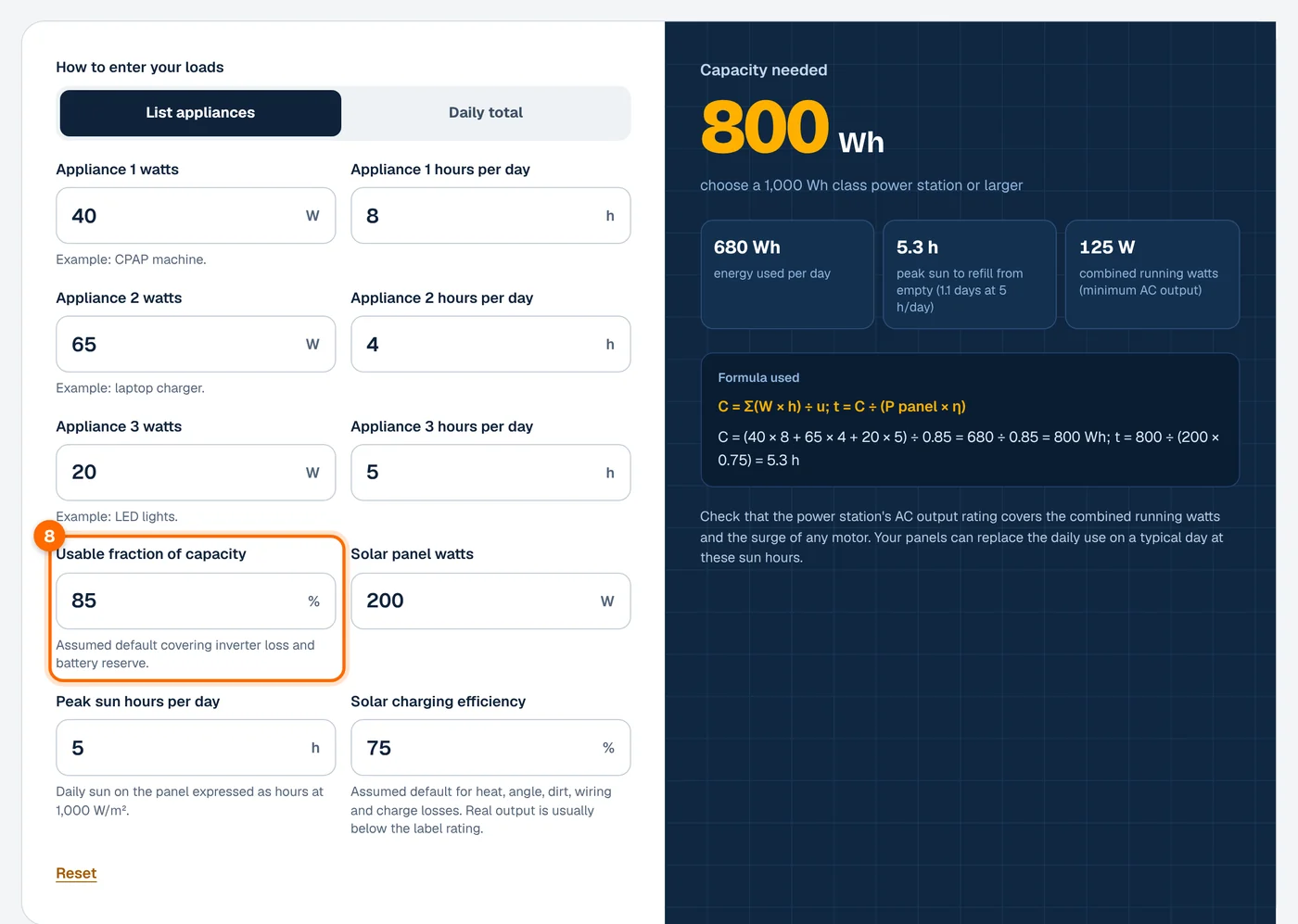
- Set the usable fraction of capacity. Power stations lose some energy in their inverter and keep some charge in reserve. The 85% default is an assumption; use your own test or the maker’s AC output efficiency if known.
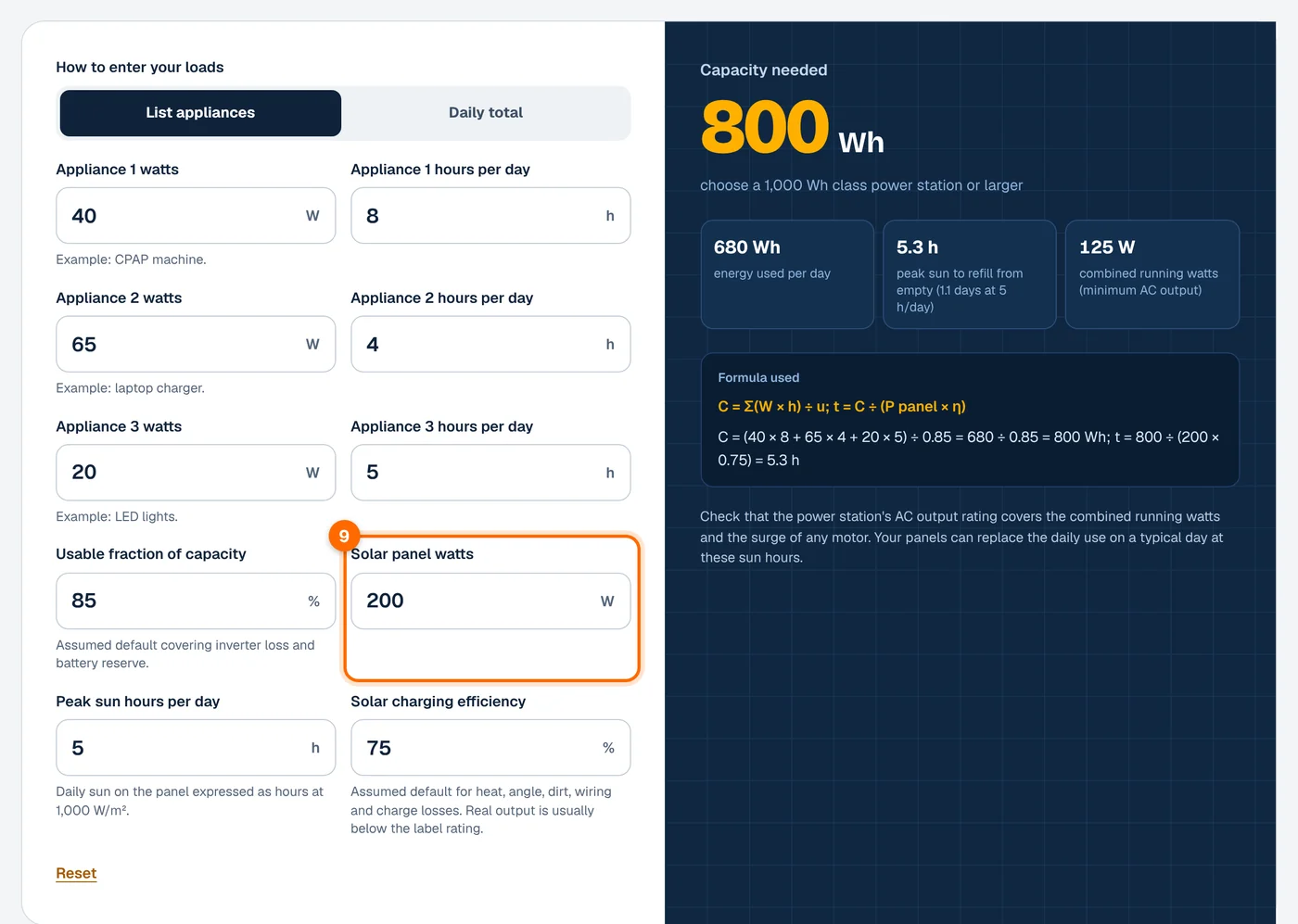
- Enter the solar panel watts. Use the total rated watts of the panels you will connect, such as one 200 W folding panel.
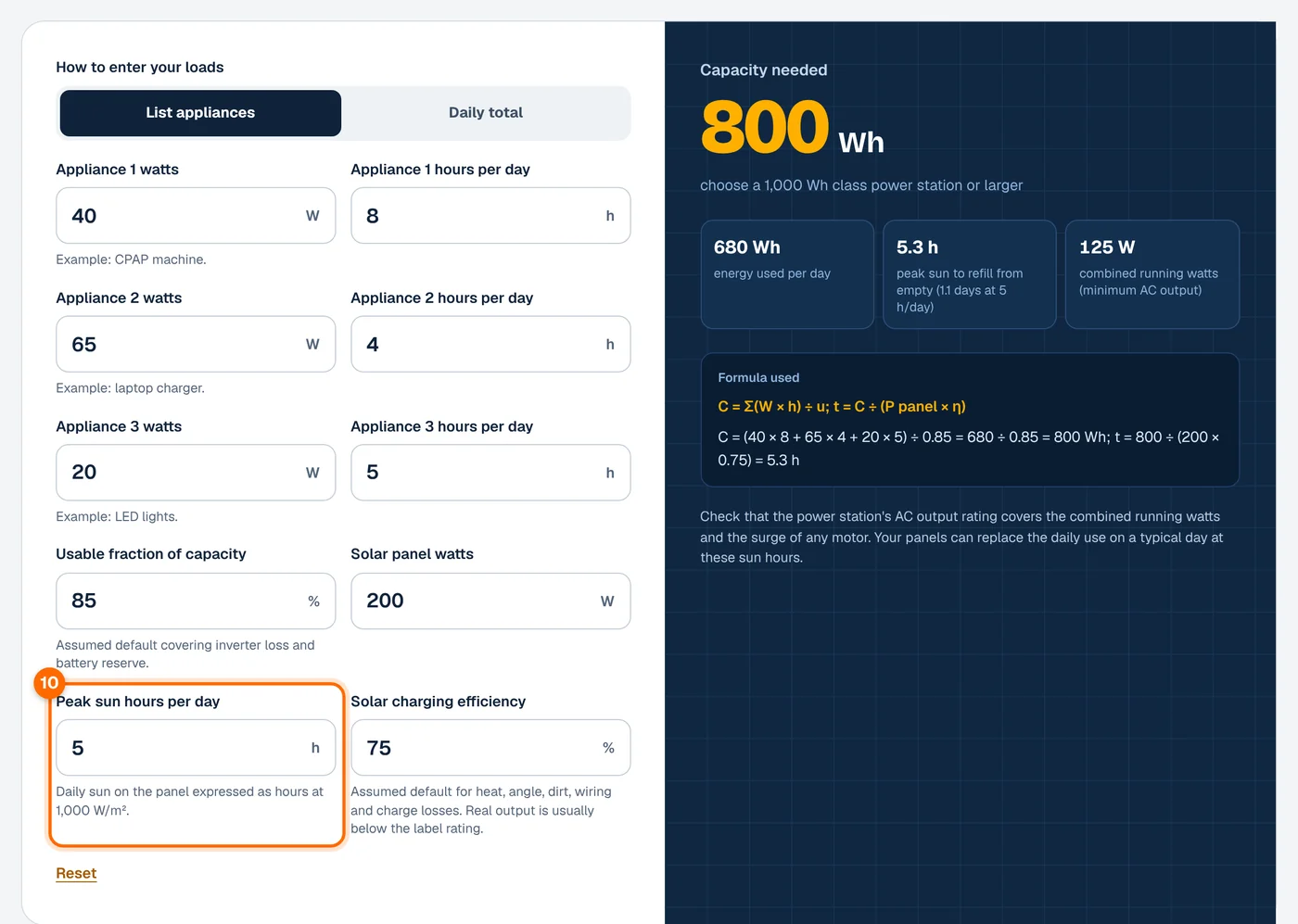
- Enter the peak sun hours. This is the daily sunlight expressed as hours at full strength (1,000 W/m²). It varies by location and season, and it is lower in winter.
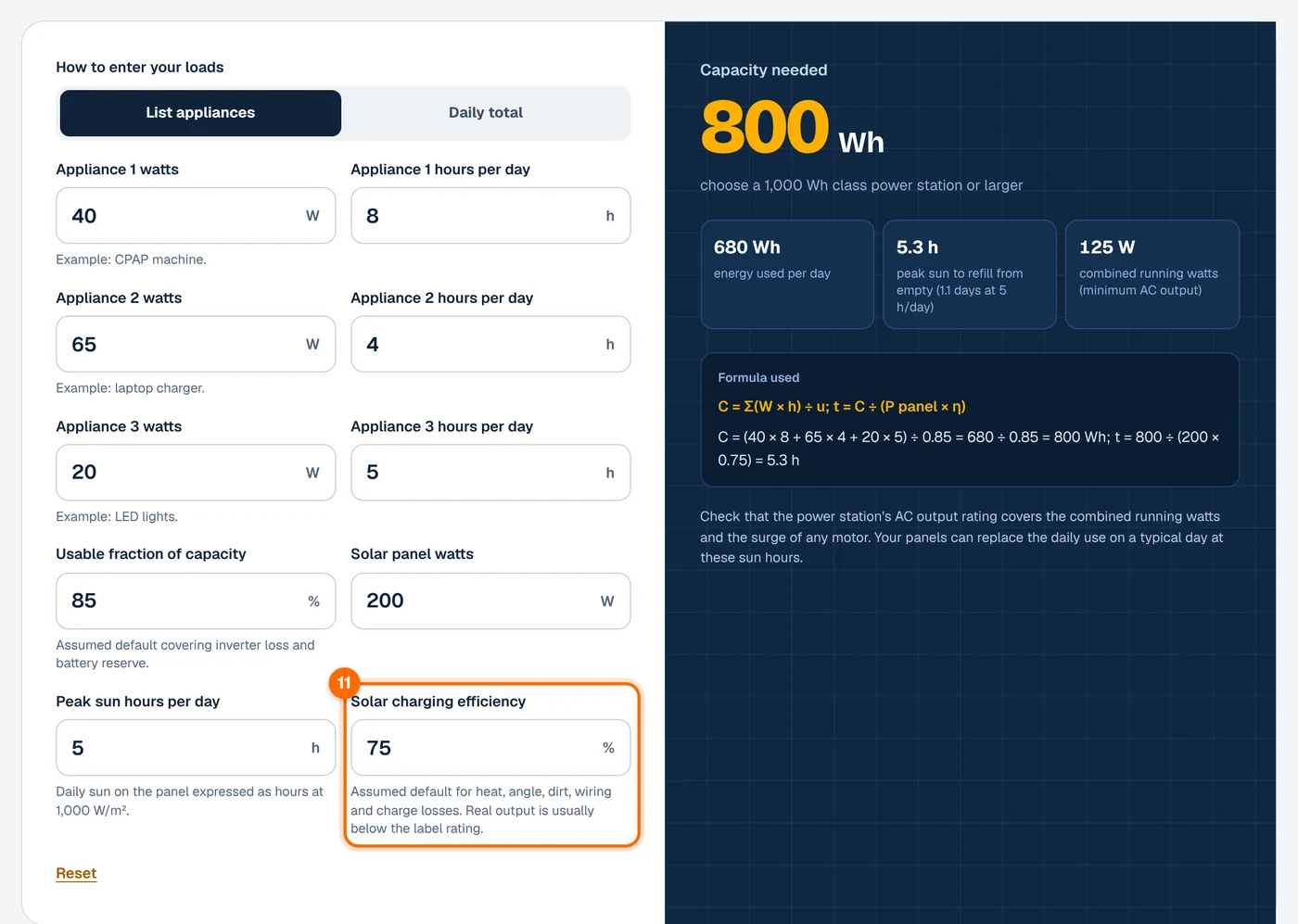
- Enter the solar charging efficiency. This covers heat, angle, dirt, cable and charging losses. The 75% default is an assumption for portable panels.
- Read the capacity needed. The big number is the battery capacity in Wh. The line below suggests a size class, and the cards show daily use, recharge time and the combined running watts.

Solar generator formula
Where:
- W and h are each appliance’s running watts and hours of use per day.
- Eday is the energy you use per day in Wh.
- u is the usable fraction of the battery’s rated capacity, as a decimal.
- C is the rated battery capacity you need in Wh.
- Ppanel is the panel’s rated watts and η is the solar charging efficiency.
- trecharge is the hours of peak sun needed to refill from empty.
- PSH is peak sun hours per day and Esolar is the energy harvested per day.
Worked examples
Example 1: CPAP, laptop and lights
Example loads: a 40 W CPAP for 8 hours, a 65 W laptop for 4 hours and 20 W of LED lights for 5 hours.
A 1,000 Wh class power station covers one night. With a 200 W panel and 5 peak sun hours, it refills in about 1.1 days, and the daily harvest of 750 Wh covers the 680 Wh used.
Example 2: camping fridge for a weekend
An example 12 V compressor fridge averages 45 W over 24 hours as it cycles on and off.
A 1,500 Wh class unit fits. A 400 W panel at 4 peak sun hours harvests 400 × 4 × 0.75 = 1,200 Wh a day, enough to keep up with the fridge.
Example 3: power outage at home
An example home outage needs 2,500 Wh per day for a refrigerator, internet router, phones and lights.
A 3,000 Wh class unit runs one day. A single 400 W panel at 4.5 peak sun hours adds only 1,350 Wh per day, so the battery will drain over a longer outage unless you add panels or cut the load.
Recharge time by panel size
Hours of peak sun to refill each capacity from empty at 75% charging efficiency. Divide by your peak sun hours to get days.
| Capacity | 100 W panel | 200 W panel | 400 W panel | 600 W panel |
|---|---|---|---|---|
| 500 Wh | 6.7 h | 3.3 h | 1.7 h | 1.1 h |
| 1,000 Wh | 13.3 h | 6.7 h | 3.3 h | 2.2 h |
| 2,000 Wh | 26.7 h | 13.3 h | 6.7 h | 4.4 h |
| 3,000 Wh | 40.0 h | 20.0 h | 10.0 h | 6.7 h |
A power station’s solar input limit can cap charging below the panel rating, so check the maximum input watts and voltage before buying panels.
What affects the result
Running watts and surge
Capacity is only half the story. The unit’s AC output must cover all the appliances running at once, plus the brief starting surge of anything with a motor or compressor, such as a fridge or a pump.
Usable capacity
The label shows the battery’s rated capacity. Some of that energy is lost converting DC to AC, and some is held back to protect the battery. Running devices from the DC or USB ports usually wastes less than using the AC outlets.
Real solar output
Panels are rated in lab conditions. Heat, angle, dust and wiring all cut real output. NREL’s PVWatts manual uses a default 14% for system losses before inverter losses, and portable panels laid on the ground at a poor angle often do worse.
Season and weather
Peak sun hours change through the year and drop sharply on cloudy days. Size the panels for the season you need them most, and plan a margin for a run of poor weather.
Frequently asked questions
What size solar generator do I need to run a refrigerator?
Find the fridge’s daily energy use from its label or a plug-in meter, often shown as kWh per year; divide by 365 for kWh per day. Divide that by 0.85 for the capacity. The AC output must also handle the compressor’s starting surge, so check the surge rating as well.
How long will a 1,000 Wh solar generator last?
Multiply 1,000 Wh by the usable fraction, about 0.85, and divide by your load in watts. At an 85 W average load, it lasts about 10 hours. At 40 W, it lasts about 21 hours. Actual runtime depends on the inverter efficiency and the battery’s reserve.
How many solar panels do I need to charge a power station?
Divide the energy you use per day by peak sun hours × charging efficiency. For 680 Wh a day at 5 sun hours and 75% efficiency, you need 680 ÷ (5 × 0.75) = 181 W, so a 200 W panel. Stay within the unit’s solar input limits.
What is the difference between a solar generator and a gas generator?
A solar generator is a battery with a built-in inverter and charge controller, recharged from panels or the wall. It is quiet and makes no exhaust, so it can run indoors. A gas generator makes more power for longer but needs fuel and must run outside.
Can a solar generator power a whole house?
Small and mid-size units run essentials such as a fridge, lights, internet and phone charging. Running a whole house, including heating, cooling and a range, needs much larger battery systems and inverters. Use the battery and inverter calculators to size a whole-home system.