How Long Does a 30kWh Battery Last? Runtime for Your Home and Appliances
Short answer
A 30 kWh battery holds about 27 kWh of usable energy, so it runs a steady 1 kW load for about 27 hours. That is close to one full day for an average US home, which uses about 30 kWh a day, as long as you skip big loads like an electric water heater or EV charger. About 20 residential solar panels can refill it on a typical sunny day.
A 30 kWh battery is the size people reach for when they want the whole house to keep running through an outage, not just the fridge and the Wi-Fi. It is roughly one day of electricity for a typical American household, which makes it a useful benchmark for whole-home backup and for smaller off-grid homes.
“Roughly” matters here. Below: real runtimes, which loads to give up to stretch it across 24 hours, how the bank is built, how much solar refills it, where code allows it and what it costs in late 2026.
Is a 30 kWh battery enough to run a house for a day?
For an average home, almost. The US Energy Information Administration puts the typical residential customer at about 10,791 kWh a year, which works out to about 29.6 kWh a day. A 30 kWh label sounds like a perfect match, but two losses sit between the label and your outlets.
First, the battery management system keeps a reserve to protect the cells. This site assumes 90% usable capacity. Second, the inverter loses about 5% to 10% turning DC into AC.
Example: 30 kWh × 0.90 × 0.90 to 0.95 = 24.3 to 25.7 kWh
So a 30 kWh battery delivers about 24 to 26 kWh to your appliances. That covers a full day for a home using 25 kWh or less, or about 85% of an average day. Turning off two or three heavy loads closes the gap.
How many hours does 30 kWh last at different loads?
Runtime depends on how many kilowatts the house draws on average, not on the peak. Divide usable energy by the load:
Example: 30 kWh × 0.90 ÷ 1.25 kW = 21.6 hours
The 1.25 kW figure is the average US home spread over 24 hours (30 kWh ÷ 24).
| Average load | What it looks like | Runtime from 27 kWh |
|---|---|---|
| 0.3 kW | Fridge, freezer, lights, Wi-Fi, phones | about 90 hours (3.75 days) |
| 0.5 kW | Essentials plus a gas furnace blower or fans | about 54 hours (2.25 days) |
| 1.0 kW | Most of the house, no AC or electric heat | about 27 hours |
| 1.25 kW | Average US home, 30 kWh a day | about 21.6 hours |
| 2.0 kW | Hot day with central AC cycling often | about 13.5 hours |
| 3.5 kW | A 3 ton central AC running nonstop | about 7.7 hours |
| 7.2 kW | Level 2 EV charger at full rate | about 3.75 hours |
Subtract 5% to 10% for inverter losses for a conservative number. To run your own mix of appliances and outage length, the battery backup calculator does the same math with your loads.
Which loads do you keep, and which do you shed?
A full day on 30 kWh is a budgeting exercise. The table below is one realistic summer day for a family home with central air and a gas water heater. Every line is wattage × hours, so you can swap in your own figures.
| Keep running | Assumption | Energy per day |
|---|---|---|
| Refrigerator | Cycling, 24 hours | 1.5 kWh |
| Chest freezer | Cycling, 24 hours | 1.0 kWh |
| LED lighting | 15 bulbs × 9 W × 6 hours | 0.81 kWh |
| Wi-Fi and modem | 10 W × 24 hours | 0.24 kWh |
| TVs, laptops, chargers | Mixed use | 0.8 kWh |
| Ceiling fans | 4 × 50 W × 10 hours | 2.0 kWh |
| Central AC, 3 ton | 3.5 kW × 4 hours of compressor time | 14.0 kWh |
| Microwave | 1.1 kW × 30 minutes | 0.55 kWh |
| Induction cooktop | 1.5 kW × 1 hour | 1.5 kWh |
| Dishwasher | One cycle | 1.2 kWh |
| Clothes washer | One load, motor only | 0.4 kWh |
| Well pump | 1 kW × 1 hour | 1.0 kWh |
| Total | about 25.0 kWh |
That day lands right at the 24 to 26 kWh the battery delivers. Cutting the AC to three hours, or setting the thermostat a few degrees higher, buys a margin of 3.5 kWh. This is the realistic meaning of “a full day of whole-home backup”: everything runs, but the big thermal loads are rationed.
Loads that break a 30 kWh budget
These are the appliances most owners put on a non-backed-up panel or simply switch off during an outage:
- Electric resistance water heater: a 4.5 kW element running 3 hours uses 13.5 kWh, half the battery.
- Electric clothes dryer: about 5 kW, so one hour-long load takes 5 kWh.
- Level 2 EV charging: 7.2 kW for 2 hours is 14.4 kWh. At 3 to 4 miles per kWh, the whole usable battery adds only about 80 to 110 miles.
- Pool pump: 1.5 kW for 8 hours is 12 kWh.
- Electric furnace or heat strips: 10 kW for 3 hours is 30 kWh, more than the entire battery.
If you are not sure what your house really draws, list your appliances in the solar load calculator before you settle on 30 kWh.

How is a 30 kWh battery bank built?
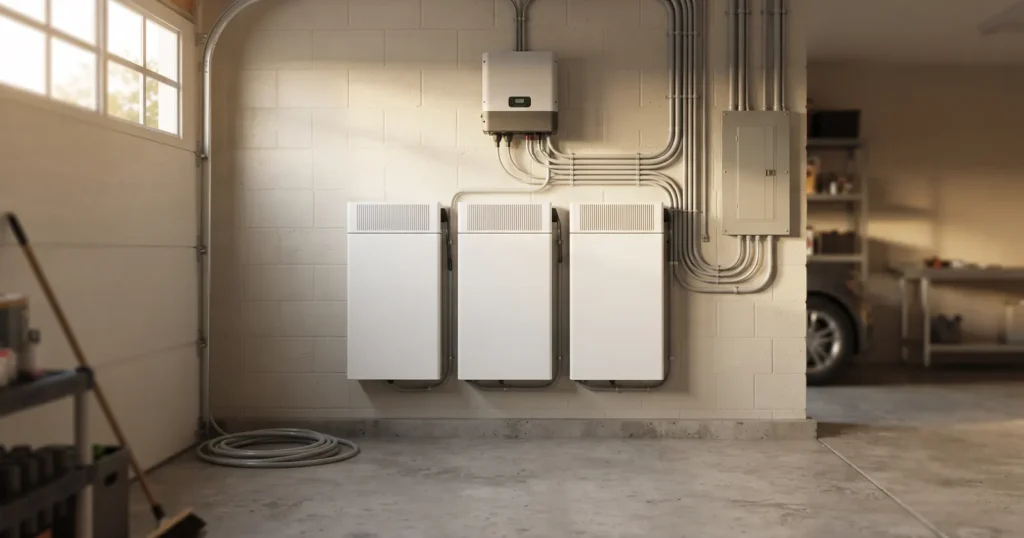
You rarely buy 30 kWh as one box. Residential batteries come as modules or units that stack or connect in parallel to one inverter. Common ways to reach about 30 kWh:
| Configuration | Rated capacity | Usable at 90% | Typical setup |
|---|---|---|---|
| 6 × 5.12 kWh (48 V, 100 Ah) modules | 30.7 kWh | 27.6 kWh | Server rack, DIY or installer-built |
| 3 × 10 kWh modules | 30 kWh | 27 kWh | Floor stack or wall-mounted units |
| 2 × 15 kWh units | 30 kWh | 27 kWh | Two cabinets on one hybrid inverter |
| 2 × 13.5 kWh units | 27 kWh | 24.3 kWh | Popular all-in-one home batteries |
Some makers quote usable capacity on the label instead of rated capacity, so read the spec sheet before you compare.
Amp hours and voltage
Most stacked home batteries are 48 V lithium iron phosphate (LFP), with a nominal 51.2 V. At that voltage, 30 kWh is about 586 Ah, which is why six 100 Ah modules (600 Ah) are such a common build. The same energy at 12 V would take about 2,500 Ah, far too much current for practical cables, so 30 kWh is a 48 V or high-voltage job.
Example: 30,000 Wh ÷ 51.2 V = 586 Ah
Energy is not the same as power
The kWh rating sets how long the house runs, while the inverter’s kW rating sets how much runs at once. A 3.5 kW central AC, a 1.5 kW cooktop, a 1 kW well pump, the fridge and lighting can overlap at 6.5 to 7 kW, plus the compressor’s startup surge. Size yours with the inverter size calculator.
How many solar panels does it take to refill 30 kWh every day?
To put 27 kWh back into the battery, the panels must produce a bit more, because charging also loses energy. Using a 90% charging efficiency, 27 kWh in the battery needs about 30 kWh from the array. With the site’s standard 80% system efficiency and 430 W panels:
Panels = array kW ÷ 0.43
Example: 30 ÷ (4.5 × 0.80) = 8.33 kW ÷ 0.43 = 19.4, so 20 panels
| Peak sun hours | kWh per kW per day | Array needed | 430 W panels |
|---|---|---|---|
| 3.5 (cloudy north, winter average) | 2.8 | 10.7 kW | 25 |
| 4.5 (US middle value) | 3.6 | 8.3 kW | 20 |
| 5.5 (sunny South and West) | 4.4 | 6.8 kW | 16 |
| 6.5 (desert Southwest) | 5.2 | 5.8 kW | 14 |
Each 430 W panel covers about 21 square feet (430 W ÷ 1,000 W/m² ÷ 0.22 efficiency = 1.95 m²), so 20 panels need roughly 420 square feet of panel area before setbacks and gaps.
Those 20 panels only refill the battery. If the array also runs the house in daylight, you need more. For your own roof and sun hours, the how many solar panels calculator handles both jobs.
Should you use 30 kWh for backup or for off-grid living?
The same battery behaves very differently depending on whether the grid is there most of the time.
Grid-tied backup
With the grid available, 30 kWh is generous. It rides through an overnight outage without anyone changing habits, and with solar refilling it each day it can carry a home through a multi-day outage as long as the sun cooperates. On time-of-use rates it can also shift solar into expensive evening hours.
Off-grid
Off grid, 30 kWh is only about one day of autonomy for an average home, with no buffer for clouds. Many off-grid designs plan for two or more days, which pushes an average home toward 60 kWh. It works better in an efficient home or cabin using 10 to 15 kWh a day: 27 ÷ 10 = 2.7 days of autonomy.
The array also grows off grid. A home using 30 kWh a day, with part of it stored overnight, needs roughly 31 to 33 kWh of production. At 3 winter sun hours that is 33 ÷ (3 × 0.8) = 13.75 kW, or about 32 panels, which is why off-grid homes often add a generator for winter. The off-grid solar calculator sizes the array, battery and days of autonomy together.
Where can you install a 30 kWh battery?
Battery placement in US homes follows NFPA 855, the fire code standard for energy storage, as adopted through the residential and fire codes in your state. The general limits for one and two family homes are:
- Each individual unit is rated at 20 kWh or less, so a 30 kWh bank is always two or more units.
- An aggregate of 40 kWh in a utility closet, basement or storage room.
- An aggregate of 80 kWh in an attached or detached garage, on an exterior wall or outdoors on the ground.
- No batteries in sleeping rooms, closets, spaces that open directly into sleeping rooms or habitable living space.
At 30 kWh you sit under every aggregate limit. Local rules still add details: many jurisdictions require about 3 feet between units unless the product’s fire test data allows closer spacing, gypsum board between a garage and living space, smoke or heat detection, and protection from vehicle impact in garages. Your permit office and installer have the final word.
How much does a 30 kWh battery cost?
Typical US ranges in late 2026, before any state or utility rebates:
| Route | Typical price per kWh | For about 30 kWh |
|---|---|---|
| DIY 48 V LFP modules, batteries only | about $150 to $330 | about $4,500 to $10,000 |
| DIY hybrid inverter, breakers, cables | not per kWh | add about $2,000 to $5,000 |
| Professionally installed stacked home batteries | about $700 to $1,200 | about $21,000 to $36,000 |
The 30% federal residential clean energy credit ended for homeowner-owned systems installed after December 31, 2025, so leave it out of a new budget. Spread over the battery’s life, the cost looks more reasonable:
Example: $28,000 ÷ (6,000 × 27 kWh) = $28,000 ÷ 162,000 kWh = about $0.17 per kWh
That assumes daily full cycling. A battery used only for rare outages costs far more per kWh delivered.
30 kWh compared with 10 kWh and 100 kWh
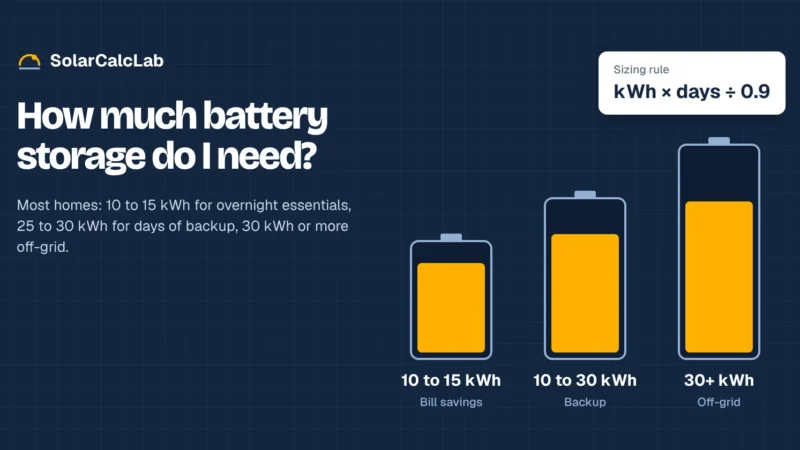
A single 10 kWh battery is an essentials pack: fridge, lights, internet and a few circuits through one night. A 30 kWh bank is the first size that treats the whole house as the backed-up load, AC included, for about a day. A 100 kWh battery moves into multi-day off-grid and small business territory, where placement limits and costs grow quickly.
Frequently asked questions
Will a 30 kWh battery power my whole house for 24 hours?
For an average US home using about 30 kWh a day, it delivers roughly 24 to 26 kWh, so it gets close but not quite there unchanged. Skipping an electric water heater, dryer or EV charger, and rationing the AC, usually stretches it to a full 24 hours.
How long will a 30 kWh battery run central air conditioning?
A 3 ton central AC draws about 3.5 kW while the compressor runs, so 27 kWh of usable energy gives about 7.7 hours of compressor time on its own. Because the compressor cycles on and off, that can spread across most of a hot day if nothing else large is running.
How many 5 kWh batteries make 30 kWh?
Six. A common 48 V, 100 Ah lithium iron phosphate module holds about 5.12 kWh, so six of them make about 30.7 kWh rated, or 27.6 kWh usable at 90%. Connected in parallel, they total about 600 Ah at 51.2 V.
How long does it take to charge a 30 kWh battery from the grid or a generator?
Divide the energy by the charging power. Refilling 27 kWh at 5 kW takes about 5.4 hours, plus around 10% for charging losses, so roughly 6 hours. A faster 10 kW charge rate cuts that to about 3 hours, if the inverter and generator can supply it.
Is a 30 kWh battery overkill for a home?
Not if you want whole-home backup with air conditioning or have long outages. If you only need the fridge, lights, internet and a well pump overnight, 10 to 15 kWh is usually enough. Size it from your real daily loads rather than from the label.