How Much Battery Storage Do I Need for My Home?

Short answer
Most homes need 10 to 15 kWh of battery storage to keep essentials running through a typical overnight outage, 25 to 30 kWh to cover essentials for three days without solar or a whole average home for about a day, and 30 kWh or more for off-grid living. Size it by adding up the kWh your chosen loads use, multiplying by the hours or days you want covered, and dividing by about 0.9 for reserve and losses. Then check that the battery’s kW output can start your largest motor.
Battery quotes usually start with a product, not a number. An installer offers one Powerwall or two, a 10 kWh stack or a 20 kWh stack, and you are left to guess which one fits. It is easier to work the other way: measure the job first, then pick hardware.
This guide walks through that process with three worked examples: essentials backup, a time-of-use evening shift and an off-grid cabin. Each one produces a different answer, which is the main reason “how much battery storage do I need” has no single number.
Decide what the battery is for
Home batteries do three different jobs. The job sets the size far more than the house does.
| Goal | What you are sizing for | Typical size |
|---|---|---|
| Outage backup | Selected circuits for a set number of hours | 10 to 30 kWh |
| Bill savings (time-of-use or net billing) | Evening peak hours, every day | 10 to 15 kWh |
| Off-grid | Your entire daily use plus cloudy days | 30 kWh and up |
If you want both evening savings and storm backup, remember that the reserve you hold for storms is energy you cannot use for savings, so a dual-purpose battery tends to be one size larger.
Step 1: add up the kilowatt-hours
Energy is what decides runtime. For each load, multiply its running watts by the hours it runs in a day and divide by 1,000. Nameplate watts overstate cycling appliances like a fridge, so use a measured daily figure where you have one. Our appliance wattage chart lists typical draws if you have nothing to measure.
Battery size (kWh) = daily kWh × days covered ÷ 0.9
The 0.9 accounts for the reserve most systems keep and for conversion losses. If a battery is sold on DC capacity and paired with a separate inverter, divide by about 0.95 as well. The battery calculator handles that conversion if you are working in amp-hours or volts.
Worked example: an essentials panel for one winter day
Here is a gas-heated home that wants the fridge, internet, a few lights, the furnace blower, the sump pump and a TV during an outage.
| Load | Watts | Hours per day | kWh per day |
|---|---|---|---|
| Refrigerator (cycling) | measured | 24 | 1.50 |
| Wi-Fi router and modem | 20 | 24 | 0.48 |
| LED lights, 6 bulbs | 60 | 6 | 0.36 |
| Phone and laptop charging | 60 | 4 | 0.24 |
| Gas furnace blower | 500 | 8 | 4.00 |
| Sump pump | 800 | 1 | 0.80 |
| TV | 100 | 4 | 0.40 |
| Total | 7.78 |
One day of coverage needs 7.78 ÷ 0.9 = 8.6 kWh. Three days with no solar recharge needs 7.78 × 3 ÷ 0.9 = 25.9 kWh. The furnace blower is more than half of the total, which is typical in cold climates: heating fans and well pumps often matter more than the obvious loads.
Compare that with the whole house. The average US home used 865 kWh a month in 2024 according to the EIA, or about 28.4 kWh a day. Covering all of it for 24 hours takes 28.4 ÷ 0.9 = 31.6 kWh, close to four times the essentials figure.
Step 2: check power, not only capacity
A battery has two ratings. Capacity in kWh is the size of the tank. Output in kW is how fast it can pour. A large tank with a narrow spout still trips when the well pump and microwave start together.
In the example above, every load running at once adds up to about 1.7 kW, which nearly any home battery handles. Central air is a different story. A Tesla Powerwall 3, for instance, is rated at 13.5 kWh and 11.5 kW continuous, and its datasheet lists a motor starting capability of 185 locked rotor amps (LRA). Most other batteries list lower continuous output per unit, so check the specs before assuming a single unit will start a large compressor.
How to check a motor load
- Find the LRA value on the nameplate of the AC condenser, well pump or other motor.
- Compare it with the battery’s load start or surge rating, not its continuous kW.
- If it is close, ask about a soft starter, which lowers the inrush current of many compressors.
The battery backup calculator takes both your kWh and your peak load, so it flags a battery that is big enough in energy but too weak in power.
Step 3: choose how long you want to be covered
Days of coverage is the multiplier that swings the answer most. Real outage data helps here. The EIA reports that US customers averaged 11 hours without power in 2024, and major events such as hurricanes caused 80% of those hours. In a normal year without major events, the average is about two hours.
That points to three practical targets:
- Overnight, about 12 hours. Covers most outages. A single 10 to 13.5 kWh battery is usually enough for essentials.
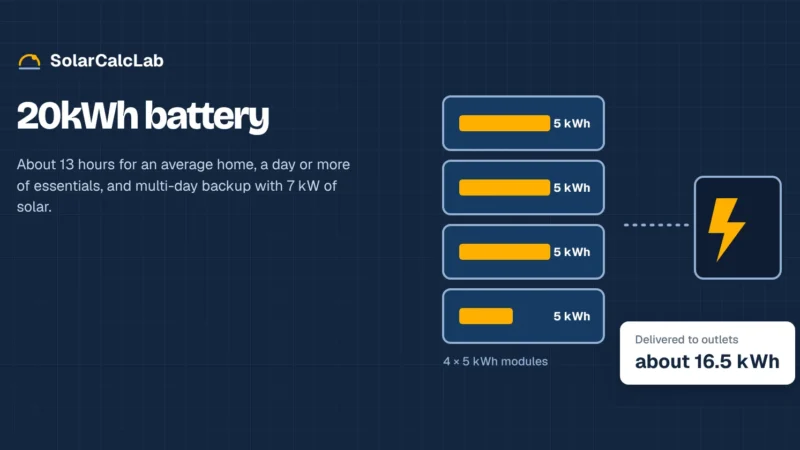
- One full day. Covers storm outages that start in the evening and end the next afternoon. Plan on 10 to 15 kWh for essentials, or around 30 kWh for a whole average home.
- Several days. Only practical without solar if you limit loads hard. With solar on the roof, the battery refills on sunny days, so a mid-size battery can last much longer than its kWh rating suggests.
Solar changes the math. On an average day, about ten 400 W panels at 4.5 peak sun hours and 80% system efficiency produce the 13.5 kWh needed to refill one Powerwall-sized battery. If you are planning panels too, our guide on how many solar panels you need shows how to size the array for your yearly use.
Sizing for time-of-use and net billing
Bill savings work differently from backup. You are not covering a rare event. You are covering the same peak window every day, often 4 PM to 9 PM.
Say your home averages 1.6 kW during a five-hour peak. That is 1.6 × 5 = 8 kWh a day, or 8.9 kWh once you divide by 0.9. A 10 kWh battery covers it, and a bigger one sits partly unused most evenings. The savings ceiling is easy to estimate:
Example: 8 kWh × $0.30 = $2.40 a day, or about $876 a year if every day had that spread
Real savings come in lower because of round-trip losses and days without a large rate gap. Tesla lists 89% solar to battery to home efficiency for the Powerwall 3, so delivering 8 kWh takes roughly 9 kWh of stored solar. The home battery savings calculator runs this with your own rates.
Off-grid: size for the worst week, not the average day
Off-grid batteries carry everything, every night, and must also cover cloudy stretches. A cabin using 15 kWh a day with two days of autonomy needs:
That is before winter. Lithium batteries lose usable capacity in the cold, and panels make far less in December. Most off-grid designers size for the darkest month and add a generator rather than buying a battery bank for a full week. Run your loads through the off-grid solar calculator to size the array and battery together.

Matching the result to real battery sizes
Once you have a number, round up to the nearest product size. Here is where common capacities land:
| Your result | Common product size | Detailed guide |
|---|---|---|
| Under 8 kWh | 5 kWh unit or a portable station | 5 kWh battery |
| 8 to 11 kWh | 10 kWh | 10 kWh battery |
| 11 to 14 kWh | 12 to 13.5 kWh | 12 kWh battery |
| 14 to 18 kWh | 15 to 16 kWh | 16 kWh battery |
| 25 to 32 kWh | Two to three stacked units | 30 kWh battery |
What that storage costs in 2026
EnergySage puts a typical 13.5 kWh installation at about $15,650 before incentives, roughly $1,160 per kWh, and whole-home backup with two or three batteries at $24,000 to $40,000.
The federal 30% credit no longer applies to batteries that homeowners buy and install after 2025. Leased systems and some state programs still offer help, which our solar tax credit guide covers. Because each extra kWh costs real money, trimming loads is often the cheapest way to shrink the battery you need.
Sizing mistakes to avoid
- Using nameplate watts for a fridge or freezer. A 700 W label does not mean 16.8 kWh a day. Measure with a plug-in meter or use the appliance’s yellow EnergyGuide label.
- Forgetting the reserve. If your bill-savings settings keep 20% for backup, only 80% is available each evening.
- Backing up electric heat or a range. A heat strip can draw 10 kW or more. Leave it off the backup panel.
- Buying for a rare event. A 40 kWh bank for a once-a-decade storm may cost more than a standby generator that only runs that week.
Frequently asked questions
Is one 13.5 kWh battery enough for a house?
It is enough for essentials through most outages. A 13.5 kWh battery covers the 7.8 kWh essentials example in this guide for about 1.7 days, but it runs an average US home using 28.4 kWh a day for only about 11 hours.
How many kWh of battery do I need to run central air?
A central AC that draws 3.5 kW while running for 8 hours a day uses 28 kWh, so you would need about 31 kWh for a full day on AC alone. Just as important, the battery must be able to start the compressor, so compare its surge or LRA rating with the condenser nameplate.
Do I need a battery if I have solar panels?
Not always. Standard grid-tied solar shuts off during an outage, so a battery is the only way to use your panels when the grid is down. If you have full retail net metering and rare outages, a battery often does not pay for itself on bill savings alone.
Should I size for backup or for bill savings?
Size for whichever needs more storage, then set a backup reserve. Bill savings usually need 10 to 15 kWh for a typical evening peak, while multi-day backup needs more. If both matter, choose the larger size and keep part of it in reserve.
How much battery do I need to go off-grid?
Start with your daily use and multiply by two or three days of autonomy, then divide by about 0.86 for usable capacity and inverter losses. A home using 15 kWh a day needs about 35 kWh for two days, plus a solar array sized for winter and usually a backup generator.