500Ah Battery: How Many kWh It Holds and How Long It Lasts
Short answer
A 500Ah battery holds about 6 kWh at 12V, 12 kWh at 24V and 24 kWh at 48V (a little more for lithium, which runs at 12.8V and 51.2V). A 12V 500Ah lithium bank gives about 5.4 kWh of usable energy, enough to run a 300 W load for roughly 16 hours through an inverter. The same amp hours at 48V last four times longer.
Amp hours alone do not tell you how much energy a battery stores. A 500 Ah battery at 12V and a 500Ah bank at 48V share the same rating, yet the 48V bank holds four times the energy.
Most 500Ah setups are not a single battery. They are banks of smaller modules wired together for an off-grid cabin, a liveaboard boat or a large RV. This guide covers the energy at each voltage, real runtimes, how to build and wire the bank safely, and how much solar it takes to refill.
How many kWh is a 500Ah battery at 12V, 24V and 48V?
Multiply amp hours by voltage to get watt hours, then divide by 1,000 for kWh. Lithium iron phosphate (LiFePO4) batteries sold as “12V” actually sit at 12.8V nominal, so their true rating is slightly higher.
Example: 500 Ah × 12 V ÷ 1,000 = 6.0 kWh (500 Ah × 12.8 V = 6.4 kWh for LiFePO4)
You cannot drain every battery to zero. This site assumes 90% usable capacity for lithium and 50% for lead-acid, which protects lead-acid cycle life. The usable columns below use the round nominal voltage, so they lean slightly conservative.
| Bank voltage | Nominal energy | LiFePO4 rating | Usable, lithium (90%) | Usable, lead-acid (50%) |
|---|---|---|---|---|
| 12V | 6.0 kWh | 6.4 kWh at 12.8V | 5.4 kWh | 3.0 kWh |
| 24V | 12.0 kWh | 12.8 kWh at 25.6V | 10.8 kWh | 6.0 kWh |
| 48V | 24.0 kWh | 25.6 kWh at 51.2V | 21.6 kWh | 12.0 kWh |
For any other voltage or capacity, the amp hours to kWh converter does the same math instantly. A single 2V lead-acid cell rated 500Ah, the building block of many traditional off-grid banks, holds just 1 kWh.
How long will a 500 amp hour battery last?
Runtime depends on the load in watts, the usable energy and the inverter. This guide assumes 90% inverter efficiency for AC loads. DC loads wired straight to a 12V battery skip that loss.
Example: 500 × 12 × 0.90 × 0.90 ÷ 300 W = 16.2 hours
| AC load | Draw from a 12V bank | 12V lead-acid (2.7 kWh) | 12V LiFePO4 (4.86 kWh) | 48V LiFePO4 (19.4 kWh) |
|---|---|---|---|---|
| 100 W (laptop, lights, router) | 9 A | 27 h | 48.6 h | 194 h |
| 300 W (TV and game console) | 28 A | 9 h | 16.2 h | 64.8 h |
| 500 W (several small loads) | 46 A | 5.4 h | 9.7 h | 38.9 h |
| 1,000 W (small window AC running) | 93 A | 2.7 h* | 4.9 h | 19.4 h |
| 2,000 W (kettle or space heater) | 185 A | 1.4 h* | 2.4 h | 9.7 h |
*Lead-acid capacity is usually rated over 20 hours. At high current it delivers noticeably less (the Peukert effect), so treat the starred figures as optimistic.
Cycling appliances such as refrigerators run longer than the table suggests. The battery backup calculator lets you enter your own mix of loads.
How do you build a 500Ah battery bank?
Single 500Ah units exist, but they are heavy and expensive to ship. One 51.2V 500Ah LiFePO4 cabinet on the market weighs 240 kg (about 529 lb). Most people build 500Ah from modules instead:
| Target bank | How to build it | Energy (nominal) | Typical use |
|---|---|---|---|
| 12V 500Ah lithium | 5 × 12V 100Ah in parallel | 6.4 kWh | Boats, vans, small cabins |
| 24V 500Ah lithium | 5 parallel strings of 2 × 12V 100Ah in series (10 batteries) | 12.8 kWh | Larger cabins, bigger boats |
| 48V 500Ah lithium | 5 × 48V 100Ah server rack modules in parallel | 25.6 kWh | Full-time off-grid homes |
| 12V 500Ah lead-acid | 6 × 2V 500Ah cells in series | 6.0 kWh | Traditional off-grid banks |
| 48V 500Ah lead-acid | 24 × 2V 500Ah cells in series | 24.0 kWh | Large legacy systems |
Parallel connections add amp hours. Series connections add volts. Use identical batteries of the same age and brand, and charge each one fully before connecting them.
Lead-acid behaves poorly with many parallel strings. Victron’s wiring guidance puts the practical limit for 12V lead-acid at about three or four parallel strings, which is why a 500Ah lead-acid bank is normally built from 2V cells in one series string. Lithium modules with their own battery management system (BMS) parallel more easily, and each 48V 100Ah rack module is effectively a 5 kWh battery you can stack. For example, one popular 12V 100Ah model lists no parallel limit.
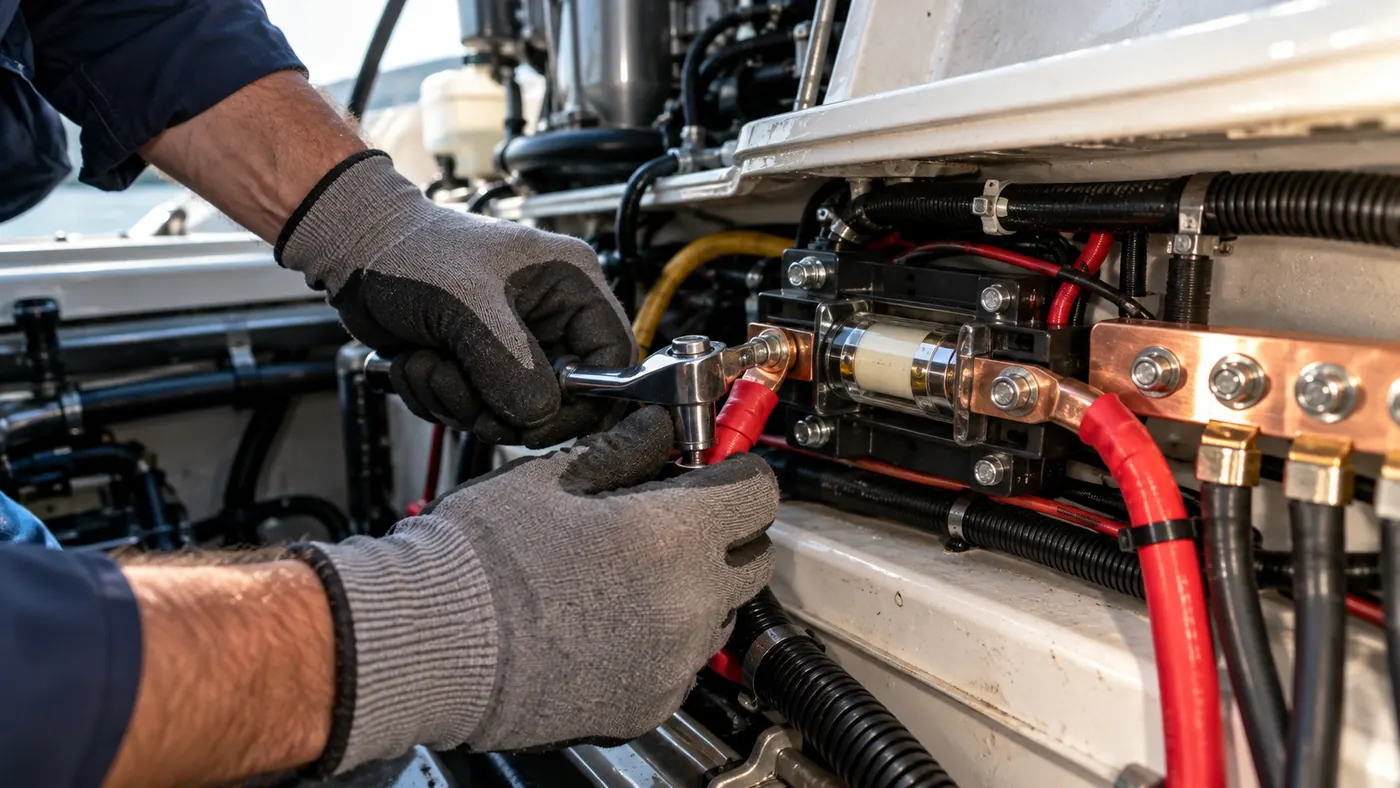
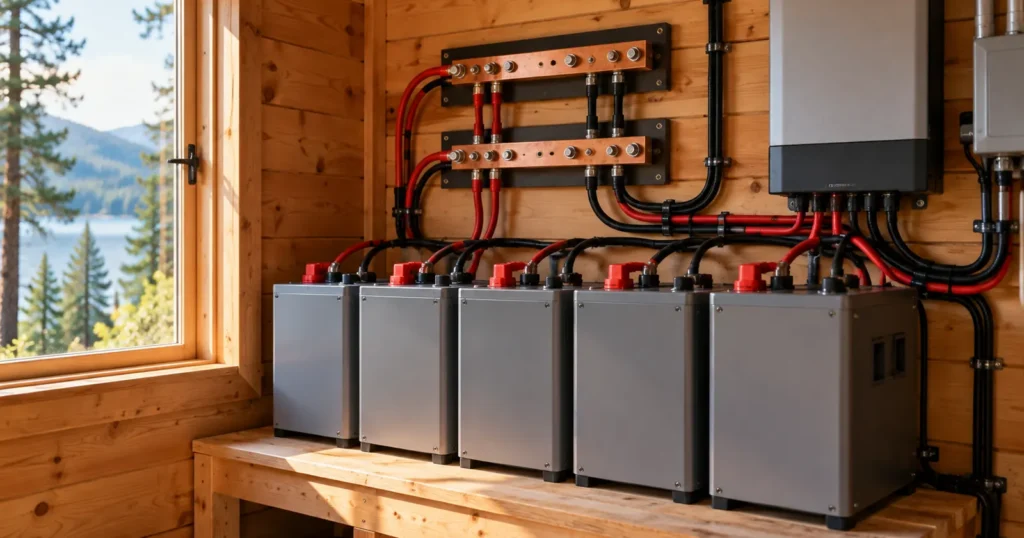
Wire parallel batteries so they share the load
If the inverter cables land on the first battery in a chain, that battery works hardest and wears first. Connect the main positive and negative to a pair of busbars, and run cables of identical length and gauge from each battery to them. The diagonal method, taking positive from one end of the bank and negative from the other, is a simpler second choice.
Is a 500Ah battery enough for an off-grid cabin?
For a weekend or part-time cabin with efficient appliances, a 12V or 24V 500Ah lithium bank usually is. For a full-time home it is not: the average US home uses about 10,800 kWh a year, close to 30 kWh a day, according to the US Energy Information Administration. That would empty even a 48V 500Ah bank in under a day.
Here is a realistic daily budget for a small cabin:
| Load | Watts | Hours per day | Energy per day |
|---|---|---|---|
| Efficient full-size refrigerator | cycles | 24 | 1,200 Wh |
| LED lights (8 × 9 W) | 72 | 5 | 360 Wh |
| Wi-Fi router | 12 | 24 | 288 Wh |
| Laptop | 60 | 4 | 240 Wh |
| TV | 80 | 3 | 240 Wh |
| Water pump | 100 | 1 | 100 Wh |
| Total, plus 10% inverter loss | about 2.7 kWh |
Example: 5.4 kWh ÷ 2.7 kWh = 2.0 days (12V LiFePO4); 21.6 ÷ 2.7 = 8.0 days (48V LiFePO4)
A 12V lead-acid bank would last only about one day at this load. If you plan to add a well pump, a microwave or power tools, size the bank from your own load list with the battery bank calculator.
Is a 500Ah lithium bank a good choice for a boat?
A 12V 500Ah LiFePO4 house bank is a common upgrade on cruising sailboats and trawlers. It gives about 450 usable amp hours, so a boat that uses 150 Ah a day at anchor gets roughly three days between charges. A lead-acid bank of the same rating gives only 250 usable amp hours.
Points that matter on the water:
- Weight: five 100Ah lithium batteries weigh about 155 lb at 31 lb each. A 12V bank of six 2V 500Ah lead-acid cells weighs about 400 lb or more, since one supplier lists 31 kg per cell.
- Alternator charging: lithium accepts high current and can overheat a stock alternator. Many owners add a DC-to-DC charger or an external regulator.
- Cold: do not charge LiFePO4 below 32°F (0°C) unless the battery has heating or low-temperature charge protection.
- Wiring rules: boats follow marine standards (ABYC E-11 in the US), which differ from building code.
What size cable and fuse does a 500Ah battery bank need?
A big inverter on a low-voltage bank pulls very high current, and the cable and fuse must handle it. Size the fuse at 125% of the continuous current, which matches the National Electrical Code margin for energy storage circuits, then choose cable rated above the fuse.
Fuse (A) = battery current × 1.25, rounded up to a standard size
Example: 2,000 W ÷ (12 × 0.90) = 185 A; 185 × 1.25 = 231 A, so a 250 A fuse
| Inverter | Bank | Continuous current | Fuse | Minimum copper cable (90°C rating) |
|---|---|---|---|---|
| 1,000 W | 12V | 93 A | 125 A | 2 AWG (130 A) |
| 2,000 W | 12V | 185 A | 250 A | 4/0 AWG (260 A) |
| 3,000 W | 12V | 278 A | 350 A | Beyond 4/0: move to 24V or 48V |
| 3,000 W | 24V | 139 A | 175 A | 2/0 AWG (195 A) |
| 3,000 W | 48V | 69 A | 100 A | 2 AWG (130 A) |
| 6,000 W | 48V | 139 A | 175 A | 2/0 AWG (195 A) |
Cable ratings come from NEC Table 310.16 at the 90°C column. If any lug or terminal is rated only 75°C, use that lower column, which drops 4/0 copper to 230 A and makes the 2,000 W 12V row too tight. Long runs also need thicker cable to limit voltage drop, so check your distances with the wire size calculator.
Fusing a parallel bank
- Put a main fuse as close as practical to the battery positive, as NEC section 240.21(H) requires for battery conductors.
- Use a Class T fuse for the main lithium fuse. Class T fuses carry a 20,000 A interrupt rating, which matters because a large lithium bank can deliver a huge short-circuit current.
- Fuse each battery or string in a parallel bank, so a fault in one battery cannot draw current from the other four.
- A BMS is not a fuse. Treat it as a second layer of protection.
The solar fuse size calculator covers the panel and charge controller side of the system.
How many solar panels does it take to charge a 500Ah battery?
Size the array from the energy you need to put back each day. Using this site’s standard assumptions of 4.5 peak sun hours and 80% system efficiency, each kilowatt of panels returns about 3.6 kWh a day.
Example: 5.4 kWh ÷ (4.5 × 0.80) = 1.5 kW, or four 430 W panels
| Goal | kWh per day | Array needed | 430 W panels | Controller output (nominal) |
|---|---|---|---|---|
| Cabin daily use (example above) | 2.7 | 0.75 kW | 2 | 72 A at 12V |
| Refill 12V lithium from 10% | 5.4 | 1.5 kW | 4 | 143 A at 12V |
| Refill 24V lithium from 10% | 10.8 | 3.0 kW | 7 | 125 A at 24V |
| Refill 48V lithium from 10% | 21.6 | 6.0 kW | 14 | 125 A at 48V |
A full 12V refill needs over 140 A of charging current, more than most single MPPT controllers deliver, so plan on two controllers or a higher bank voltage. The charge controller calculator sizes this from your panel specs. Winter sun is weaker, so the free NREL PVWatts calculator is worth running for your exact site.
500Ah lithium vs 500Ah lead-acid: what really changes?
Same amp hours, very different batteries. Lithium gives about 80% more usable energy (450 Ah against 250 Ah), keeps its voltage steady under load, and weighs far less. A quality LiFePO4 module is typically rated for 3,000 to 6,000 cycles, depending on brand and depth of discharge.
Lead-acid costs less up front and tolerates cold charging, but it needs regular full charges, ventilation for flooded types, and a bank twice as large for the same usable energy.
How much does a 500Ah battery bank cost?
Typical US ranges in late 2026, batteries only:
- 12V 500Ah LiFePO4: five 12V 100Ah modules at about $100 to $300 each, so roughly $500 to $1,500. Marine-rated or heated models cost more.
- 24V 500Ah LiFePO4: ten 12V 100Ah modules, roughly $1,000 to $3,000.
- 48V 500Ah LiFePO4: five 48V 100Ah rack modules at about $700 to $1,500 each, so roughly $3,500 to $7,500.
Budget extra for busbars, a Class T fuse, per-battery fuses, heavy cable, lugs and a battery monitor.
Frequently asked questions
How long will a 12V 500Ah battery run a 220 W load?
A 12V 500Ah lithium battery runs a 220 W AC load for about 22 hours: 6,000 Wh × 0.90 usable × 0.90 inverter efficiency ÷ 220 W. A 12V 500Ah lead-acid battery used to 50% runs it for about 12 hours. The inverter’s own rating, such as 750 W, does not change runtime much.
How many 100Ah batteries make 500Ah?
Five 100Ah batteries wired in parallel make 500Ah at the same voltage. Five 12V 100Ah batteries give a 12V 500Ah bank. For 24V 500Ah you need ten 12V batteries in five parallel strings of two. For 48V 500Ah, five 48V 100Ah rack modules in parallel is the simplest route.
What size inverter can a 500Ah battery run?
On a 12V bank, 2,000 W is a practical ceiling because a 2,000 W inverter already draws about 185 A and needs 4/0 cable. A 24V bank handles 3,000 W comfortably, and a 48V bank can run 5,000 to 6,000 W. Also check that the combined BMS discharge rating of your modules exceeds the inverter’s current.
Can a 500Ah battery run an air conditioner?
A 12V 500Ah lithium bank can run a 1,000 W window air conditioner for about 5 hours of compressor time, often longer in practice because the compressor cycles. A 48V 500Ah bank lasts about 19 hours of running time. Central air conditioning draws far more and is not practical on 12V.
How long does it take to charge a 500Ah battery?
At 100 A, a 500Ah lithium bank goes from 10% to full in about 5 hours, because it needs 450 Ah plus a short finishing stage. At 50 A, expect 9 to 10 hours. Lead-acid takes longer because its final absorption stage slows the last 20% of charging.