How Long Will a Battery Run a Refrigerator?

Short answer
A 12 V 100Ah lithium (LiFePO4) battery runs a typical full-size refrigerator for about 11 to 20 hours through an inverter. The same size AGM battery manages only about 6 to 11 hours, because you should use just half of it. A 1 kWh power station lasts roughly 9 to 16 hours, and a 5 kWh battery covers about two to three and a half days.
How long a battery will run a refrigerator comes down to one division: usable watt-hours in the battery divided by the watts the fridge really averages, plus whatever the inverter burns just by being on. The trap is using the wrong fridge number. The compressor might draw 150 W while it runs, but it cycles off for much of the day, so the average is closer to 40 to 85 W.
This guide gives runtimes for six common batteries, shows the math with two worked examples, and covers the things that make a real battery die sooner than the calculator said.
Refrigerator runtime by battery size
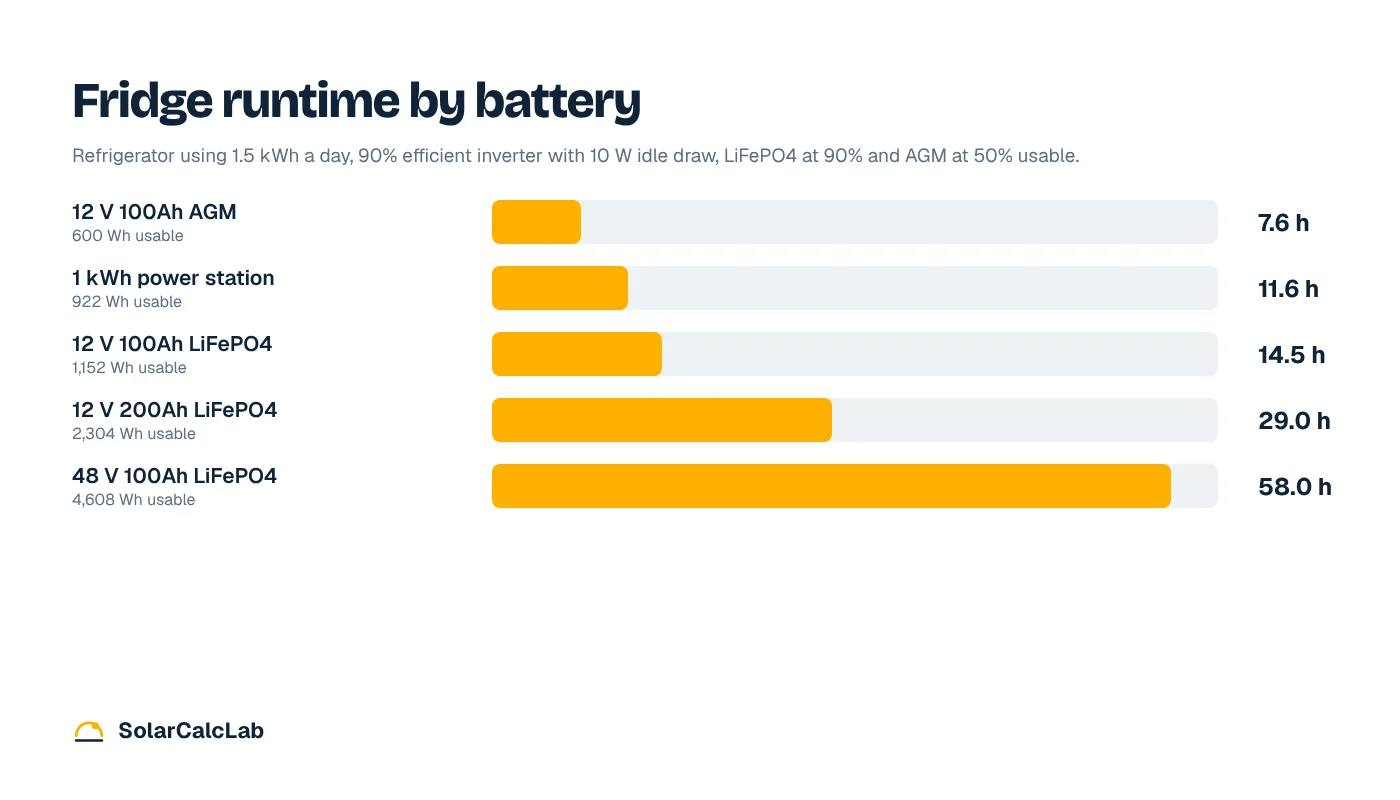
The table uses three fridges by daily energy: 1.0 kWh a day (an efficient top-freezer model), 1.5 kWh (a typical bottom-freezer or side-by-side) and 2.0 kWh (a large French door). If you do not know your number, the yellow EnergyGuide label gives yearly kWh; divide by 365. Our guide to how many watts a refrigerator uses lists typical figures by type.
| Battery | Usable energy | Fridge at 1.0 kWh/day | Fridge at 1.5 kWh/day | Fridge at 2.0 kWh/day |
|---|---|---|---|---|
| 12 V 100Ah AGM (50% usable) | 600 Wh | 10.7 h | 7.6 h | 5.8 h |
| 12 V 100Ah LiFePO4 | 1,152 Wh | 20.5 h | 14.5 h | 11.2 h |
| Power station, 1,024 Wh | 922 Wh | 16.4 h | 11.6 h | 9.0 h |
| 12 V 200Ah LiFePO4 | 2,304 Wh | 40.9 h | 29.0 h | 22.5 h |
| 48 V 100Ah LiFePO4 (5.12 kWh) | 4,608 Wh | 81.9 h | 58.0 h | 44.9 h |
Assumptions: lithium batteries at 90% usable capacity, AGM at 50%, a 90% efficient inverter and 10 W of inverter idle draw. Change any of those in the battery life calculator to match your own gear.
The runtime formula, step by step
Battery draw (W) = fridge average watts ÷ inverter efficiency + inverter idle watts
Runtime (hours) = usable battery Wh ÷ battery draw
Worked example: 12 V 100Ah lithium and a bottom-freezer fridge
- Usable energy: 12.8 V × 100 Ah = 1,280 Wh, and 90% of that is 1,152 Wh. The Ah to Wh converter does this first step for any battery.
- Fridge average: 1.5 kWh × 1,000 ÷ 24 = 62.5 W.
- Battery draw: 62.5 ÷ 0.90 = 69.4 W, plus 10 W idle = 79.4 W.
- Runtime: 1,152 ÷ 79.4 = 14.5 hours.
Without the idle line the answer would be 16.6 hours. Those 10 W cost two hours of fridge time, which is why the inverter you pick matters almost as much as the battery.
Worked example: what a three-day outage needs
Say you want to keep the 1.5 kWh fridge cold for three days with no recharging. Each day the battery supplies 1.5 ÷ 0.90 = 1.67 kWh for the fridge plus 0.24 kWh of idle (10 W × 24 h), or 1.91 kWh. Three days is 5.72 kWh usable, which means about 6.4 kWh of nominal LiFePO4 capacity. A single 5.12 kWh rack battery falls a little short; it gets you about 2.4 days. For a full plan that includes lights, internet and a furnace blower, work through how much battery storage you need.
Four things that cut runtime
1. Inverter idle draw
Every inverter uses some power just to stay on. Small, efficient units are low: Victron, for example, lists 7 W of zero-load power for its Phoenix 12/1200. Large inverters and all-in-one units are often 30 to 80 W. A fridge averaging 62.5 W paired with a 50 W idle draw spends nearly as much energy on the inverter as on the food. Use the smallest pure sine inverter that handles the startup surge, which for most full-size fridges is about 1,000 W continuous.
2. Lead-acid depth of discharge
An AGM battery holds about as many nameplate watt-hours as a lithium battery of the same Ah, but taking it below about 50% shortens its life sharply. That is why the 100Ah AGM row above runs barely half as long. A fridge drawing all night is exactly the deep daily cycling lead-acid handles worst.
3. A warm room and an open door
Duty cycle rises when the kitchen is hot or the door opens often. If your fridge uses 30% more energy on a summer day than its label says, the 100Ah lithium runtime drops from 14.5 to 11.5 hours. During an outage, keep the door shut and group trips to the fridge.
4. Startup surge and the battery’s BMS
A compressor can pull 600 to 1,200 W for a second or two when it starts. On a 12 V battery that is roughly 52 to 104 A after inverter losses. Many 12 V 100Ah lithium batteries have a 100 A battery management system, so a hard-starting fridge on a nearly empty battery can trip it. If the inverter beeps and shuts off each time the compressor kicks in, that is usually the cause.
How long does a fridge need power in an outage?
Not every hour of an outage needs battery power. According to FoodSafety.gov, a refrigerator keeps food safe for up to 4 hours if the door stays closed, and the target is 40°F or colder. A full freezer holds for up to 48 hours closed, and a half-full one for 24 hours.
That buys flexibility. With a small battery you can save it for the evening and overnight hours, when the house is warmest from the day and an outage is hardest to wait out. Put an appliance thermometer in the fridge and let the reading, not a schedule, decide when the battery goes on. Once the fridge has been above 40°F for more than 4 hours, the guidance is to throw out perishable food.
Which setup fits your goal?
| Goal | Fridge at 1.5 kWh/day | Practical setup |
|---|---|---|
| Get through one night (12 hours) | About 950 Wh from the battery | 12 V 100Ah LiFePO4 or a 1 kWh power station, small 1,000 W inverter |
| A full day without recharging | About 1.9 kWh | 12 V 200Ah LiFePO4 or a 2 kWh power station |
| A three-day storm outage | About 5.7 kWh usable | 6 to 7 kWh of LiFePO4, or 5 kWh plus a solar panel |
| Indefinite, with solar | About 1.9 kWh a day | 400 to 600 W of panels plus a 2 kWh battery |
On the solar row: 400 W of panels at 4.5 peak sun hours and 80% system efficiency make about 1.44 kWh a day, enough for an efficient fridge but short for the 1.5 kWh model once idle draw is counted. That is why the table suggests up to 600 W. The solar panel charging time calculator shows how fast a given panel refills your battery.
If you already own a home battery, the fridge is a small slice of it. A 13.5 kWh unit could run a 1.5 kWh fridge alone for about eight days on paper, but in a real outage it also feeds lights, the furnace blower and everything else on the backed-up panel, so plan the whole load rather than the fridge alone.
What about a 12 V DC fridge?
For RVs, vans and boats, a fridge that runs straight from 12 V skips the inverter entirely, so there is no idle draw and no conversion loss. Take away the 10 W idle and the 90% conversion step, and the same 1,152 Wh battery runs a 62.5 W average load for 18.4 hours instead of 14.5, about 27% longer. That is the main reason people living off a single battery buy DC compressor fridges even though they cost more up front.
Battery died sooner than expected? Check these
- The inverter was left on with a large idle draw. Check the “no-load consumption” line on the spec sheet and compare it with the fridge’s average.
- The battery was not full. A battery stored at 60% gives 60% of the runtime. Top it up before storm season.
- Cold storage. Lithium batteries kept in an unheated garage can limit charging below freezing, and lead-acid loses usable capacity in the cold.
- Defrost cycles. Frost-free fridges run a heater of a few hundred watts for a short spell once or more a day. A runtime test of only a few hours can miss it.
- The fridge is older than its label. Dirty condenser coils and worn door seals raise energy use. Measure it with a plug-in meter for 24 hours to get the real number.
For a fridge that has to share the battery with other loads, the battery backup calculator totals everything at once, and our 100Ah solar battery guide covers what a single 12 V battery can and cannot run.
Frequently asked questions
Can a 100Ah battery run a refrigerator overnight?
Yes, if it is lithium. A 12 V 100Ah LiFePO4 battery with a small inverter runs a typical 1.5 kWh-a-day fridge for about 14 hours. A 100Ah AGM battery manages about 7 to 8 hours before it reaches 50%, which may not last until morning.
How many batteries do I need to run a refrigerator for 24 hours?
About 1.9 kWh of usable energy for a typical fridge, including inverter losses and a 10 W idle draw. That is two 12 V 100Ah lithium batteries or one 200Ah, or four 100Ah AGM batteries if you stay above 50% charge.
What size inverter do I need for a refrigerator on a battery?
A pure sine wave inverter of about 1,000 W continuous with roughly 2,000 W of surge handles most full-size fridges. Going much larger raises idle draw and shortens runtime. The inverter size calculator checks the surge for your model.
Will a power station run a full-size refrigerator?
Most 1,000 Wh class power stations can start and run a full-size fridge. Expect roughly 9 to 16 hours depending on the fridge, a little less than a 100Ah lithium battery because a 1,024 Wh unit stores less energy.
Is it better to run the fridge all the time or in intervals during an outage?
Keeping the door shut matters more than the pattern. An unopened fridge stays safe for up to 4 hours without power, so with a small battery you can run it in blocks, as long as an appliance thermometer shows 40°F or below. Do not let it sit above 40°F for more than 4 hours.