200Ah Battery: How Many kWh It Holds and How Long It Lasts

Short answer
A 12 V 200Ah battery stores 2.4 kWh, or 2.56 kWh for a 12.8 V lithium (LiFePO4) model. You can safely use about 2.3 kWh from lithium but only about 1.2 kWh from lead-acid, which should stay above 50%. That runs a 12 V van fridge for about 5 days on lithium, or 1,000 W through an inverter for about 2 hours.
When people shop for a 200 amp battery, they almost always mean a 200 amp-hour (200Ah) deep cycle battery: the big single battery that sits under an RV step, in a van build, or in the hull of a fishing boat. It is the most common size for anyone who wants to run a fridge, lights and a laptop for a few days without plugging in.
The amp-hour label alone does not tell you how much energy you have. Voltage and chemistry decide that. This guide converts 200Ah into kWh, shows runtimes for real 12 V loads, and covers the solar, charging and inverter limits that seller blogs skip.
Is a “200 amp battery” the same as 200 amp-hours?
In everyday use, yes. A 200 amp-hour rating means the battery can, in theory, deliver 200 amps for one hour, 10 amps for 20 hours, or any combination that multiplies to 200. Amp-hours measure stored charge, while amps measure the flow of current at a given moment.
Do not confuse it with two other numbers. Many 12 V 200Ah lithium batteries list a 200 A continuous discharge limit, which is the most current the built-in battery management system (BMS) allows. Engine starting batteries are rated in cold cranking amps, a burst rating that says nothing about deep daily cycling.
How many kWh is a 200Ah battery at 12 V, 24 V and 48 V?
Multiply amp-hours by the nominal voltage to get watt-hours, then divide by 1,000 for kWh. Lithium iron phosphate (LiFePO4) batteries are built from 3.2 V cells, so a “12 V” model is really 12.8 V, which is why lithium labels say 2,560 Wh instead of 2,400 Wh.
Example: 200 Ah × 12.8 V ÷ 1,000 = 2.56 kWh
Usable energy is what matters for runtime. This site plans with 90% usable capacity for lithium. Lead-acid (flooded, AGM or gel) should be kept above half charge for a reasonable life, so we count 50%.
| 200Ah battery | Nominal voltage | Total energy | Usable energy | Usable amp-hours |
|---|---|---|---|---|
| 12 V lead-acid (AGM) | 12 V | 2.4 kWh | 1.2 kWh (50%) | 100 Ah |
| 12 V LiFePO4 | 12.8 V | 2.56 kWh | 2.3 kWh (90%) | 180 Ah |
| 24 V LiFePO4 | 25.6 V | 5.12 kWh | 4.6 kWh | 180 Ah |
| 48 V lead-acid bank | 48 V | 9.6 kWh | 4.8 kWh | 100 Ah |
| 48 V LiFePO4 | 51.2 V | 10.24 kWh | 9.2 kWh | 180 Ah |
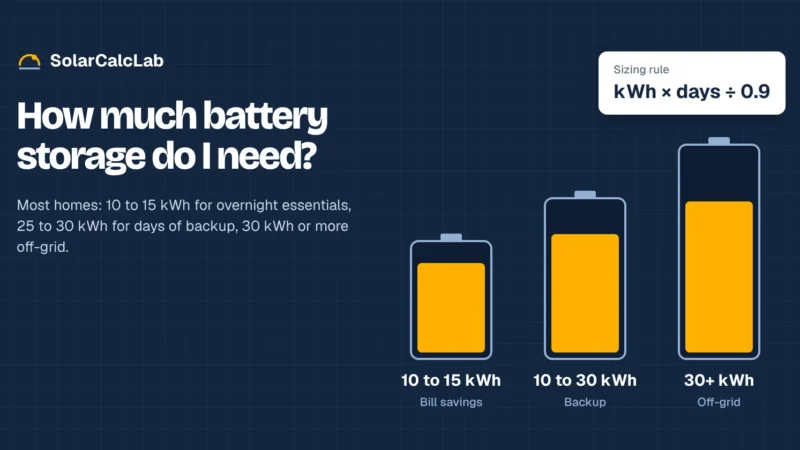
A 200Ah battery at 48 V holds four times the energy of one at 12 V. That is why a 48 V 200Ah rack battery is a home backup product, closer to a 10 kWh battery, while a 12 V 200Ah battery is a mobile and marine product. For other sizes, the Ah to kWh converter does the math for any voltage.
How long will a 12 V 200Ah battery run my loads?
On a 12 V system it is easiest to think in amps. Divide each load’s watts by battery voltage to get its current draw, then divide usable amp-hours by that current. Loads that run through an inverter (anything with a household plug) draw more, because the inverter loses roughly 10% as heat.
AC load: hours = usable Ah ÷ (watts ÷ (12.8 × 0.9))
Example: 180 Ah ÷ (1,000 W ÷ 11.52) = 180 ÷ 86.8 A = about 2.1 hours
The table uses 180 Ah usable for lithium and 100 Ah usable for AGM, with each load running alone. Wattages are typical values, so check the label on your own gear.
| Load (typical draw) | Current at 12.8 V | LiFePO4 (180 Ah) | AGM (100 Ah) |
|---|---|---|---|
| LED lights, 24 W total (DC) | 1.9 A | about 96 hours | about 53 hours |
| 12 V compressor fridge, 0.4 kWh a day (DC) | 1.3 A average | about 5.8 days | about 3.2 days |
| Roof vent fan on medium, about 3 A (DC) | 3 A | 60 hours | about 33 hours |
| CPAP, 40 W, no heated humidifier (DC) | 3.1 A | about 7 nights of 8 hours | about 4 nights |
| Trolling motor at mid speed, about 25 A | 25 A | about 7 hours | under 4 hours |
| TV, 100 W (via inverter) | 8.7 A | about 20 hours | about 11 hours |
| Microwave, 1,200 W input (via inverter) | 104 A | about 1 hour 45 minutes | under 1 hour |
| RV rooftop AC, about 1,500 W running (via inverter) | 130 A | about 1 hour 20 minutes | not practical |
RV air conditioners vary, so read the running watts or amps on the data plate. For a full list of your own devices, the battery backup calculator adds up mixed loads and hours of use.

Why does a 200Ah lead-acid battery deliver less than its label?
Two effects stack up against lead-acid. The first is depth of discharge. Renogy, for example, rates its 12 V 200Ah AGM at 500 cycles at 50% depth of discharge and advises against going lower, so half the label is your daily budget.
The second is discharge rate. Lead-acid amp-hour ratings are usually measured over 20 hours, which for a 200Ah battery is a gentle 10 A. Pull current faster and you get less. Trojan’s T-105 data shows 225 Ah at the 20-hour rate but only 185 Ah at the 5-hour rate, about 82%. Applied to a 200Ah AGM running a steady 40 A load, that suggests roughly 164 Ah total and only about 82 Ah you should actually use.
LiFePO4 holds its rated capacity far better at moderate currents. In usable terms, one 200Ah lithium battery is close to two 200Ah AGMs, at about 45 pounds instead of roughly 256.
A real van day: how many amp-hours do you use?
What you really need is a daily budget. Here is a typical weekend van setup in amp-hours at 12.8 V.
| Load | Use per day | Energy | Amp-hours |
|---|---|---|---|
| 12 V compressor fridge | 24 hours, cycling | 400 Wh | 31 Ah |
| Roof vent fan, 3 A | 8 hours | 307 Wh | 24 Ah |
| Laptop, 60 W | 4 hours | 240 Wh | 19 Ah |
| LED lights, 24 W | 5 hours | 120 Wh | 9 Ah |
| Phones and small USB devices | charging | 40 Wh | 3 Ah |
| Water pump, about 6 A | 15 minutes | 19 Wh | 2 Ah |
| Total | about 1.13 kWh | about 88 Ah |
At 88 Ah a day, a 200Ah LiFePO4 battery (180 Ah usable) carries this van about 2 days with no charging at all. A 200Ah AGM (100 Ah usable) lasts only about 1 day before it reaches the 50% floor.
How many solar panels does it take to charge a 200Ah battery?
Use this site’s standard planning values: 4.5 peak sun hours as a US middle value and 80% system efficiency for heat, wiring and controller losses. Your own sun hours can be checked with NREL’s PVWatts calculator.
Example: 1,130 Wh ÷ (4.5 × 0.8) = about 314 W
- To keep up with the van day above: about 300 to 400 W of panels. A 400 W array makes about 1,440 Wh, or 112 Ah, on an average day.
- To refill a fully drained lithium battery in one day: 2,304 Wh ÷ 3.6 = about 640 W, such as two 430 W residential panels on a cabin or trailer rack.
- In winter: at 2.5 sun hours, 400 W makes only about 800 Wh, so plan on running the engine, a generator or shore power to top up.
A charge controller sits between the panels and the battery. For 400 W on 12 V, divide watts by battery voltage: 400 ÷ 12.8 is about 31 A, so a 40 A MPPT controller gives sensible headroom. The charge controller calculator handles other array sizes and voltages.
How long does a 200Ah battery take to charge?
Divide the amp-hours you need to replace by the charger’s current, then add about 10% for losses and the slow finish near full. The times below refill a lithium battery from 10% to full, which is 180 Ah.
| Charging source | Charge current | Time to replace 180 Ah |
|---|---|---|
| Shore power charger | 20 A | about 10 hours |
| DC-DC charger from the vehicle alternator | 40 A | about 5 hours of driving |
| Larger shore or inverter-charger | 60 A | about 3.3 hours |
| 400 W solar, 4.5 sun hours | about 112 Ah a day | about 1.6 days |
Lead-acid needs a long absorption stage near the top, so its final 20% can take several hours whatever the charger size. Try your own numbers in the battery charging time calculator.
Charging in cold weather
Most LiFePO4 batteries block charging below about 32°F (0°C) to protect the cells. If you camp or fish in freezing weather, choose a self-heating model or keep the battery inside the heated living space.
What size inverter can a 12 V 200Ah battery handle?
This is the limit most buyers discover too late. A typical 12 V 200Ah lithium battery has a 200 A continuous BMS limit. At 12.8 V that is 2,560 W of DC power, or about 2,300 W of AC output after inverter losses. A 2,000 W inverter is the practical ceiling for one battery.
Example: 3,000 W ÷ (12.8 × 0.9) = about 260 A, above a 200 A BMS limit
A 3,000 W inverter on one 200Ah battery will trip the BMS at full load. Put two batteries in parallel or move to 24 V instead. The inverter size calculator matches inverter size to your loads.
High current also means heavy cable. Size wires for the full inverter current, keep runs short, and fuse the positive cable close to the battery terminal.
Should you build at 12 V, 24 V or 48 V with 200Ah batteries?
Two 12 V 200Ah batteries can be wired two ways, and the stored energy is the same either way: 5.12 kWh for lithium.
- Parallel: 12 V, 400 Ah. Keeps every 12 V fridge, pump and light compatible. Best for vans, small RVs and boats.
- Series: 24 V, 200 Ah. Halves the current for the same power, so cables shrink and a 3,000 W inverter becomes realistic. Common on larger boats and cabins.
Four in series reach 51.2 V for a home or cabin, but a purpose-built 48 V rack battery is usually simpler. For a small cabin or outage kit, compare a 5 kWh battery first.
How much does a 200Ah battery cost, and which lasts longer?
Typical US prices in late 2026 run about $350 to $550 for a 12 V 200Ah AGM and about $400 to $1,800 for 200Ah of 12 V LiFePO4. The low end is a single budget-brand 200Ah battery. The high end is two premium 100Ah batteries with longer warranties and support.
The gap closes once you count lifetime energy.
| 12 V 200Ah AGM | 12 V 200Ah LiFePO4 | |
|---|---|---|
| Example price | $400 | $650 |
| Usable energy per cycle | 1.2 kWh | 2.3 kWh |
| Cycles assumed | 500 at 50% depth | 4,000 (below typical 6,000 rating) |
| Lifetime energy | 600 kWh | 9,200 kWh |
| Cost per kWh delivered | about $0.67 | about $0.07 |
| Weight | about 128 lb | about 45 lb |
AGM still makes sense for a battery that sits on float most of the year. For anything cycled daily, lithium costs less in the long run.
Frequently asked questions
How long will a 200Ah battery last with a 1,000 W load?
A 12 V 200Ah LiFePO4 battery has about 2.3 kWh usable. Through an inverter that loses 10%, a 1,000 W load draws about 87 A, so the battery lasts about 2 hours. A 200Ah AGM gives under 1 hour before it reaches 50%, because of its lower usable capacity and the high discharge rate.
How many solar panels do I need to charge a 200Ah battery?
About 300 to 400 W of panels keeps up with typical van or RV use of around 1.1 kWh a day at 4.5 peak sun hours. To refill a fully drained 12 V 200Ah lithium battery in one day, you need about 640 W, plus a 40 A to 60 A MPPT charge controller.
Is a 200Ah lithium battery better than a 200Ah AGM?
For daily cycling, yes. Lithium gives about 180 Ah usable versus 100 Ah for AGM, weighs about a third as much, and lasts thousands of cycles instead of hundreds. AGM costs less upfront and suits a battery that mostly sits on float, such as standby backup or a boat used a few weekends a year.
Can a 200Ah battery run an RV air conditioner?
Only briefly. A rooftop unit drawing about 1,500 W needs roughly 130 A from a 12 V battery, so one 200Ah lithium battery runs it for about 1 hour 20 minutes. Overnight cooling needs two to four times that capacity, a 24 V or 48 V bank, or a soft starter and generator.
How many kWh is a 48 V 200Ah battery?
A true 48 V 200Ah battery holds 9.6 kWh, and a 51.2 V LiFePO4 rack battery holds 10.24 kWh, with about 9.2 kWh usable at 90%. That is often enough to back up a fridge, lights, internet and a few circuits in a home for about a day, which a 12 V 200Ah battery cannot do.