What Will a 20kW Inverter Run? Appliances, Battery Size and Solar Panels
Short answer
A 20kW inverter can power up to 20,000 watts of appliances at the same time, enough for an all-electric home running central air, a dryer, a water heater and cooking together. In US homes it is usually two 10 to 12 kW hybrid inverters stacked, while businesses use one three-phase unit. Pair it with about 22 to 27 kW of panels and at least 25 to 30 kWh of battery.
Twenty kilowatts is where inverter shopping changes. Below this size, one wall-mounted box usually covers the whole house. At 20 kW, you are either combining two hybrid units into a single split-phase system or buying a three-phase inverter built for shops, farms and small commercial buildings.
Below, you will see what that much power runs, how it copes with motor starts, the battery and array it needs, and why the panel connection is often the hardest part.
Note that searches for an “inverter 20000 watt” often return 2,000 watt RV units. This page covers 20,000 watts.
Is a 20kW inverter one box or two?
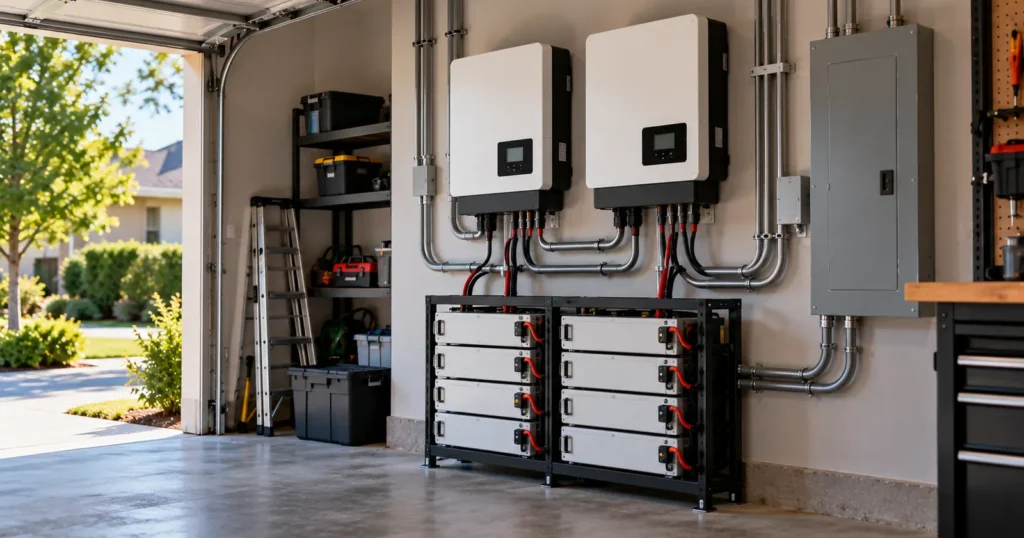
It depends on the building’s electrical service. Most US homes have 120/240 V split-phase service, and very few split-phase hybrid inverters reach 20 kW in a single unit. Popular models top out around 12 to 15 kW, so installers reach 20 kW or more by paralleling two units.
For example, the EG4 18kPV is rated 12,000 W at 240 V with a 50 A continuous output, and the maker allows up to 10 units in parallel. Two of them give 24 kW, comfortably above a 20 kW target. The Sol-Ark 15K is rated 15,000 W and can be paralleled the same way.
Commercial buildings usually have three-phase service, and that is where single 20 kW inverters are common. The AC current per conductor depends on the voltage:
Three phase: Amps = Watts ÷ (1.732 × line voltage)
Example: 20,000 ÷ (1.732 × 208) = 55.5 A per phase
| Service type | Common setup | Current at 20 kW | Typical user |
|---|---|---|---|
| 120/240 V split phase | Two 10 to 12 kW hybrids in parallel | 83.3 A | Large or all-electric homes |
| 208Y/120 V three phase | One three-phase inverter | 55.5 A per phase | Shops, offices, apartment buildings |
| 480Y/277 V three phase | One three-phase string inverter | 24.1 A per phase | Farms, warehouses, light industrial |
| 400 V three phase (UK, EU, AU) | One three-phase hybrid | 28.9 A per phase | Larger homes with three-phase supply |
What will a 20kW inverter run?
The rule is simple: add the running watts of everything that can be on at the same moment, then keep that total under 20,000 W with some margin. The table below uses typical running watts. Your nameplates may differ, so check them or use the solar load calculator to total your own list.
| Load | Typical running watts | Share of 20 kW |
|---|---|---|
| Level 2 EV charger at 48 A | 11,520 W | 58% |
| Level 2 EV charger at 32 A | 7,680 W | 38% |
| Electric range, oven plus two burners | 4,000 to 7,000 W | 20 to 35% |
| Electric clothes dryer | 5,000 to 6,000 W | 25 to 30% |
| Electric tank water heater | 4,500 W | 23% |
| Central air or heat pump, 3 ton | 3,000 to 4,000 W | 15 to 20% |
| Well pump, 1 hp | 1,000 to 1,500 W | 5 to 8% |
| Microwave | 1,000 to 1,500 W | 5 to 8% |
| Refrigerator | 150 to 400 W | 1 to 2% |
EV charger figures are amps times 240 V. One fast charger uses more than half the inverter.
Three real-world load mixes
All-electric home at dinner time: central air 3,500 W, range 4,000 W, dryer 5,500 W, water heater 4,500 W, refrigerator 200 W and lights and electronics 800 W. Total: 18,500 W. It fits, with 1,500 W to spare. Plug in a 32 A EV charger and the total jumps to 26,180 W, which overloads it.
Home with a 48 A EV charger: charger 11,520 W, central air 3,500 W and water heater 4,500 W add up to 19,520 W. It runs, but nothing else large can start. Many hybrids let you program the EV circuit as a load that sheds first.
Small shop on three-phase power: a rooftop HVAC unit at 6,000 W, a walk-in cooler at 2,500 W, kitchen equipment at 5,000 W, lighting at 2,000 W and computers at 800 W total 16,300 W. Spread evenly, that is about 5,400 W per phase, well inside a 20 kW three-phase inverter.
How does a 20kW inverter handle motor starting current?
Compressors and pumps draw a large burst of current for a fraction of a second when they start. Nameplates list it as locked rotor amps (LRA). Multiply LRA by voltage to see the burst.
Example: 75 A LRA × 240 V = 18,000 VA for well under a second
If 12 kW of other loads are already running when that compressor starts, the inverter momentarily sees about 30 kVA. That is where datasheets need careful reading. Many hybrid “surge” ratings are minutes-long overloads, not instant peaks. The EG4 18kPV, for instance, lists 14,700 W for 10 minutes with solar, roughly 22% above its rating. Other models list a short peak, such as 2 times rated power for half a second.
A stacked pair doubles both figures. To stay safe:
- Fit a soft starter on central air and heat pump compressors.
- Stagger large motor loads so two never start together.
- Keep steady loads at or below about 80% of rating, so 16 kW, when big motors share the system.
The inverter size calculator adds a surge allowance to your running watts so you can test your own mix.
How much battery does a 20kW inverter need?
Two limits apply: energy stored and power delivered at once. At 20 kW, the power limit often sets the minimum bank size.
The current limit
Nearly all home hybrids run on 48 V batteries. Using 94% battery-to-AC efficiency, a full 20 kW load pulls:
Example: 20,000 ÷ (48 × 0.94) = 443 A
With two inverters, each draws about 222 A, under the 250 A limit on units like the 18kPV. The batteries must supply the full 443 A together. If each 48 V, 100 Ah rack module (about 5.1 kWh) is rated 100 A continuous, you need at least five modules, or roughly 25.6 kWh, just to deliver full power. Check the continuous discharge rating on your battery datasheet, since it varies widely by model.
Runtime by bank size
Runtime uses 90% usable capacity and 94% inverter efficiency. Few homes run near 20 kW for long, so the middle columns are most realistic.
Example: 40 kWh × 0.90 × 0.94 ÷ 6 kW = 5.6 hours
| Battery bank | Usable AC energy | 3 kW load | 6 kW load | 10 kW load | 20 kW load |
|---|---|---|---|---|---|
| 20 kWh | 16.9 kWh | 5.6 h | 2.8 h | 1.7 h | 0.8 h |
| 30 kWh | 25.4 kWh | 8.5 h | 4.2 h | 2.5 h | 1.3 h |
| 40 kWh | 33.8 kWh | 11.3 h | 5.6 h | 3.4 h | 1.7 h |
| 60 kWh | 50.8 kWh | 16.9 h | 8.5 h | 5.1 h | 2.5 h |
For whole-day coverage, start from your daily use. The US Energy Information Administration puts the average home at about 10,800 kWh a year, close to 30 kWh a day. Covering one average day takes 30 ÷ (0.90 × 0.94) = 35.5 kWh of battery. Homes that need a 20 kW inverter usually use more than average, so 40 to 60 kWh banks are common. Our 30 kWh battery guide shows what one day of backup looks like in practice, and the battery backup calculator runs the numbers for your own loads.
How many solar panels go with a 20kW inverter?
Three-phase grid-tie: size by DC-to-AC ratio
Grid-tie inverters usually get 10% to 35% more panel capacity than their AC rating, since panels rarely reach full label output. SolarEdge’s former 20 kW three-phase model, for example, accepted up to 27,000 W of DC. That ratio range gives 22 to 27 kW of panels, or 52 to 63 panels at 430 W each.
Example: 25,000 W ÷ 430 W = 58.1, so 59 panels
Stacked hybrids: check each unit’s PV limit
Each hybrid has its own solar input limit and MPPT voltage window. The 18kPV can use up to 18,000 W of solar and recommends no more than 21,000 W per unit, so a pair can take far more than you will likely need. A practical range for a two-unit home system is 24 to 30 kW of panels, or 56 to 70 panels, split evenly between the units. The how many solar panels calculator turns any target into a panel count.
What that array produces
| Array size | Panels at 430 W | Per day at 4.5 sun hours | Per year (US range) |
|---|---|---|---|
| 22 kW | 52 | 79 kWh | 24,200 to 35,200 kWh |
| 25 kW | 59 | 90 kWh | 27,500 to 40,000 kWh |
| 27 kW | 63 | 97 kWh | 29,700 to 43,200 kWh |
Daily figures use array kW × 4.5 sun hours × 80% system efficiency, and yearly figures use 1,100 to 1,600 kWh per kW. For an address-specific estimate, run the array through NREL PVWatts. If you are still planning the array itself, our 20kW solar system guide covers roof space, cost and payback.
Off-grid systems are different: size the array to energy, not to the inverter. A cabin or farm using 50 kWh a day needs 50 ÷ (4.5 × 0.8) = 13.9 kW of panels at average sun, and more for winter. The 20 kW inverter is there for peak power, not daily energy.
Can a 20kW inverter connect to a 200 amp panel?
This is the step most buyers miss. A grid-connected inverter that feeds a home’s main panel through a breaker must pass the NEC 705.12 “120% rule”:
Example: 200 A bus, 200 A main: 240 − 200 = 40 A left for solar
A 20 kW split-phase system outputs 83.3 A. Multiply by 1.25 and you get 104 A, which means a 110 A breaker, well over the 40 A a standard 200 A panel allows. Even a 400 A panel with a 400 A main leaves only 80 A. Common fixes include:
- Supply-side connection: tapping between the meter and the main breaker, the most common route for systems this large.
- Power control or export limiting: a listed control system that caps current on the busbar, allowed in recent NEC editions.
- Service upgrade: a larger service with a dedicated solar or battery feed.
Rules vary by code edition and utility, so your installer and inspector decide. A 20 kW export system may also face a more detailed utility interconnection review.
What does a 20kW inverter setup cost in 2026?
As typical US retail ranges in late 2026, split-phase hybrid inverters in the 12 to 15 kW class sell for about $4,000 to $5,500 each, so a stacked pair runs roughly $8,000 to $11,000 before batteries, panels, wiring and labor. Three-phase grid-tie inverters vary widely by brand and voltage, so get quotes from a commercial distributor.
On taxes, the 30% federal residential clean energy credit no longer applies to homeowner-owned systems installed after December 31, 2025. Business-owned systems fall under different rules, so confirm eligibility with a tax adviser.
If 20 kW looks like more than you need, our 15kW inverter guide covers a single-unit option that suits many large homes without stacking.
Frequently asked questions
Can a 20kW inverter run a whole house?
Yes, for most homes. A 20,000 W inverter covers central air, an electric range, a dryer and a water heater running together, which totals roughly 18,000 W. Adding a Level 2 EV charger at the same time can push it over, so set the charger as a sheddable load or schedule charging when other big loads are off.
How many amps does a 20kW inverter draw from a 48 V battery?
At full output it pulls about 443 A, using 20,000 W divided by 48 V and 94% efficiency. That current is why 20 kW systems use two inverters, each handling about half, and why the battery bank needs enough modules to supply the combined current continuously without tripping their protection.
Is a 20kW inverter the same as a 20 kVA inverter?
Not always. kW is real power and kVA is apparent power. A 20 kVA inverter with a 0.8 power factor rating delivers only 16 kW of real power. Check the datasheet for continuous output in watts at your voltage, since some units also produce less at 208 V than at 240 V.
Can I combine two 10kW inverters to make 20kW?
Only if the model supports parallel operation. Both units must be the same model and firmware, linked by a communication cable, and usually share one battery bank. Mixing brands or connecting outputs without parallel support can damage both inverters. Many makers recommend leaving headroom, which is why two 12 kW units are a common choice.
What size wire does a 20kW inverter need?
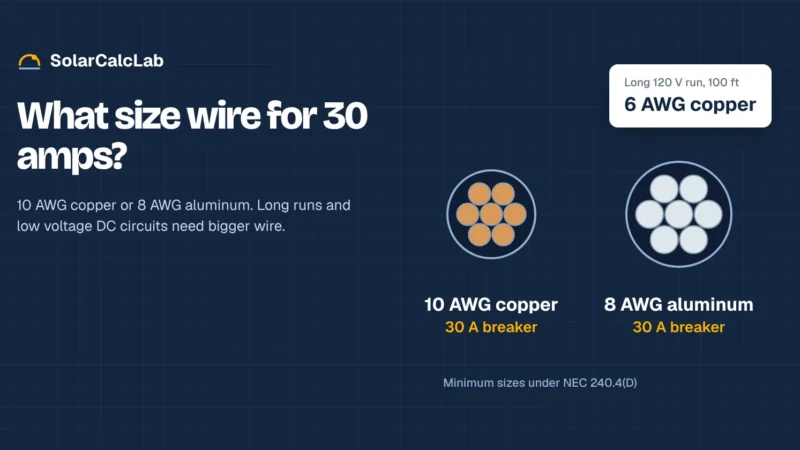
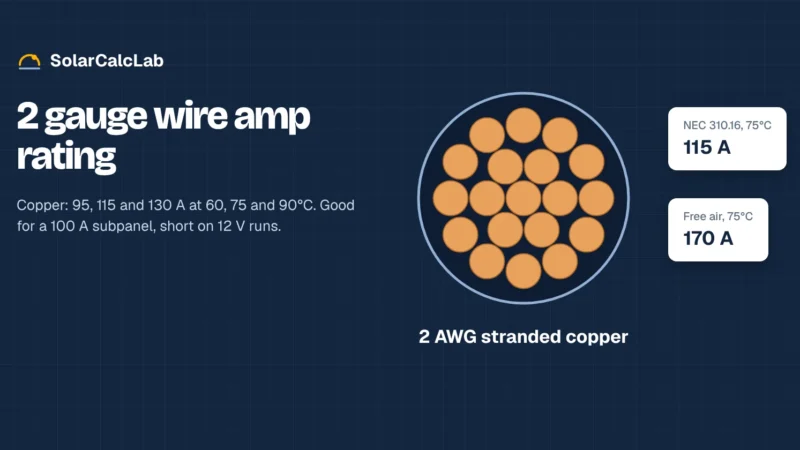
On the AC side, a split-phase 20 kW system at 83.3 A needs a 110 A breaker and matching conductors, while a 208 V three-phase unit needs about a 70 A breaker. Battery cables carry over 400 A combined, so each inverter gets its own heavy cable run and fuse.