What Size Wire for 30 Amps? Sizes by Job and Distance
Short answer
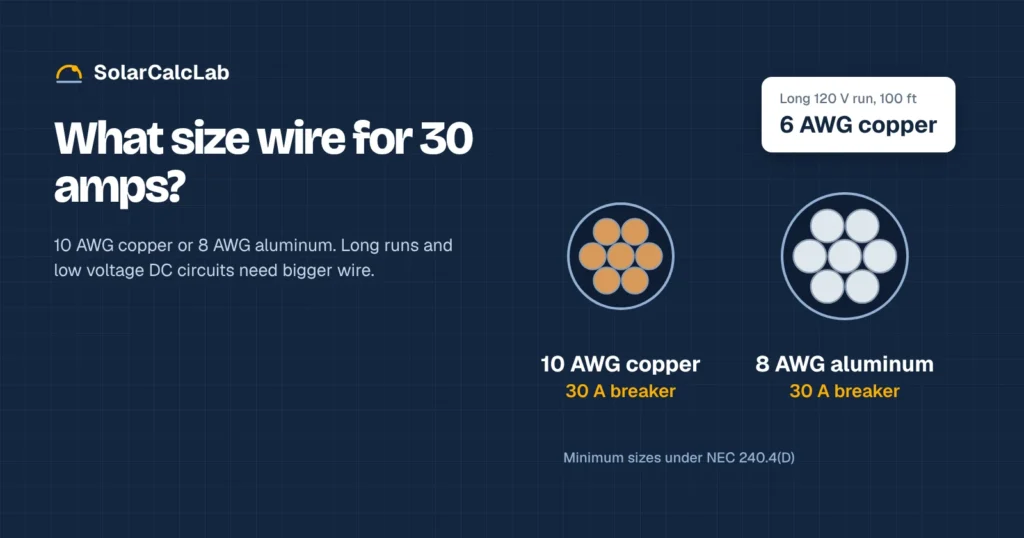
For a 30 amp circuit, use 10 AWG copper wire, such as 10/2 or 10/3 NM-B cable or 10 AWG THHN in conduit. With aluminum, use 8 AWG. Those sizes hold for runs up to about 100 feet at 240 V and about 50 feet at 120 V. Beyond that, voltage drop pushes you to 8 or 6 AWG copper, and a 30 amp DC circuit in a 12 V solar system needs 6 AWG for even a 10 foot run.
The code answer for 30 amps is short. NEC Section 240.4(D) lets 10 AWG copper sit on a 30 amp breaker, and nothing smaller is allowed for general circuits. What makes the question harder is the job behind it. A dryer, a water heater, an RV hookup at the end of a long driveway and a battery cable in a van all draw about 30 amps, yet they can need four different wire sizes.
This guide sorts 30 amp wiring by job and by distance. For the full rating of the wire itself, including derating and the 90°C column, see our 10 gauge wire amp rating guide.
The minimum wire size for a 30 amp breaker
| Wire type | Minimum size on 30 A | Ground wire | Typical use |
|---|---|---|---|
| Copper NM-B (Romex) | 10 AWG | 10 AWG copper | Indoor branch circuits |
| Copper THHN/THWN in conduit | 10 AWG | 10 AWG copper | Garages, outdoor runs, conduit to a shed |
| Copper UF-B | 10 AWG | 10 AWG copper | Direct burial |
| Aluminum (XHHW, SER) | 8 AWG | 8 AWG aluminum | Feeders to subpanels |
Why 8 AWG for aluminum? Section 240.4(D) caps 10 AWG aluminum at 25 amps, so it cannot go on a 30 amp breaker. The ground sizes come from Table 250.122, which lists 10 AWG copper or 8 AWG aluminum for any circuit protected at 30 amps. All of these rules live in NFPA 70, the National Electrical Code.
30 amp wire size by job
Each common 30 amp load has its own cable detail. These are the ones that trip people up.
Electric dryer
Most US dryers use a 30 amp, 240 V circuit. A new dryer circuit needs four wires: two hots, a neutral and a ground, run as 10/3 NM-B with ground to a NEMA 14-30 receptacle. The old three-wire 10-30 setup is only allowed to stay where it already exists. A 5,600 W heating element draws 23.3 amps at 240 V, comfortably inside the 30 amp rating.
Electric water heater
Water heaters count as continuous loads, so the circuit must carry 125% of the nameplate current. A 4,500 W heater draws 18.75 A, sized at 23.4 A. A 5,500 W heater draws 22.9 A, sized at 28.6 A. Both fit a 30 amp breaker with 10/2 cable, since a 240 V water heater needs no neutral.
Level 2 EV charger at 24 amps
EV charging is also continuous. A charger set to 24 amps needs 24 × 1.25 = 30 amps of circuit capacity, so 10 AWG copper on a 30 amp breaker. That delivers 5,760 W at 240 V. If you think you may move to a 40 or 48 amp charger later, pull 6 AWG now. It costs less than opening the wall twice.
30 amp RV hookup
An RV “30 amp” service is 120 V, not 240 V, on a NEMA TT-30 receptacle. It uses 10/2 cable with ground. The catch is distance. RV outlets are often placed far from the panel, and 120 V circuits lose twice the percentage that 240 V circuits do. See the distance table below before you buy cable for a driveway pedestal.
Subpanel in a shed or garage
A 30 amp, 120/240 V feeder needs 10/3 with ground copper or 8 AWG aluminum conductors. In a detached building, keep neutral and ground separate in the subpanel and drive a grounding electrode at the building. Underground UF-B needs 24 inches of cover. In PVC conduit, 18 inches is enough.
Air conditioner or heat pump
Here the nameplate rules, not the breaker. If a condenser lists a minimum circuit ampacity of 21 A and a maximum breaker of 30 A, Section 240.4(G) allows 12 AWG copper THHN in conduit on that 30 amp breaker, because 12 AWG at 75°C carries 25 A. NM cable is held to the 60°C rating of 20 A, so it would not qualify. Read the label before you assume 10 AWG.
30 amp wire size for 100 feet and longer runs
Ampacity tells you what the wire can carry safely. Voltage drop tells you what the load actually gets. The usual target is 3% or less on a branch circuit.
10 AWG copper, 100 ft, 24 A, 240 V: 2 × 100 × 1.24 × 24 ÷ 1,000 = 5.95 V, or 2.48%
The table uses NEC Chapter 9, Table 8 resistance values for uncoated copper and a 24 amp load, the most a 30 amp breaker should carry continuously. It shows the smallest copper size that stays at or under 3%.
| One-way distance | 240 V, 24 A load | 120 V, 24 A load |
|---|---|---|
| 25 ft | 10 AWG (0.62%) | 10 AWG (1.24%) |
| 50 ft | 10 AWG (1.24%) | 10 AWG (2.48%) |
| 75 ft | 10 AWG (1.86%) | 8 AWG (2.33%) |
| 100 ft | 10 AWG (2.48%) | 6 AWG (1.96%) |
| 150 ft | 8 AWG (2.33%) | 6 AWG (2.95%) |
| 200 ft | 6 AWG (1.96%) | 4 AWG (2.46%) |
At 100 feet, 8 AWG on a 120 V RV circuit lands at 3.11%, just over the target, which is why the table jumps to 6 AWG. If the load really pulls the full 30 amps, 10 AWG at 100 feet and 240 V reaches 3.1%, so step up to 8 AWG. Run your own numbers in the voltage drop calculator.
Two details when you upsize
- The ground grows too. Section 250.122(B) says that when you enlarge the hot wires for voltage drop, the ground must grow in proportion. Going from 10 to 6 AWG hots means a 6 AWG copper ground.
- Check the terminals. Many 30 amp breakers and receptacles will not accept 6 or 4 AWG. The usual fix is to land the large wire in a junction box near the end and splice a short 10 AWG pigtail to the device.
30 amps on a 12 V, 24 V or 48 V solar system
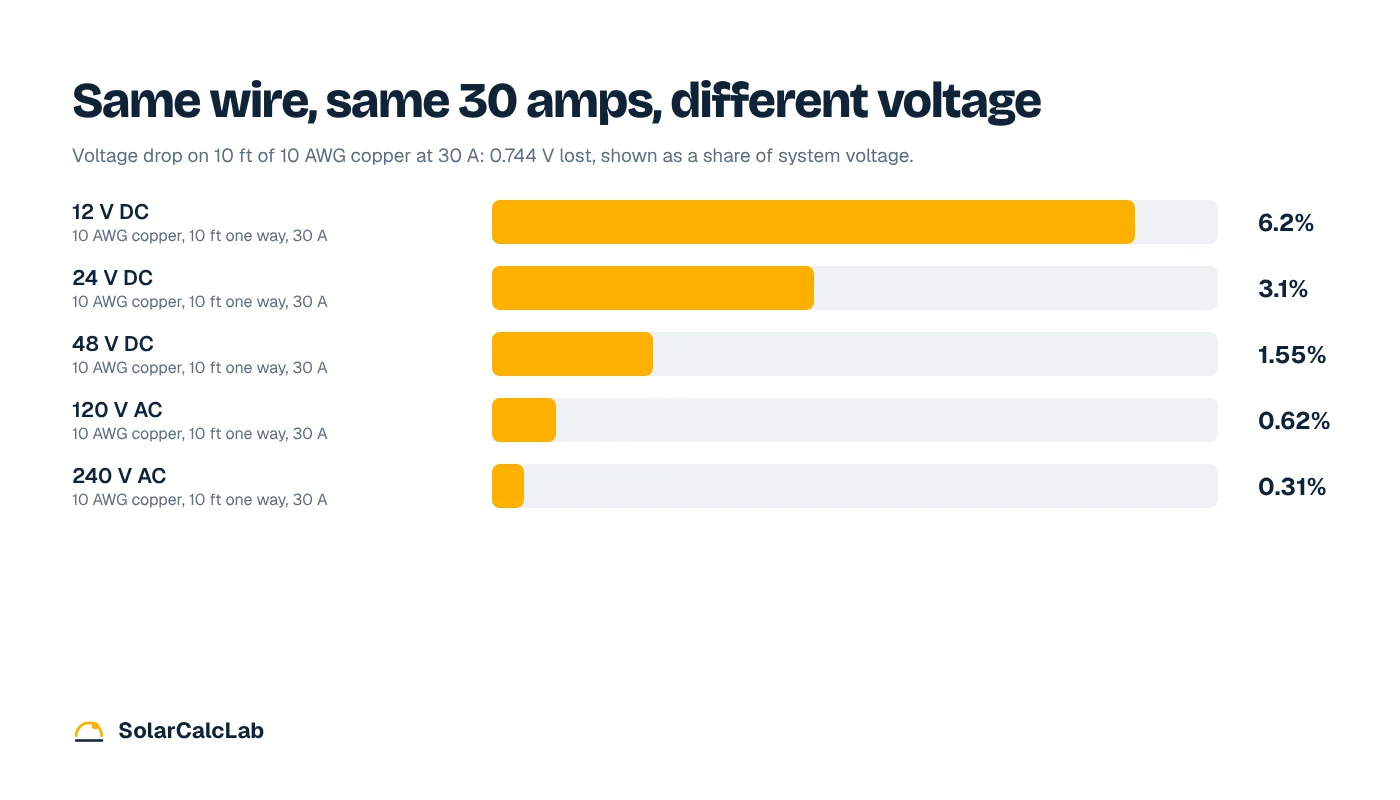
Low voltage DC is where 10 AWG stops being the right answer. The current is the same 30 amps, but each volt lost is a much bigger share of 12 V than of 240 V. Ten feet of 10 AWG at 30 amps drops 0.744 V. At 240 V that would be 0.3%. At 12 V it is 6.2%, enough to stall a controller’s charging or trip an inverter’s low voltage alarm.
| One-way distance at 30 A | 12 V system | 24 V system | 48 V system |
|---|---|---|---|
| 5 ft | 8 AWG | 10 AWG | 10 AWG |
| 10 ft | 6 AWG | 8 AWG | 10 AWG |
| 15 ft | 4 AWG | 8 AWG | 10 AWG |
| 20 ft | 3 AWG | 6 AWG | 8 AWG |
| 30 ft | 2 AWG | 4 AWG | 8 AWG |
Every size here is chosen for a 3% drop. For charge controller to battery runs, many installers aim for 2%, which moves several cells up one more size. The solar cable size calculator handles both targets and accounts for the fuse size too.
Worked example: a 30 amp MPPT in a camper
A 30 amp controller sits 12 feet from a 12 V battery bank. At 6 AWG the drop is 2 × 12 × 0.491 × 30 ÷ 1,000 = 0.35 V, or 2.9%. At 4 AWG it is 0.22 V, or 1.8%. The wire costs a little more, but the battery sees about 0.13 V more at full charge current, which can be the difference between reaching absorption voltage or not.
Common mistakes on 30 amp circuits
- Reusing 12 AWG from an old circuit when a 30 amp breaker goes in. Unless a nameplate exception applies, 12 AWG stops at 20 amps.
- Using 10 AWG aluminum because a copper chart said 10 AWG.
- Running three-wire 10/2 to a new dryer outlet. New dryer circuits need a separate neutral and ground.
- Sizing a long RV run for 240 V when the TT-30 outlet is 120 V.
- Using household rules on battery cables. At 12 V, length matters far more than ampacity.
For sizes above 30 amps, the same logic continues in our guide to wire size for a 40 amp breaker, and the wire gauge amp chart covers every size from 14 AWG to 4/0.
Frequently asked questions
Can I use 12 gauge wire on a 30 amp breaker?
Not for a general circuit. Section 240.4(D) limits 12 AWG copper to 20 amps. The exception is equipment such as an air conditioner whose nameplate lists a 30 A maximum breaker and a minimum circuit ampacity the 12 AWG wire can carry, for example 21 A on 75°C rated THHN.
What size wire do I need for 30 amps at 100 feet?
At 240 V with a 24 amp load, 10 AWG copper keeps the drop at about 2.5%, which is fine. At 120 V, such as an RV outlet, use 6 AWG copper to stay under 3%. If you upsize, the ground wire must grow in proportion.
Is 10/2 or 10/3 wire right for 30 amps?
Use 10/2 with ground for 240 V loads with no neutral, such as a water heater or EV charger, and for a 120 V RV outlet. Use 10/3 with ground when the load needs both 120 V and 240 V, such as a dryer or a subpanel.
What size aluminum wire is needed for 30 amps?
8 AWG aluminum, with an 8 AWG aluminum ground. 10 AWG aluminum is limited to 25 amps.
How many watts can a 30 amp circuit handle?
7,200 W at 240 V and 3,600 W at 120 V as a peak. For loads that run three hours or more, hold it to 24 amps: 5,760 W at 240 V or 2,880 W at 120 V. Convert any appliance rating with the watts to amps calculator.