LiFePO4 vs Lithium Ion: Which Battery Is Better for Solar?

Short answer
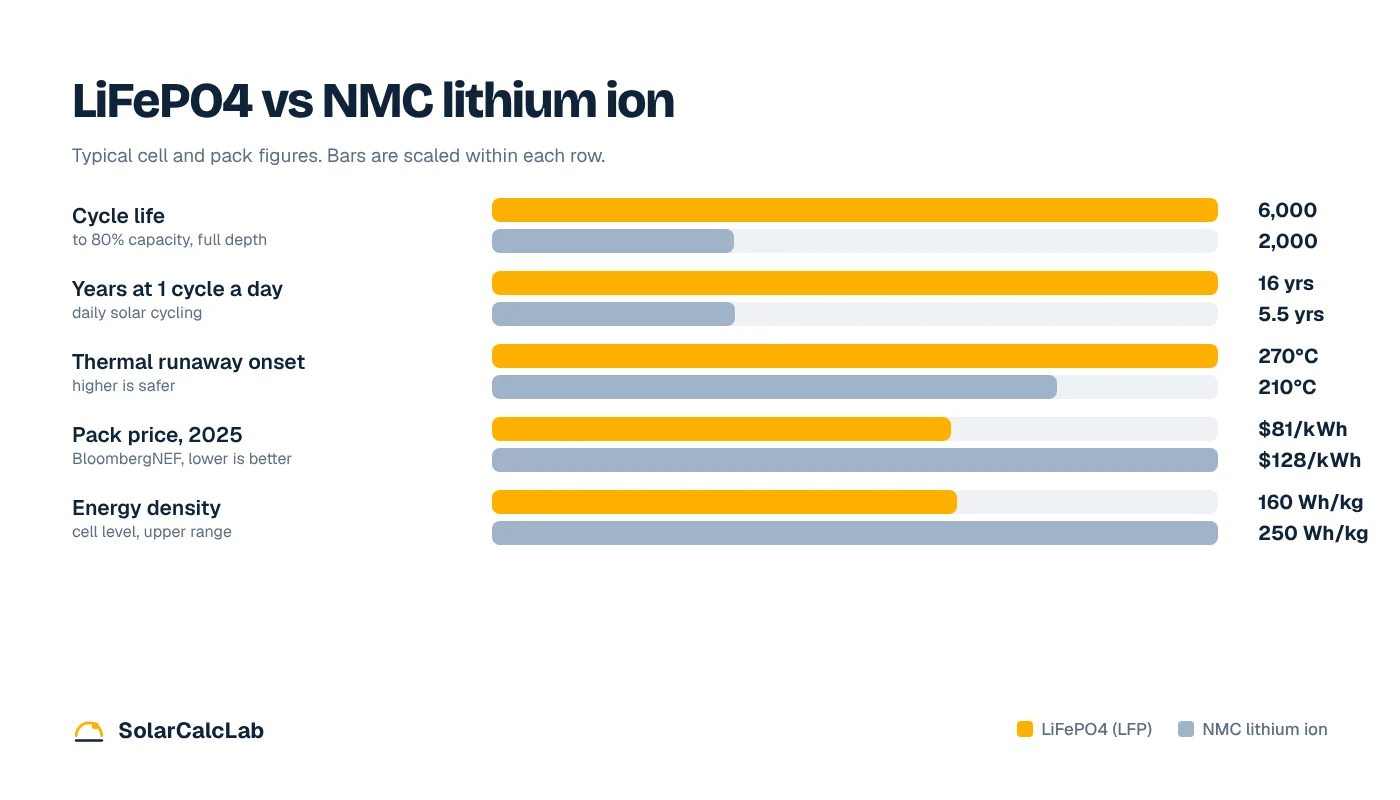
For solar storage, LiFePO4 (lithium iron phosphate, LFP) is the better battery. It lasts 3,000 to 6,000+ cycles versus roughly 1,000 to 2,000 for NMC lithium ion, resists thermal runaway up to about 270°C instead of 210°C, and LFP packs averaged $81/kWh in 2025 against $128/kWh for NMC. NMC only wins on weight and size, which matters in cars, not on a garage wall.
“Lithium ion” is a family, not a single battery. Every lithium battery moves lithium ions between two electrodes, and the cathode material decides how it behaves. The two chemistries you will meet in solar are LiFePO4 (LFP) and NMC (nickel manganese cobalt). So when people search LiFePO4 vs lithium ion, they almost always mean LFP vs NMC.
Below we compare voltage, energy density, cycle life, safety, cost and cold charging, list which home batteries use which chemistry, and work out the cost per cycle.
LiFePO4 vs lithium ion (NMC) at a glance
The table compares typical cell-level figures. Individual products vary, but the gap between the two chemistries is consistent.
| Property | LiFePO4 (LFP) | NMC lithium ion |
|---|---|---|
| Cathode | Lithium iron phosphate | Lithium nickel manganese cobalt oxide |
| Nominal cell voltage | 3.2 V | 3.6 to 3.7 V |
| Energy density (cell) | About 90 to 160 Wh/kg | About 150 to 250 Wh/kg |
| Cycle life (to 80% capacity) | 3,000 to 6,000+ cycles | 1,000 to 2,000 cycles |
| Thermal runaway onset | About 270°C (518°F) | About 210°C (410°F) |
| Pack price, 2025 average | $81/kWh | $128/kWh |
| Contains cobalt or nickel | No | Yes |
| Charging below 32°F (0°C) | Not allowed without heating | Not allowed without heating |
| Main use today | Home storage, RVs, boats, utility batteries | Long-range EVs, phones, laptops, power tools |
Chemistry and nominal voltage
Why LFP cells sit at 3.2 volts
An LFP cell has a nominal voltage of 3.2 V, while an NMC cell runs at 3.6 to 3.7 V. That is why the common battery sizes look different. Four LFP cells in series make a 12.8 V “12 volt” battery, and 16 cells make a 51.2 V “48 volt” battery. NMC packs reach similar system voltages with different cell counts, for example 13 or 14 cells for a 48 V class pack (48.1 V or 51.8 V nominal).
LFP: 4 × 3.2 V = 12.8 V | 16 × 3.2 V = 51.2 V
NMC: 14 × 3.7 V = 51.8 V
A flat discharge curve
LFP holds close to 3.2 to 3.3 V per cell across most of its charge, then drops sharply near empty. That flat curve gives steady power to an inverter, but it also means voltage is a poor fuel gauge between about 20% and 90%. Our LiFePO4 voltage chart lists the state of charge for 12 V, 24 V and 48 V packs. NMC voltage slopes more evenly, so its state of charge is easier to read from voltage alone.
Energy density and weight
NMC stores more energy per kilogram, roughly 150 to 250 Wh/kg at the cell level against about 90 to 160 Wh/kg for LFP. That matters for an electric car, but hardly at all for a battery bolted to a garage wall.
The practical effect is that an LFP home battery of the same capacity is somewhat heavier and larger. In vans, boats and small cabins, a 12 V 100Ah LiFePO4 battery weighs about a third or less of a lead acid battery of the same usable capacity, so space and weight are rarely a reason to choose NMC for solar.
Cycle life and lifespan
How many cycles each chemistry delivers
Cycle life is the biggest difference for solar. A solar battery typically does one full cycle a day: charge from the panels, discharge in the evening. At that pace:
- 6,000 cycles (a good LFP cell) is about 16 years of daily use.
- 4,000 cycles (a budget LFP rating) is about 11 years.
- 2,000 cycles (a typical NMC cell at full depth) is about 5.5 years.
You can model your own pattern with the battery cycle life calculator, which accounts for depth of discharge and temperature.
Calendar aging
Batteries also age with time, even when they sit unused. LFP tolerates being held at a high state of charge better than NMC, which is why many LFP products allow charging to 100% daily while NMC systems often reserve the top 5 to 10%.
Safety and thermal runaway
Thermal runaway is a chain reaction where a cell heats itself, releases gas and can ignite neighboring cells. The iron phosphate cathode holds its oxygen tightly, so LFP cells do not reach runaway until about 270°C (518°F), and when they do, they release far less heat. NMC cells start at about 210°C (410°F) and release oxygen that feeds a fire.
This is not a reason to fear NMC, which is used safely in millions of cars and homes. It is a reason installers prefer LFP for batteries mounted inside or against living spaces. Some earlier NMC home batteries, such as certain LG RESU units, were recalled for fire risk.
Cost per kWh in 2026
Pack and cell prices
LFP has become the low-cost chemistry. In its December 2025 survey, BloombergNEF reported average LFP pack prices of $81/kWh against $128/kWh for NMC, about 37% less, with stationary storage packs averaging just $70/kWh. LFP uses no cobalt or nickel, the two most expensive and price-volatile battery metals.
What you actually pay
Retail prices are much higher than pack prices because of the inverter, enclosure, installation and margin. A 12 V 100Ah LiFePO4 battery (1.28 kWh) sells for roughly $250 to $350 from budget brands such as Redodo and LiTime, around $200 to $270 per kWh. Installed home batteries are a different market: EnergySage’s mid-2026 data puts a typical 13.5 kWh system at about $15,600 before incentives, or roughly $1,160 per kWh. Use the battery calculator to size the capacity you need before comparing quotes.
Cold weather charging
Neither chemistry should be charged below freezing. Charging lithium cells under 32°F (0°C) causes lithium plating on the anode, which permanently cuts capacity and can create internal shorts. Most LFP batteries list a charge range of 32°F to 122°F (0°C to 50°C) and can discharge down to about -4°F (-20°C).
Which one handles cold better?
NMC keeps a little more capacity in the cold and some cells accept a slow charge just below freezing, so it has a small edge. LFP loses more usable capacity in the cold. The fix is simple: buy an LFP battery with low-temperature charge protection or self-heating pads, or install it in a conditioned space. Home batteries like the Powerwall 3 manage their own thermal systems, so this mainly concerns DIY batteries in sheds, RVs and cabins.
Which home batteries use LFP or NMC?
The home battery market has moved almost entirely to LiFePO4. Current models and their chemistry:
| Battery | Chemistry | Usable capacity | Warranty |
|---|---|---|---|
| Tesla Powerwall 3 | LFP | 13.5 kWh | 10 years, 70% retention |
| Tesla Powerwall 2 (older) | NMC | 13.5 kWh | 10 years, 70% retention |
| Enphase IQ Battery 5P | LFP | 5 kWh per unit | 15 years or 6,000 cycles |
| Enphase IQ Battery 10C | LFP | 10 kWh | 15 years or 6,000 cycles |
| FranklinWH aPower 2 | LFP | 15 kWh | 15 years |
| LG RESU Prime 16H | NMC | 14.4 kWh | 10 years |
Tesla’s switch from NMC in the Powerwall 2 to LFP in the Powerwall 3 is the clearest sign of where the market went. The Powerwall 3 warranty now covers unlimited cycles for solar self-consumption and backup, with at least 70% of capacity (9.45 kWh) at 10 years. Check the current datasheet before you buy.
Worked example: cost per cycle
Purchase price alone is misleading. A cheaper battery that wears out in five years can cost twice as much per kWh delivered. Divide the price by the energy the battery will deliver over its life.
Cost per kWh stored = battery price ÷ (usable kWh × rated cycles)
Home battery: LFP vs NMC
Compare two 10 kWh usable home batteries. The LFP unit costs $10,000 and is rated for 6,000 cycles. The NMC unit costs $9,000 and is rated for 3,000 cycles.
| Item | LFP, 10 kWh | NMC, 10 kWh |
|---|---|---|
| Price | $10,000 | $9,000 |
| Rated cycles | 6,000 | 3,000 |
| Cost per cycle | $1.67 | $3.00 |
| Lifetime energy | 60,000 kWh | 30,000 kWh |
| Cost per kWh stored | $0.17 | $0.30 |
| Years at 1 cycle a day | About 16 | About 8 |
Even at an 11% higher purchase price, the LFP battery stores each kWh for about 44% less. If your utility charges $0.30/kWh at peak, the NMC battery barely breaks even on storage cost alone, while the LFP battery saves about $0.13 on every kWh it shifts. The home battery savings calculator runs this against your own rates.
DIY 12 V battery
A 12.8 V 100Ah LiFePO4 battery holds 1.28 kWh. At $269.99 and 4,000 rated cycles, it costs about $0.07 per cycle and $0.053 per kWh stored, which is why LFP has replaced lead acid in almost every off-grid build. See our 100Ah solar battery guide for runtime and panel sizing.
When NMC still makes sense
- Weight is critical, such as portable power for backpacking, drones or e-bikes.
- Space is very tight and you need the most kWh in the smallest box.
- You already own one. A working NMC home battery does not need replacing just because LFP exists.
For a new home, RV, boat or cabin solar system, choose LiFePO4.
Frequently asked questions
Is LiFePO4 a lithium ion battery?
Yes. LiFePO4 is one type of lithium ion battery, named after its lithium iron phosphate cathode. When people compare LiFePO4 with “lithium ion,” they usually mean NMC or other cobalt-based lithium ion cells used in phones, laptops and many electric cars.
Which lasts longer, LiFePO4 or lithium ion?
LiFePO4 lasts much longer. Quality LFP cells deliver 3,000 to 6,000 or more cycles before falling to 80% capacity, while NMC cells typically deliver 1,000 to 2,000 cycles at full depth of discharge. At one cycle a day, that is roughly 8 to 16 years versus 3 to 6 years.
Is LiFePO4 safer than NMC?
Yes. LFP cells resist thermal runaway up to about 270°C (518°F), compared with about 210°C (410°F) for NMC, and they release far less heat and oxygen if they do fail. That is the main reason most home batteries, including the Tesla Powerwall 3, now use LFP.
Can you charge a LiFePO4 battery in freezing weather?
Not safely without heating. Most LiFePO4 batteries block charging below 32°F (0°C) to prevent lithium plating, although they can still discharge down to about -4°F (-20°C). For cold sheds, RVs or cabins, choose a battery with self-heating or low-temperature charge protection.
Is LiFePO4 cheaper than lithium ion?
Per kWh, yes. BloombergNEF’s 2025 survey put LFP packs at an average of $81/kWh against $128/kWh for NMC. Because LFP also lasts two to three times as many cycles, its cost per kWh stored over its life is often less than half that of NMC.