20kWh Battery: Runtime, Cost and Solar Pairing
Short answer
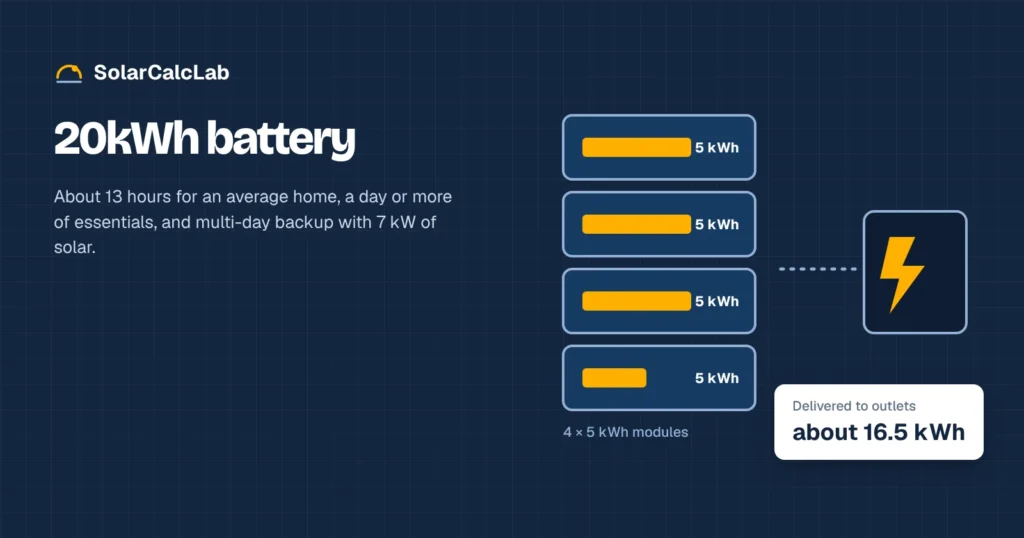
A 20 kWh battery stores about 18 kWh you can use, and roughly 16.5 kWh of that reaches your outlets after inverter losses. That runs an average US home for about 13 hours, or a gas-heated home’s essentials for more than a day. Paired with about 7 kW of solar, it can carry essentials through a multi-day outage even in winter, but not a whole house with heavy loads.
Twenty kilowatt hours sits in an awkward spot on most quotes. It is bigger than a single wall battery, smaller than the 27 kWh you get from two popular units, and often priced as two or four modules stacked together. Before you pay for it, see what those 20 kWh do on a real outage night.
This guide runs a 20 kWh battery through a three-night outage with solar, shows how the backup reserve setting changes what you get, and explains why 20 kWh is also the largest single battery unit the residential fire code allows.
What does “20 kWh” mean on a quote?
Most spec sheets list nominal capacity. The battery management system keeps part of it in reserve to protect the cells, and this site assumes 90% is usable. The inverter then loses some energy converting DC to AC. We use 92% inverter efficiency in the examples below.
20 kWh × 0.90 × 0.92 = 16.56 kWh
One catch: some manufacturers print usable capacity on the label instead. If your quote says “20 kWh usable,” skip the 0.90 step and you get about 18.4 kWh at the outlets. Ask the installer which figure they quoted, because the gap is close to two hours of runtime for an average home.
How many hours does it last in different homes?
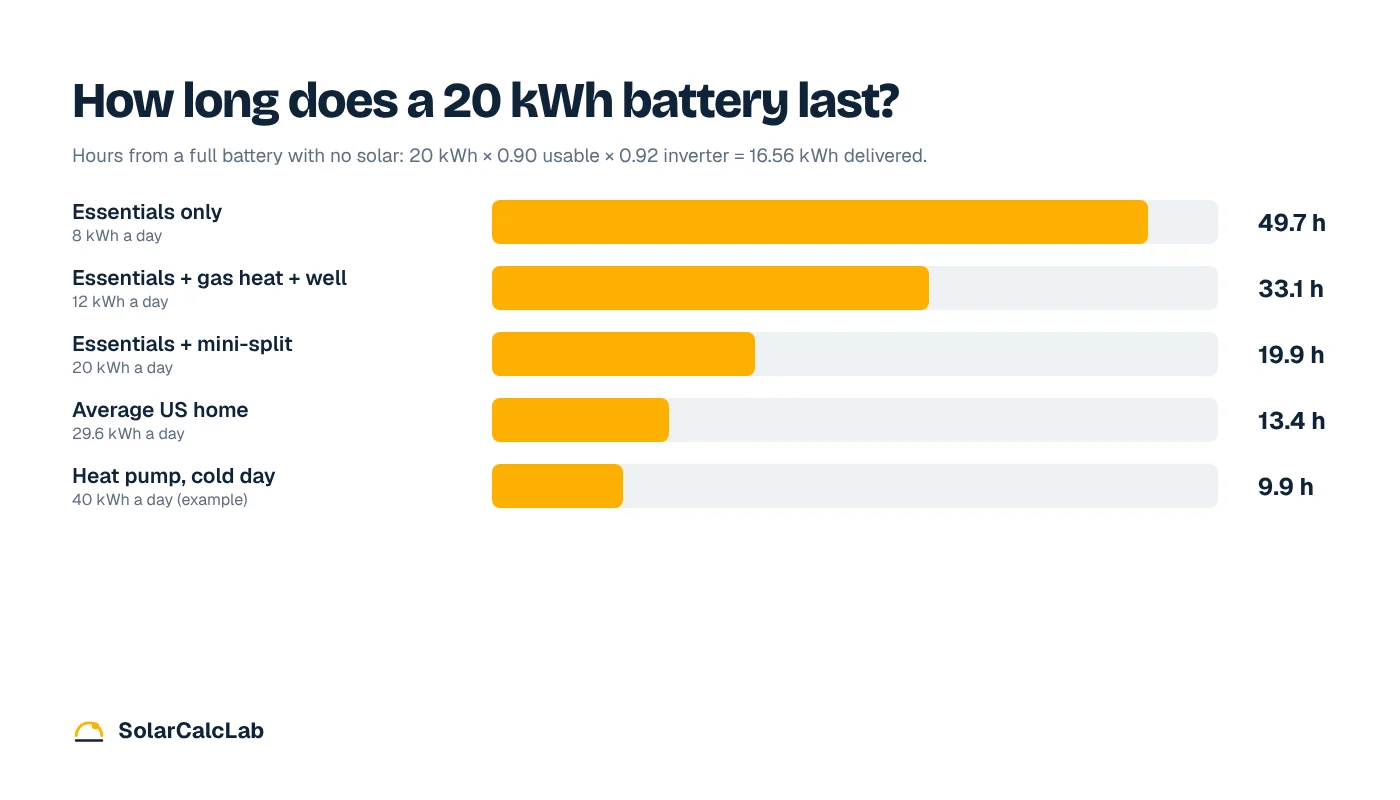
Runtime is energy divided by average draw. The U.S. Energy Information Administration puts the average residential customer at 10,791 kWh a year (2022 data), about 29.6 kWh a day or 1.23 kW on average. Few homes run everything during an outage, so here are five realistic daily budgets:
| Home during the outage | Daily use | Runtime on 16.56 kWh |
|---|---|---|
| Fridge, freezer, lights, Wi-Fi, phones | 8 kWh | about 49.7 hours |
| Essentials plus gas furnace blower and well pump | 12 kWh | about 33.1 hours |
| Essentials plus a bedroom mini-split in summer | 20 kWh | about 19.9 hours |
| Average US home, nothing switched off | 29.6 kWh | about 13.4 hours |
| Heat pump home on a cold day | 40 kWh | about 9.9 hours |
The 40 kWh row is an example, not a rule. Heat pump use swings widely with outdoor temperature and house size. If you heat with electricity, check last winter’s highest daily usage in your utility account before trusting any battery size.
To build your own load list instead of using these profiles, the battery backup calculator adds up appliances and outage hours for you.
A three-night outage with 7 kW of solar
Runtime tables assume the battery never gets refilled. With panels on the roof, the real question is whether each sunny day puts back what each night takes out. We modeled a 7 kW array feeding a 20 kWh battery (18 kWh usable) through an outage that starts at dusk with the battery full.
Assumptions
- 55% of the day’s energy is used overnight, 45% during daylight.
- Solar output = 7 kW × peak sun hours × 0.80. That is 30.8 kWh on a 5.5-hour summer day, 14 kWh on a 2.5-hour winter day and 2.8 kWh on a stormy 0.5-hour day.
- Daytime loads run on solar first. Surplus charges the battery at 90% efficiency.
- Nighttime loads come from the battery through a 92% efficient inverter.
| Scenario | Daily use | Solar per day | Battery at dawn, days 1 to 3 | Result |
|---|---|---|---|---|
| Winter, essentials, gas heat | 12 kWh | 14 kWh | 10.8, 10.8, 10.8 kWh | Refills every day, runs indefinitely |
| Summer, essentials plus mini-split | 20 kWh | 30.8 kWh | 6.0, 6.0, 6.0 kWh | Refills every day, runs indefinitely |
| Summer, whole average home | 29.6 kWh | 30.8 kWh | 0.3, 0, 0 kWh | Runs out about an hour before dawn each night from night 2 |
| Winter, whole average home | 29.6 kWh | 14 kWh | 0.3, 0, 0 kWh | Dark most of every night after the first |
| Storm days, essentials | 12 kWh | 2.8 kWh | 10.8, 0.8, 0 kWh | Empty during day 2 |
What the model tells you
The battery is rarely the weak link for essentials. A 12 kWh day only needs about 7.2 kWh from storage overnight, and a winter day of 7 kW of solar more than replaces it. For a whole house, though, 20 kWh is a one-night battery. Even in summer, the array makes barely more than the home uses, so the battery never fully recovers.
The storm row matters most if your outages come with hurricanes or ice storms, because the sun is weakest exactly when the grid is down. Two cloudy days with essentials is about the limit. After that you need a generator or a smaller load list.
To refill 18 usable kWh on an average 4.5-sun-hour day, the array needs to send about 20 kWh to the battery: 20 ÷ (4.5 × 0.80) = 5.6 kW, or 13 panels of 430 W, on top of whatever runs the house in daylight. The how many solar panels calculator sizes both jobs together.
The backup reserve setting changes everything
Many owners also use their battery every evening to avoid peak time-of-use rates. The app then lets you pick a backup reserve, the share it keeps for outages. If a storm knocks out power at 9 pm, after the evening peak, the reserve is all you have.
| Backup reserve | Energy held back | Delivered at outlets | Hours at 12 kWh a day | Hours for an average home |
|---|---|---|---|---|
| 20% | 3.6 kWh | 3.31 kWh | 6.6 | 2.7 |
| 30% | 5.4 kWh | 4.97 kWh | 9.9 | 4.0 |
| 50% | 9.0 kWh | 8.28 kWh | 16.6 | 6.7 |
| 100% (backup only) | 18 kWh | 16.56 kWh | 33.1 | 13.4 |
A 20% reserve on a 20 kWh battery holds about the same outage energy as a fully charged 4 kWh battery. If backup is the main reason you bought it, raise the reserve before storm season or turn on the storm-watch feature if your system has one. The home battery savings calculator shows what the daily peak shifting is worth, so you can judge how much reserve to trade away.
Why 20 kWh is a code limit, not just a size
US residential codes based on NFPA 855 cap each individual battery unit in a home at 20 kWh. They also limit the total to 40 kWh in a utility closet, basement or storage room, and 80 kWh in a garage, on an exterior wall or outdoors. So 20 kWh is the largest single unit you can put in a home, and two of them fill an indoor utility room to its limit. Your local code still sets spacing and separation details.
Common ways to reach 20 kWh
- Four 48 V, 100 Ah server-rack modules: 4 × 5.12 kWh = 20.48 kWh. Popular for DIY and off-grid builds.
- Two 10 kWh units on one hybrid inverter, with room to add a third in a garage.
- One 20 kWh cabinet, sitting right at the per-unit limit.
At a nominal 51.2 V, 20 kWh is about 391 Ah. The same energy at 25.6 V would be 781 Ah, which is why home banks this size are almost always 48 V or high voltage. The kWh to Ah converter works out other voltages.
What does a 20 kWh battery cost in 2026?
EnergySage marketplace data for the first half of 2026 puts a typical 13.5 kWh installed battery at $15,647 before incentives, about $1,159 per kWh. At that rate, 20 kWh comes to about $23,200 installed. State averages on the same marketplace range from about $563 to $1,586 per kWh, so a 20 kWh quote anywhere from about $11,300 to $31,700 is within the normal spread.
The 30% federal credit no longer applies to batteries that homeowners buy and install after 2025, as our solar tax credit guide explains. State storage rebates and utility programs still exist in some areas and can cut the price a lot.
$23,180 ÷ (6,000 cycles × 18 kWh) = about $0.21 per kWh
That only holds with daily cycling. A battery used just for outages is insurance, and the per-kWh math matters less.
Is 20 kWh the right size for you?
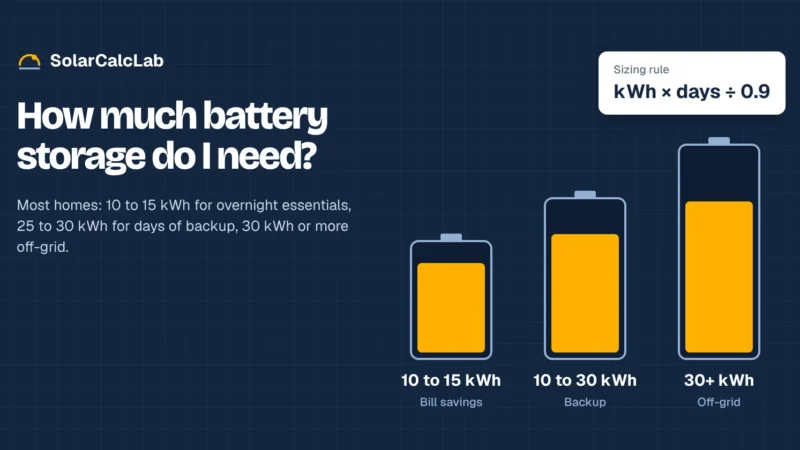
Our battery sizing guide walks through the full method. As a shortcut:
- Choose about 16 kWh if you only back up essentials and outages rarely last past one night. Our 16 kWh battery guide shows what that covers.
- Choose about 20 kWh if you want essentials plus one cooled room, or you use the battery daily for time-of-use and still want a useful reserve left over.
- Choose 27 to 30 kWh if you expect to run the whole house, including central air, through a full night with margin. The 30 kWh battery guide covers that case.
Check power as well as energy. A 20 kWh bank with a 7.6 kW inverter cannot start a well pump, a central AC compressor and a cooktop at the same moment. The inverter size calculator adds up running and surge watts.
Frequently asked questions
Can a 20 kWh battery run a house off grid?
Only a very efficient home. Off grid, most designs plan for two or more days without sun. A home using 10 kWh a day gets about 1.7 days from 16.56 kWh delivered, so it works for a cabin or a small efficient house with a generator for long cloudy spells. An average home using about 30 kWh a day needs much more storage.
How many solar panels does it take to charge a 20 kWh battery?
About 13 panels of 430 W, or 5.6 kW, refill 18 usable kWh on a day with 4.5 peak sun hours, after allowing 20% system losses and 10% charging loss. Those panels are in addition to what your home uses during daylight.
Can a 20 kWh battery charge an electric car?
Yes, but not very far. A Level 2 charger at 7.2 kW empties 16.56 kWh in about 2.3 hours. At 3.5 miles per kWh, that adds roughly 58 miles of range and leaves nothing for the house, so most owners keep the EV charger off the backed-up panel.
How many Tesla Powerwalls equal 20 kWh?
None exactly. A Powerwall 3 holds 13.5 kWh, so one is below 20 kWh and two give 27 kWh. If a quote compares a 20 kWh stack with two Powerwalls, compare usable kWh, inverter output and installed price per usable kWh rather than the unit count.
Will a 20 kWh battery run central air conditioning?
A 3 ton central AC draws about 3.5 kW while the compressor runs, so 16.56 kWh gives about 4.7 hours of compressor time on its own. Because the compressor cycles, that can stretch across an evening, but it will not cool the whole house through a hot night with other loads running.