How Many Watts Does a TV Use? Measured Data by Screen Size

Short answer
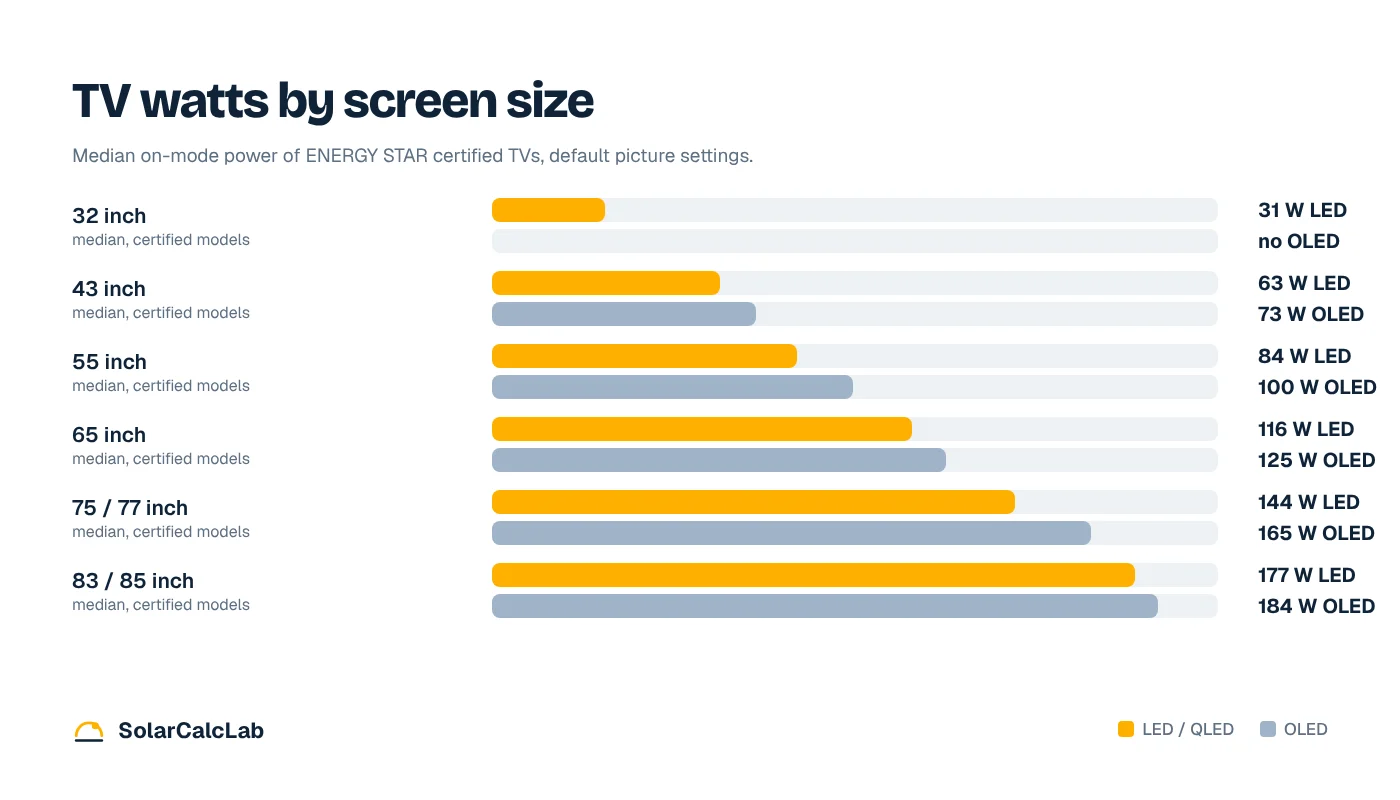
A modern TV uses about 30 to 200 watts while on, mostly depending on screen size. In ENERGY STAR test data, a typical 55 inch LED TV draws about 84 W and a 65 inch about 116 W; OLED sets of the same size run roughly 8 to 20% higher. Watching five hours a day, a 65 inch TV uses about 210 kWh a year, close to $3.20 a month at 18.2 cents per kWh. Standby adds well under 1 W.
TV wattage questions usually come from one of three places: a surprising electric bill, a power station or inverter you want to run the TV from, or a shopping decision between two sets. Each needs a slightly different number, so this guide gives the measured on-mode watts first, then shows what changes them and how to turn watts into kWh, dollars and battery hours.
The figures here come from the ENERGY STAR certified TV list, which reports power measured under the federal DOE test procedure for every certified model. We downloaded the full list of 175 models on October 31, 2026 and grouped the 122 entries that report both screen size and on-mode power by screen class and panel type.
TV wattage by screen size
The table shows the middle (median) value for each size, with the lowest and highest certified model in brackets. These are default picture settings, the way most people leave a TV out of the box.
| Screen class | LED / QLED (LCD) | OLED | Models in data |
|---|---|---|---|
| 32 inch | 31 W (27 to 36) | n/a | 9 |
| 43 inch | 63 W (45 to 78) | 73 W | 8 |
| 48 inch | 70 W (61 to 90) | 84 W (74 to 87) | 15 |
| 55 inch | 84 W (73 to 102) | 100 W (64 to 114) | 21 |
| 65 inch | 116 W (87 to 128) | 125 W (85 to 135) | 23 |
| 75 / 77 inch | 144 W (120 to 154) | 165 W (143 to 176) | 14 |
| 83 / 85 inch | 177 W (166 to 189) | 184 W (168 to 215) | 10 |
Two real examples from the list: LG’s 65 inch C4 OLED is reported at 131.9 W, and Samsung’s 65 inch S85F OLED at 114.2 W. Certified models are the more efficient part of the market, so an uncertified budget or older set can sit above these ranges. Our appliance wattage chart puts these numbers next to the rest of the house.
LED vs OLED: which uses more power?
An LED (LCD) TV lights the whole screen from behind and dims zones as needed. An OLED lights each pixel by itself, so its draw rises and falls with what is on screen. A dark movie scene can cost an OLED very little, while a bright hockey rink or white spreadsheet pushes it up.
On the test clip used for certification, the median OLED came in about 19% above the median LED set at 55 inches and about 8% above at 65 inches. In money terms, that gap is about $3 to $5 a year at five hours a day. Picture quality, room light and price matter far more to the buying decision than the watts.
Why your TV can use more than the chart says
The test measures default settings. Real use often differs, and these four settings move the number most.
Picture mode
Vivid or Dynamic modes run the backlight near full output. ENERGY STAR sets a separate, higher limit for the brightest preset than for the default one, which tells you how large the gap can be. Standard, Movie or Filmmaker modes sit close to the tested figure.
HDR content
HDR movies and games drive bright highlights much harder than regular video. Expect noticeably higher draw during HDR scenes, especially on bright LED models with mini-LED backlights.
Brightness sensor and power saving
Many sets ship with an ambient light sensor that dims the screen in a dark room. Switching it off to get a brighter picture raises evening power use. Eco or power saving modes do the opposite.
Everything plugged in around the TV
A soundbar, streaming stick, cable box and game console each add their own draw. A console adds its own load during play, so measure the whole setup if you are planning battery backup.
How much electricity does a TV use per month?
Example, 65 inch LED: 115.8 × 5 × 365 ÷ 1,000 = 211 kWh a year, about 17.6 kWh a month
The table uses five hours a day, the same viewing time the federal test assumes, and 18.2 cents per kWh, the 2026 US average residential price forecast in the EIA Short-Term Energy Outlook.
| TV | Watts | kWh per year | Cost per year | Cost per month |
|---|---|---|---|---|
| 32 inch LED | 31 | 57 | $10.33 | $0.86 |
| 43 inch LED | 63 | 115 | $20.86 | $1.74 |
| 55 inch LED | 84 | 153 | $27.87 | $2.32 |
| 55 inch OLED | 100 | 182 | $33.05 | $2.75 |
| 65 inch LED | 116 | 211 | $38.46 | $3.21 |
| 65 inch OLED | 125 | 229 | $41.59 | $3.47 |
| 77 inch OLED | 165 | 301 | $54.77 | $4.56 |
A household with the TV on as background noise for eight hours a day pays proportionally more: the 65 inch LED rises to about 338 kWh and $62 a year. Plug in your own hours and rate with the watts to kWh calculator and the electricity cost calculator.
Does a TV use power when it is off?
Yes, but very little on a modern set. ENERGY STAR requires 0.5 W or less in passive standby and 1.0 W or less in networked standby. The certified models in the data report a median of 0.4 W with the network connected.
Unplugging the TV itself saves almost nothing. The bigger standby users are usually the boxes around it: older cable boxes, consoles left in an instant-on mode and subwoofers. A switched power strip for the whole cabinet is the easy fix.
Running a TV on a power station, inverter or solar
For off-grid and outage use, size for watts first, then energy.
- Amps: 116 W ÷ 120 V is about 1 A on a household circuit. On a 12 V battery the same TV pulls nearly 10 A from the DC side, plus inverter losses. Check any setup with the watts to amps calculator.
- Inverter: a 300 W pure sine wave inverter covers a 65 inch TV with room for a streaming box. Modern TVs use switching power supplies, so startup surge is small, but cheap modified sine units can cause buzzing; see pure vs modified sine wave.
- Runtime: a 1 kWh power station at 85% usable after conversion runs a 116 W TV for about 7.3 hours, or a 55 inch at 84 W for about 10 hours.
Example: 1,000 × 0.85 ÷ 115.8 = 7.3 hours
To cover a TV’s yearly energy with solar, divide by what 1 kW of panels makes at your sun. At 4.5 peak sun hours, 1 kW makes about 1,314 kWh a year, so the 211 kWh TV needs about 160 W of panels. The appliance solar panel calculator runs this for any device.
How to find your own TV’s real wattage
- Check the EnergyGuide label or spec sheet. US TVs carry a yellow label with estimated yearly energy use. Divide that kWh figure by 1.825 to get average on-mode watts at five hours a day.
- Do not use the back-panel rating. The number near the power cord is a maximum for the power supply, often well above normal viewing draw.
- Use a plug-in meter. An inexpensive plug-in watt meter shows real draw. Test your usual picture mode with a normal show, then a bright sports broadcast, then standby.
- Look it up on the ENERGY STAR TV page if your model is certified.
Frequently asked questions
How many watts does a 55 inch TV use?
About 84 W for a typical certified LED model and about 100 W for an OLED, at default settings. Certified models range from about 64 to 114 W. Bright picture modes and HDR content push the draw higher.
How much does it cost to run a TV for an hour?
Very little. A 65 inch LED at 116 W uses 0.116 kWh an hour, which costs about 2.1 cents at 18.2 cents per kWh. A 32 inch set costs under 1 cent an hour.
Do bigger TVs always use more electricity?
Generally yes, because there is more screen to light. In the certified data, median power more than doubles from a 43 inch LED (63 W) to a 75 inch LED (144 W). Within one size, efficiency differences between models can still be 30 W or more.
Can a 100 watt solar panel run a TV?
Not directly. A 100 W panel makes far less than 100 W most of the day and nothing at night. Paired with a battery and inverter, it produces roughly 0.36 kWh on a 4.5 sun hour day, enough for about 2.5 hours of a 116 W TV once battery and inverter losses are counted.
Is it cheaper to watch TV on a laptop or tablet?
Yes. A tablet or laptop typically uses a fraction of a big TV’s watts. Still, at 2 cents an hour for a 65 inch set, the savings are small unless the TV runs most of the day.