Appliance Wattage Chart: How Many Watts Common Appliances Use

Short answer
Most small household appliances use 10 to 1,500 watts, while the big loads use far more: a central air conditioner draws about 3,000 to 3,500 W, an electric water heater 4,000 to 4,500 W and an electric dryer 1,800 to 5,000 W. The average US home uses about 28 kWh a day, an average draw of roughly 1,200 watts. Find any appliance in the chart below, then multiply watts by hours of use to get daily kWh.
Every appliance has a wattage rating, but that one number can mislead. A refrigerator might be labeled 700 watts yet average under 100, because its compressor cycles on and off. A well pump might run on 1,000 watts but need three times that for a second at startup. If you are sizing a generator, a battery or a solar array, you need both the running watts and how long each appliance actually runs.
This appliance wattage chart lists running watts, starting watts and typical daily energy for 33 common US household appliances. Below it you will find the formulas to turn watts into kWh and dollars, and worked examples for backup power and solar sizing.
Appliance wattage chart
Running watts are typical ranges for current models. Starting watts apply to appliances with motors or compressors, which draw a short surge when they switch on. Daily hours are typical use for an average household, and the kWh column uses a midpoint wattage times those hours. For cycling appliances such as refrigerators and AC units, hours mean the time the compressor actually runs.
| Appliance | Running watts | Starting watts | Typical use per day | Energy per day |
|---|---|---|---|---|
| Central air conditioner (3 ton) | 3,000 to 3,500 W | 6,000 to 9,000 W | 8 h | 25.6 kWh |
| Window air conditioner (10,000 BTU) | 800 to 1,200 W | 1,800 to 2,500 W | 8 h | 7.2 kWh |
| Ductless mini split (12,000 BTU) | 500 to 1,200 W | No surge (inverter) | 8 h | 5.6 kWh |
| Space heater | 1,500 W | None | 4 h | 6.0 kWh |
| Electric water heater (tank) | 4,000 to 4,500 W | None | 2.5 h | 11.3 kWh |
| Clothes dryer (electric) | 1,800 to 5,000 W | Small motor surge | 1 h | 3.0 kWh |
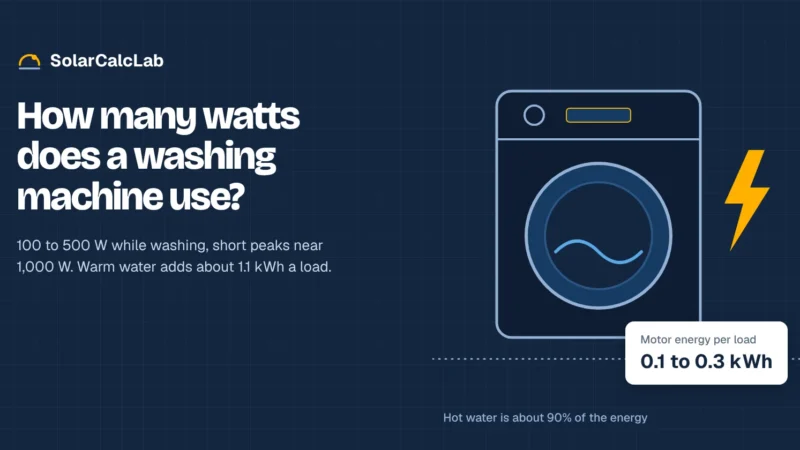
| Washing machine | 350 to 500 W | 1,000 to 1,500 W | 1 h | 0.5 kWh |
| Dishwasher (with heated dry) | 1,200 to 2,400 W | None | 1 h | 1.8 kWh |
| Refrigerator (full size) | 100 to 250 W | 600 to 1,200 W | 8 h | 1.2 kWh |
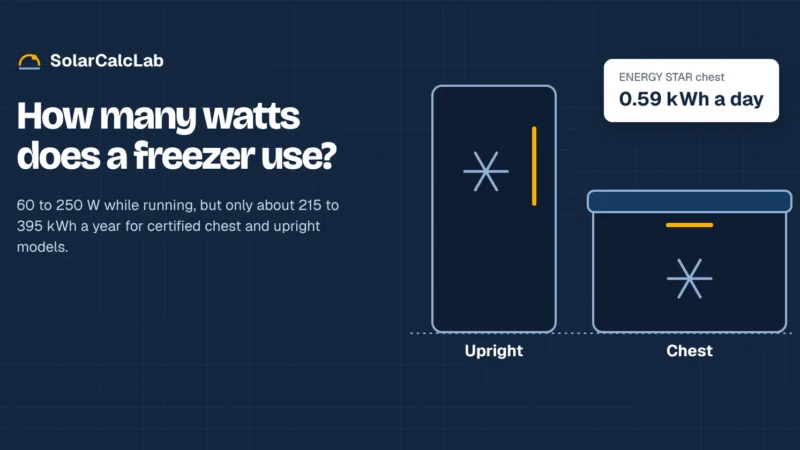
| Chest freezer | 80 to 150 W | 400 to 800 W | 8 h | 0.8 kWh |
| Electric range burner (large) | 2,000 to 3,000 W | None | 0.5 h | 1.2 kWh |
| Electric oven | 2,000 to 5,000 W | None | 1 h | 3.0 kWh |
| Microwave (1,000 W cooking) | 1,200 to 1,500 W | None | 0.25 h | 0.3 kWh |
| Coffee maker | 800 to 1,400 W | None | 0.25 h | 0.2 kWh |
| Toaster | 800 to 1,500 W | None | 0.1 h | 0.1 kWh |
| Electric kettle | 1,200 to 1,500 W | None | 0.1 h | 0.1 kWh |
| Air fryer | 1,200 to 1,800 W | None | 0.5 h | 0.8 kWh |
| Slow cooker | 150 to 300 W | None | 8 h | 1.6 kWh |
| LED TV (55 inch) | 60 to 120 W | None | 5 h | 0.5 kWh |
| Gaming console | 100 to 200 W | None | 2 h | 0.3 kWh |
| Desktop computer with monitor | 150 to 400 W | None | 4 h | 1.0 kWh |
| Laptop | 30 to 70 W | None | 6 h | 0.3 kWh |
| Wi-Fi router and modem | 10 to 20 W | None | 24 h | 0.4 kWh |
| LED light bulb (60 W equivalent) | 8 to 10 W | None | 5 h | 0.05 kWh |
| Ceiling fan | 15 to 75 W | None | 8 h | 0.3 kWh |
| Furnace blower fan | 300 to 800 W | 800 to 1,500 W | 6 h | 3.0 kWh |
| Dehumidifier (50 pint) | 400 to 700 W | 800 to 1,200 W | 8 h | 4.0 kWh |
| Hair dryer | 1,200 to 1,875 W | None | 0.25 h | 0.4 kWh |
| Vacuum cleaner | 500 to 1,400 W | None | 0.25 h | 0.2 kWh |
| Well pump (1 hp) | 750 to 1,000 W | 2,000 to 3,000 W | 1 h | 1.0 kWh |
| Sump pump (1/2 hp) | 800 to 1,050 W | 1,300 to 2,200 W | 0.5 h | 0.5 kWh |
| Pool pump (1.5 hp single speed) | 1,500 to 2,000 W | 3,000 to 4,000 W | 8 h | 13.6 kWh |
| EV charger (Level 2, 32 A) | 7,000 to 7,700 W | None | 1.5 h | 11.4 kWh |
Ratings vary by model, so check the nameplate sticker or the yellow EnergyGuide label for your exact unit. For refrigerators, freezers, dishwashers and washers, the ENERGY STAR product finder lists measured yearly kWh for each certified model, which is more accurate than a nameplate wattage.

How to calculate appliance power consumption
Wattage tells you how fast an appliance uses energy. To find how much energy it uses, multiply by time.
Monthly cost = daily kWh × 30 × price per kWh
Example: 1,500 W space heater × 4 h ÷ 1,000 = 6.0 kWh a day, and 6.0 × 30 × $0.18 = $32.40 a month
The watts to kWh calculator does this for any appliance, and the electricity cost calculator turns the result into a bill at your local rate.
If the label only shows amps
Many tools and motors list amps and volts instead of watts. Multiply them: watts = volts × amps. A 120 V vacuum rated 10 A uses about 1,200 W, and a 240 V appliance rated 20 A uses about 4,800 W. For motor loads this gives a maximum, since real draw is usually a bit lower. Our guide to volts vs amps explains the relationship in more detail.
Running watts vs starting watts
Motors and compressors need extra current to get moving. That surge lasts from a fraction of a second to a few seconds and can be two to three times the running watts. It barely affects your energy bill, but it decides whether a generator or inverter can start the appliance. Heating appliances such as toasters, kettles and water heaters have no meaningful surge.
How many watts does a house use?
The US Energy Information Administration reports that the average residential customer used 865 kWh a month in 2024. That is 28.4 kWh a day, or an average draw of about 1,185 watts around the clock. Demand is not steady, though. A home might draw 300 to 500 W overnight and spike to 5,000 to 10,000 W in the early evening when the AC, oven and dryer overlap. The dryer alone can hold that peak for most of an hour, and our breakdown of how many watts a dryer uses covers kWh per load, amps and running cost.
A typical day without air conditioning might look like this:
| Load | Energy per day |
|---|---|
| Electric water heater | 11.3 kWh |
| Clothes dryer and electric oven | 6.0 kWh |
| Furnace blower fan | 3.0 kWh |
| Dishwasher and washing machine | 2.3 kWh |
| Refrigerator | 1.2 kWh |
| Computer, TV, router and 10 LED bulbs | 2.3 kWh |
| Small kitchen appliances | 1.0 kWh |
| Total | 27.0 kWh |
Add central air conditioning running eight hours on a summer day and the total nearly doubles. That is why summer bills in the South often run 1,500 kWh or more. Our guide to how many watts an air conditioner uses breaks this load down by tonnage and unit type.
Which appliances use the most electricity?
The biggest monthly costs come from appliances that combine high wattage with long run times. At an example rate of 18 cents per kWh:
| Appliance | kWh per month | Cost per month at $0.18 |
|---|---|---|
| Central AC (3 ton, 8 h a day) | 768 kWh | $138 |
| Pool pump (single speed, 8 h) | 408 kWh | $73 |
| EV charging (about 1,000 miles) | 342 kWh | $62 |
| Electric water heater | 338 kWh | $61 |
| Space heater (4 h a day) | 180 kWh | $32 |
| Ductless mini split (8 h) | 168 kWh | $30 |
| Dehumidifier (8 h) | 120 kWh | $22 |
| Clothes dryer (1 load a day) | 90 kWh | $16 |
| Refrigerator | 36 kWh | $6.50 |
Small electronics barely register. A 55 inch LED TV used five hours a day costs about $2.40 a month, and our breakdown of how many watts a TV uses shows how that changes with screen size and panel type. The fastest savings come from the top of the list: a variable-speed pool pump, a heat pump water heater or a better thermostat schedule each beat swapping every light bulb in the house. For a deeper look at one of the most common always-on loads, see how many watts a refrigerator uses.
Worked examples
Example 1: Sizing backup power for an outage
You want to keep a refrigerator, a sump pump, five LED bulbs, the Wi-Fi router and a TV running during an outage. Running watts add up to 150 + 900 + 45 + 15 + 90 = 1,200 W. The largest surge is the sump pump, which adds about 1,300 W above its running load when it kicks on, so the peak is 1,200 + 1,300 = 2,500 W. If the fridge and pump could start at the same moment, add the fridge surge too, for about 3,550 W. A generator or inverter rated around 3,500 W continuous covers both. The inverter size calculator runs this check for any list of loads.
Example 2: How many solar panels to run a mini split
A 12,000 BTU mini split averages 700 W for 8 hours, or 5.6 kWh a day. At 4.5 peak sun hours and 80% system efficiency, that needs 5.6 ÷ (4.5 × 0.80) = 1.56 kW of panels, or 4 panels at 430 W. The appliance solar panel calculator does this for a single appliance, and the solar load calculator adds up a whole house. For the full home, see our guide on how many solar panels you need.
Example 3: Checking a breaker
A 1,500 W space heater on a 120 V circuit draws 1,500 ÷ 120 = 12.5 A. A 15 A circuit should carry no more than 80% of its rating, 12 A, for continuous loads, so a space heater should not share a 15 A circuit with anything else. For low and high settings, amps and what one costs to run each month, see how many watts a space heater uses.
Frequently asked questions
What household appliances use the most watts?
Electric water heaters (4,000 to 4,500 W), central air conditioners (3,000 to 3,500 W), electric ovens and dryers (up to about 5,000 W) and Level 2 EV chargers (about 7,600 W) draw the most power. In monthly energy, central AC and pool pumps usually top the list because they run for many hours.
How many watts does a house use per day?
The average US home uses about 28.4 kWh a day, based on EIA’s 2024 figure of 865 kWh a month. That works out to an average draw of roughly 1,185 watts, with peaks of 5,000 W or more when several large appliances run together.
How do I find the wattage of an appliance?
Check the nameplate sticker on the back or bottom of the appliance, or the manual. If it lists only volts and amps, multiply them to get watts. For the most accurate figure, plug the appliance into a watt meter and record its draw over a full day.
What is the difference between running watts and starting watts?
Running watts are the steady power an appliance uses once it is on. Starting watts are the brief surge a motor or compressor needs to start, often two to three times higher. Size generators and inverters for the highest starting load plus everything else running.
How many watts does a refrigerator use?
A full-size refrigerator draws about 100 to 250 W while the compressor runs and 600 to 1,200 W for a moment at startup. Because the compressor cycles, it averages only about 40 to 90 W, or roughly 1 to 2 kWh a day.