How Many Watts Does an Electric Water Heater Use?
Short answer
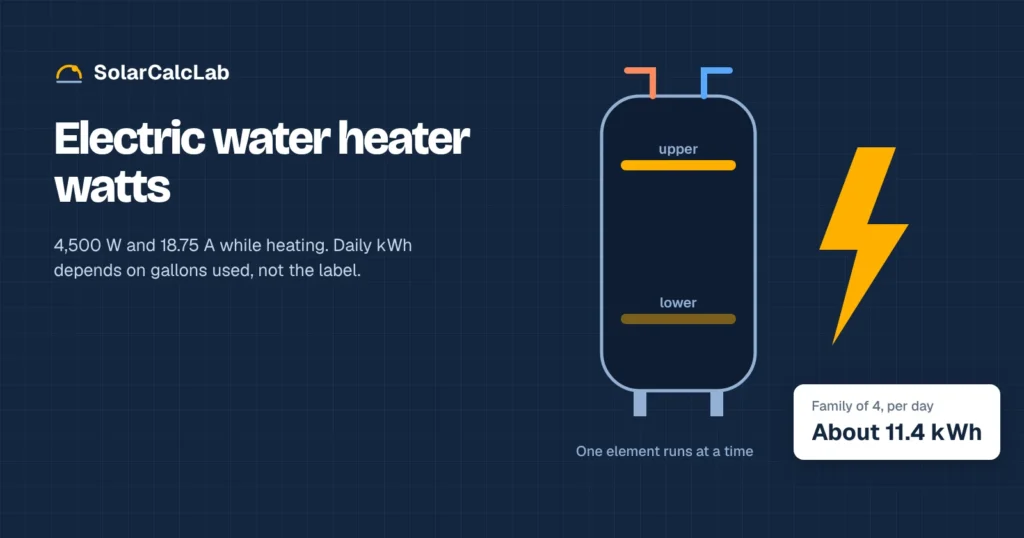
A standard electric tank water heater uses 4,500 watts while an element is heating, which draws 18.75 amps on a 240 V circuit. A family of four using about 64 gallons of hot water a day needs roughly 11.4 kWh a day, or about $62 a month at the 2026 US average of 18.19 cents per kWh. A heat pump water heater does the same job on about 2.8 kWh a day.
The 4,500 W figure on the label tells you how fast the water heater can use power, not how much it uses. A tank heater only switches an element on when the water cools below the thermostat setting, so it might run 30 minutes on a quiet day and four hours when the house is full of guests. What sets the bill is how many gallons you heat and how far you heat them.
That makes the water heater easy to estimate with simple physics. Below are wattage by type, daily kWh by household size, the circuit it needs and what it means for a battery or solar system.
Water heater wattage by type
| Type | Watts while heating | Amps at 240 V | Notes |
|---|---|---|---|
| Small point-of-use tank (2.5 to 6 gal, 120 V) | 1,440 to 1,500 W | 12 to 12.5 A at 120 V | Under-sink units |
| Standard tank, 3,500 W elements | 3,500 W | 14.6 A | Older or smaller tanks |
| Standard tank, 4,500 W elements | 4,500 W | 18.75 A | Most 40 and 50 gal tanks |
| Standard tank, 5,500 W elements | 5,500 W | 22.9 A | Faster recovery |
| Heat pump (hybrid) tank | Well under 1,000 W in heat pump mode, 4,500 W on backup element | Varies | Uses about a quarter of the energy |
| Whole-house electric tankless | 18,000 to 36,000 W | 75 to 150 A | Draws only while water flows |
Most tank heaters have two elements, one near the top and one near the bottom, but they are wired so only one runs at a time. A tank with two 4,500 W elements never draws 9,000 W. The upper element heats the top of the tank first so you get some hot water quickly, then hands off to the lower one.
Why a heater on 208 V makes less heat
Apartments and some commercial buildings supply 208 V instead of 240 V. An element is a fixed resistance, so its power falls with the square of the voltage: 4,500 × (208 ÷ 240)² = about 3,380 W. The water still gets hot, but the recovery rate drops by about 25%. Daily kWh stays about the same, because the same water still needs the same heat.
How many kWh does a water heater use per day?
Heating one gallon of water by 1°F takes 8.34 BTU, and one kWh equals 3,412 BTU. That is all you need to estimate daily energy.
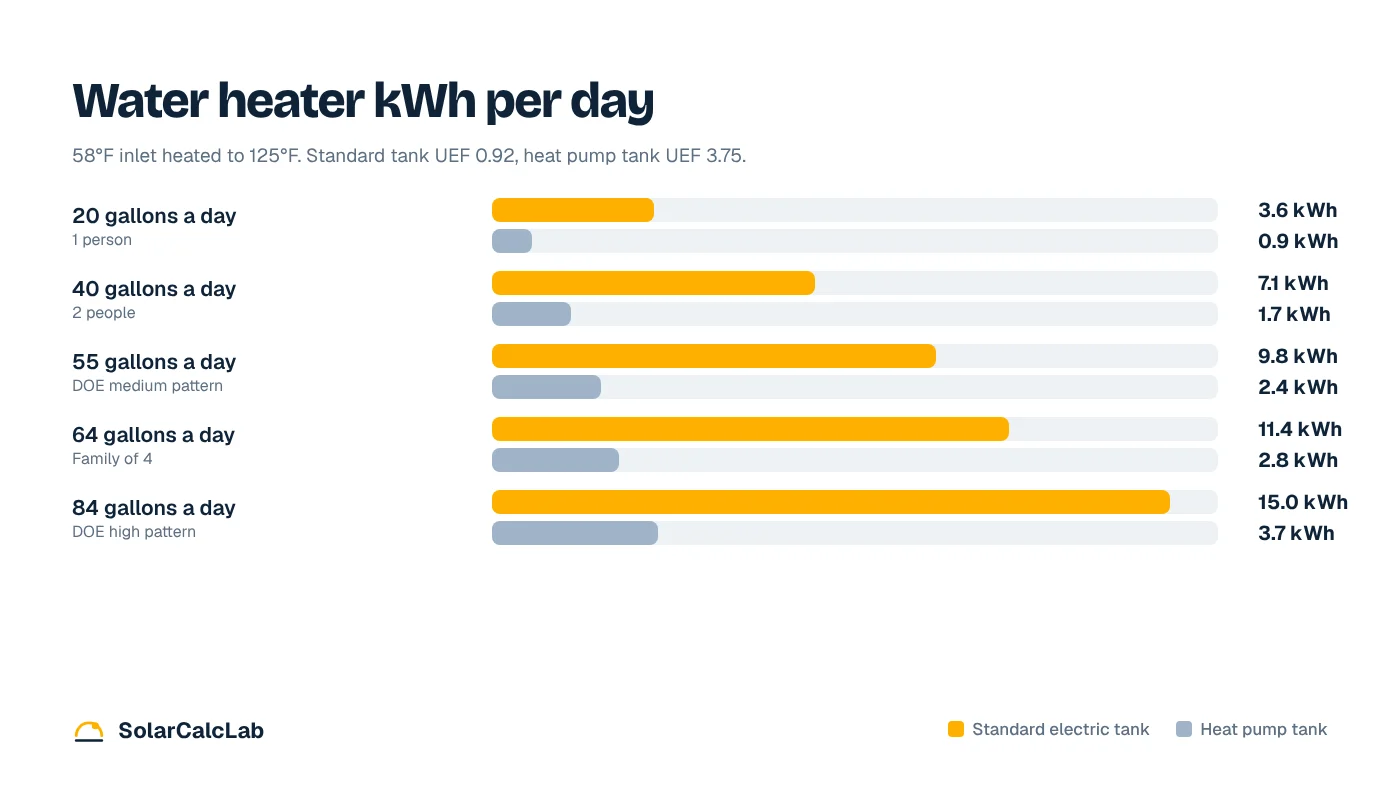
Example: 64 gal × 8.34 × 67°F ÷ 3,412 ÷ 0.92 = 11.4 kWh a day
The 67°F rise matches the Department of Energy test, which heats 58°F water to 125°F. UEF (uniform energy factor) is the efficiency rating on the yellow EnergyGuide label, and it already includes heat lost from the tank while it sits. A typical electric resistance tank rates around 0.92, and many heat pump models rate 3.5 to 4.0. We used 3.75 below.
| Household | Hot water per day | Standard tank | Heat pump tank | Standard tank cost per month |
|---|---|---|---|---|
| 1 person | 20 gal | 3.6 kWh | 0.9 kWh | $19 |
| 2 people | 40 gal | 7.1 kWh | 1.7 kWh | $39 |
| DOE medium test pattern | 55 gal | 9.8 kWh | 2.4 kWh | $53 |
| Family of 4 | 64 gal | 11.4 kWh | 2.8 kWh | $62 |
| DOE high test pattern | 84 gal | 15.0 kWh | 3.7 kWh | $82 |
Costs use 18.19 cents per kWh and a 30-day month. To estimate runtime, divide daily kWh by the element size: 11.4 kWh ÷ 4.5 kW is about 2.5 hours of element time a day. The immersion heater running cost calculator works the same way if you know the element size and hours, and the electricity cost calculator applies your own rate.
How long does it take to heat a full tank?
Heating 50 gallons from 50°F to 120°F takes about 8.6 kWh. With a 4,500 W element running nonstop, that is just under 2 hours. Recovery ratings work the other way: one 4,500 W element can raise about 20 gallons an hour by 90°F, or about 26 gallons an hour by 70°F. That is why a family can run out of hot water after back-to-back showers even with a 50 gallon tank.
Why your water heater may use more than the table
Real homes often beat the test numbers. The usual causes:
- A high thermostat setting. Raising the setpoint from 120°F to 140°F adds about 30% to the temperature rise from 58°F inlet water, and standby losses go up too.
- Cold inlet water in winter. Northern groundwater can drop into the 40s, which can add about 15% to daily energy compared with the 58°F test condition.
- A dripping hot tap or leaking relief valve. Water that drips around the clock has to be heated around the clock.
- A tank in an unheated garage. Standby losses rise when the air around the tank is cold.
A plug-in watt meter will not work on a 240 V heater. A clamp meter on one of the hot wires, or a whole-home energy monitor, shows exactly when the elements cycle.
Water heater amps, breaker and wire size
The National Electrical Code treats a storage water heater of 120 gallons or less as a continuous load in Section 422.13, so the circuit must be rated for at least 125% of the nameplate current.
Minimum circuit = 18.75 × 1.25 = 23.4 A → usually a 30 A double-pole breaker on 10 AWG copper
A 5,500 W tank draws 22.9 A, which needs at least 28.6 A, so it also lands on a 30 A breaker and 10 AWG wire. A 3,500 W tank needs only 18.2 A but is often wired the same way. Always follow the heater’s installation manual, which may specify the breaker. You can check these figures with the watts to amps calculator and the wire size calculator for long runs.
Whole-house electric tankless units are a different scale. A 27 kW unit draws 112.5 A at 240 V and a 36 kW unit draws 150 A, usually split across two to four double-pole breakers. Many older 100 A and 150 A services cannot handle that alongside a range and dryer, which is why a tankless conversion often ends with a service upgrade quote. The same 240 V circuit logic applies to the other big laundry load, covered in our guide to how many watts a dryer uses.
Standard tank or heat pump: what the numbers say
For the family of four in the table, a heat pump water heater saves 11.4 − 2.8 = 8.6 kWh a day. At 18.19 cents, that is about $570 a year. For a two-person home the saving is closer to $360 a year.
The ENERGY STAR heat pump water heater page lists certified models and their ratings. A few practical limits decide whether one fits your house:
- Space and air. A heat pump tank pulls heat from the surrounding air, so it needs a room with enough air volume, or ducting. It also cools and dries that room, which helps in a damp basement and works against you in a heated laundry closet in winter.
- Air temperature. Below the range the manufacturer specifies, the unit switches to its backup element and uses as much power as a standard tank.
- Condensate. It needs a drain or a condensate pump.
The 30% federal tax credit for heat pump water heaters (Section 25C) ended for equipment installed after December 31, 2025. Some utilities and states still offer rebates.
Running a water heater on solar or a battery
A standard tank is one of the hardest loads to put on a home battery. At 11.4 kWh a day, it would drain most of a 13.5 kWh battery by itself, and the inverter must supply 4,500 W at 240 V on top of everything else running. Most backup setups leave it off the protected panel.
A heat pump tank changes the math. At about 2.8 kWh a day, a family’s hot water fits easily inside a 10 kWh battery, and the compressor draw is small enough for most hybrid inverters.
On solar, the water heater is a good load to shift into daylight. The tank stores heat, so a timer or smart controller that heats from late morning to mid afternoon soaks up solar output that would otherwise be exported. The array needed to cover it is:
Standard tank: 11.4 ÷ (4.5 × 0.80) = 3.2 kW | Heat pump tank: 2.8 ÷ (4.5 × 0.80) = 0.8 kW
That is the strongest case for a heat pump unit in a solar home: about 2.4 kW fewer panels for the same hot water. The appliance solar panel calculator runs this for your own sun hours, and the battery backup calculator shows how long a battery will carry the load. For the rest of the house, our appliance wattage chart lists typical watts and daily kWh for 33 common appliances.
Frequently asked questions
How many watts does a 50 gallon electric water heater use?
Most 50 gallon electric tanks have 4,500 W elements, and only one runs at a time, so the heater draws 4,500 W while heating. Some models use 5,500 W elements for faster recovery. A 50 gallon heat pump model uses well under 1,000 W in heat pump mode.
How much does it cost to run an electric water heater per hour?
While an element is on, a 4,500 W heater uses 4.5 kWh per hour, which costs about 82 cents at 18.19 cents per kWh. It only runs part of the day, though. A family of four typically adds up to about 2.5 hours of element time, or roughly $2 a day.
Can I run an electric water heater on a 20 amp breaker?
Not a standard 4,500 W tank. It draws 18.75 A at 240 V, and because the code treats it as a continuous load, the circuit must be rated for at least 23.4 A. That means a 25 A or, more commonly, a 30 A breaker with 10 AWG copper wire.
Does turning off the water heater at night save money?
A little, because the tank loses less heat while it is cooler, but the water still has to be reheated in the morning. For most homes the saving is small. It makes more sense on time-of-use rates, or with solar, where heating during the day replaces expensive or exported power.
Can a generator run an electric water heater?
A 4,500 W element needs a generator with a 240 V outlet and at least 4,500 running watts left over after your other loads. Many portable generators can do it, but it uses a large share of their output. Running the heater only when other big loads are off is the practical approach.