How Many Watts Does a Space Heater Use?
Short answer
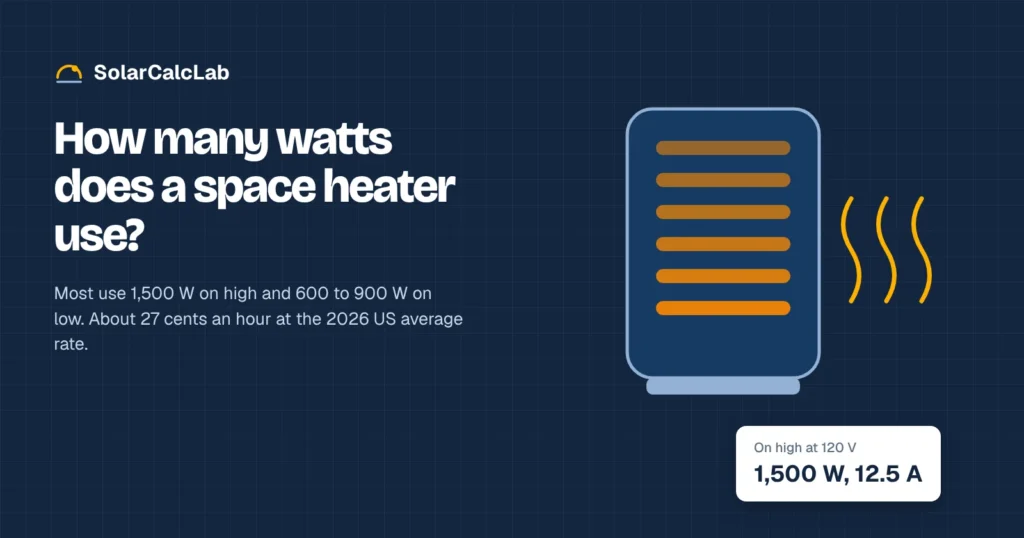
Most plug-in space heaters use 1,500 watts on high, and many have a low setting of 600 to 900 watts. At 120 volts, 1,500 W draws 12.5 amps and puts out about 5,118 BTU of heat per hour. At the 2026 US average of 18.19 cents per kWh, running one on high costs about 27 cents an hour, or roughly $33 a month for 4 hours a day.
Walk down the heater aisle at any hardware store and you will notice the same number on almost every box: 1,500 W. Ceramic towers, oil-filled radiators, quartz infrared units and baseboard-style plug-ins all stop there. That is not a coincidence, and it tells you most of what you need to know about wattage, amps and cost.
What changes from heater to heater is the low setting, how the thermostat cycles, and where you plug it in. Those decide your real bill and whether the breaker trips.
Space heater wattage by type
The figures below come from published US product listings. Your own heater’s label, usually on the back or base, shows its exact rating.
| Heater | High | Lower settings | Amps on high (120 V) |
|---|---|---|---|
| Lasko 754200 ceramic | 1,500 W | 900 W, fan only | 12.5 A |
| PowerZone DF-150P9-7 oil-filled | 1,500 W | 900 W, 600 W | 12.5 A |
| VISIONAIR 1VAHL22M oil-filled | 1,500 W | 900 W, 600 W | 12.5 A |
Why nearly every plug-in heater stops at 1,500 W
Standard US household outlets sit on 15 amp circuits. A heater runs for hours at a time, so manufacturers keep the draw under the circuit rating with some room to spare. At 120 V, 1,500 W is 12.5 A. Going much higher would trip ordinary breakers, so bigger electric heaters move to hardwired 240 V circuits instead.
1,500 W ÷ 120 V = 12.5 A | 900 W ÷ 120 V = 7.5 A | 600 W ÷ 120 V = 5.0 A
Does the type of heater change the heat output?
No. Every electric resistance heater turns essentially all of its input into heat, so 1 watt always gives about 3.412 BTU per hour. A 1,500 W oil-filled radiator and a 1,500 W ceramic fan heater put the same 5,118 BTU per hour into the room. The VISIONAIR listing states exactly that figure, 5,118 BTU.
What differs is delivery. Fan heaters warm the air quickly. Oil-filled radiators heat slowly and keep radiating after the element cycles off. Infrared units warm people and objects in their line of sight, which suits a drafty garage or a desk you sit at. Pick by the room, not by marketing claims about efficiency.
Amps, circuits and the tripping breaker
A 1,500 W heater at 12.5 A leaves only 2.5 A of headroom on a 15 A circuit. That is above the 80% level (12 A) electricians use as the limit for a continuous load on that circuit. In practice it means the heater should be the only significant load on the circuit.
| Circuit | Breaker limit | 80% continuous level | Room left beside a 1,500 W heater |
|---|---|---|---|
| 15 A, 120 V | 1,800 W | 1,440 W | 300 W to the breaker |
| 20 A, 120 V | 2,400 W | 1,920 W | 900 W to the breaker |
If the breaker keeps tripping
- Something else shares the circuit. A hair dryer, vacuum or second heater in another room on the same breaker is the usual cause. Flip the breaker off and see which outlets go dead.
- Drop to the low setting. At 900 W (7.5 A) the heater leaves 7.5 A for everything else on a 15 A circuit.
- Look at the plug, not just the breaker. A plug that feels hot, or a loose outlet that lets it wobble, points to a worn receptacle. Stop using that outlet until it is replaced.
- Remove extension cords and power strips. Heater makers tell you to plug directly into a wall outlet. Light-duty cords overheat at 12.5 A.
To check a different heater or voltage, the watts to amps calculator does the conversion instantly.
What a space heater costs to run
Cost is the heater’s kilowatts times the hours the element is actually on, times your electricity rate. The thermostat matters a lot here. Once a room reaches temperature, the element cycles on and off, so a heater left on “high” for 8 hours rarely draws 1,500 W for all 8.
The table uses the US average residential price for January through August 2026, 18.19 cents per kWh, from EIA Electric Power Monthly. Monthly totals assume 30 days.
| Scenario (8 hours a night) | kWh per night | Cost per night | Cost per month |
|---|---|---|---|
| 600 W low, running the whole time | 4.8 | $0.87 | $26 |
| 1,500 W high, thermostat on 50% of the time | 6.0 | $1.09 | $33 |
| 900 W low, running the whole time | 7.2 | $1.31 | $39 |
| 1,500 W high, thermostat on 75% of the time | 9.0 | $1.64 | $49 |
| 1,500 W high, no thermostat cycling | 12.0 | $2.18 | $65 |
Notice the 1,500 W heater with a working thermostat can cost less than the 900 W setting left running nonstop. The low setting only saves money when the room still feels warm enough on it.

Your rate changes the answer more than the heater does
Rates vary widely by state. Holding usage at 6 kWh a day (the 50% cycling scenario), a month costs about $23 at 13 cents per kWh, $33 at 18.19 cents and $54 at 30 cents. Use the electricity cost calculator with the rate on your bill, or try the electric heater running cost calculator, which lets you set the thermostat on-time directly. Replace its default unit rate with your own price per kWh.
When a space heater saves money, and when it does not
A space heater makes sense as zone heating. If you lower the whole-house thermostat by several degrees and warm only the room you are in, you can cut total heating cost, especially in homes with an old furnace or electric baseboard heat.
It works against you in two cases:
- You already have a heat pump. A heat pump with a coefficient of performance of 3 moves three units of heat for every unit of electricity. Heating with a space heater gives one unit per unit. Producing the heat of 6 kWh of resistance heating costs about $1.09 with a space heater and about $0.36 with that heat pump at the same rate.
- You run several at once. Three 1,500 W heaters on high draw 4.5 kW, use 4.5 kWh every hour they run flat out, and need three separate circuits.
Running a space heater on a battery or solar
Space heaters are among the hardest loads for portable power. The table shows approximate runtime on a portable power station or home battery, allowing 90% usable capacity and 90% inverter efficiency, with the element running continuously.
| Battery capacity | Usable AC energy | Runtime at 1,500 W | Runtime at 600 W |
|---|---|---|---|
| 1 kWh | 0.81 kWh | about 32 minutes | about 1.4 hours |
| 2 kWh | 1.62 kWh | about 1.1 hours | about 2.7 hours |
| 5 kWh | 4.05 kWh | about 2.7 hours | about 6.8 hours |
| 10 kWh | 8.1 kWh | about 5.4 hours | about 13.5 hours |
The inverter also needs a continuous rating of at least 1,500 W, and a 2,000 W unit gives a margin. During an outage, an electric blanket or heated mattress pad keeps a person warm for a small fraction of the energy, so check its label and plan the battery around that instead. The battery backup calculator handles mixed loads if you want the heater alongside a fridge and lights.
Solar is a poor match for resistance heating. Six kWh a day in a winter month with 3 peak sun hours needs 6 ÷ (3 × 0.80) = 2.5 kW of panels, about seven 400 W modules, just for one heater. Heating demand also peaks at night and on cloudy days, when panels make the least. The appliance solar panel calculator shows the panel count for any wattage and hours. For other loads in the house, our appliance wattage chart lists typical watts side by side.
Safe placement
Space heaters need clear space around them. Keep at least 3 feet of clear space around the heater, use a model with tip-over and overheat shutoff, set it on a hard, level floor, and turn it off when you leave the room or go to sleep unless the manual says it is designed for unattended use.
Frequently asked questions
How many amps does a 1,500 watt space heater use?
12.5 amps at 120 volts. On the 900 W low setting it draws 7.5 amps, and at 600 W it draws 5 amps. Because 12.5 A is close to the limit of a 15 amp circuit, run the heater on high only when little else shares that circuit.
How much does it cost to run a space heater for 24 hours?
At 1,500 W running nonstop, it uses 36 kWh, which costs about $6.55 at the 2026 US average of 18.19 cents per kWh. With a thermostat cycling the element half the time, it uses 18 kWh, about $3.27.
Do oil-filled heaters use less electricity than ceramic heaters?
Not per watt. Both convert electricity to heat at essentially the same rate, about 3.412 BTU per hour per watt. An oil-filled radiator can feel more even and may cycle less often in a closed room, but a 1,500 W radiator and a 1,500 W ceramic heater produce the same heat while running.
Can I plug a space heater into an extension cord or power strip?
Heater makers say no. Plug it directly into a wall outlet. Most household extension cords and power strips are not built for a continuous 12.5 amp load and can overheat at the plug or along the cord.
How many watts does a small space heater use?
Most small personal heaters still list 1,500 W on high, with a low setting of 600 to 900 W. A few compact desk models use less, so check the label. A compact 1,500 W heater on high draws the same 12.5 amps and costs the same per hour as a large one.