Inverter Battery: How to Choose and Size One

Short answer
An inverter battery is a deep-cycle battery that stores DC power and feeds an inverter, which turns it into 120 V AC for your home, RV or cabin. To size one, use battery Ah = (load watts × hours) ÷ (battery volts × usable depth of discharge × inverter efficiency). Running 500 W for 4 hours on a 12 V lithium (LiFePO4) battery takes about 231 Ah, or about 370 Ah if you use lead-acid.
This guide covers the four battery types sold for inverters in the US, the sizing formula with worked examples, how to choose between a 12 V, 24 V and 48 V bank, and what each option really costs per kWh over its life. If you already know your loads, the battery backup calculator does the math for you.
What is an inverter battery?
An inverter battery is a rechargeable battery built for deep, repeated discharges that supplies DC power to an inverter, which converts it to AC. A charger refills it from the grid, a generator or solar panels.
A car starting battery is not a good inverter battery. It is built for a few seconds of very high current, and draining one deeply every night can ruin it within months. Inverter batteries use thicker plates or lithium cells made for slow, deep cycling.
Outside the US, “tubular” flooded lead-acid batteries are common. In the US, the same job is done by golf cart batteries, AGM batteries or, more and more, LiFePO4 lithium.
Inverter battery types compared
All four types below can power an inverter. The differences are in how much of the rated capacity you can actually use, how many cycles they last, and how much care they need. Prices are typical US retail for a single 12 V 100 Ah battery in October 2026.
| Type | Usable capacity | Cycle life | Weight (12 V 100 Ah) | Maintenance | Typical price |
|---|---|---|---|---|---|
| Flooded lead-acid | 50% | 500 to 1,000 | 55 to 65 lb | Add water, vent gas | $120 to $200 |
| AGM (sealed lead-acid) | 50% | 400 to 800 | 60 to 65 lb | None | $200 to $300 |
| Gel | 50% | 500 to 1,000 | 60 to 70 lb | None, slow charge | $250 and up |
| LiFePO4 (lithium) | 80 to 100% | 3,000 to 6,000 | 19 to 26 lb | None | $200 to $330 |
Lithium prices have fallen so far that a 12 V 100 Ah LiFePO4 battery now often costs about the same as a good AGM battery. Since you can use roughly 80% of a lithium battery against 50% of a lead-acid one, a 100 Ah LiFePO4 battery does the work of about a 160 Ah lead-acid battery at a third of the weight.
Lead-acid still makes sense for a standby system used a few times a year, very cold unheated spaces, or a tight budget with a flooded battery you are willing to maintain.
How to size an inverter battery
Size the battery from energy, not the inverter rating. A 2,000 W inverter running a 300 W load only pulls 300 W plus losses. Follow these steps:
- List the loads you need during an outage and their running watts. A modern refrigerator averages around 150 W, a Wi-Fi router and modem about 20 W, and LED lights 10 W each. Our guide to how many watts a refrigerator uses has real figures by fridge type.
- Multiply by the hours you want to run them to get watt-hours (Wh).
- Divide by the usable depth of discharge: 0.8 for LiFePO4, 0.5 for lead-acid.
- Divide by inverter efficiency, about 0.9 for a good pure sine wave inverter.
- Divide by battery voltage to get amp-hours.
Example: (500 W × 4 h) ÷ (12 V × 0.8 × 0.9) = 2,000 Wh ÷ 8.64 = 231 Ah LiFePO4
With lead-acid, the same 2,000 Wh job needs 2,000 ÷ (12 × 0.5 × 0.9) = 370 Ah. Move the lithium bank to 24 V and the requirement drops to 116 Ah, because the energy is the same but each amp-hour carries twice the voltage. Here are common backup loads worked out the same way:
| Load and runtime | Energy used | LiFePO4 needed | 12 V lithium | 12 V lead-acid |
|---|---|---|---|---|
| 150 W for 8 h (fridge, router) | 1,200 Wh | 1.67 kWh | 139 Ah | 222 Ah |
| 300 W for 6 h (fridge, lights, TV) | 1,800 Wh | 2.50 kWh | 208 Ah | 333 Ah |
| 500 W for 4 h | 2,000 Wh | 2.78 kWh | 231 Ah | 370 Ah |
| 1,000 W for 4 h | 4,000 Wh | 5.56 kWh | 463 Ah | 741 Ah |
| 1,500 W for 3 h | 4,500 Wh | 6.25 kWh | 521 Ah | 833 Ah |
Round up, and add 10 to 20% for a cold garage. For whole-home numbers, see how long a 10 kWh battery lasts with typical household loads.
How long will a 12 V 100 Ah battery run?
The 12 V 100 Ah battery is the most common building block for small inverter systems. It stores 1,200 Wh on paper. After depth of discharge and inverter losses, a LiFePO4 version delivers about 864 Wh of AC power and a lead-acid version about 540 Wh.
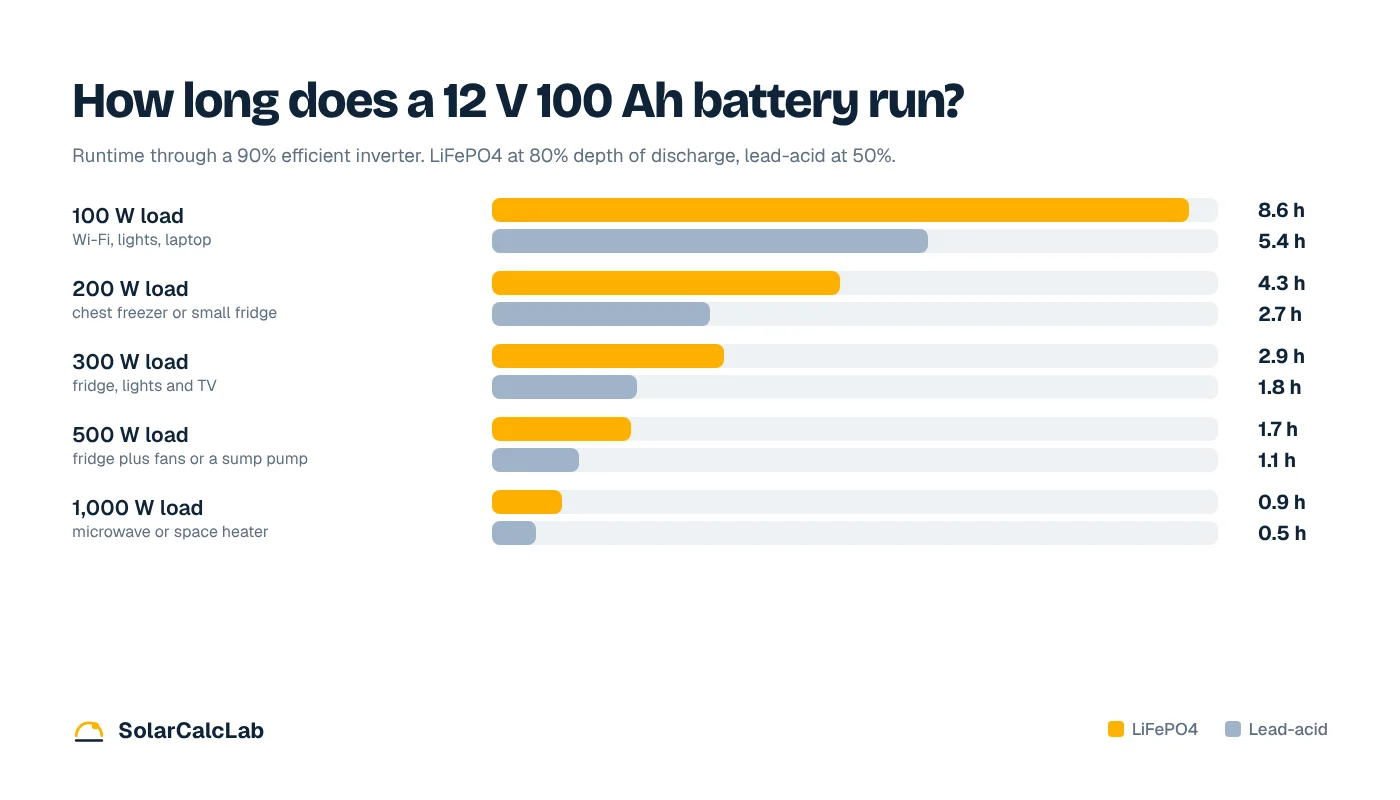
Example: 12 × 100 × 0.8 × 0.9 ÷ 300 W = 2.9 hours
Lead-acid results at high loads are optimistic. Above about 0.2C, or 20 A from a 100 Ah battery, lead-acid capacity shrinks because of the Peukert effect, so a 1,000 W load may run closer to 20 minutes than 30. Lithium holds its capacity much better at high current. To test other sizes and loads, use the battery calculator.
12 V, 24 V or 48 V: choosing the battery voltage
The battery voltage must match the inverter’s DC input, so you are really choosing the system voltage. The main factor is current: battery amps equal inverter watts divided by battery volts and efficiency.
| Inverter load | 12 V battery current | 24 V battery current | 48 V battery current |
|---|---|---|---|
| 1,000 W | 93 A | 46 A | 23 A |
| 1,500 W | 139 A | 69 A | 35 A |
| 2,000 W | 185 A | 93 A | 46 A |
| 3,000 W | 278 A | 139 A | 69 A |
| 5,000 W | 463 A | 231 A | 116 A |
A 3,000 W inverter on 12 V pulls nearly 280 A, which needs very heavy cable and a large fuse. A practical rule:
- 12 V for inverters up to about 1,500 W, such as vans, boats, small RVs and fridge-only backup.
- 24 V for 1,500 to 3,000 W, such as cabins and larger RVs.
- 48 V for 3,000 W and up, which covers nearly all whole-home inverters and server-rack batteries.
Use the inverter size calculator to set the inverter rating first, then size the cable and fuse for the battery current with the solar fuse size calculator.
Matching the battery to the inverter
Capacity and voltage are only part of the match. Check these specs before you buy:
- Continuous discharge rating. Most 12 V 100 Ah lithium batteries have a 100 A BMS, which supports about a 1,000 W inverter at full load. For a 2,000 W inverter at 12 V, you need two in parallel or a battery with a 200 A BMS.
- Surge current. Motors in fridges, pumps and power tools can draw two to three times their running watts for a moment. The BMS surge rating must cover the inverter’s surge, or the battery will shut off.
- Charger profile. If you use an inverter-charger, make sure it has a LiFePO4 setting, typically 14.2 to 14.6 V absorption on a 12 V battery. A lead-acid profile with equalization can damage lithium cells.
- Low-temperature protection. LiFePO4 cells must not be charged below 32°F. Buy a self-heating model for unheated garages, sheds or RVs in northern states.
Recharge time
Recharge time is roughly the amp-hours used divided by charger current, plus a small allowance for losses.
Example: 200 Ah LiFePO4 at 80% used = 160 Ah ÷ (40 A × 0.95) = 4.2 hours
Lead-acid takes longer, since the last 20% goes in slowly and often adds three to four hours. The battery charging time calculator covers both chemistries.
Cost per kWh over the battery’s life
Divide the price by the total energy the battery delivers over its life:
| 12 V 100 Ah battery | Price | Energy per cycle | Cycles | Lifetime energy | Cost per kWh |
|---|---|---|---|---|---|
| LiFePO4 | $250 | 0.96 kWh (80%) | 4,000 | 3,840 kWh | $0.07 |
| Flooded lead-acid | $150 | 0.60 kWh (50%) | 800 | 480 kWh | $0.31 |
| AGM | $230 | 0.60 kWh (50%) | 500 | 300 kWh | $0.77 |
For daily solar cycling, lithium wins by a wide margin. For a standby battery, calendar life matters more than cycles. Keeping a lithium battery out of high heat and away from 100% charge for long periods helps it last, as Battery University explains.
Installation and safety tips
- Fuse the positive cable as close to the battery as possible, sized for the cable, not just the inverter.
- Keep parallel cables short and equal so batteries share current. Size them with the solar cable size calculator.
- Ventilate flooded batteries, which release hydrogen while charging, and never mix chemistries or ages in one bank.
- Connecting a backup system to home wiring needs a transfer switch or interlock and, in most places, a permit. Hire a licensed electrician for that part.
Frequently asked questions
What is the best type of inverter battery?
For most new systems, a LiFePO4 lithium battery is the best choice. It gives 80 to 100% usable capacity, lasts 3,000 to 6,000 cycles, weighs a third as much as lead-acid and needs no maintenance. Lead-acid is still fine for a rarely used standby system on a tight budget.
How many batteries do I need for a 1,000 W inverter?
It depends on runtime. At a full 1,000 W load for 4 hours, you need about 463 Ah of 12 V lithium, so five 100 Ah batteries, or about 741 Ah of 12 V lead-acid. Most real loads average well below the inverter rating, so size from your actual watts.
How long does a 200 Ah inverter battery last?
A 12 V 200 Ah LiFePO4 battery delivers about 1,728 Wh through a 90% efficient inverter at 80% depth of discharge. That runs a 150 W load for about 11.5 hours or a 500 W load for about 3.5 hours. A lead-acid battery of the same size gives roughly 60% of those times.
Can I use a car battery with an inverter?
Only for short, light use, such as running a small inverter from a running vehicle. Car starting batteries are not built for deep discharge, and draining one repeatedly will ruin it quickly. For backup power, use a deep-cycle lead-acid or LiFePO4 battery.
How long does an inverter battery last in years?
Flooded and AGM lead-acid batteries usually last 3 to 6 years with regular cycling. LiFePO4 batteries typically last 10 years or more, and many carry 5 to 10 year warranties. Heat, deep discharges and poor charging shorten the life of every type.