How Many Watts Does a Refrigerator Use? Running, Startup and Daily kWh

Short answer
A typical full-size refrigerator uses about 100 to 250 watts while the compressor runs and 600 to 1,200 watts for a second or two at startup. Because the compressor cycles on and off, the average is only about 40 to 90 watts. A new Energy Star fridge uses roughly 1 to 2 kWh a day, or 300 to 750 kWh a year, which costs about $4.50 to $11 a month at 18 cents per kWh.
The question of how many watts a refrigerator uses has three answers: running watts, the brief startup surge, and the average over a day. Surge watts size an inverter or generator, and daily kWh sizes a battery, solar array and bill.
Below are typical figures for each fridge type, the math behind them, and a wattage chart for 40 common home appliances. For starting watts and daily kWh across the whole house, see the full appliance wattage chart.
How many watts does a refrigerator use while running?
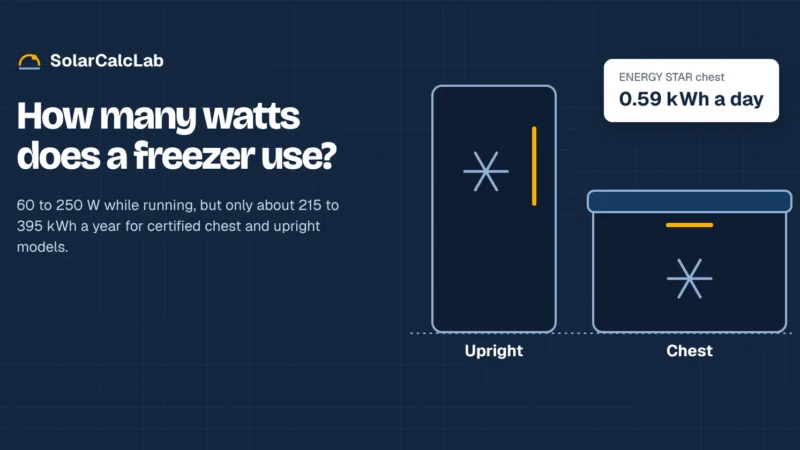
Most full-size refrigerators draw 100 to 250 watts when the compressor is on. Mini fridges and chest freezers draw less, and variable-speed (inverter) compressors often run long and slow at the low end. If you run a separate chest or upright unit in the garage, our guide to how many watts a freezer uses covers its daily kWh and backup sizing.
Yearly figures come from the ENERGY STAR certified product lists and show the middle 80% of models in each group. The French door row uses bottom-freezer models of 24 cubic feet and up, since that is how the data classifies them.
| Type and typical size | Typical running watts | Typical startup watts | Energy Star kWh per year | kWh per day |
|---|---|---|---|---|
| Top freezer, about 18 cu ft | 100 to 150 W | 500 to 800 W | 300 to 450 | 0.8 to 1.2 |
| Bottom freezer, 20 to 24 cu ft | 120 to 200 W | 600 to 1,000 W | 500 to 670 | 1.4 to 1.8 |
| French door, 24 to 30 cu ft | 150 to 250 W | 700 to 1,200 W | 610 to 780 | 1.7 to 2.1 |
| Side by side, about 25 cu ft | 150 to 250 W | 700 to 1,200 W | 460 to 760 | 1.3 to 2.1 |
| Mini fridge, about 3 cu ft | 50 to 100 W | 250 to 500 W | 205 to 335 | 0.6 to 0.9 |
| Chest freezer, 5 to 15 cu ft | 60 to 150 W | 300 to 800 W | 175 to 280 | 0.5 to 0.8 |
| Upright freezer, 13 to 20 cu ft | 100 to 250 W | 600 to 1,200 W | 355 to 550 | 1.0 to 1.5 |
How many watts does a refrigerator use at startup?
A standard compressor pulls a large inrush current for a second or two as it starts. A useful planning rule:
Example: 180 W running × 3 to 5 = 540 to 900 W surge
Inverter compressors ramp up gradually, so their surge stays close to running watts, which suits small inverters and power stations. Frost-free models also run a defrost heater of a few hundred watts for 20 to 40 minutes, once or several times a day.
Why do nameplate amps overstate refrigerator wattage?
The sticker inside the door often lists something like 6 amps at 115 volts. Multiplying gives 690 watts, which is several times what the compressor actually draws.
Example: 115 V × 6 A = 690 W (a worst-case rating, not the running draw)
The nameplate is a safety maximum covering the compressor, fans, lights and defrost heater at their highest combined draw. To convert any rating, the watts to amps calculator works in both directions.

How many kWh does a refrigerator use per day and per year?
A new full-size refrigerator usually lands between 300 and 750 kWh a year, or about 1 to 2 kWh a day. The yellow EnergyGuide label on a new model gives its rated yearly kWh. According to ENERGY STAR, certified refrigerators are about 9% more efficient than models that only meet the federal minimum, and a fridge more than 15 years old uses about 20% more energy than a certified one.
Example: 600 kWh ÷ 365 = 1.64 kWh per day
Duty cycle: why the average is so low
The compressor runs only part of each hour. The share of time it runs is the duty cycle, and you can work it out from the yearly rating and the running watts:
Duty cycle = average watts ÷ running watts
Example: 600 kWh × 1,000 ÷ 8,760 = 68 W average; 68 ÷ 150 W = 46% duty cycle
Duty cycle rises in a hot room, with frequent door openings, colder settings, dusty condenser coils and leaky door seals.
How much does it cost to run a refrigerator per month?
The EIA Short-Term Energy Outlook puts the average US residential price at about 18.2 cents per kWh for 2026, so the table uses 18 cents.
Example: 600 kWh × $0.18 ÷ 12 = $9.00 per month
| Yearly use | Typical fridge | Cost per year | Cost per month |
|---|---|---|---|
| 250 kWh | Mini fridge or chest freezer | $45 | $3.75 |
| 400 kWh | Top freezer, 18 cu ft | $72 | $6.00 |
| 600 kWh | Bottom freezer or side by side | $108 | $9.00 |
| 750 kWh | Large French door | $135 | $11.25 |
Use your own rate in the electricity cost calculator.
What size generator, inverter, battery or solar system does a fridge need?
Generator
A generator must cover the fridge’s startup surge plus everything else running at that moment. A 2,000 W inverter generator handles a fridge, lights and chargers comfortably.
Inverter
Use a pure sine wave inverter whose surge rating exceeds the fridge’s startup watts. For a full-size fridge, 1,000 W continuous with about 2,000 W surge is a practical minimum. The inverter size calculator adds up running and surge watts for a whole list of appliances.
Battery
Batteries are sized on daily kWh, not watts. This guide assumes 90% usable battery capacity and 90% inverter efficiency:
Example: 1.5 kWh × 1 day ÷ 0.81 = 1.85 kWh of battery
Solar panels
This guide uses 4.5 peak sun hours as a US middle value and 80% system efficiency:
Example: 1.5 kWh × 1,000 ÷ (4.5 × 0.80) = 417 W, about one 430 W panel
| Component | Fridge using 1.0 kWh/day | Fridge using 1.5 kWh/day | Fridge using 2.0 kWh/day |
|---|---|---|---|
| Battery for 1 day | 1.23 kWh | 1.85 kWh | 2.47 kWh |
| Battery for 2 days | 2.47 kWh | 3.70 kWh | 4.94 kWh |
| Solar at 4.5 sun hours | 278 W | 417 W | 556 W |
| 430 W panels | 1 | 1 | 2 |
The battery backup calculator shows runtime for a battery you already own, and the appliance solar panel calculator sizes panels for any single appliance.
How do you measure your own refrigerator’s wattage?
- Read the EnergyGuide label for the rated yearly kWh.
- Plug the fridge into a plug-in usage monitor for at least 24 hours, ideally a week, so defrost cycles are included.
- Divide the kWh total by the days measured to get your daily figure.
- Note running watts while the compressor hums. Plug-in meters often miss the full startup surge, so treat their peak as a minimum.
Turn a week of readings into monthly and yearly totals with the kWh calculator.
How many watts does a house use?
EIA data shows the average US residential customer bought about 10,791 kWh in 2022, close to 30 kWh a day. Over 24 hours that is an average of about 1,230 watts (29.6 kWh × 1,000 ÷ 24). A fridge using 1.5 kWh a day is about 5% of the total.
Wattage chart for 40 common home appliances
Startup watts apply to motor and compressor loads. Heating appliances have no meaningful surge. Treat these as typical planning ranges.
| Appliance | Typical running watts | Typical startup watts (where relevant) | Typical daily use | kWh per day |
|---|---|---|---|---|
| Refrigerator, full size | 100 to 250 W | 600 to 1,200 | 24 h, cycling | 1.0 to 2.0 |
| Mini fridge | 50 to 100 W | 250 to 500 | 24 h, cycling | 0.6 to 0.9 |
| Chest freezer | 60 to 150 W | 300 to 800 | 24 h, cycling | 0.5 to 0.8 |
| Upright freezer | 100 to 250 W | 600 to 1,200 | 24 h, cycling | 1.0 to 1.5 |
| Wine or beverage cooler | 60 to 150 W | 300 to 600 | 24 h, cycling | 0.3 to 0.6 |
| Microwave | 1,000 to 1,600 W | None | 15 min | 0.25 to 0.40 |
| Electric oven | 2,000 to 5,000 W | None | 1 h, cycling | 1.0 to 2.5 |
| Electric cooktop burner | 1,200 to 3,000 W | None | 30 min | 0.60 to 1.5 |
| Portable induction burner | 1,200 to 1,800 W | None | 30 min | 0.60 to 0.90 |
| Toaster | 800 to 1,500 W | None | 6 min | 0.08 to 0.15 |
| Toaster oven | 1,200 to 1,800 W | None | 20 min | 0.40 to 0.60 |
| Air fryer | 1,200 to 1,800 W | None | 30 min | 0.60 to 0.90 |
| Drip coffee maker | 800 to 1,200 W | None | 15 min | 0.20 to 0.30 |
| Electric kettle | 1,200 to 1,500 W | None | 10 min | 0.20 to 0.25 |
| Slow cooker | 100 to 250 W | None | 6 h | 0.60 to 1.5 |
| Blender | 300 to 1,000 W | Brief motor surge | 5 min | 0.03 to 0.08 |
| Dishwasher | 1,200 to 2,400 W | None | 1 cycle | 0.8 to 1.5 |
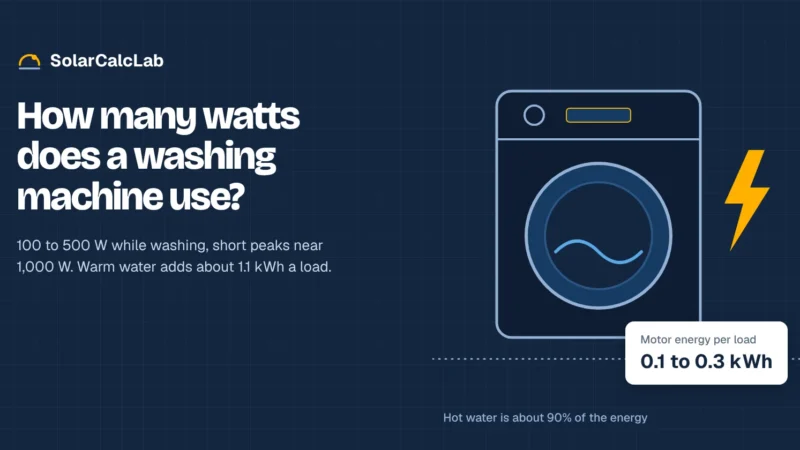
| Clothes washer | 300 to 500 W | 800 to 1,200 | 1 load | 0.30 to 0.50 |
| Electric clothes dryer | 2,000 to 5,000 W | None | 1 load | 2.0 to 5.0 |
| Gas clothes dryer | 300 to 600 W | 600 to 1,200 | 1 load | 0.30 to 0.60 |
| Clothes iron | 1,000 to 1,800 W | None | 20 min | 0.33 to 0.60 |
| Hair dryer | 1,200 to 1,875 W | None | 10 min | 0.20 to 0.31 |
| Vacuum cleaner | 500 to 1,400 W | Brief motor surge | 20 min | 0.17 to 0.47 |
| Central AC, 3 ton | 3,000 to 4,000 W | 7,000 to 12,000 | 6 h running | 18.0 to 24.0 |
| Window AC | 500 to 1,500 W | 1,500 to 3,000 | 8 h | 4.0 to 12.0 |
| Portable AC | 800 to 1,400 W | 1,600 to 3,000 | 8 h | 6.4 to 11.2 |
| Space heater | 750 to 1,500 W | None | 4 h | 3.0 to 6.0 |
| Ceiling fan | 15 to 75 W | None | 8 h | 0.12 to 0.60 |
| Box fan | 50 to 100 W | None | 8 h | 0.40 to 0.80 |
| Dehumidifier | 300 to 700 W | 600 to 1,500 | 12 h | 3.6 to 8.4 |
| Electric water heater | 4,000 to 4,500 W | None | 3 h heating | 12.0 to 13.5 |
| Well pump, 1/2 to 1 hp | 750 to 1,500 W | 2,000 to 4,500 | 1 h | 0.75 to 1.5 |
| Sump pump, 1/3 to 1/2 hp | 800 to 1,050 W | 1,300 to 2,200 | 1 h | 0.80 to 1.1 |
| Gas furnace blower | 300 to 800 W | 600 to 1,500 | 8 h | 2.4 to 6.4 |
| LED TV, 32 to 65 inch | 30 to 150 W | None | 5 h | 0.15 to 0.75 |
| Desktop computer | 60 to 300 W | None | 8 h | 0.48 to 2.4 |
| Laptop | 30 to 90 W | None | 8 h | 0.24 to 0.72 |
| Game console, playing | 100 to 200 W | None | 3 h | 0.30 to 0.60 |
| Wi-Fi router | 6 to 20 W | None | 24 h | 0.14 to 0.48 |
| LED light bulb, 60 W equivalent | 8 to 12 W | None | 5 h | 0.04 to 0.06 |
How many watts does a TV use?
Most LED TVs from 32 to 65 inches draw 30 to 150 watts, with bigger screens and bright picture modes at the top.
How many watts does a microwave use?
A microwave draws more than its cooking power rating: a 1,000 W model typically pulls 1,400 to 1,600 W, a big inverter load but little energy. Our breakdown of how many watts a microwave uses shows the amps on a 120 V circuit and what inverter size handles one.
Frequently asked questions
How many watts does a fridge use per hour?
While the compressor runs, a full-size fridge draws about 100 to 250 watts. Averaged over a full hour with the compressor cycling, it is closer to 40 to 90 watts. Divide the yearly kWh on the EnergyGuide label by 8,760 hours and multiply by 1,000 to get your model’s average.
Can a 1,000 watt inverter run a refrigerator?
Usually yes, if it is a pure sine wave inverter with a surge rating of about 2,000 watts. That covers the 600 to 1,200 watt startup of most full-size fridges. Running other appliances at the same time may need a 1,500 to 2,000 watt inverter.
How long can a battery run a refrigerator?
Divide the battery’s usable kWh by the fridge’s daily kWh. A 5 kWh battery with 90% usable capacity and a 90% efficient inverter delivers about 4 kWh, which runs a fridge using 1.5 kWh a day for roughly 2.7 days.
How many solar panels does a refrigerator need?
A fridge using 1.5 kWh a day needs about 417 watts of panels at 4.5 peak sun hours and 80% system efficiency, which is one 430 W panel. Use two panels for winter or shade, and add a battery so the fridge runs at night.