What Will a 15kW Inverter Run? Appliances, Battery Size and Solar Panels
Short answer
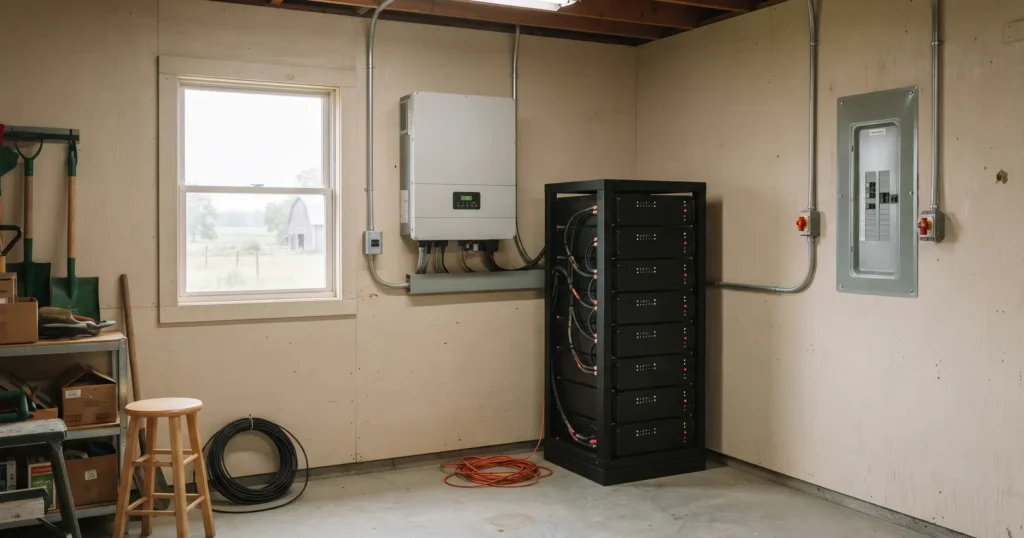
A 15kW inverter supplies up to 15,000 watts at once: enough for central air, a well pump, a water heater and everyday loads together, but usually not all of that plus an EV charger and a dryer. On a 48 V battery it pulls about 313 A at full load, closer to 340 A with losses, so it needs four or more battery modules in parallel and heavy cables.
Fifteen kilowatts is the point where an inverter stops covering a few essential circuits and starts covering the whole house, big 240 V loads included. That is why this size shows up on off-grid homesteads, rural homes with deep wells, and large homes that want central air to keep running in an outage.
Whether a 15kW inverter keeps up depends on three things the headline rating does not show: what starts at the same moment, how much current the battery can deliver, and how the inverter connects to a US split-phase panel. Each is worked through below with the formulas shown.
What does the 15kW rating on an inverter actually mean?
A spec sheet lists more than one power figure. The one that matters for planning is continuous output: the AC power the inverter can deliver for hours without overheating. A true 15 kW unit holds 15,000 W at its rated ambient temperature, and many derate above it, so a hot garage can cost you capacity.
Surge (or peak) output is a short burst above that, used to start motors. Spec sheets vary widely in how high the surge goes and how long it lasts, from a fraction of a second to several seconds. Low-frequency, transformer-based inverters generally ride through surges better than lightweight high-frequency designs with the same continuous rating.
Also check what the model name refers to. Some hybrid units carry a “15K” label because of their maximum solar input, while their continuous AC output is lower. Look for the line labeled continuous AC output, both on-grid and off-grid, before you compare a power inverter 15000 watts listing with another.
Example: 15,000 W ÷ 240 V = 62.5 A across the two hot legs of a US split-phase panel
You can convert any other voltage in the watts to amps calculator.
Which whole-home loads fit inside 15,000 watts?
Add up the running watts of everything that could be on together. The figures below are typical planning values; the nameplate on your own appliance always wins.
| Appliance | Voltage | Typical running watts | Notes |
|---|---|---|---|
| Central air, 3 ton | 240 V | 3,000 to 3,500 W | Large motor start, see LRA below |
| Well pump, 1 hp | 240 V | 1,500 to 2,000 W | Starts every time pressure drops |
| Level 2 EV charger, 30 A | 240 V | 7,200 W | Steady load for hours, no surge |
| Electric range, all elements | 240 V | 8,000 to 12,000 W | Normal cooking often 2,000 to 5,000 W |
| Electric clothes dryer | 240 V | 5,000 to 5,600 W | Heating element cycles on and off |
| Electric tank water heater | 240 V | 4,500 W | One element on at a time in most tanks |
| Microwave | 120 V | 1,000 to 1,500 W | Short runs |
| Refrigerator | 120 V | 100 to 250 W | Compressor cycles |
| Lights, TV, Wi-Fi, computers | 120 V | 300 to 600 W | Evening peak |
The EV figure comes from the US Department of Energy Alternative Fuels Data Center, which says most residential Level 2 chargers run at up to 30 A and 7.2 kW, while Level 2 units in general span 2.9 to 19.2 kW. A 48 A charger draws 11,520 W at 240 V, which alone uses three quarters of the inverter.
Three whole-home scenarios
| Scenario | Loads on together | Total | Fits 15 kW? |
|---|---|---|---|
| Summer evening | AC 3,500 + water heater 4,500 + well pump 1,800 + microwave 1,200 + lights 500 + fridge 200 | 11,700 W | Yes, 3,300 W spare |
| Laundry and EV | EV 7,200 + dryer 5,500 + lights 500 + fridge 200 | 13,400 W | Yes, but no motor can start |
| Everything at once | Summer evening loads + EV 7,200 | 18,900 W | No, overload |
So a 15 kW inverter runs every appliance in a large home, just not every appliance at the same moment. An EV charger that throttles when the house is busy, or a relay that locks out the water heater while the dryer runs, keeps the total under the limit. The solar load calculator helps you list loads and find your realistic peak.
What happens when a compressor or well pump starts?
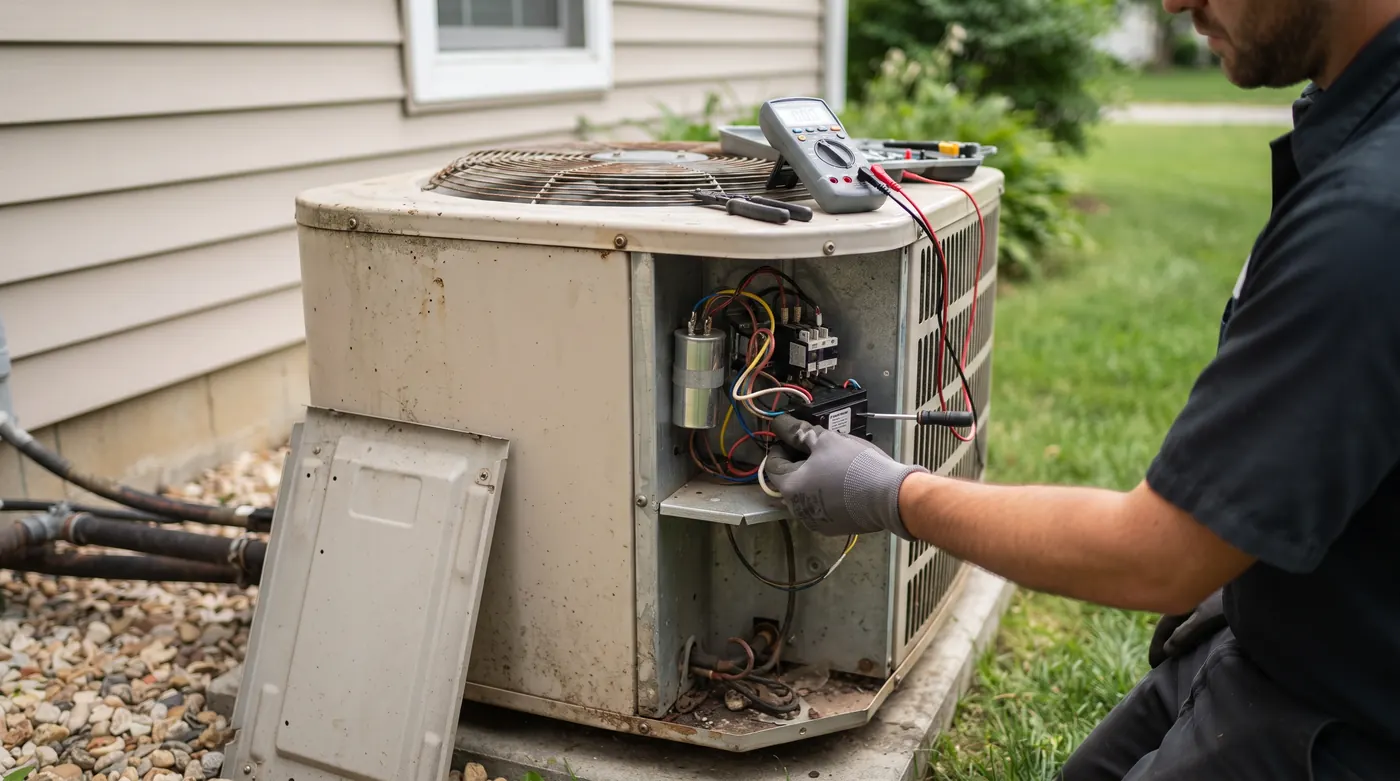
Induction motors in compressors and pumps draw a large inrush for a split second while they reach speed. The nameplate lists this as LRA, locked rotor amps, and it is often several times the running current.
Example: a compressor with a 100 A LRA at 240 V needs about 24,000 VA for a fraction of a second
The LRA values below are assumptions for illustration, since ratings vary by brand and size. Read the label on your outdoor unit and pump control box, then see what happens when the inverter is already carrying 5,000 W.
| Event | Background load | Starting demand | Instant total |
|---|---|---|---|
| AC starts, no soft starter (100 A LRA) | 5,000 W | 24,000 VA | 29,000 VA |
| AC starts with soft starter (about 40 A) | 5,000 W | 9,600 VA | 14,600 VA |
| Well pump starts (assumed 40 A LRA) | 5,000 W | 9,600 VA | 14,600 VA |
| AC and pump start together, no soft starter | 5,000 W | 33,600 VA | 38,600 VA |
A 29,000 VA instant demand is almost twice the continuous rating. Whether the inverter rides through depends on its surge figure and how long that surge lasts. Two fixes make the difference:
- Soft starters on the air conditioner ramp the compressor up gradually instead of slamming it on. A start of about 40 A is the planning figure used here for a 3 ton unit fitted with one; check the actual result with the installer.
- Staggered starts stop two motors from kicking in at the same instant. Some hybrid inverters and load controllers can delay a second load by a few seconds.
How many 48 V battery modules does a 15kW inverter need?
The bank has two separate limits: current (can it deliver 15 kW without tripping its protection) and energy (how long it lasts). Size for both and use the larger answer.
Current at 48 V
Example: 15,000 ÷ 48 = 312.5 A before losses; 15,000 ÷ (48 × 0.92) = 340 A; near empty at 46 V, 15,000 ÷ (46 × 0.92) = 354 A
The 92% efficiency is an assumption for a large inverter near full load. The common 48 V rack battery, a 100 Ah module of about 5.12 kWh, is often rated around 100 A continuous, although some allow more. At 100 A each, you need at least four modules in parallel just to supply 354 A, about 20 kWh, even if you only want short runtimes.
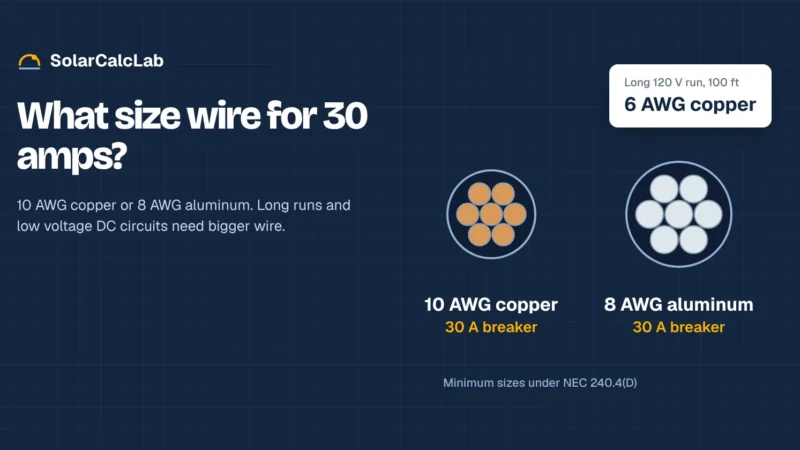
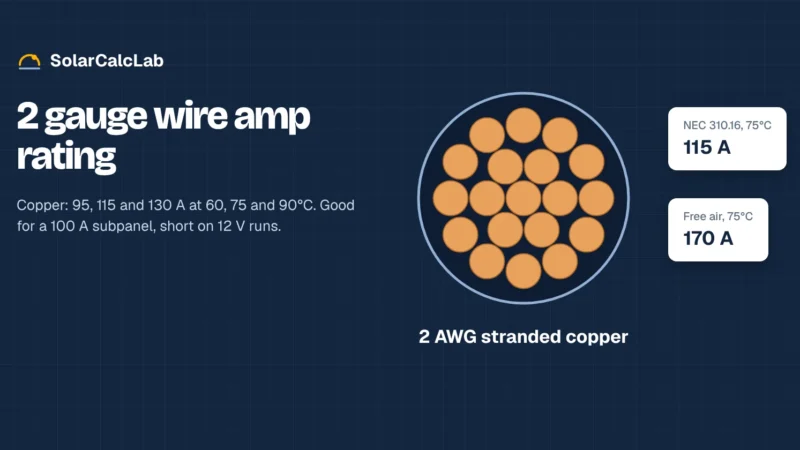
That current also sets the cable. With a 125% continuous factor, 354 A becomes about 443 A. At the NEC ampacity of 230 A for 4/0 copper with 75°C terminals, that means two parallel 4/0 runs per pole or one larger conductor, checked against the inverter manual and local code. Run your own numbers through the wire size calculator. High-voltage battery systems, often above 100 V DC, cut this current to a fraction, which is one reason they pair well with large hybrids.
Runtime by bank size
This site assumes 90% usable capacity; the table also applies the 92% inverter efficiency.
Example: 30 kWh × 0.90 × 0.92 = 24.8 kWh delivered; ÷ 5 kW = 5.0 hours
| Battery bank | Modules (5.12 kWh) | Energy delivered | At 15 kW full load | At 5 kW average | At 1.5 kW overnight base |
|---|---|---|---|---|---|
| 20 kWh | 4 | 16.6 kWh | 1.1 hours | 3.3 hours | 11 hours |
| 30 kWh | 6 | 24.8 kWh | 1.7 hours | 5.0 hours | 16.6 hours |
| 45 kWh | 9 | 37.3 kWh | 2.5 hours | 7.5 hours | 24.8 hours |
| 60 kWh | 12 | 49.7 kWh | 3.3 hours | 9.9 hours | 33.1 hours |
Nobody runs a home at 15 kW for hours, so the 5 kW and 1.5 kW columns are closer to real life. Module counts are rounded to the nearest whole unit. For sizing from your own daily kWh and days of autonomy, use the battery calculator.
Grid-tie, hybrid or off-grid: which 15kW inverter type?
| Type | Battery | Works in an outage | Exports to grid | Best fit at 15 kW |
|---|---|---|---|---|
| Grid-tie string inverter | No | No, shuts down for line-worker safety | Yes | Large array, lowest cost per watt, no backup |
| Hybrid | Yes | Yes, on backed-up circuits or the whole home | Yes, where allowed | Whole-home backup including central air |
| Off-grid | Yes, required | There is no grid | No | Rural homes, wells, generator input |
Single-unit 15 kilowatt inverter models for grid-tie are more common outside the US, where homes often have three-phase service. At 400 V three-phase, 15,000 ÷ (1.732 × 400) = 21.7 A per phase, a modest load. A US home on 240 V split-phase faces the larger currents covered further down.
What size solar array pairs with a 15 kilowatt inverter?
Grid-tie and hybrid: use a DC-to-AC ratio
Panels rarely reach their full rating on a roof, so installers commonly put 1.1 to 1.3 watts of panels on each watt of inverter. For 15 kW of AC, that is 16.5 to 19.5 kW of panels: 39 to 46 panels at 430 W. At 4.5 peak sun hours and 80% system efficiency, that array makes about 59 to 70 kWh a day (16.5 × 4.5 × 0.80 = 59.4). Stay within the inverter’s maximum PV input and its MPPT voltage and current limits. The inverter size calculator checks the ratio, and the 15kW solar system guide covers the array side in depth.
Off-grid: size to energy, not to the inverter
Example: 40 kWh a day ÷ (4.5 × 0.80) = 11.1 kW, or 26 panels at 430 W
An off-grid home with a 15 kW inverter might need only 11 kW of panels in an average month. Winter is the catch: at 3 sun hours, the same 40 kWh needs 40 ÷ (3 × 0.80) = 16.7 kW, or 39 panels. Most off-grid owners settle between those numbers and use a generator for the darkest weeks.
Will a 15kW inverter work on a 200 A split-phase panel?
US homes get two 120 V legs that combine to 240 V. A split-phase inverter feeds both. The 240 V loads (AC, dryer, range, well pump, EV charger) draw from both legs equally, while each 120 V circuit draws from one leg only.
Leg balancing
Many split-phase inverters cap each leg at about half the rating, so 7,500 W, or 62.5 A at 120 V. Put the microwave, a space heater and a kitchen toaster oven on the same leg and that side can trip while the total still reads well under 15 kW. Spread large 120 V loads across both legs and confirm the per-leg limit on the spec sheet.
Backfeed breaker and the 120% rule
120% rule allowance = (busbar rating × 1.2) minus main breaker; 200 A bus with 200 A main: 240 minus 200 = 40 A
An 80 A backfeed breaker is double what a standard 200 A panel allows under the NEC 120% rule. A 225 A bus with a 200 A main allows 70 A, still short. The usual fixes are a supply-side connection ahead of the main breaker, a smaller main if a load calculation supports it (a 225 A bus with a 175 A main allows 95 A), or a new panel. Off-grid installs avoid backfeed limits but still need conductors rated for 62.5 A continuous.
Who actually needs a 15kW inverter?
Homes that only want lights, the fridge, internet and a few outlets during an outage are well served by 5 to 8 kW. An inverter 15 kW unit earns its cost when one or more of these is true:
- The home is off grid with a deep well pump, central air and electric cooking.
- You want whole-home backup that includes a 3 to 5 ton air conditioner, not just a critical-loads panel.
- An EV charges at home and you do not want charging to lock out the rest of the house.
- The array is big enough that a smaller inverter would clip heavily, such as the arrays in the 20kW solar system guide.
Idle draw is the hidden cost. Large inverters use power just being switched on, and the figure varies by model. At an example 60 W no-load draw, that is 60 × 24 = 1,440 Wh, about 1.4 kWh a day, which matters off grid in winter. Some owners stack two smaller inverters instead, so one can sleep when loads are light.
Frequently asked questions
Is 15 kW enough for a house with central air and an EV?
Usually, with some planning. Central air, a well pump, a water heater and household loads together come to about 11 to 12 kW, leaving roughly 3 kW spare. Adding a 7.2 kW EV charger on top pushes the total near 19 kW, so set the charger to throttle or charge when the AC and water heater are off.
What size fuse and cable does a 15kW inverter need on 48 V?
Full load draws about 340 A at 48 V with an assumed 92% efficiency, and about 354 A near empty at 46 V. Adding 25% for continuous duty gives about 443 A, which points to two parallel 4/0 copper runs per pole or a larger single conductor, with the fuse sized to match the inverter manual.
Do I need a soft starter with a 15kW inverter?
Often, yes, for central air. A compressor with an assumed 100 A locked rotor rating asks for about 24,000 VA at 240 V for a split second, well above 15 kW. A soft starter that brings the start down to around 40 A makes the start comfortable, especially when other loads are already running.
How many solar panels do I need for a 15kW inverter?
For grid-tie or hybrid use, 39 to 46 panels at 430 W, a DC-to-AC ratio of 1.1 to 1.3. Off-grid arrays are sized to daily energy instead. A home using 40 kWh a day needs about 11.1 kW of panels at 4.5 sun hours, or 26 panels, and more for winter.
Can one leg of a 15kW inverter overload before the total does?
Yes. Many split-phase models limit each 120 V leg to about half the rating, so 7,500 W per leg. If several large 120 V appliances sit on the same leg, that side can shut down while the total load still looks safe. Balance 120 V circuits across both legs in the panel.
Does a 15kW inverter need a bigger electrical panel?
Often, on grid-tied homes. At 240 V it outputs 62.5 A, which needs an 80 A breaker. A standard 200 A panel with a 200 A main allows only 40 A of backfeed under the NEC 120% rule, so many installs use a supply-side connection, a smaller main breaker or a panel upgrade.