How Long Does a 5kWh Battery Last? Runtime for Your Home and Appliances

Short answer
A 5 kWh battery gives about 4.5 kWh of usable energy, which runs a steady 1 kW load for about 4.5 hours, or about 4 hours once inverter losses are counted. That keeps a fridge, Wi-Fi, lights, phones and a CPAP going for roughly a day during an outage, or powers an RV or van for two to three days. Four 430 W solar panels can refill it on a typical sunny day.
A 5 kWh battery sits in an interesting middle ground. It is too small to back up a whole house, yet it is far bigger than the power banks and small portable stations most people start with. It is the size people choose for a camper van, a weekend cabin, an RV, or a small essentials-only backup that keeps the fridge cold and the internet on.
This guide answers one question: what will 5 kWh actually run, and for how long? It also compares a 5 kWh solar battery with large portable power stations and covers recharging and cost.
How long does a 5 kWh battery last at different loads?
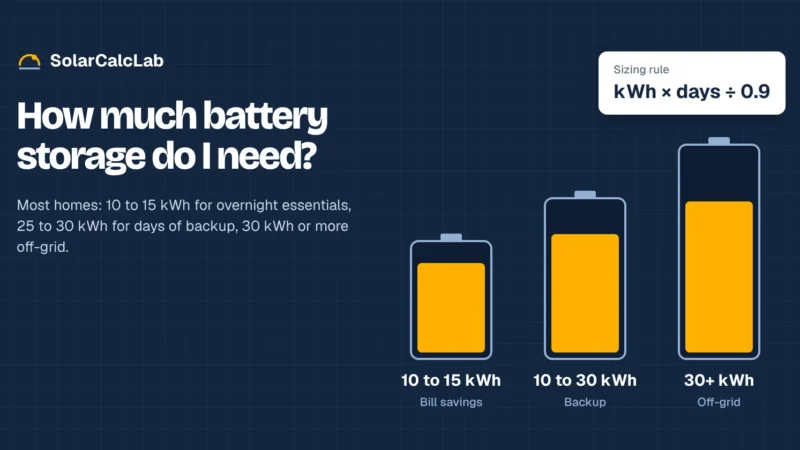
Start with usable energy, not the label. Lithium batteries keep a reserve at the top and bottom to protect the cells, and this site plans with 90% usable capacity. If you run AC appliances, the inverter then loses roughly another 5% to 10%. This guide uses 10% to stay on the safe side.
Example: 5 kWh × 0.90 × 0.90 ÷ 1 kW = 4.05, so about 4 hours
Steady loads are rare, so treat the table as a worst case.
| Continuous load | On 4.5 kWh usable (DC loads) | On 4.05 kWh (AC loads via inverter) | Typical example |
|---|---|---|---|
| 100 W | 45 hours | about 40 hours | Router, a few LED lights, laptop |
| 300 W | 15 hours | about 13.5 hours | Fridge running plus TV and lights |
| 500 W | 9 hours | about 8 hours | A small window AC on its own |
| 1,000 W | 4.5 hours | about 4 hours | Microwave or sump pump running |
| 2,000 W | 2.25 hours | about 2 hours | Kettle or induction burner in use |
| 3,000 W | 1.5 hours | about 1.35 hours | Several heating loads at once |
The DC column applies to vans and RVs running 12 V fridges, fans and lights straight from the battery. For a mixed list of your own appliances, the battery backup calculator adds up the watts and hours for you.
What can a 5 kWh battery run? Appliance runtimes
Each row runs one appliance alone from 4.5 kWh. Wattages are typical running values, so check the rating plate or use a plug-in meter.
| Appliance | Typical draw | Runtime on 4.5 kWh |
|---|---|---|
| Kitchen refrigerator | about 1.5 kWh a day | about 3 days |
| Chest freezer, small | about 0.75 kWh a day | about 6 days |
| 12 V compressor fridge (van or RV) | about 0.4 kWh a day | about 11 days |
| CPAP without heated humidifier | about 40 W | about 112 hours, or 14 nights of 8 hours |
| Wi-Fi router and modem | 20 W | about 225 hours |
| Laptop | 60 W | 75 hours |
| LED lights, 6 bulbs at 9 W | 54 W | about 83 hours |
| 55 inch LED TV | 100 W | 45 hours |
| Microwave (1,000 W cooking) | about 1,200 W input | about 3.75 hours of cooking |
| Sump pump, 1/3 hp | about 800 W running | about 5.6 hours of pumping |
| Window AC, 6,000 BTU | about 550 W | about 8 hours of compressor time |
| RV rooftop AC, 13,500 BTU | about 1,300 W | about 3.5 hours |
| Space heater | 1,500 W | 3 hours |
Electronics and refrigeration run for days, while anything that makes heat or cold drains the battery in hours. Our guide to how many watts a refrigerator uses shows how to measure yours.

Is 5 kWh enough for backup power in an outage?
For a whole house, no. The average US home buys about 10,800 kWh of electricity a year according to the U.S. Energy Information Administration, close to 30 kWh a day. At that rate, 4.05 kWh of AC energy would last a little over 3 hours.
For essentials, yes. The trick is to treat 5 kWh as a daily budget and decide in advance what fits inside it. Here is a realistic outage day for a home with gas heat or mild weather:
| Essential load | Use per day | Energy per day |
|---|---|---|
| Refrigerator | 24 hours, cycling | 1.50 kWh |
| Wi-Fi router and modem, 20 W | 24 hours | 0.48 kWh |
| CPAP, 40 W | 8 hours | 0.32 kWh |
| TV, 100 W | 3 hours | 0.30 kWh |
| LED lights, 54 W | 5 hours | 0.27 kWh |
| Phones and laptop charging | through the day | 0.25 kWh |
| Total | about 3.1 kWh |
With 4.05 kWh available through the inverter, that list runs for about 1.3 days. Add a sump pump running an hour in a storm (about 0.8 kWh) and you are down to roughly one day. Add a furnace blower, a well pump or a space heater and you will want the larger 10 kWh battery instead.
What to leave off a 5 kWh backup circuit
Keep central AC (about 3.5 kW for a 3 ton unit), electric water heaters, ovens, dryers and EV charging off the backed-up circuits. Any one of them can empty the battery in one to three hours.
Is a 5 kWh battery a good size for an RV, van or cabin?
This is where 5 kWh shines. A typical off-grid van day with a 12 V compressor fridge (0.4 kWh), roof fan (about 0.25 kWh), lights, a laptop for remote work (about 0.5 kWh) and phone charging uses around 1.5 kWh. On that budget, a full battery lasts about three days without any charging at all.
A weekend cabin with LED lights, a chest freezer, a small water pump and an evening TV can stay under 2 kWh a day, so 5 kWh covers a cloudy weekend. The limit is air conditioning: a 13,500 BTU rooftop unit uses most of the battery in an afternoon, so RV owners usually lean on shore power or a generator on hot days.
Charging on the road
A 30 A DC-DC charger on the alternator delivers about 420 W at 14 V, so refilling 5 kWh takes about 12 hours of driving. A 50 A unit (about 700 W) needs around 7 hours, and a 1,500 W shore power charger about 3.5 to 4 hours.
5 kWh battery vs a large portable power station
The biggest single-unit portable power stations typically hold about 2 to 4 kWh, and some expandable models reach 5 kWh or more when you add a matching battery pack. A DIY or installed 5 kWh battery splits the same job into separate parts: battery, inverter and charge controller.
| Feature | Portable power station (large) | 5 kWh battery system (DIY or installed) |
|---|---|---|
| Capacity | about 2 to 4 kWh, more with add-on packs | about 5 kWh, expandable in modules |
| Setup | Plug and play, all in one case | Separate inverter, controller and wiring |
| Continuous AC output | about 2,000 to 4,000 W | Set by the inverter you choose |
| Home connection | Extension cords or a transfer switch | Hard-wired subpanel or RV distribution panel |
| Repairs | Usually replace the whole unit | Swap the failed part only |
| Typical US price, late 2026 | about $1,500 to $4,000 | about $1,800 to $4,000 DIY, $5,000 to $9,000 installed |
A portable station suits renters and anyone who wants nothing wired in. A component system suits a permanent van or cabin install, or anyone who may grow from 5 kWh to 10 or 15 kWh later by adding modules.
Is a 48 V 100 Ah battery 5 kWh?
Very nearly. Most 48 V lithium iron phosphate (LiFePO4) server-rack modules use 16 cells in series, for a nominal voltage of 51.2 V.
Example: 51.2 V × 100 Ah = 5,120 Wh, or about 5.1 kWh (4.6 kWh usable at 90%)
A battery sold as a plain 48 V, 100 Ah unit works out to 4.8 kWh, so always check which voltage the spec sheet uses. The same 5 kWh can be built at other voltages:
| System voltage | Amp hours for about 5 kWh | Common build | Battery current at 2,000 W AC |
|---|---|---|---|
| 12 V (12.8 V LiFePO4) | about 400 Ah | Four 12 V 100 Ah batteries in parallel | about 174 A |
| 24 V (25.6 V) | about 200 Ah | Two 24 V 100 Ah batteries in parallel | about 87 A |
| 48 V (51.2 V) | 100 Ah | One server-rack module | about 43 A |
Current assumes a 90% efficient inverter. At 12 V that needs very heavy cable, so 12 V suits vans and RVs with existing 12 V wiring, while cabins and home backup use 48 V. Convert your own figures with the kWh to Ah converter.
Also check the battery management system (BMS) limit. Many 100 Ah modules allow 50 to 100 A continuous, about 2.5 to 5 kW at 51.2 V, and a bigger load trips the BMS even on a full battery.
How many solar panels recharge a 5 kWh battery?
Using this site’s standard assumptions of 430 W panels, 4.5 peak sun hours and 80% system efficiency, each panel makes about 1.55 kWh a day.
Example: 5 ÷ (0.43 × 4.5 × 0.80) = 5 ÷ 1.55 = 3.2, so 4 panels
Sizing to the full 5 kWh leaves a margin for charging losses. The table adds the smaller panels common on RVs and vans.
| Peak sun hours | 430 W panels needed | 200 W panels needed |
|---|---|---|
| 3.5 (cloudy north, winter) | 5 | 9 |
| 4.5 (US middle value) | 4 | 7 |
| 5.5 (sunny south) | 3 | 6 |
| 6.5 (desert Southwest) | 3 | 5 |
Four 430 W panels (1.72 kW) charging a 51.2 V battery push about 34 A, so a 40 A MPPT controller fits. Seven 200 W panels on a 12 V van battery push close to 100 A, which is why many builders move to 24 V or use two controllers. Check your own array with the charge controller calculator, and adjust the panel count for your location with the how many solar panels calculator.
How much does a 5 kWh battery cost?
These are typical US ranges in late 2026, before any local incentives:
- One 51.2 V 100 Ah server-rack module: about $700 to $1,500.
- Four 12 V 100 Ah LiFePO4 batteries: about $800 to $1,800 in total.
- Inverter/charger, charge controller, fuses and cable for a DIY build: roughly $800 to $2,500 more.
- Installed home battery around 5 kWh: about $5,000 to $9,000 with labor, permits and the gateway. Fixed installation costs make small installed batteries more expensive per kWh than large ones.
The 30% federal residential clean energy credit ended for homeowner-owned systems installed after December 31, 2025, so leave it out of your budget.
If you plan to cycle it daily to dodge peak rates, check the savings first:
Example: 4.05 kWh × $0.20 × 365 = about $296 a year
At about $300 a year, a $2,500 DIY system can pay back in under a decade, while a $7,000 installed system would take more than 20 years. For a 5 kWh battery, backup and off-grid use usually justify the cost better than rate shifting does.
Frequently asked questions
Can a 5 kWh battery run a house?
Not a whole house. The average US home uses close to 30 kWh a day, so a 5 kWh battery would last only about 3 hours at normal use. It can run essentials such as a fridge, Wi-Fi, lights, a CPAP and phone charging for about a day, longer if solar panels recharge it.
How long will a 5 kWh battery run a refrigerator?
A typical kitchen fridge uses about 1.5 kWh a day, so 4.5 kWh of usable energy runs it alone for about 3 days, or a little less once inverter losses are counted. A small 12 V compressor fridge in a van uses about 0.4 kWh a day and can run for over a week.
Is a 48V 100Ah battery 5 kWh?
Close to it. Most 48 V LiFePO4 modules are 51.2 V nominal, and 51.2 V × 100 Ah is 5,120 Wh, about 5.1 kWh. A unit rated at a true 48 V holds 4.8 kWh. At 90% usable capacity, expect about 4.3 to 4.6 kWh of working energy.
How long does it take to charge a 5 kWh battery with solar?
Four 430 W panels make about 6.2 kWh on a day with 4.5 peak sun hours, enough to refill an empty 5 kWh battery in a single sunny day. Fewer panels, cloudy weather or winter sun stretch that to two or three days, unless you add panels or charge from the grid.
Is 5 kWh enough for an RV or camper van?
For most vans and many RVs, yes. A van running a 12 V fridge, fan, lights and a laptop uses about 1.5 kWh a day, so 5 kWh lasts about three days without charging. Air conditioning is the exception: a rooftop unit can use most of the battery in a single afternoon.