How Long Does a 16kWh Battery Last? Runtime for Your Home and Appliances

Short answer
A 16 kWh battery gives about 14.4 kWh of usable energy, which runs a steady 1 kW load for about 14 hours, or 13 hours once inverter losses are counted. That is enough to carry a typical home’s essentials plus a bedroom mini-split through the night, but central air conditioning can drain it in about 4 hours. About 11 residential panels refill it on an average day.
Sixteen kilowatt hours is where a home battery stops being a fridge-and-Wi-Fi safety net and starts covering a real evening. It is often a single large wall unit or two stacked 8 kWh modules, and it is a common add-on for homes with an 8 to 10 kW rooftop array.
This guide works out how long a 16 kWh battery lasts at different loads, what it can run overnight with some cooling, how it pairs with your solar array, and what it costs in the US in late 2026. Every number comes from a formula shown on the page, so you can swap in your own figures.
How many hours will a 16 kWh battery power a house?
The label figure is nominal capacity. The battery management system holds back a reserve to protect the cells, and this site assumes 90% is usable. The inverter then loses about 5% to 10% turning DC into AC for your outlets.
Example: 16 × 0.90 × 0.90 ÷ 1 kW = 13.0 hours
The average US home bought about 10,791 kWh of electricity in 2022, according to the U.S. Energy Information Administration. That is about 30 kWh a day, or an average draw of roughly 1.25 kW. At that rate a 16 kWh battery lasts about 10 to 12 hours.
| Steady load | Runtime on 14.4 kWh | Runtime after inverter losses (13.0 kWh) | Typical situation |
|---|---|---|---|
| 0.5 kW | 28.8 hours | about 26 hours | Essentials only, gas heat, mild weather |
| 1 kW | 14.4 hours | about 13 hours | Essentials plus a furnace blower or well pump |
| 1.25 kW | 11.5 hours | about 10.4 hours | Average US home, whole-house backup |
| 2 kW | 7.2 hours | about 6.5 hours | Essentials plus a mini-split and cooking |
| 3.5 kW | 4.1 hours | about 3.7 hours | A 3-ton central AC running nonstop |
| 5 kW | 2.9 hours | about 2.6 hours | AC, electric oven and dryer together |
Real homes do not draw a flat load. The fridge and AC cycle on and off, so these figures are a floor rather than a promise. To run the numbers on your own appliance list, use the battery backup calculator.
How long does a 16 kWh battery run individual appliances?
Each row below runs one appliance alone on 14.4 kWh. Wattages are typical running values, so check your nameplate or a plug-in meter for your own.
| Appliance | Typical running power | Runtime on 14.4 kWh |
|---|---|---|
| Refrigerator (about 1.5 kWh a day) | about 60 W average | about 9.5 days |
| Wi-Fi router and modem | 20 W | about 30 days |
| LED lights, 10 bulbs at 9 W | 90 W | 160 hours |
| Gas furnace blower | 500 W | about 29 hours |
| Ductless mini-split, 12,000 BTU | about 1,000 W | about 14 hours of compressor time |
| Well pump, 1 hp | 1,000 W | about 14 hours of pumping |
| Space heater | 1,500 W | about 9.6 hours |
| Central AC, 3 ton | 3,500 W | about 4.1 hours |
| Electric water heater | 4,500 W | about 3.2 hours |
Small electronics barely dent 16 kWh. Anything that heats or cools does, and it is those loads that decide whether the battery makes it to sunrise.

Can a 16 kWh battery run AC through the night?
This is the question most buyers at this size are really asking. The answer depends on the type of air conditioner and how hard it works. Here is a 12-hour outage night, 7 pm to 7 am, using the 13.0 kWh that reaches your outlets after inverter losses.
| Overnight plan | Essentials | Cooling | Total | Left at 7 am |
|---|---|---|---|---|
| Essentials only | 2.0 kWh | none | 2.0 kWh | 11.0 kWh |
| Essentials plus bedroom mini-split, running half the time | 2.0 kWh | 1 kW × 12 h × 0.5 = 6.0 kWh | 8.0 kWh | 5.0 kWh |
| Essentials plus central AC, 3 hours of compressor time | 2.0 kWh | 3.5 kW × 3 h = 10.5 kWh | 12.5 kWh | 0.5 kWh |
| Essentials plus central AC cycling 35% all night | 2.0 kWh | 3.5 kW × 12 h × 0.35 = 14.7 kWh | 16.7 kWh | runs out around 4 am |
The essentials line covers a fridge (0.75 kWh overnight), 90 W of lights for 5 hours (0.45 kWh), the router (0.24 kWh), a TV for 3 hours (0.3 kWh) and phone and laptop charging (about 0.25 kWh).
The takeaway: 16 kWh comfortably cools one or two rooms all night, but it can only take the edge off with central air. Pre-cooling the house before sunset, setting the thermostat to 78°F and closing off unused rooms all stretch the battery.
Watch the power rating as well as the capacity
Capacity (kWh) decides how long the battery lasts. Power (kW) decides what it can start. The LG RESU Prime 16H, for example, is rated about 7 kW continuous and 11 kW peak. A central AC compressor can draw several times its running watts for a split second at startup, so ask your installer whether you need a soft starter on the unit before you count on it during an outage.
How does a 16 kWh battery pair with an 8 to 10 kW solar system?
A battery only helps every night if the array has energy left over after daytime use. This site’s standard figure is 4.5 peak sun hours at 80% system efficiency, which gives 3.6 kWh per kW of panels per day. To refill 14.4 usable kWh with about 10% charging loss, the battery needs roughly 16 kWh from the array.
The table assumes the home uses 14 kWh during daylight hours, about half of a 30 kWh day. Winter uses 3 peak sun hours.
| Array size | Average day output | Surplus after 14 kWh daytime use | Battery on an average day | Battery on a winter day |
|---|---|---|---|---|
| 8 kW | 28.8 kWh | 14.8 kWh | about 92% full | about 33% full |
| 9 kW | 32.4 kWh | 18.4 kWh | full, 2.4 kWh exported | about 48% full |
| 10 kW | 36.0 kWh | 22.0 kWh | full, 6.0 kWh exported | about 63% full |
An 8 kW array nearly fills the battery on an average day, while 9 to 10 kW fills it with room to spare. In winter none of them refill it fully, which matters if you want multi-day outage coverage. Our 8kW solar system guide covers that array size in detail, and the free NREL PVWatts calculator gives month-by-month output for your address.
How many panels to recharge it from empty?
Example: 16 ÷ (4.5 × 0.80) ÷ 0.43 = 10.3, so 11 panels of 430 W
Those 11 panels (about 4.7 kW) only cover the battery. Your daytime loads need panels of their own, which is why 16 kWh batteries usually sit beside 8 kW or larger arrays. The how many solar panels calculator sizes both together.
Is 16 kWh one battery or two stacked units?
It can be either. Some products ship as a single 16 kWh cabinet, such as the LG RESU Prime 16H or 48 V wall-mount LiFePO4 units built from 314 Ah cells. Others reach 16 kWh by stacking two 8 kWh modules, or by combining a 10 kWh and a 5 kWh unit for 15 kWh.
Two things to know before you choose:
- Fire code limits. Residential codes based on NFPA 855 cap each individual battery unit at 20 kWh and limit the total in a utility room to 40 kWh, or 80 kWh in an attached garage or on an exterior wall. A single 16 kWh unit sits under the per-unit cap, but your local adopted code is what counts.
- Room to grow. Modular systems let you add a third module later. Single cabinets often allow a second identical unit, but rarely a mix of sizes.
Amp hours at each battery voltage
If you are building a bank from cells or server-rack batteries, divide watt hours by nominal voltage. 16,000 Wh is about 312.5 Ah at 51.2 V, 625 Ah at 25.6 V, or 1,250 Ah at 12.8 V. That is why almost every home-scale 16 kWh battery runs at 48 V nominal. The kWh to Ah converter handles other voltages.
What does 16 kWh get you over a 13.5 kWh battery?
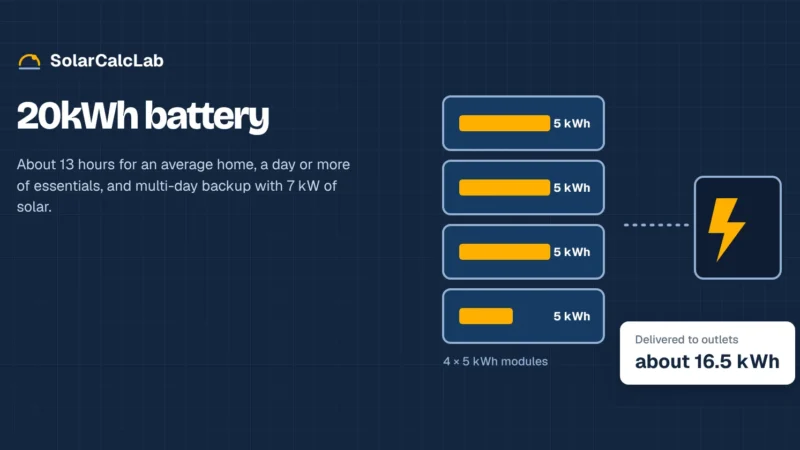
Many quotes compare a 16 kWh battery with a 13.5 kWh unit. The extra 2.5 kWh nominal is about 2.25 kWh usable, or roughly 2 kWh at the outlet. That buys about 2 more hours at a 1 kW load, about 35 minutes of central AC, or another day and a half of refrigerator. It is useful margin, not a different class of backup. Stepping up to a 20 kWh battery adds about 3.6 kWh of usable energy over 16 kWh, enough to run a bedroom mini-split at half duty for about 7 more hours. If you need a full day for the whole house, look at our 30 kWh battery guide instead. For lighter needs, the 10 kWh battery guide shows what a smaller unit covers.
How much does a 16 kWh battery cost?
These are typical US ranges in late 2026, before any state or utility incentives:
- Installed, grid-tied with a hybrid inverter or backup gateway: about $12,000 to $20,000. EnergySage marketplace data for the first half of 2026 puts a typical 13.5 kWh installed battery near $15,600, or about $1,160 per kWh.
- DIY 48 V LiFePO4 battery hardware only: about $3,500 to $4,500 for a 16 kWh wall-mount unit, plus $2,000 to $4,000 for a hybrid inverter, wiring, permits and an electrician’s sign-off.
The 30% federal residential clean energy credit ended for homeowner-owned systems installed after December 31, 2025, so do not budget for it. Some states and utilities still pay storage rebates or demand-response credits. If you have time-of-use rates, the home battery savings calculator estimates what daily peak shifting is worth.
How many years will it last?
LiFePO4 makers commonly claim 6,000 to 10,000 cycles at 80% depth of discharge. One full cycle a day is 3,650 cycles in 10 years, so the cells usually outlast the warranty. Typical warranties run 10 years and guarantee 70% or more of original capacity at the end, which would leave a 16 kWh battery with at least 11.2 kWh.
Frequently asked questions
How long will a 16 kWh battery last during a power outage?
About 10 to 12 hours for an average US home using 30 kWh a day with everything on. If you back up essentials only, such as the fridge, lights, Wi-Fi and a furnace blower, it can last 24 hours or more. Central air conditioning is the biggest drain, using the whole battery in about 4 hours of nonstop running.
Is a 16 kWh battery enough to run a house?
It is enough for one evening and night of normal use, or a day or two of essentials. It is not enough to run a whole house with central AC, an electric water heater and an EV charger through a long outage. Pair it with 8 to 10 kW of solar to refill it most days.
How many solar panels do I need to charge a 16 kWh battery?
About 11 panels of 430 W, or 4.7 kW, refill it from empty in one average day at 4.5 peak sun hours. Those panels are on top of what your home uses during daylight, so most homes pair a 16 kWh battery with an 8 kW or larger array.
How long does it take to charge a 16 kWh battery from the grid or a generator?
Divide the energy you need by the charge rate. Refilling 14.4 usable kWh plus about 10% loss takes roughly 3.2 hours at a 5 kW charge rate, or about 5.3 hours from a generator feeding a 3 kW charger. Check your inverter’s maximum charge current first.
What is the difference between a 16 kW and a 16 kWh battery?
Kilowatt hours (kWh) measure stored energy, which sets how long the battery lasts. Kilowatts (kW) measure power, which sets how many appliances it can run at once. A 16 kWh battery is often rated only 5 to 10 kW of continuous output, so it cannot run every large appliance at the same moment.