What Will a 12kW Inverter Run? Appliances, Battery Size and Solar Panels
Short answer
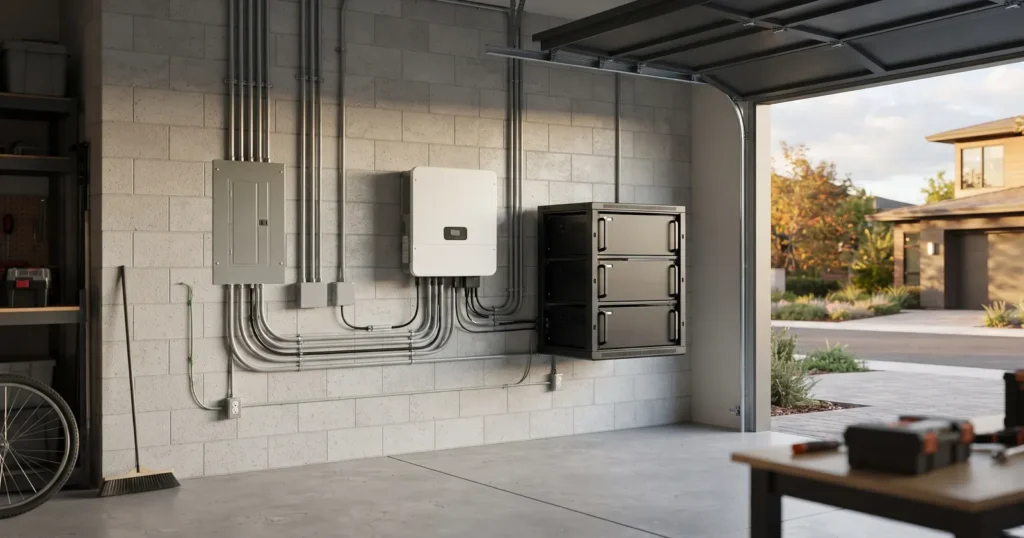
A 12kW inverter delivers up to 12,000 watts at once, or 50 A at 240 V. In a large home that covers a 4-ton central air conditioner, refrigerators, lights, a pool pump and a microwave together, but not air conditioning plus an electric dryer and water heater, or an EV charger. On a 48 V battery it pulls about 250 to 280 A, so plan on at least three rack modules.
Twelve kilowatts is the inverter size people reach for when a 10 kW unit feels tight and a 15 kW unit feels like overkill. It usually means a bigger house, a split-phase 120/240 V hybrid inverter, and the goal of keeping central air and the kitchen running through a long outage instead of backing up a few circuits.
The number on the box does not always mean what buyers assume. Below, each part of the decision is worked through with the formula shown: real output, load combinations, battery current, battery bank and solar array.
Is a “12K” inverter always 12 kW of AC output?
No, and this is the most expensive mistake in this size class. Some model names quote the solar input, and some add AC and DC output together. The figure that decides what your house can run is continuous AC output, so read it from the datasheet, not the product title.
Four 48 V split-phase units, from their published datasheets:
| Model (as sold) | Continuous AC output | Max solar input | Max battery current | Grid passthrough |
|---|---|---|---|---|
| EG4 12kPV | 8,000 W | 12,000 W used | 167 A | 80 A |
| Sol-Ark 12K-2P | 9,000 W AC (plus 3,000 W DC) | 13,000 W | 185 A | 63 A |
| EG4 18kPV | 12,000 W at 240 V | 18,000 W used | 250 A | 200 A |
| SunGold 12000 W LF inverter charger | 12,000 W | None (no built-in MPPT) | Not listed | Charger input only |
Two of the four products with “12” in their name supply 8 to 9 kW of household power. If your load list needs a true 12,000 W, you may be shopping for a unit marketed as an 18kPV or 18 kW PV model, because its 12 kW figure is the AC side.
Also check the battery current limit. A unit capped at 185 A can only deliver about 185 A × 51.2 V × 0.95 = 9,000 W from the battery, no matter what the solar or AC ratings say.
What can a 12kW inverter run in a large house?
Treat 12,000 W as a budget for everything running at the same moment. For loads that run for hours, stay at or under about 80% of the rating, which is 9,600 W. That margin covers motor starts and heat derating in a warm garage.
The running watts below are typical planning values for a large home. Your nameplates may differ, and the solar load calculator will total your own list.
| Scenario | Loads (running watts) | Total | Fits 12 kW? |
|---|---|---|---|
| Summer outage, everyday living | 4-ton central AC 4,500, two refrigerators 400, pool pump 1,500, lights and electronics 800, microwave 1,200 | 8,400 W | Yes, under the 80% line |
| AC plus hot water | 4-ton AC 4,500, electric water heater 4,500, two refrigerators 400, lights and electronics 800 | 10,200 W | Yes, but tight; fine while the heater cycles |
| Winter, heat pump with well | 3-ton heat pump 3,500, 1.5 HP well pump 2,400, refrigerators 400, lights 800, microwave 1,200 | 8,300 W | Yes, if the pump and compressor do not start together |
| Laundry day with AC | 4-ton AC 4,500, electric dryer 5,000, water heater 4,500 | 14,000 W | No |
| EV charging during an outage | Level 2 charger at 32 A × 240 V = 7,680, 4-ton AC 4,500 | 12,180 W | No; charge at a lower current or pause the AC |
The pattern: a 12 kW inverter runs one big 240 V heater or charger alongside air conditioning, but not two. Whole-home installs handle this by shedding the EV charger or dryer while on battery.
Motor starts eat the headroom
Compressors and well pumps briefly draw several times their running watts. Surge ratings vary a lot: one 12 kW low-frequency unit lists 36 kW for 20 seconds, while high-frequency hybrids often list a modest overload measured in minutes. Compare your largest motor’s locked rotor amps (LRA on the nameplate) with the inverter’s surge figure, and stagger big motors with a soft starter or load controls.
Each 120 V leg gets half
A split-phase inverter feeds two 120 V legs. At 50 A per leg, each can carry about 6,000 W of 120 V loads, and one manufacturer states the same limit as 50% of rated power. 240 V loads draw from both legs evenly, but a kitchen full of 120 V appliances on one leg can overload it while the total still reads well under 12 kW.
12kW vs 10kW vs 15kW: what do the extra kilowatts change?
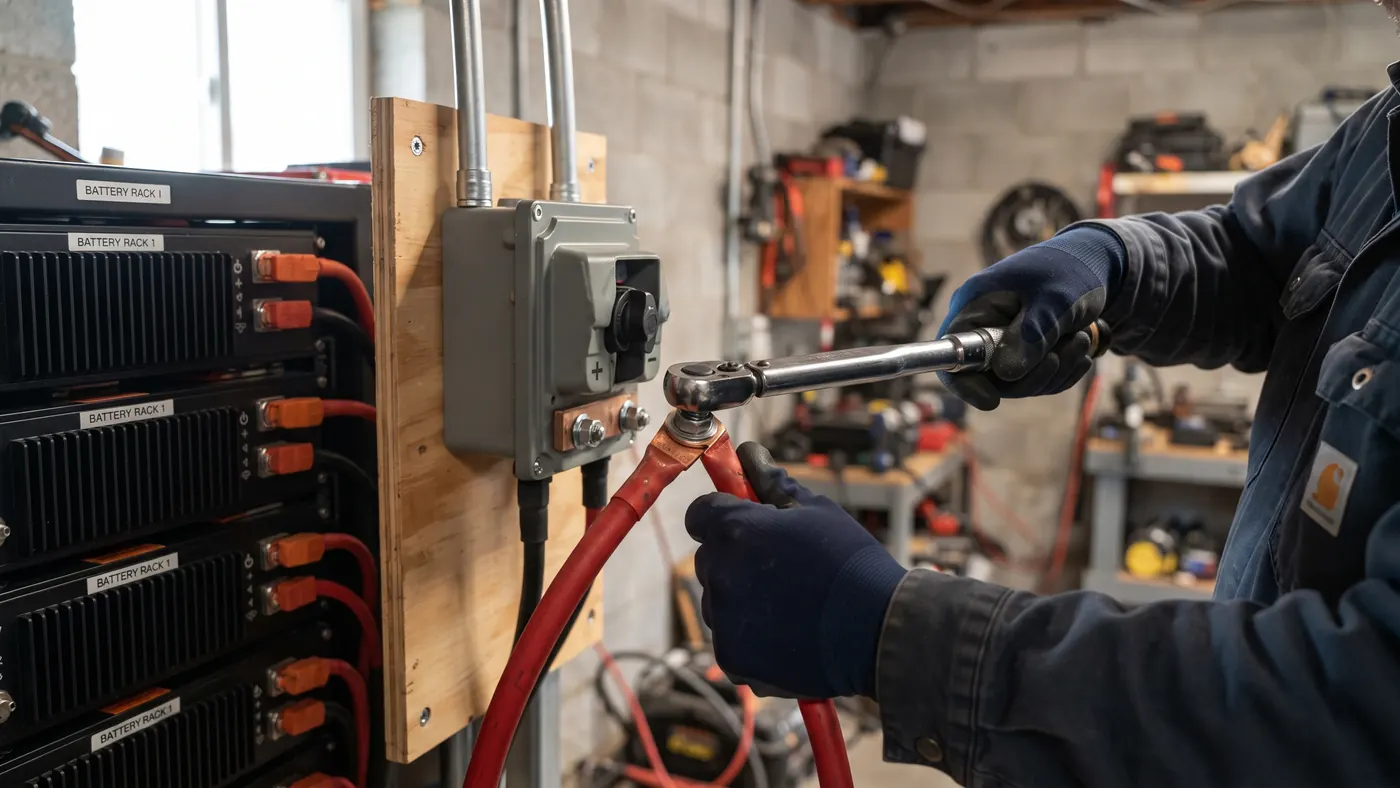
Stepping up in size also raises the AC current your panel must accept and the DC current your batteries must supply. The table assumes a 51.2 V lithium bank, 95% efficiency and a 44.8 V low cutoff.
| Item | 10 kW | 12 kW | 15 kW |
|---|---|---|---|
| AC current at 240 V | 41.7 A | 50 A | 62.5 A |
| Battery current at 51.2 V | 206 A | 247 A | 308 A |
| Battery current at 44.8 V | 235 A | 282 A | 352 A |
| 100 A battery modules needed for current | 3 | 3 | 4 |
| Backfeed breaker (AC current × 1.25, rounded up) | 60 A | 70 A | 80 A |
12 kW keeps the same three-module minimum as 10 kW, yet it is the smallest size that comfortably adds a water heater or dryer to central air. If you also want EV charging during outages, the 15kW inverter guide shows what the next step adds. If your loads fit in 8 kW, the 10kW inverter guide may save you money.
How many amps does a 12kW inverter draw from a 48 V battery?
DC current rises as battery voltage falls, so size for the bottom of the window.
Example: 12,000 ÷ (44.8 × 0.95) = 282 A
| Battery voltage | State | Current at full 12 kW |
|---|---|---|
| 56.0 V | Nearly full LiFePO4 | 226 A |
| 51.2 V | Nominal LiFePO4 | 247 A |
| 48.0 V | Low state of charge | 263 A |
| 46.0 V | Near empty | 275 A |
| 44.8 V | Typical BMS cutoff | 282 A |
How many battery modules for current?
A common 48 V rack module (51.2 V, 100 Ah, 5.12 kWh) is rated for 100 A continuous discharge. Three in parallel give 300 A, just above the 282 A worst case. Two would trip their BMS at full load. That makes three modules, about 15 kWh nominal, the floor for any real 12 kW inverter, even if your energy needs are small.
Fuse and cable
Size the battery fuse from the inverter’s maximum battery current, times 1.25. For a 250 A limit that is 312.5 A, so the next standard size is 350 A, usually a class T fuse. Then choose cable that carries at least that much at your run length; the solar fuse size calculator and the inverter manual’s lug sizes keep the two matched.
How big a battery bank does whole-home backup need?
Current sets the minimum module count; energy sets how long the house runs. The average US home uses about 10,800 kWh a year, close to 30 kWh a day, according to the US Energy Information Administration. A large home can use well above that, yet its average load during an outage is still far below the 12 kW rating.
Example: 30.72 × 0.9 × 0.95 ÷ 3 = 8.8 hours
| Bank (5.12 kWh modules) | Delivered energy | 1.5 kW essentials | 3 kW with AC cycling | 5 kW heavy use |
|---|---|---|---|---|
| 3 modules, 15.36 kWh | 13.1 kWh | 8.8 h | 4.4 h | 2.6 h |
| 6 modules, 30.72 kWh | 26.3 kWh | 17.5 h | 8.8 h | 5.3 h |
| 9 modules, 46.08 kWh | 39.4 kWh | 26.3 h | 13.1 h | 7.9 h |
For a large house that wants overnight air conditioning, 30 kWh is a practical starting point, with solar refilling the bank each day. Run your own numbers in the battery backup calculator.
How many solar panels pair with a 12kW hybrid inverter?
By DC-to-AC ratio
Hybrid inverters are commonly paired with 1.1 to 1.3 times their AC rating in panels, within the datasheet’s maximum solar input. For 12 kW that is 13.2 to 15.6 kW, or 31 to 36 panels at 430 W. At the site’s standard 1,100 to 1,600 kWh per kW a year, 31 panels (13.3 kW) make about 14,700 to 21,300 kWh a year.
By daily energy
Example: 45 kWh ÷ (4.5 × 0.8) = 12.5 kW, or 30 panels at 430 W (12.9 kW)
A 45 kWh-a-day home lands in the ratio range, which is why 12 kW inverters and 12 to 15 kW arrays travel together. Check your sun hours and local output with NREL’s PVWatts calculator, or use our how many solar panels calculator.
Can a 12kW hybrid back up an entire 200 A panel?
Only if its passthrough rating allows it. During normal operation, grid power flows through the inverter to your loads. A unit with a 200 A grid bypass can sit in front of the main panel and back up every circuit. A unit with a 63 A or 80 A passthrough has to feed a separate critical loads subpanel, which is a different install and a smaller backup.
Whole-home backup still means a 12 kW budget. Large 240 V loads such as the EV charger, dryer or pool heater go on smart breakers or load controllers that switch off when the grid is down.
The 120% rule when exporting to the grid
If the inverter backfeeds a breaker on the panel bus, the National Electrical Code limits the combined main breaker and solar breaker to 120% of the busbar rating.
Example: 200 × 1.2 − 200 = 40 A allowed, but a 12 kW inverter needs 50 × 1.25 = 62.5 A, so a 70 A breaker
A 70 A backfeed breaker does not fit a standard 200 A panel with a 200 A main. Electricians solve this with a supply-side connection, a downsized main breaker after a load calculation, or a panel upgrade. Price this in early.
Who should choose a 12kW inverter?
A 12 kW unit makes the most sense for:
- Homes around 3,000 to 5,000 sq ft with one large central AC or heat pump and electric hot water.
- Rural homes with a deep well pump plus central air, where a 10 kW unit leaves no room for a pump start.
- Owners who want one inverter now, with room to parallel a second unit later if the model supports it.
It is the wrong choice if you have two large AC systems running together, all-electric heat strips above about 5 kW, or plan to charge an EV fast during outages. Typical US prices in late 2026 run about $3,000 to $7,500 for the inverter alone, before batteries, panels and labor. The 30% federal residential credit no longer applies to homeowner-owned systems installed after 2025, so budget without it. The solar payback calculator shows the real return.
Frequently asked questions
How many amps does a 12kW inverter draw at 48 V?
About 247 A at a nominal 51.2 V lithium battery and up to about 282 A near the 44.8 V low cutoff, assuming 95% efficiency. On the AC side it supplies 50 A at 240 V. Size modules, fuse and cables for the high figure.
Is a 12kW inverter enough for a 4,000 sq ft house?
Usually, if you manage the big loads. A 4,000 sq ft home with one 4- or 5-ton AC system, refrigerators, lights and a well pump fits under 12,000 W. Add an electric dryer, water heater and EV charger at the same time and it does not. Load shedding on those circuits solves it.
Can a 12kW inverter run a 5-ton air conditioner?
A 5-ton unit runs at roughly 5,000 to 6,000 W, which fits, but its starting surge is the real test. Compare the compressor’s locked rotor amps with the inverter’s surge rating and duration. A soft starter cuts the inrush sharply and is a common fix when a large compressor trips a hybrid inverter.
Why does my 12K inverter only output 8 or 9 kW?
Some model names refer to solar input or to AC and DC output combined. The EG4 12kPV is rated 8,000 W AC and the Sol-Ark 12K-2P 9,000 W AC on their datasheets. The continuous AC output line on the spec sheet is the number that tells you what loads the inverter can run.
Do I need a 12 kWh battery for a 12kW inverter?
Not necessarily. kW is power at one moment and kWh is stored energy. The battery must deliver the current, which for 12 kW at 48 V means about three 100 A modules, roughly 15 kWh. Most large homes then add capacity for runtime, often 30 kWh or more.