Federal Solar Tax Credit: What Changed and Who Still Qualifies

Short answer
The 30% federal solar tax credit for homeowners (Section 25D) is gone for any system whose installation was completed after December 31, 2025. If you buy solar with cash or a loan in 2026, there is no federal credit to claim. Three groups still benefit: owners of systems finished in 2025 who are claiming or carrying forward the credit, lease and PPA customers whose solar company claims the business credit, and homeowners in states with their own solar credits.
Few solar topics changed as much in one year as the federal solar tax credit. Through 2025, a homeowner who bought a $25,000 system could subtract $7,500 straight off their federal tax bill. In 2026 that same homeowner gets nothing from the IRS, yet many ads and sales scripts still mention “the 30% credit.”
This guide skips the history lesson and focuses on the questions people are asking now: does my system qualify, what happens to credit I could not use, can I still fix a missed claim, and what do leases and state programs offer instead.
What changed, in one table
The One Big Beautiful Bill Act, signed on July 4, 2025, ended several home energy credits early. Here is where each one stands for a typical household.
| Credit | Who claims it | Status for 2026 installs |
|---|---|---|
| Residential Clean Energy Credit (25D): solar, batteries, solar water heating | Homeowner who owns the system | Ended. No credit for expenditures made after December 31, 2025 |
| Energy Efficient Home Improvement Credit (25C): heat pumps, insulation, windows | Homeowner | Ended for property placed in service after December 31, 2025 |
| Clean Electricity Investment Credit (48E) | Businesses, including the companies that own leased and PPA systems | Still available, with construction and in-service deadlines |
| State solar credits | Depends on the state | Unchanged by federal law; rules vary |
The IRS summarizes these end dates in its FAQs on the 2025 law.
The date that decides it: when installation was finished
For 25D, the payment date does not matter. The law treats the expenditure as made when the original installation is completed. The IRS has said directly that a homeowner who paid in 2025 but whose installation was completed in 2026 cannot claim the credit.
| Your situation | Federal 25D credit? |
|---|---|
| Contract signed and paid in 2025, panels fully installed in November 2025 | Yes, claim on your 2025 return |
| Deposit paid in 2025, installation finished in January 2026 | No |
| Installed in December 2025, utility permission to operate in February 2026 | A gray area; some tax attorneys argue installation was complete in 2025. Get written advice from a tax professional |
| Battery added in 2026 to a 2025 solar system | No, the battery is a separate 2026 expenditure |
| New home bought in 2026 with solar built in | No, the expenditure counts when you begin using the home |
If your installer’s final invoice or inspection sign-off is dated in 2025, keep a copy with your tax records. It is your best evidence of the completion date.
If your system was installed in 2025
This is the group that still has real money on the table, and many owners leave part of it unclaimed.
Claiming it on the 2025 return
The credit is 30% of the qualified cost, including panels, inverters, racking, labor, permits and a battery of at least 3 kWh. It is claimed on Form 5695 with your 2025 federal return. It is a nonrefundable credit, so it can reduce your tax to zero but cannot create a refund beyond the tax you owe.
Carrying unused credit forward
If your credit was larger than your 2025 tax, the rest carries forward. A Congressional Research Service analysis notes that the 2025 law did not change the carryforward rules, so unused amounts can still be used in 2026 and later years until the full credit is gone.
Carryforward = credit − tax liability used this year
Example: $27,600 × 30% = $8,280; $8,280 − $5,100 = $3,180 carried to 2026
In that example, a household with $4,000 of federal tax in 2026 uses the full $3,180 on the 2026 return. One with lower tax would carry any remainder again. Check the 2026 Form 5695 instructions for the line that takes the prior-year carryforward, and keep the 2025 form, because you will need its figures.
Forgot to claim it?
You can file Form 1040-X. The IRS generally allows an amended return to claim a refund within 3 years after you filed the original return, or 2 years after you paid the tax, whichever is later. A 2025 system has plenty of time left, but older missed claims from 2022 or 2023 may be close to the limit.
Leases and PPAs: the credit goes to the company
With a lease or power purchase agreement, the solar company owns the panels, so it is the taxpayer. It claims the business credit under Section 48E, not you. Your benefit, if any, arrives as a lower monthly payment or price per kWh.
Two timing rules matter for those companies. Projects that began construction by July 4, 2026 keep their eligibility under the normal continuity rules. Projects that began later must be placed in service by December 31, 2027. Starting in 2026, projects also face new limits on components and materials from certain foreign suppliers. The law separately bars the business credit for leased solar water heaters and small wind turbines, but rooftop solar electric systems are not covered by that restriction.
What this means in practice: when a salesperson says a lease is “priced with the tax credit,” ask whether the company has already secured eligibility for your project and what happens to your rate if it has not. Get the answer in the contract. Our comparison of a solar PPA vs a lease vs buying runs a full 20-year cost example, and the solar finance calculator lets you test your own quote.
Business and rental property owners
A business that owns solar on its own building, or a landlord who installs it on a rental, falls under 48E rather than 25D. The same construction and in-service deadlines apply, and the system may also be depreciated. Our guide to solar panel depreciation and MACRS covers how the credit and depreciation interact. A home office inside your own house does not turn a residential system into a business one, so talk to a tax adviser before assuming it does.
State solar credits that still exist
Federal changes did not touch state programs. Two examples show how different they can be.
| State | Credit | Cap | Carryforward | Leases and PPAs |
|---|---|---|---|---|
| New York | 25% of qualified equipment cost | $5,000 total | Up to 5 years | Qualify, including PPAs of at least 10 years |
| South Carolina | 25% of purchase and installation cost | Lesser of $3,500 per year or 50% of your state tax | Up to 10 years | Do not qualify; you must own the system |

On a $20,000 system, the New York credit is the full $5,000, since 25% of $20,000 is exactly the cap. In South Carolina the same system earns $5,000 in total, but no more than $3,500 can be used in one year, so at least $1,500 moves to the next year. New York’s rules are on the state tax department’s credit page. For other states, check your state energy office and your utility, which may offer rebates, property tax exemptions or sales tax exemptions instead of a credit.
What losing the federal credit does to payback
Here is the same system priced with and without the old 30% credit, using an 8 kW array at $2.62 per watt, the average for that size in our 2026 solar panel cost guide. Production is the PVWatts estimate for Denver, 13,010 kWh a year, valued at $0.18 per kWh.
Yearly savings: 13,010 kWh × $0.18 = $2,342
| Scenario | Net cost | Simple payback |
|---|---|---|
| 2026 purchase, no federal credit | $20,960 | 9.0 years |
| Same system in 2025 with the 30% credit | $14,672 | 6.3 years |
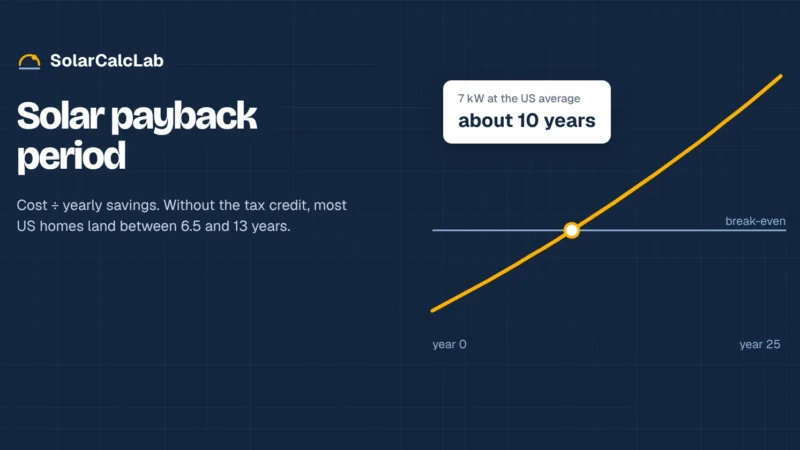
Losing the credit adds about 2.7 years to payback in this example. That is significant but not fatal for a system that lasts 25 years or more. Weak export rates, higher prices or a smaller system would stretch it further. Run your own numbers in the solar payback calculator, starting from a real quote checked against the solar panel cost calculator.
Red flags in 2026 sales pitches
- “You get 30% back from the IRS.” Not on a system you buy and install in 2026. Ask the salesperson to show which tax code section they mean.
- A loan sized around a tax credit payment. Some solar loans assume you make a lump-sum payment from your tax refund around month 18. Without the credit, that payment has to come from savings, or the monthly payment jumps.
- Backdated paperwork. An installer offering to date a 2026 installation as 2025 is asking you to take the tax risk.
- Vague lease pricing. If the rate depends on the company’s own credit, the contract should say what happens if it does not qualify.
Frequently asked questions
Is the federal solar tax credit still available in 2026?
Not for homeowners who buy their own system. The Section 25D credit ended for expenditures made after December 31, 2025, and an expenditure counts as made when installation is completed. Businesses and the owners of leased or PPA systems can still use the Section 48E credit if their projects meet its deadlines.
Can I still claim the solar tax credit for a system installed in 2025?
Yes. Claim 30% of the qualified cost on Form 5695 with your 2025 return. If you already filed without it, you can generally amend with Form 1040-X within 3 years of filing the original return or 2 years of paying the tax, whichever is later.
What happens to unused solar tax credit from 2025?
It carries forward to 2026 and later years. The 2025 law ended new 25D claims but did not change the carryforward rules. For example, a $8,280 credit used against $5,100 of 2025 tax leaves $3,180 to apply on the 2026 return.
Do I get a tax credit if I lease solar panels?
No. The solar company owns a leased or PPA system, so it claims any federal credit. You may benefit indirectly through a lower rate, and some state credits, such as New York’s, also cover leases and long PPAs. South Carolina’s credit does not.
Does the battery tax credit still exist?
Not for homeowners. Batteries of 3 kWh or more were covered by the same Section 25D credit, which ended after 2025. A battery added in 2026 does not qualify, even if the solar panels were installed in 2025. Businesses may still qualify for storage under the commercial credits.