How Many Watts Does a Microwave Use?

Short answer
A typical microwave uses 1,000 to 1,800 watts from the outlet while it runs. The number on the box, such as “1,000 watts,” is cooking power delivered to the food, not what the oven draws. A 1,000 W model usually pulls about 1,400 to 1,600 W, which is 12 to 13 amps on a 120 V circuit. Five minutes of cooking uses about 0.125 kWh, a little over 2 cents at the US average rate.
Microwaves are one of the few appliances where the advertised wattage is lower than the real draw. That catches people out in three situations: a breaker that trips when the toaster and microwave run together, a power station or inverter that shuts off the moment you press Start, and a solar or battery plan that comes up short.
This guide explains the gap between output and input watts, gives amp figures for common sizes, and works through cost, circuit rules and running a microwave on battery power. For the wider picture of household loads, see the appliance wattage chart.
Output watts vs input watts
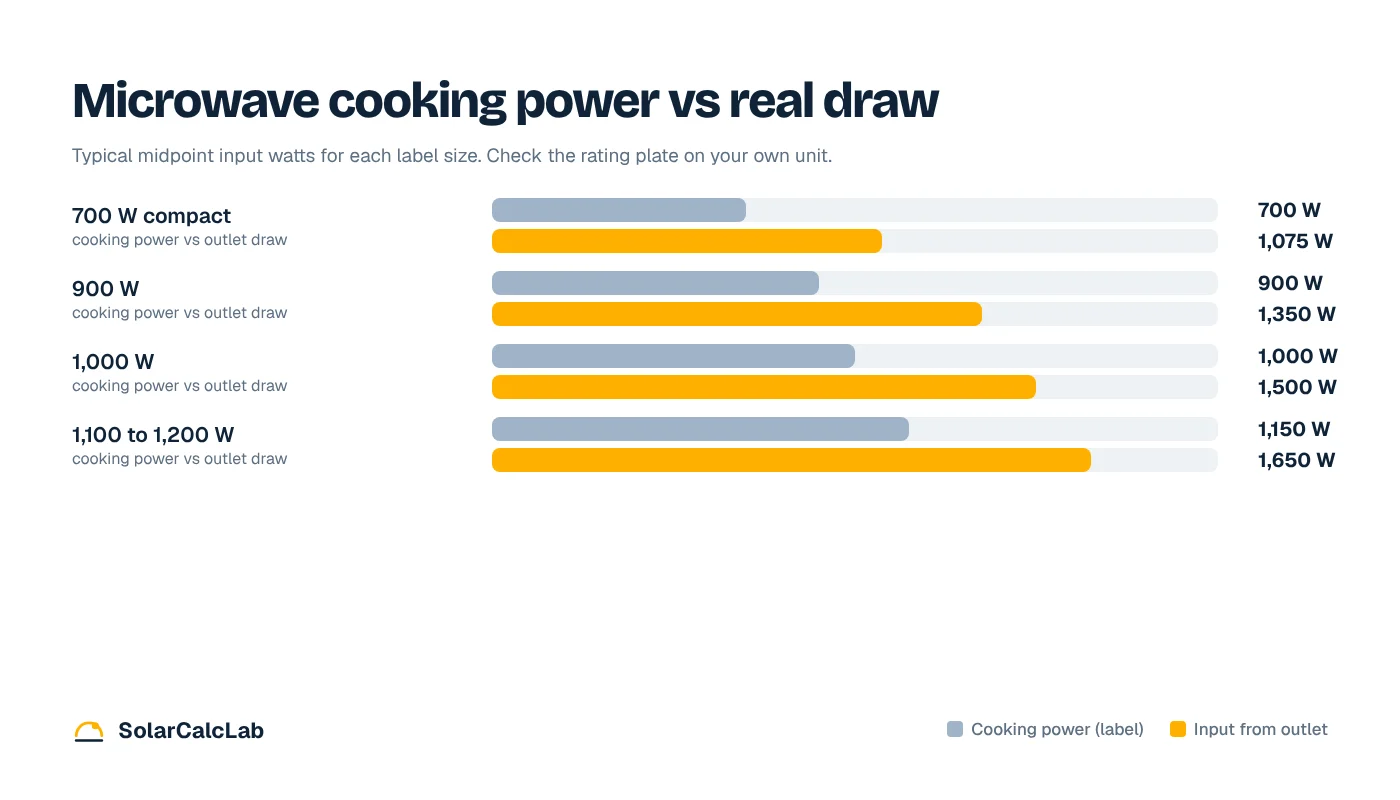
The magnetron that makes the microwaves is not perfectly efficient. Some energy turns into heat in the magnetron and power supply, and the fan, turntable motor and light also draw power. A conventional transformer microwave typically delivers only about 60 to 70% of its input as cooking power. Inverter models do somewhat better.
Panasonic’s published specifications for its NN-SN966S inverter microwave show this clearly: cooking power 1,250 W, power consumption 1,460 W. Its output is about 86% of input, which is better than most conventional units manage.
| Cooking power on the label | Typical input draw | Amps at 120 V |
|---|---|---|
| 700 W (compact) | 1,000 to 1,150 W | 8.3 to 9.6 A |
| 900 W | 1,300 to 1,400 W | 10.8 to 11.7 A |
| 1,000 W | 1,400 to 1,600 W | 11.7 to 13.3 A |
| 1,100 to 1,200 W | 1,500 to 1,800 W | 12.5 to 15.0 A |
| 1,250 W inverter (Panasonic example) | 1,460 W | 12.2 A |
Ranges are typical, so check your own unit. The input rating is usually on the label inside the door frame or on the back panel, shown in watts or as amps at 120 V. If it only lists amps, multiply by 120, or use the watts to amps calculator to convert either way.
What lower power levels really do
On most conventional microwaves, power level 5 does not run the magnetron at half power. It switches the magnetron fully on and fully off in cycles of several seconds, so the draw jumps between full input and a small idle load. Inverter microwaves can genuinely turn the power down, which is gentler on food and on a small inverter or generator. Either way, plan any backup system around the full input wattage.
How much electricity does a microwave use?
Energy depends on watts and minutes, and microwaves run for short bursts, so the totals are small.
Example: 1,500 W × 5 min ÷ 60 ÷ 1,000 = 0.125 kWh
The EIA put the average US residential electricity price at 18.16 cents per kWh in August 2026. At that rate, for a microwave drawing 1,500 W:
| Use | Energy | Cost at $0.1816/kWh |
|---|---|---|
| Reheat a cup of coffee (2 min) | 0.05 kWh | 0.9 cents |
| Frozen meal (5 min) | 0.125 kWh | 2.3 cents |
| Baked potato or larger dish (10 min) | 0.25 kWh | 4.5 cents |
| 15 minutes a day for a month | 11.25 kWh | $2.04 |
| 15 minutes a day for a year | 137 kWh | $24.86 |
To plug in your own rate and habits, use the electricity cost calculator.
Standby power
The clock and electronics draw a little power all day. Federal standards that took effect in 2016 cap standby at 1 watt for microwave-only and countertop combination models, and 2.2 watts for built-in and over-the-range combination ovens. At 1 W that is 8.8 kWh a year, about $1.59. At 2.2 W it is 19.3 kWh, about $3.50. Older units can draw more, but standby is still a minor part of the total.
What circuit does a microwave need?
At 12 to 15 amps, a full-size microwave uses most of a 15 A circuit and much of a 20 A one. Two code rules shape where it can go.
- Kitchen countertop receptacles must be served by at least two 20 A small-appliance branch circuits under NEC 210.11(C)(1). A countertop microwave sharing one of these with a kettle or toaster can trip the breaker, because 1,500 W plus a 1,500 W kettle is 25 A.
- Over-the-range and built-in microwaves are fastened in place. Under NEC 210.23(A)(2), fastened equipment may use no more than 50% of a circuit’s rating when the circuit also feeds lights or plug-in loads. On a 20 A circuit that limit is 10 A, and a typical 12.5 A unit exceeds it. That is why most manufacturers’ installation instructions call for a dedicated 20 A circuit, and NEC 110.3(B) makes those instructions enforceable.
If the breaker keeps tripping
- Check what else shares the circuit. Turn off the breaker and see which outlets go dead.
- Add up the input watts of everything that runs at the same time and divide by 120. More than 16 A on a 20 A circuit, or 12 A on a 15 A circuit, leaves no safety margin for regular use.
- If the microwave alone trips a dedicated circuit, the fault is likely in the appliance, such as a failing high-voltage diode or capacitor. That is a repair for a technician, because the high-voltage capacitor can hold a dangerous charge after unplugging.
Running a microwave on an inverter, power station or solar
This is where the output vs input gap causes the most trouble. A “1,000 W” microwave on a 1,000 W power station will usually trip the overload protection immediately.
Inverter size
Example: 1,500 W × 1.25 = 1,875 W, so choose a 2,000 W pure sine wave inverter
The margin covers the inrush when a transformer microwave starts and leaves room for a light or fridge on the same inverter. Modified sine wave inverters can make microwaves hum, heat unevenly or run hot, so a pure sine wave model is the safer choice. Our comparison of pure sine wave vs modified sine wave inverters covers why. To size for several appliances at once, use the inverter size calculator.
Battery current and energy
On the DC side, current rises fast at low voltage. Assuming 90% inverter efficiency, a 1,500 W microwave draws:
| Battery voltage | DC current |
|---|---|
| 12 V | 139 A |
| 24 V | 69 A |
| 48 V | 35 A |
A 12 V system therefore needs heavy cable and a battery that can supply 139 A continuously. Energy is less of a problem: five minutes at 1,500 W takes about 139 Wh from the battery, roughly 11% of a 12 V 100 Ah lithium battery’s 1,280 Wh. A day of normal microwave use, around 15 minutes, needs about 417 Wh. The battery backup calculator adds this to the rest of your loads.
For a solar setup, the microwave’s daily energy is modest. Replacing that 417 Wh takes roughly 100 to 130 W of extra panel capacity in a location with 4 to 5 peak sun hours, once typical losses are included. The hard part is the instantaneous power, not the energy.
How to measure your microwave’s real cooking power
If food heats slowly, you can check the output at home. Put 1,000 grams (about 4.2 cups) of cool tap water in a microwave-safe container, measure its temperature, heat it on full power for exactly 60 seconds, stir and measure again.
Example: a 14 °C rise gives 4,186 × 14 ÷ 60 = 977 W
The test reads a little low because the container absorbs some heat and the water loses some to the air. A result well below the label, say under 70%, points to a weak magnetron or an old unit. For the input side, a plug-in watt meter on a countertop model shows the real draw directly.
Frequently asked questions
How many amps does a 1,000 watt microwave draw?
About 12 to 13 amps at 120 V, because a 1,000 W cooking-power model usually draws 1,400 to 1,600 W from the outlet. Divide the input watts on the label by 120 for your exact unit.
Can a 1,000 watt inverter run a microwave?
Only a small one. A 700 W cooking-power microwave draws roughly 1,000 to 1,150 W, which is at or above a 1,000 W inverter’s limit. For a full-size 1,000 W microwave, use a pure sine wave inverter of about 2,000 W.
Does a microwave need a dedicated circuit?
Over-the-range and built-in models almost always do, because they are fastened in place and draw more than half of a 20 A circuit. Manufacturers typically specify a dedicated 20 A circuit. A countertop model can share a kitchen small-appliance circuit, but running it with a kettle or toaster may trip the breaker.
Is it cheaper to use a microwave or an oven?
For reheating and small portions, the microwave usually wins, since it runs for minutes and heats the food rather than a large oven cavity. Five minutes at 1,500 W is 0.125 kWh. An electric oven drawing several thousand watts typically needs 10 minutes or more just to preheat.
How much does it cost to run a microwave per year?
At 15 minutes a day and 1,500 W, about 137 kWh a year, or roughly $25 at the August 2026 US average of 18.16 cents per kWh. Standby adds about $1.50 to $3.50 a year depending on the model.