How Many Watts Does a Clothes Dryer Use?

Short answer
A full-size electric clothes dryer typically uses 5,000 to 5,600 watts while the heating element is on, which draws about 21 to 23 amps on a 240 V circuit. Because the element cycles on and off, a normal load uses roughly 2 to 4 kWh, or about 40 to 70 cents at the 2026 US average rate of 18.19 cents per kWh. A heat pump dryer uses around 70% less energy, and a gas dryer uses only a few hundred watts of electricity for the drum and controls.
The dryer is one of the few household appliances that needs its own 240 V circuit, and it is often the single biggest load on a laundry day. That matters for three different readers: anyone trying to cut a bill, anyone wiring or replacing a dryer outlet, and anyone wondering whether a battery or generator can handle it during an outage.
Each of those questions needs a different number, so it helps to separate watts (how hard the dryer pulls at any moment) from kWh (how much energy one load takes).
Watts while running vs kWh per load
A conventional electric dryer has two main loads: a resistive heating element and a motor that turns the drum and fan. The element does almost all the work. The thermostat switches it off when the exhaust air gets hot enough, then back on as it cools, so the full wattage is not drawn for the whole cycle.
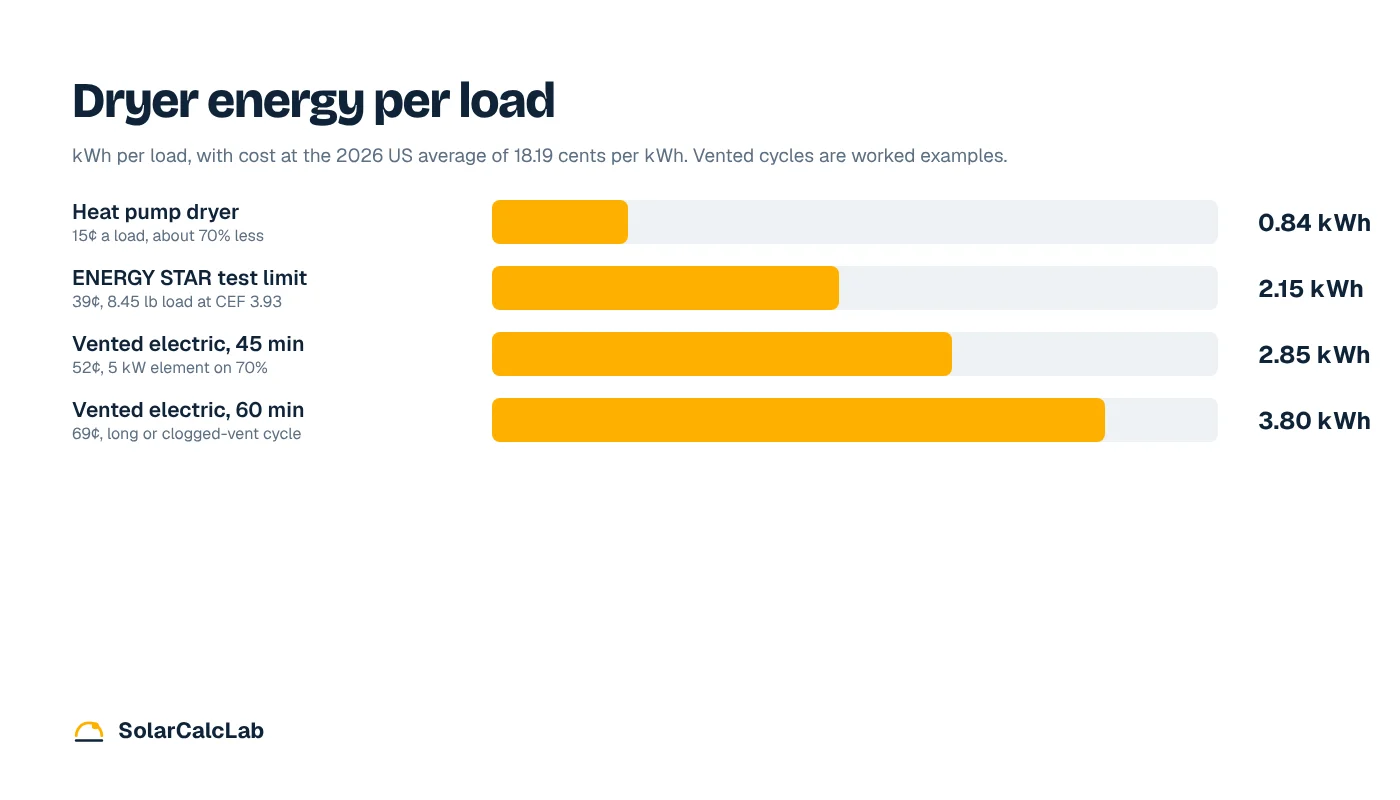
Here is an illustrative cycle with a 5.0 kW element on 70% of the time and a 300 W motor running throughout. These are example assumptions, not measured values for any model:
| Cycle length | Element on | Energy per load | Cost at 18.19¢/kWh |
|---|---|---|---|
| 45 minutes | 70% | 2.85 kWh | 52¢ |
| 50 minutes | 60% | 2.75 kWh | 50¢ |
| 60 minutes | 70% | 3.80 kWh | 69¢ |
The cycle length matters more than the nameplate. A dryer that needs a second round because the vent is clogged can double its energy use for the same clothes.
What the efficiency rating tells you
Dryers sold in the US are rated by Combined Energy Factor (CEF): pounds of clothes dried per kWh, using a standard 8.45 lb test load for full-size models. ENERGY STAR requires a CEF of at least 3.93 lbs/kWh for a standard-size electric dryer. That works out to no more than 8.45 ÷ 3.93 = 2.15 kWh per test load. Real loads are often heavier and wetter than the test load, which is why 2 to 4 kWh is a more realistic household range.
Dryer wattage by type
| Dryer type | Power while heating | Circuit | Notes |
|---|---|---|---|
| Full-size electric, vented | About 5,000 to 5,600 W | 240 V, 30 A | Most common in US homes |
| Same dryer on 208 V | About 3,750 to 4,200 W | 208 V, 30 A | Apartments and condos on three-phase service; longer cycles |
| Heat pump | Far lower; ENERGY STAR cites around 70% less energy | Varies by model | Ventless, slower cycles |
| Gas dryer | A few hundred watts of electricity | 120 V outlet | Heat comes from natural gas or propane |
Why a dryer on 208 V uses fewer watts but not less energy
A resistive element’s power falls with the square of the voltage. A 5,600 W element rated at 240 V delivers 5,600 × (208 ÷ 240)² = 4,206 W on 208 V service. The clothes still need the same heat to dry, so the cycle runs longer. You save almost nothing on energy, and drying takes noticeably more time. If your building has 208 V service and loads take forever, that is often the reason, not a faulty dryer. A tank water heater element follows the same rule, and our guide to how many watts a water heater uses shows what a 4,500 W element really delivers on 208 V.
Heat pump dryers
A heat pump dryer recycles heat instead of venting it outside. ENERGY STAR says these models use around 70% less energy than conventional dryers. If a conventional load takes 2.8 kWh, a 70% cut brings it to about 0.84 kWh, or roughly 15 cents a load. Some compact heat pump models run on a standard 120 V outlet, which also helps in homes without a dryer circuit.
Dryer amps, breaker and wire size
Divide watts by volts to get amps. A 5,600 W element on 240 V draws 5,600 ÷ 240 = 23.3 A, and a 5,000 W element draws 20.8 A. The drum motor adds a few amps on one leg.
5,600 W ÷ 240 V = 23.3 A
Standard US electric dryers use a 30 A double-pole breaker and 10 AWG copper wire, the usual limit for 10 AWG copper under NEC 240.4(D). For load calculations, NEC 220.54 counts a household dryer at 5,000 W or its nameplate rating, whichever is larger. Our 10 gauge wire amp rating guide covers that wire in more detail, and the wire size calculator checks longer runs where voltage drop could push you to 8 AWG.
New dryer circuits use a four-wire NEMA 14-30 receptacle with a separate ground. Older homes may still have a three-wire 10-30 outlet. Match the cord to the outlet, and have an electrician look at a three-wire setup if you are replacing the dryer.
If the dryer breaker keeps tripping
- Trips right away when you press start: a shorted element or wiring fault. Unplug the dryer and get it serviced.
- Trips partway through: a breaker that has weakened with age, or a loose, overheated connection at the outlet or breaker. Look for discolored plug blades.
- Only heat fails, drum still turns: often one 120 V leg is off. Check that both handles of the double-pole breaker are fully on.
What a dryer costs to run
Take a household that runs five loads a week, or 260 a year, at 2.8 kWh a load. That is 728 kWh a year. At the national average residential price of 18.19 cents per kWh for January through August 2026 (EIA Electric Power Monthly), the cost is about $132 a year. Switching to a heat pump dryer at 0.84 kWh a load cuts that to about $40, a saving of about $93 a year.
| kWh per load | Cost per load | 260 loads a year |
|---|---|---|
| 0.84 (heat pump) | 15¢ | $40 |
| 2.15 (ENERGY STAR test load limit) | 39¢ | $102 |
| 2.8 (typical vented) | 51¢ | $132 |
| 3.3 (heavy loads) | 60¢ | $156 |
Your local rate can matter more than the dryer itself. Enter your own rate and cycle time in the dryer running cost calculator, or convert any wattage and runtime with the kWh calculator.
Cheaper loads without a new dryer
- Clean the lint filter every load and the vent duct at least once a year. A restricted vent is the most common reason cycles run long.
- Use the moisture sensor setting instead of a timed cycle, so the dryer stops when clothes are dry.
- Run a higher spin speed on the washer. Water removed by spinning costs far less than water removed by heat. Our guide to how many watts a washing machine uses covers the washer side of the same laundry load.
- Dry loads back to back while the drum is still warm.
Running a dryer on solar, a battery or a generator
An electric dryer is a demanding backup load because it needs 240 V and about 5 kW at once. Most portable power stations cannot run it at all. A home battery system needs an inverter that supplies 240 V with enough continuous output for the dryer plus everything else that is on.
Energy is the easier part. A 10 kWh battery delivers about 8.1 kWh of AC power after 90% usable capacity and 90% inverter efficiency, enough for about 2.9 loads at 2.8 kWh if nothing else is running. In an outage, most people leave the dryer off the backed-up panel and save the battery for the fridge, lights and internet. The battery backup calculator shows how much runtime the dryer would cost you.
With grid-tied solar, the useful trick is timing. One 2.8 kWh load equals about 1.8 panels’ worth of output from 430 W panels on an average day at 4.5 sun hours. Running laundry at midday uses that power directly, which is worth more than exporting it under net billing rules. For how a dryer compares with other big loads, see the appliance wattage chart or our look at how many watts a space heater uses.
Frequently asked questions
How many kWh does a dryer use per load?
Most conventional electric dryers use about 2 to 4 kWh per load. ENERGY STAR certified standard models dry an 8.45 lb test load on 2.15 kWh or less. Heat pump dryers use around 70% less energy, often under 1 kWh per load.
How many amps does an electric dryer draw?
About 21 to 23 amps while the element is heating, for a 5,000 to 5,600 W element on 240 V. That is why dryers use a 30 A double-pole breaker with 10 AWG copper wire.
Can I plug an electric dryer into a regular outlet?
No. A standard full-size electric dryer needs a 240 V, 30 A circuit with a NEMA 14-30 or older 10-30 receptacle. Gas dryers and some compact or heat pump models are made for a 120 V outlet, so check the model’s installation guide.
Does a gas dryer use electricity?
Yes, but only a few hundred watts to run the drum motor, fan, controls and igniter. The heat comes from natural gas or propane, so its electric cost per load is a small fraction of an electric dryer’s.
How much does it cost to run a dryer per month?
At five loads a week, 2.8 kWh a load and 18.19 cents per kWh, about $11 a month. A heat pump dryer cuts that to roughly $3 to $4 a month under the same use.