What Size Charge Controller Do I Need?
Short answer
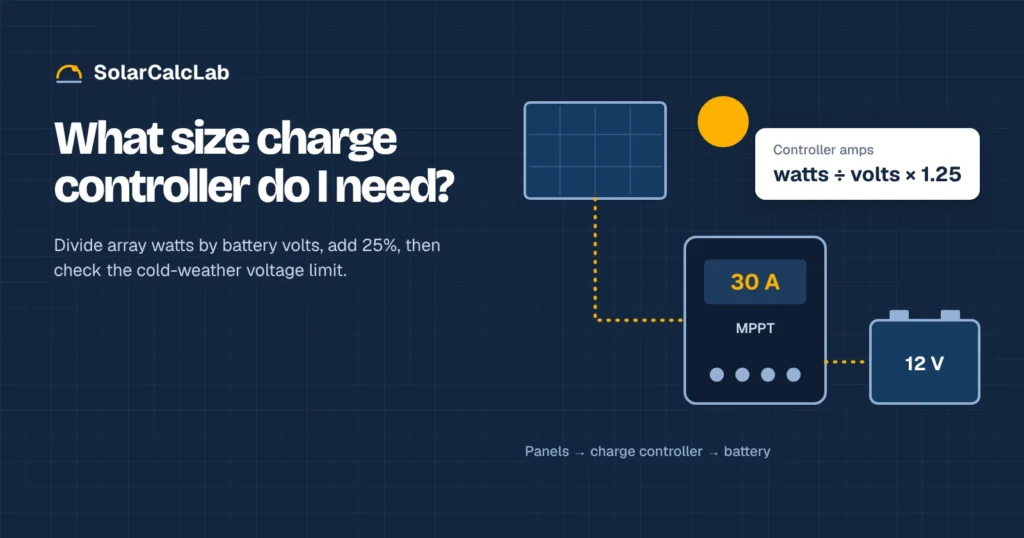
Divide your array’s watts by your battery voltage, then add 25%. A 400 W array on a 12 V battery needs about 42 A, so a 40 A or 50 A controller depending on how cautious you want to be. On 24 V the same array needs only 21 A. Then check two limits on the spec sheet: the controller’s maximum PV input voltage on your coldest morning, and its maximum PV short-circuit current.
A charge controller has three ratings that matter, and most sizing mistakes come from checking only one. The amp number is the current it can push into the battery. The voltage number is the most the panels may ever feed it. The third, buried in the datasheet, is how much panel current it tolerates on the input side.
This guide covers what size charge controller you need by working through all three, with a lookup table for common arrays, three real sizing scenarios and the problems that show up when a controller is too small. If you want the raw math for your exact panels, the charge controller calculator handles it in one screen.
How to read a controller’s name
Most MPPT controllers are named with two numbers, and the order is always voltage first, then current. Victron’s manual spells this out: a SmartSolar MPPT 100/30 accepts up to 100 V from the panels and charges the battery at up to 30 A.
The datasheet adds the figures the name leaves out. For the Victron 100/30 and 100/50, they look like this:
| Spec | MPPT 100/30 | MPPT 100/50 |
|---|---|---|
| Max charge current | 30 A | 50 A |
| Nominal PV power at 12 V | 440 W | 700 W |
| Nominal PV power at 24 V | 880 W | 1,400 W |
| Max PV open-circuit voltage | 100 V | 100 V |
| Max PV short-circuit current | 35 A | 60 A |
Nominal PV power doubles when battery voltage doubles, because the limit is output current and the same 30 A carries twice the power into a 24 V bank.
The three checks, in order
1. Output current
The 1.25 is a design margin, not a code requirement for MPPT units, because an MPPT controller limits its own output. It covers cold, bright days when panels beat their label and gives the electronics some breathing room. Some installers size to the maker’s nominal PV power instead, and the first scenario below shows where the two disagree.
2. Input voltage on the coldest day
Panel voltage rises as cells get colder, and it peaks at sunrise on the coldest morning of the year. Multiply each panel’s open-circuit voltage (Voc) by the cold correction factor and by the number of panels in series. The result must stay below the controller’s maximum PV voltage, with no exceptions. Going over can destroy the unit. The solar string size calculator does this correction for your location’s record low.
3. Input current and minimum voltage
Parallel strings add current. Check the total short-circuit current (Isc) against the controller’s input limit. Also check the other end of the voltage range: an MPPT controller needs the panel voltage to stay a few volts above the battery. Victron’s units, for example, need PV voltage at least 5 V above the battery to start charging. Hot panels lose voltage, so a marginal string can stall in July.
Charge controller size by array and battery voltage
This table applies the 1.25 margin and rounds up to the next common controller size. “Two units” means the current is past what most single controllers in that class handle, so you either split the array or move to a higher battery voltage.
| Array size | 12 V battery | 24 V battery | 48 V battery |
|---|---|---|---|
| 200 W | 20.8 A → 30 A | 10.4 A → 15 A | 5.2 A → 10 A |
| 400 W | 41.7 A → 50 A | 20.8 A → 30 A | 10.4 A → 15 A |
| 600 W | 62.5 A → 70 A | 31.2 A → 40 A | 15.6 A → 20 A |
| 800 W | 83.3 A → 100 A | 41.7 A → 50 A | 20.8 A → 30 A |
| 1,200 W | 125 A → two units | 62.5 A → 70 A | 31.2 A → 40 A |
| 2,000 W | 208 A → two or more | 104 A → two units | 52.1 A → 60 A |
| 3,000 W | 313 A → not practical | 156 A → two units | 78.1 A → 80 A |
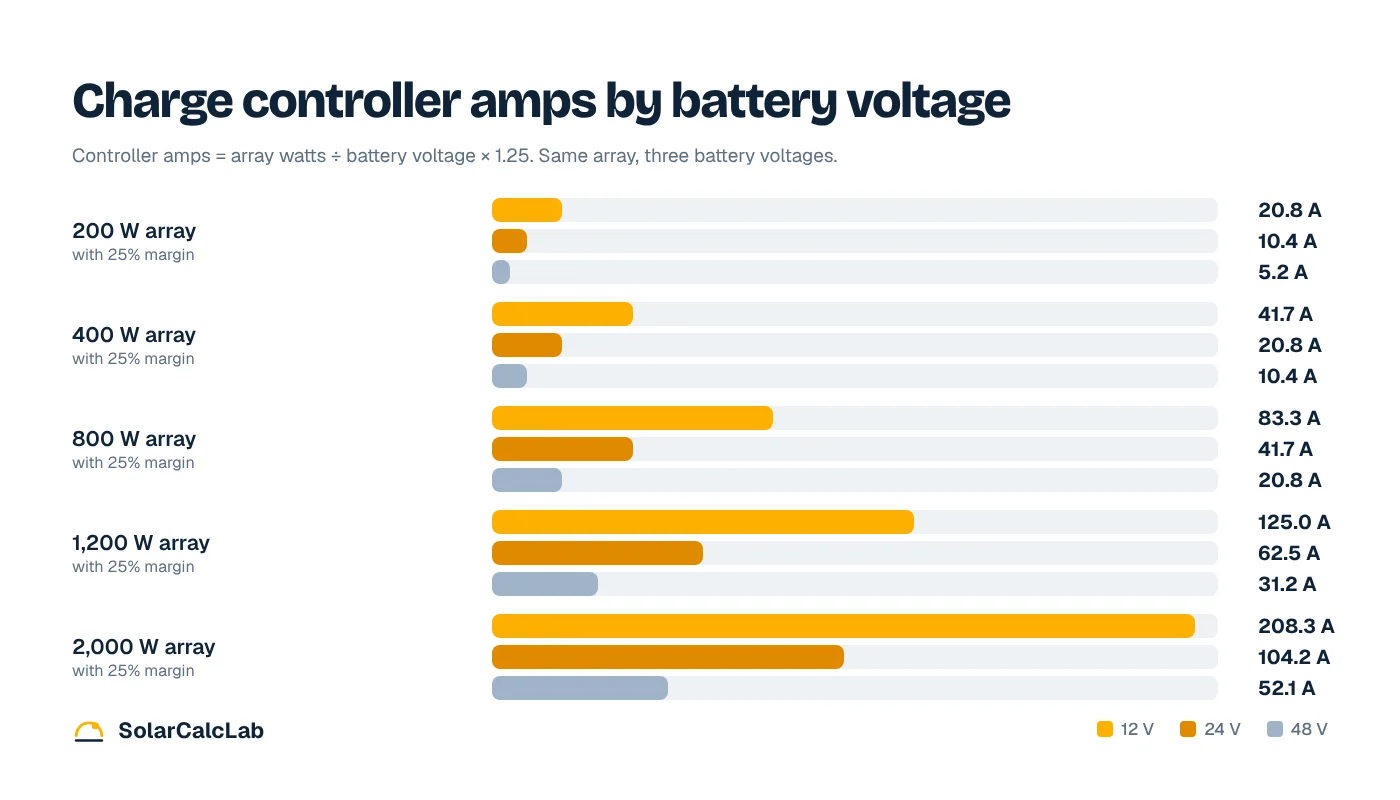
Past about 800 W, a 12 V system needs very large controllers or more than one. That is usually the point to consider a 24 V bank, as our guide to batteries in series vs parallel explains.
Three sizing scenarios
Camper van: 400 W on a 12 V lithium battery
Two 200 W panels feed a 12 V LiFePO4 battery. The margin formula says 400 ÷ 12 × 1.25 = 41.7 A, which points to a 50 A controller. Victron’s spec sheet says a 30 A unit is rated for 440 W at 12 V. So which is right?
Look at real output. On a good summer day a flat-mounted van array might reach 85% of its label, about 340 W. Into a battery charging at 13.8 V, at 97% conversion efficiency, that is about 24 A. Even at a full 400 W on a cold, clear day it works out to about 28 A. A 30 A controller covers this array with almost no clipping. The 50 A unit only makes sense if you plan to add a third panel later.
Cabin: 1,200 W on a 24 V bank
Three 400 W panels with a Voc of 37.1 V each go on a 24 V battery. The current check gives 1,200 ÷ 24 × 1.25 = 62.5 A. A 50 A controller rated for 1,400 W at 24 V would also pass on power alone, so current is not the hard part here. Voltage is.
Three panels cannot be split into two equal series strings, so you have two options:
- All three in series: at a record low of 14°F (-10°C) and a typical Voc coefficient of -0.27%/°C, the string reaches about 121.8 V. That rules out every 100 V controller and calls for a 150 V class unit.
- All three in parallel: voltage stays near one panel’s figure. A panel with a 31 V maximum power voltage drops to roughly 26.7 V when its cells reach about 149°F (65°C), using a typical -0.35%/°C voltage coefficient. That is below the 28.4 to 28.8 V a 24 V bank needs during absorption, so charging stalls on the hottest afternoons.
The series option wins, which means a 150 V class controller. On current, the 62.5 A margin figure is a ceiling: at 85% of nameplate into a 27.6 V battery, the array delivers about 36 A, so a 60 A unit has room to spare. In Victron’s 2026 recommended US dollar price list, the SmartSolar 150/60 is about $393, compared with about $207 for the 100/50. The series and parallel calculator lets you compare layouts before you buy.
Upgrade: adding panels to an existing 40 A controller
A 24 V system with 800 W of panels runs on a 40 A controller, and the owner wants to add two 200 W panels. At 85% of nameplate, 1,200 W would push about 35.8 A into the battery, so the 40 A unit would rarely clip. The catch is input current: the combined Isc may exceed the controller’s input limit, which is a hard rating, unlike output clipping. If it does, put a second small controller on the new panels. Two controllers can charge one bank side by side.
MPPT or PWM: how the choice changes the size
A PWM controller works like a fast switch between panel and battery. It pulls the panel down to battery voltage, so it is sized from panel current, not watts. The usual approach follows NEC 690.8: multiply total Isc by 1.25 for high sunlight, then by 1.25 again for continuous current.
Example: two panels with Isc 9.9 A in parallel = 19.8 × 1.5625 = 30.9 A, so a 40 A PWM unit
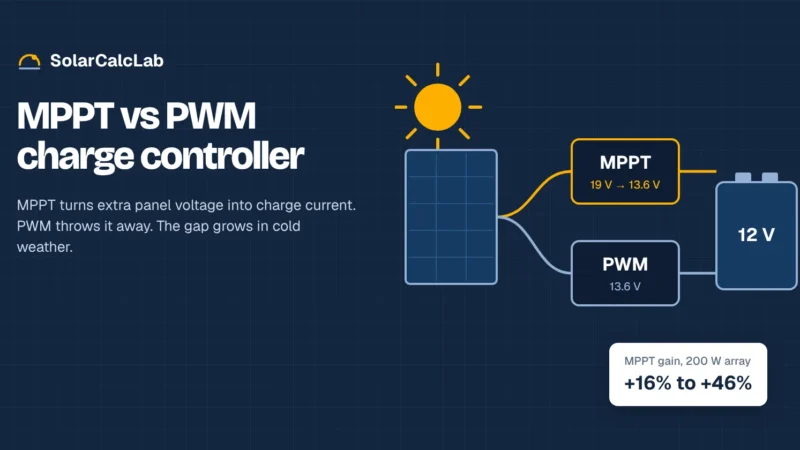
PWM only suits panels built for 12 V charging, with a maximum power voltage near 17 to 18 V. Put a 60-cell 300 W house panel on a 12 V PWM controller and it is held near 13.5 V. At about 9.2 A, that is roughly 125 W, so about 58% of the panel’s output is lost. An MPPT controller turns the same panel into about 21.6 A of charge current. For small arrays of matched 12 V panels, PWM is cheap and fine. Beyond that, MPPT earns back its price. Our MPPT vs PWM charge controller comparison shows how the gap changes with panel temperature and when a cheaper PWM plus one more panel is the better deal.
Signs your controller is the wrong size
- Charge current flat-lines at midday. The controller is hitting its output limit. A little is normal. Hours of it on most days means wasted panels.
- No charging on cold, bright mornings, or an overvoltage error. The string’s cold Voc is at or over the input limit. Shorten the string before winter.
- Charging drops out on hot afternoons. The panel voltage is sagging toward battery voltage. Add a panel in series if the cold-voltage check still passes.
- The battery never reaches full. The controller may be fine and the array too small for your loads. The battery charging time calculator shows how many hours of sun your bank needs at your charge current.
For a full system where the controller is one step among several, the off-grid solar system guide walks through loads, batteries, array and inverter in order.
Frequently asked questions
Can a charge controller be too big?
No. A 60 A controller on a 300 W array works normally and simply charges at the current the panels provide. Oversizing only costs money, and it makes sense if you expect to add panels.
Is it OK to connect more solar watts than the controller is rated for?
On most MPPT units, yes, as long as you stay within the maximum PV voltage and the maximum PV short-circuit current. The controller caps its output and the extra power is clipped. Check the datasheet, because some makers also list a maximum array power.
What size charge controller do I need for a 100 Ah battery?
Battery capacity does not set the controller size. The array does. A 100 Ah battery can usually accept the current a 20 A or 30 A controller provides, but check the battery’s maximum charge current on its datasheet so the controller never exceeds it.
Can I use two charge controllers on one battery bank?
Yes. Each controller connects to its own group of panels and to the same battery, with its own fuse. Give both the same charge voltage settings.
Does a 24 V controller work on a 12 V battery?
Most MPPT controllers rated “12/24 V” detect the battery voltage at start-up and work with either. Their output current rating stays the same, so the power they can handle at 12 V is half the 24 V figure.