What Will a 100 Watt Solar Panel Run?
Short answer
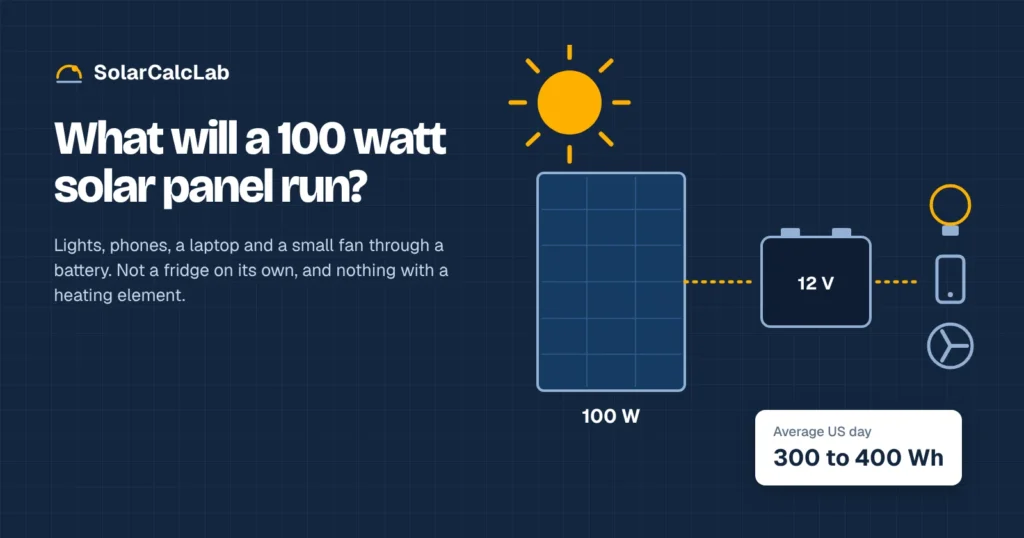
A 100 watt solar panel makes about 300 to 400 watt-hours on an average US day, and closer to 150 Wh on a short winter day. That runs LED lights, phones, a laptop, a small fan or a Wi-Fi router, all through a battery. It will not keep a 12 V compressor fridge going on its own in most of the country, and it cannot run a microwave, coffee maker, space heater or air conditioner.
Most people asking what a 100 watt panel will run picture the panel powering things directly. In practice it almost never does. The panel charges a battery through a charge controller, and your devices draw from the battery. So the useful number is not 100 watts. It is the energy the panel puts into that battery over a full day, and how your loads add up against it.
The daily energy budget of one 100 W panel
A panel rated 100 W produces 100 W only under lab conditions: 1,000 watts of sunlight per square meter and a cell temperature of 77°F. On a real roof or campsite, heat, dust, wiring, the controller and the battery all take a share. For a small 12 V system with an MPPT controller, about 75% of the rated output reaching the battery is a fair planning figure.
Example at 4.5 peak sun hours: 100 × 4.5 × 0.75 = 337.5 Wh, about 26 Ah into a 12.8 V battery
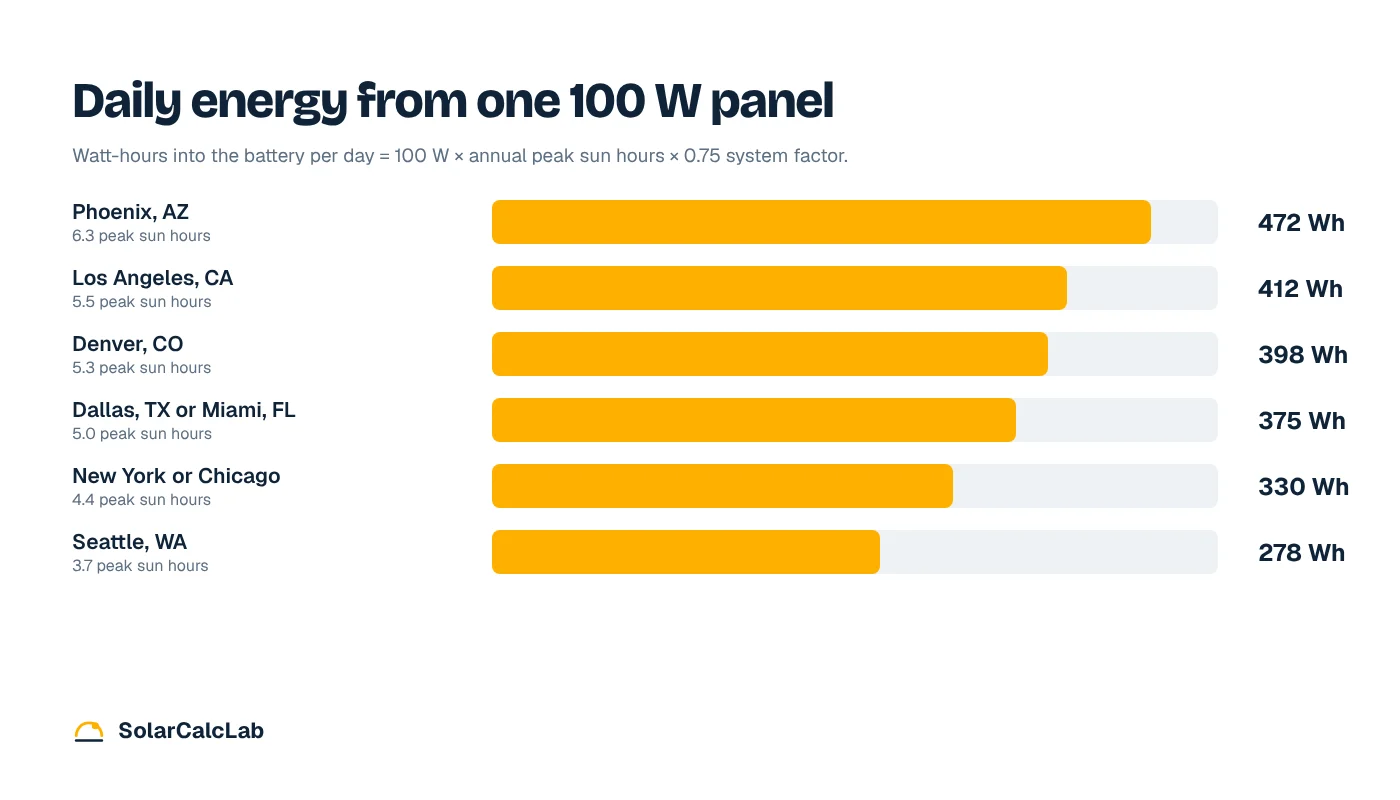
Peak sun hours are the number of hours per day that equal full sunlight, not the hours between sunrise and sunset. They vary a lot by place and season, which is why the same panel in Phoenix and Seattle gives very different results. You can look up the figure for your own location in the peak sun hours calculator.
| Location (annual average) | Peak sun hours | Energy to battery per day | Amp-hours at 12.8 V |
|---|---|---|---|
| Phoenix, AZ | 6.3 | 472 Wh | 36.9 Ah |
| Los Angeles, CA | 5.5 | 412 Wh | 32.2 Ah |
| Denver, CO | 5.3 | 398 Wh | 31.1 Ah |
| Dallas, TX or Miami, FL | 5.0 | 375 Wh | 29.3 Ah |
| New York or Chicago | 4.4 | 330 Wh | 25.8 Ah |
| Seattle, WA | 3.7 | 278 Wh | 21.7 Ah |
These are year-round averages. A clear June day can beat them, and an overcast December day in the northern half of the country can fall to 2 peak sun hours or less. At 2 hours the same panel delivers 100 × 2 × 0.75 = 150 Wh. Plan around the season you will actually use the panel in, not the annual figure. For a wider look at how output changes month to month, see how much power a solar panel produces per day.
What a 100 watt solar panel will run, device by device
The table uses the 337.5 Wh budget from a 4.5 peak sun hour day. Watt figures are typical for each type of device; check the label or measure your own with a plug-in meter, because they vary by model.
| Device | Typical draw | Daily use | Energy per day | Share of 337.5 Wh |
|---|---|---|---|---|
| Four 10 W LED lights | 40 W | 5 hours | 200 Wh | 59% |
| 12 V vent fan, medium speed | 24 W | 8 hours | 192 Wh | 57% |
| 32 inch LED TV | 40 W | 3 hours | 120 Wh | 36% |
| Laptop, one full charge | about 70 Wh | once | 70 Wh | 21% |
| Two phone charges | about 20 Wh each | once each | 40 Wh | 12% |
| 12 V compressor fridge, 40 to 50 qt | cycles on and off | 24 hours | 300 to 500 Wh | 89% to 148% |
Two patterns stand out. Small electronics are cheap: a phone charge costs about 6% of the day. Anything that runs for many hours, even at low watts, eats the budget quickly. A 24 W fan sounds tiny, but eight hours of it uses more than half of what the panel makes.
To see the panel size any appliance would need, plug its watts and hours into the appliance solar panel calculator.
What it cannot run
Heating and cooking loads are out of reach. A 1,000 W coffee maker running for 10 minutes uses about 167 Wh, half the day’s harvest, and it also needs an inverter and a battery that can deliver 80 to 90 amps at 12 V. A 1,500 W space heater would drain a full day of solar in under 14 minutes. Window and rooftop air conditioners, hair dryers, electric kettles and microwaves fall in the same group. If you need those, you are looking at a much larger system, covered in the off-grid solar system guide.
Three real setups, worked out
Weekend car camping in summer
Load list: four 10 W LED lights for 4 hours (160 Wh), two phone charges (40 Wh) and a 24 W fan for 6 hours (144 Wh). Total: 344 Wh. That is slightly over the 337.5 Wh average budget, so on a typical day the battery ends a little lower each night. Cut the fan to 4 hours and the total drops to 296 Wh, which leaves about 41 Wh of margin. In a sunny state in July, the original list fits without changes.
Lights in a backyard shed
Three 10 W LED fixtures used for 3 hours a night (90 Wh) plus a 60 Wh battery-powered tool charge make 150 Wh. One 100 W panel covers this with room to spare, even on most winter days. A 50 Ah LiFePO4 battery gives about three nights of reserve. This is the job a single 100 W panel does best.
A 12 V fridge in a van
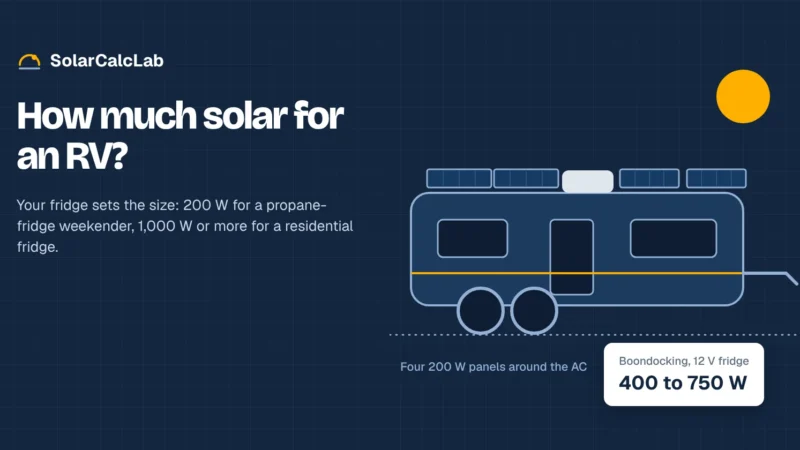
A 40 to 50 quart compressor fridge commonly uses 300 to 500 Wh a day, depending on how hot it is and how often the lid opens. Take 400 Wh as a middle case. At 4.5 peak sun hours, the panel needed is 400 ÷ (4.5 × 0.75) = 119 W, so 100 W falls short before you add a single light. Two 100 W panels give 675 Wh a day, enough for the fridge plus lights and phones. For runtime on battery alone, see how long a battery will run a refrigerator.
Pairing the panel with a battery and controller
Battery size
A 50 Ah or 100 Ah 12 V LiFePO4 battery is the usual match. The panel can refill a 50 Ah battery from 20% to full (about 512 Wh) in roughly 1.5 average days with no loads running. A 100 Ah battery holds 1,024 Wh in that same 20% to 100% window, which takes about three full days of sun to refill. The battery charging time calculator runs this for any capacity.
PWM or MPPT
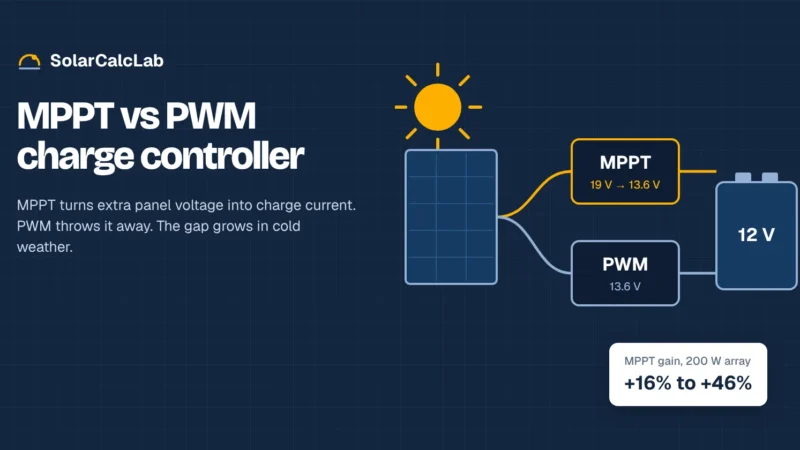
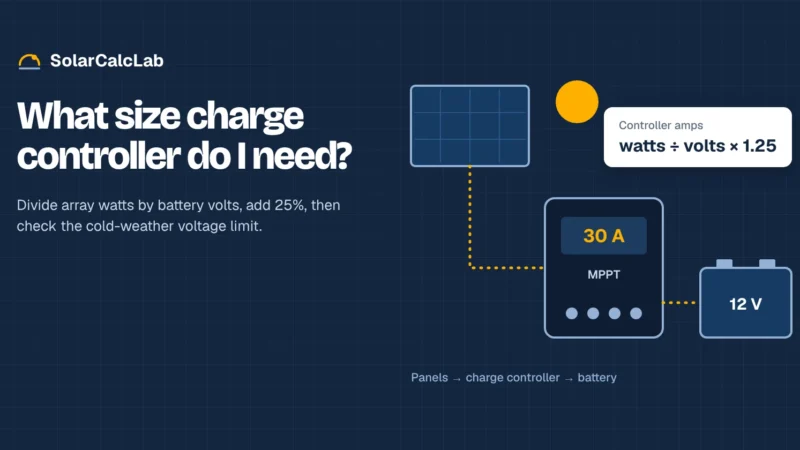
Most 100 W panels sold for 12 V use have 36 cells, with a maximum power voltage near 19 to 20 V and a current around 5 to 5.5 A. A PWM controller ties the panel to battery voltage, so with a battery at 13.2 V and 5.2 A from the panel, the most it can pass is about 69 W. An MPPT controller converts the extra voltage into current and recovers much of that gap. With one panel, a cheap PWM unit still works; it simply harvests less. The trade-offs are covered in MPPT vs PWM charge controllers, and the charge controller calculator sizes the unit. A 10 A controller is plenty for one 100 W panel.
Wire and fuse
Section 690.8 of the electrical code sizes PV circuits at 1.25 × 1.25 times short circuit current. For a panel with a 5.51 A short circuit rating, that is 8.6 A, so 12 or 10 AWG cable handles the current easily. Voltage drop is the bigger concern on long runs at 12 V. Fuse the battery side of the controller close to the battery.
Is one 100 W panel the right choice?
Single rigid 100 W panels commonly sell online for roughly $50 to $120, which makes them an easy entry point. Before buying, run through these checks:
- Daily use under about 250 Wh: one panel works in most of the US for most of the year.
- Daily use of 250 to 400 Wh: one panel works in sunny months or sunny states. Plan for a second panel or another charging source.
- A 12 V fridge or more than 400 Wh: start with 200 W or more.
- Anything with a heating element: a 100 W panel is the wrong tool. Use shore power, a generator or a much larger system.
When output looks low
If a 100 W panel shows 40 to 60 W at midday, check these in order: partial shade on even one cell row, a panel lying flat in winter instead of tilted toward the sun, a PWM controller with a nearly full battery, and a dirty surface. Hot panels also lose output; most crystalline modules give up roughly 0.3% to 0.4% per degree Celsius above 25°C, which on a 150°F roof adds up. For a panel check against expected output, use the solar panel output calculator.
Frequently asked questions
Can a 100 watt solar panel run a refrigerator?
Not reliably on its own. A small 12 V compressor fridge usually needs 300 to 500 Wh a day, while a 100 W panel delivers about 340 Wh on an average day and much less in winter. Two 100 W panels and a 100 Ah battery is a more realistic setup. A full-size household fridge needs far more.
How many amps does a 100 watt solar panel produce?
About 5 to 5.5 amps at its maximum power voltage of around 19 to 20 V, in full sun. Into a 12 V battery through an MPPT controller, the charging current at full sun is usually 5 to 6 amps after losses. Over an average day it adds roughly 26 Ah to a 12.8 V battery.
Can I run a 100 watt panel without a battery?
You can connect some DC fans or pumps directly, but output rises and falls with every cloud, so most electronics and all inverters need a battery between the panel and the load. A battery also lets you use the energy at night.
How long does a 100 watt panel take to charge a 100Ah battery?
Going from 20% to full on a 12.8 V LiFePO4 battery means adding about 1,024 Wh. At roughly 337 Wh per average day, that takes about three sunny days with nothing else running. A 50 Ah battery over the same range takes about a day and a half.
Will a 100 watt solar panel run a TV?
A 32 inch LED TV using about 40 W for 3 hours needs 120 Wh, roughly a third of an average day’s output, so yes, through a battery and a small inverter. Larger TVs over 100 W shorten that to an hour or two before they use the whole day’s harvest.