MPPT vs PWM Charge Controller: Which One Should You Use?
Short answer
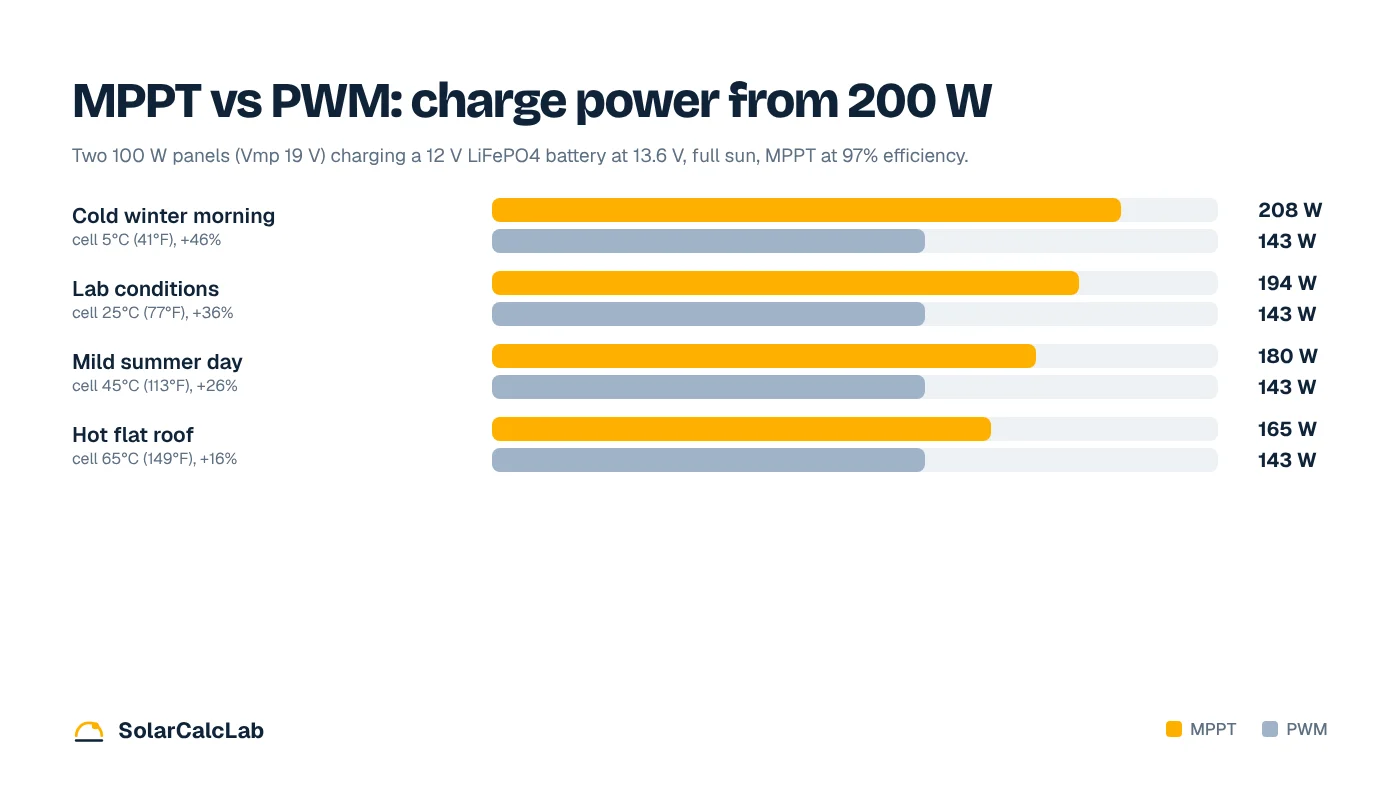
Choose MPPT if your panels are house-style modules (60, 72 or 108 cells), if you wire panels in series, or if the array is over about 200 W. Choose PWM only for one or two small “12 V” panels charging a 12 V battery, where a $25 to $35 PWM unit does the job. In our 200 W example, MPPT delivers 16% more charge on a hot roof and 46% more on a cold, bright morning.
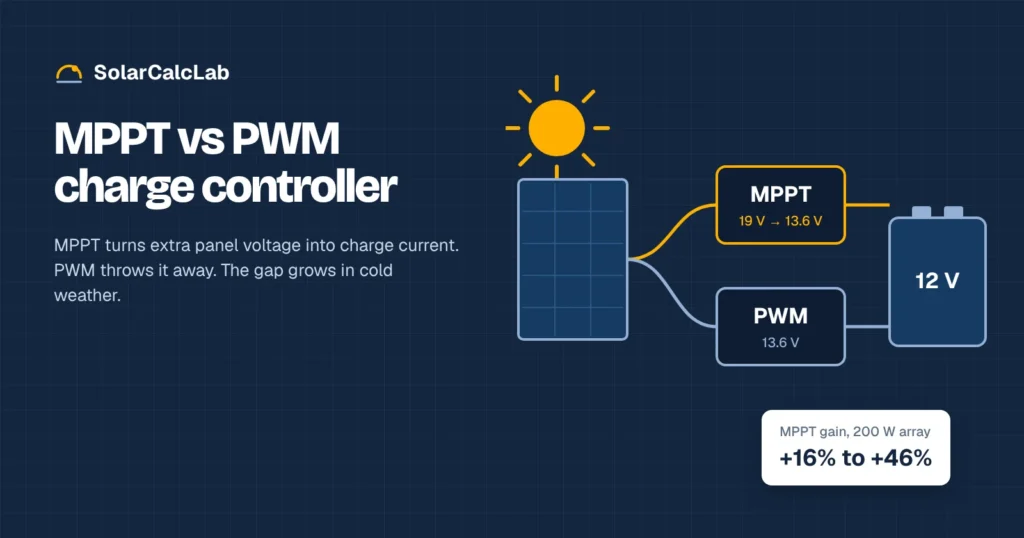
Both controllers stop your battery from being overcharged. The difference is what they do with the panel’s voltage. A PWM controller throws away whatever voltage the battery cannot use. An MPPT controller converts that extra voltage into extra current. Whether that matters to you depends on your panels, your climate and how much roof you have.
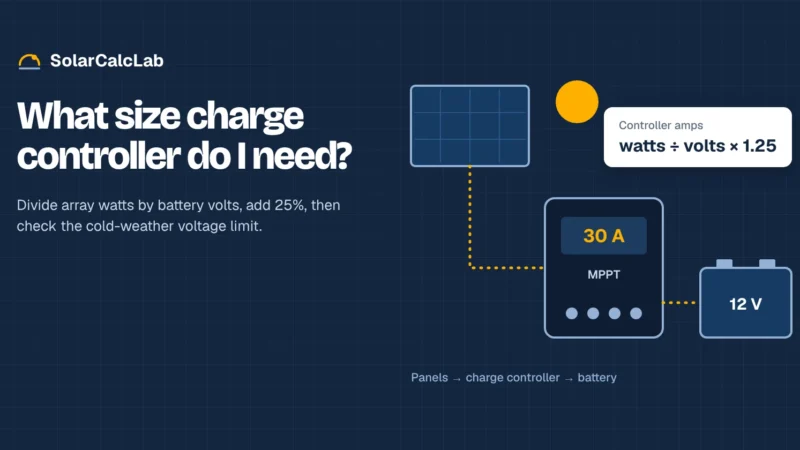
This comparison works through real numbers for a small 12 V system, shows the cases where the cheap controller is the smarter buy, and ends with a setup-by-setup pick. If you already know you want MPPT and only need the amp rating, our guide on what size charge controller you need covers that math.
What each controller does to your panel
PWM: a fast switch
PWM stands for pulse width modulation. The controller connects the panel straight to the battery and switches that connection on and off to hold the charging voltage. While it is connected, the panel is forced down to battery voltage. A panel that could make its full power at 19 V is working at about 13.6 V, so the extra 5 V or so is simply lost.
The current a panel produces barely changes when you pull its voltage down, so a PWM controller delivers roughly the panel’s rated current at battery voltage:
MPPT charge power ≈ panel maximum power × converter efficiency (about 97%)
MPPT: a DC-to-DC converter
MPPT stands for maximum power point tracking. The controller keeps the panel at the voltage where it makes the most power, then steps that voltage down to the battery and raises the current to match. Good units convert with very little loss. Victron rates its SmartSolar 100/30 and 100/50 controllers at 98% peak efficiency.
Because it can step voltage down, an MPPT controller also accepts panels in series and high-voltage house modules. A typical 12 V PWM controller cannot.
MPPT vs PWM side by side
| Feature | PWM | MPPT |
|---|---|---|
| Panel voltage during charging | Pulled down to battery voltage | Held at the panel’s best voltage |
| Typical 30 A price (late 2026) | About $25 to $35 | About $140 for a Victron 100/30; budget brands cost less |
| Max PV input voltage | Often about 25 V on 12 V models | 75 V, 100 V, 150 V or higher |
| Panels in series | No (on 12 V models) | Yes, within the voltage limit |
| House panels (60 to 108 cells) | Not suitable | Yes |
| Extra harvest vs PWM | Baseline | About 15% to 45% with 12 V panels, much more with house panels |
| Best fit | One or two small panels, tight budget | Most systems above 200 W |
Prices are current listings: Renogy lists its Wanderer Li 30 A PWM at $32.99 and it often sells for less, and the Victron SmartSolar 100/30 lists for about $140 at US retailers.
The real numbers: one 200 W array in four kinds of weather
Take two 100 W “12 V” panels wired in parallel to a 12 V LiFePO4 battery. Each panel has a maximum power voltage (Vmp) of 19.0 V, a current at that point (Imp) of 5.26 A and a power temperature coefficient of about -0.37% per °C, which are typical spec sheet figures for this class of panel. The battery sits near 13.6 V while it charges.
Panels lose voltage as they heat up, and that is the whole story here. When the panel is hot, its best voltage drops toward battery voltage, and PWM loses less. When the panel is cold, its voltage climbs and PWM wastes more of it.
| Condition (full sun) | Cell temp | Panel Vmp | MPPT to battery | PWM to battery | MPPT advantage |
|---|---|---|---|---|---|
| Cold, bright winter morning | 5°C (41°F) | 20.4 V | 208 W | 143 W | +46% |
| Lab test conditions | 25°C (77°F) | 19.0 V | 194 W | 143 W | +36% |
| Mild summer day | 45°C (113°F) | 17.6 V | 180 W | 143 W | +26% |
| Hot, flat-mounted roof | 65°C (149°F) | 16.2 V | 165 W | 143 W | +16% |
The PWM column stays flat because it depends on current (10.52 A for two panels) times battery voltage, and neither changes much with temperature. Panel current actually rises slightly when hot, so PWM does a little better than shown on very hot days. If the battery is lead-acid and sitting lower, say 12.8 V early in the charge, PWM drops to about 135 W.
One more detail shrinks the gap in daily use. Once the battery is full, both controllers throttle back and the difference disappears. If your battery is usually full by late morning, you only collect the MPPT advantage for a few hours a day.
When PWM is the better buy
PWM is not obsolete. It is the right choice in a few common setups:
- A trailer, boat or gate opener with one small panel. A 30 to 100 W panel keeping a battery topped up does not need every watt. The $100 saved buys more than the extra harvest is worth.
- Hot climates with roof-mounted panels. In Arizona or Texas summers the gain falls toward 15%, and the panel is often running hotter than our 65°C row.
- You have room for one more panel. See the payback check below. Adding panel area is often cheaper than upgrading the controller.
- Matched panels on a 24 V battery. Two 12 V class panels in series give a Vmp near 38 V, which suits a 24 V PWM controller the same way one panel suits a 12 V one. The PWM must be rated for 24 V and for that input voltage.
When MPPT pays for itself
House-style panels
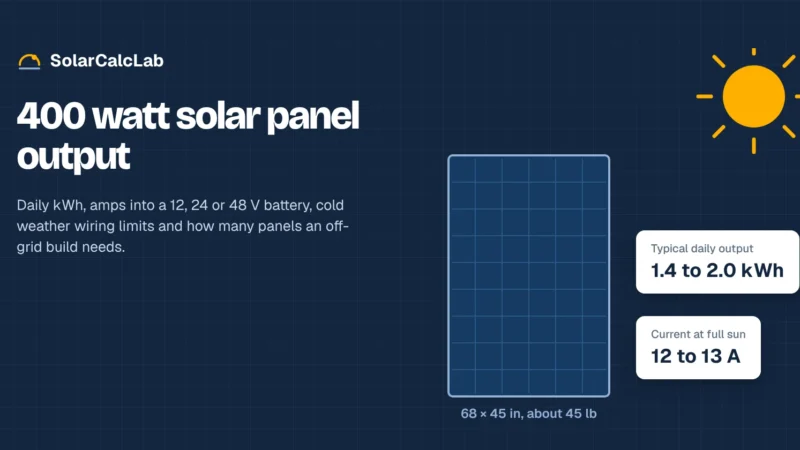
Large residential panels are cheap per watt, but their voltage is far above a 12 V battery. A 400 W, 108 half-cell panel has a Vmp around 31 V and an Imp around 12.9 A. On a 12 V PWM it would deliver about 12.9 × 13.6 = 175 W, losing 56% of its rating. In most cases it cannot be connected at all: its open-circuit voltage of about 37 V is above the 25 V input limit on many 12 V PWM controllers. With house panels, MPPT is the only workable option.
Long wire runs
Because MPPT lets you wire in series, the same power travels at higher voltage and lower current. That cuts wire loss sharply. Here are four 100 W panels, 30 feet from the controller, on 10 AWG copper (1.24 ohms per 1,000 feet):
| Wiring | Array voltage | Current | Voltage drop | Power lost in wire |
|---|---|---|---|---|
| 4 in parallel | 19 V | 21.0 A | 1.57 V (8.2%) | 33 W |
| 2 series x 2 parallel | 38 V | 10.5 A | 0.78 V (2.1%) | 8 W |
| 4 in series | 76 V | 5.3 A | 0.39 V (0.5%) | 2 W |
Series wiring has a limit, though. Four of these panels have an open-circuit voltage of 90 V at 25°C. Using the NEC Table 690.7(A) correction factor of 1.14 for a 14°F (-10°C) morning, that becomes 102.6 V, which is over a 100 V controller’s limit. The 2 x 2 layout stays near 51 V and is safe on a 100 V unit. The solar panel series parallel calculator checks string voltage for your panels, and the solar cable size calculator picks the wire gauge.
Cold, short winter days
Winter is when an off-grid battery is most likely to run low, and it is exactly when MPPT has its biggest edge. If your system has to carry you through December rather than just July, the 40% to 45% gain on cold mornings is worth more than the summer average suggests. Our off-grid solar system guide sizes the array for the worst month for this reason.
Is the extra $110 worth it? A payback check
Compare two ways to spend money on the 12 V system above, using a mild summer day and 5 peak sun hours:
| Option | Extra cost | Summer charge per day | Cold morning output |
|---|---|---|---|
| A. Two panels + 30 A MPPT | About $110 more than PWM | About 898 Wh | 208 W |
| B. Three panels + 30 A PWM | One 100 W panel, roughly $50 to $100 | About 1,073 Wh | 215 W |
Option B wins on both energy and cost, provided you have space for the third panel and the PWM is rated for the 15.8 A it will carry. That is the honest case for PWM on small systems: panel watts are cheap.
Option A wins when space is the limit. A van roof with room for two panels cannot take a third, so the only way to get more charge is a better controller. MPPT also wins as soon as the array grows past what a 12 V PWM can take, or when you want to use house panels.
To see how many hours of sun your battery needs at either charge current, use the battery charging time calculator.
Three spec sheet checks before you buy
- Max PV input voltage. This must exceed your array’s open-circuit voltage on the coldest morning, with margin. Many 12 V PWM units stop at 25 V.
- Start-up voltage. Many MPPT controllers need the panel voltage to sit a few volts above the battery before they begin charging. Victron units, for example, wait until PV voltage is about 5 V above the battery. With one 12 V class panel on a 12 V battery in weak light, that can delay charging.
- Output amps. MPPT is sized from array watts divided by battery voltage, PWM from panel short-circuit current. The charge controller calculator handles both.
Which one fits your setup
| Your setup | Pick |
|---|---|
| One 30 to 100 W panel keeping a battery topped up | PWM |
| Two 12 V class panels, space for more, hot climate | PWM, and add a panel later |
| Van or RV roof with limited space | MPPT |
| Any 60, 72 or 108 cell house panel | MPPT |
| Panels 20 feet or more from the battery | MPPT with series wiring |
| Year-round off-grid cabin or home | MPPT |
Frequently asked questions
How much more efficient is MPPT than PWM?
The controllers themselves are both efficient. The difference is how much panel power they capture. With 12 V class panels, MPPT typically delivers about 15% more charge in hot weather and up to about 45% more in cold weather. With house panels on a 12 V battery, the gap can be more than double.
Is MPPT worth it for a single 100 watt panel?
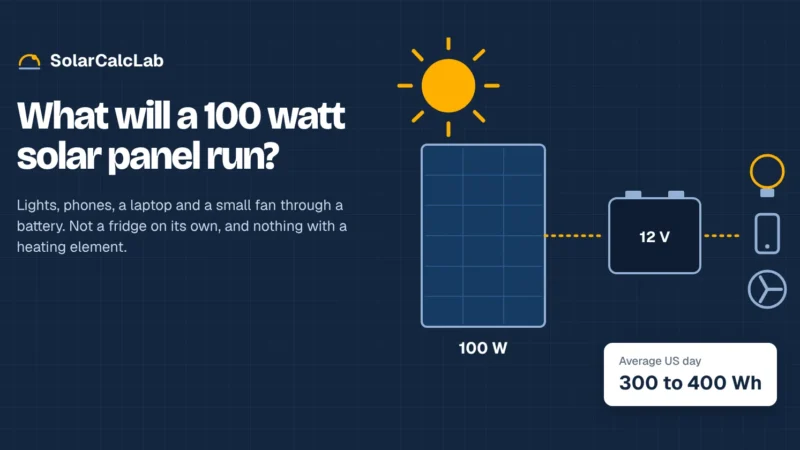
Usually not. The panel’s best voltage is only about 5 V above a charging 12 V battery, so in our example the gain is about 10 to 33 watts in full sun, depending on panel temperature. A $25 to $35 PWM controller with the right battery profile is a sensible match. Spend the difference on a second panel if you need more charge.
Can I connect a residential 400 W panel to a PWM controller?
Generally no. A 400 W house panel has an open-circuit voltage around 37 V, which exceeds the 25 V input limit on many 12 V PWM controllers. Even on a PWM that accepts it, the panel would be pulled down to battery voltage and lose more than half its output. Use an MPPT controller.
Why does my MPPT controller not start charging early in the morning?
Many MPPT units need panel voltage several volts above battery voltage before they start. With one 12 V class panel and a 12 V battery, weak morning light may not reach that threshold. Wiring two panels in series raises the voltage and solves it, provided the cold-weather voltage stays under the controller’s limit.
Can I use a PWM controller with a lithium battery?
Yes, if it has a lithium or LiFePO4 charging profile, or lets you set the absorption and float voltages yourself. Older PWM units built only for lead-acid may charge a LiFePO4 battery to the wrong voltage, so check the manual before connecting one.