8kWh per Day Solar System: How Many Panels and What Size You Need
Short answer
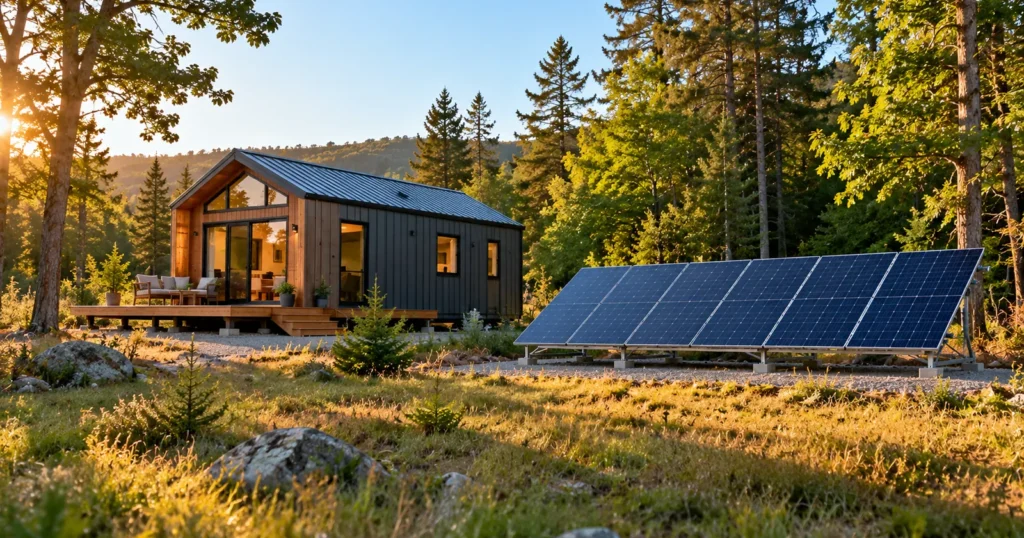
To produce 8 kWh a day you need about a 2.2 kW solar array, which rounds up to six 430 W panels (2.58 kW) at 4.5 peak sun hours and 80% system efficiency. Six panels make roughly 9.3 kWh a day and 3,390 kWh a year. Off grid, plan on about 4.4 kWh of battery for the night, or 8.9 to 17.8 kWh to cover one or two cloudy days.
Eight kilowatt-hours a day is the electricity budget of a tiny home, a year-round cabin, a backyard ADU or an efficient one-bedroom apartment. On a utility bill it looks like about 240 kWh a month. That is a little over a quarter of what a typical American household buys, so the solar system that covers it is small, cheap to expand and easy to fit on one roof face or a ground rack.
Most results for “8 kWh solar system” actually describe 8 kW systems, which make three to four times more energy. This page stays on the daily number: array size, panel count, what fits in 8 kWh, and how to size an off-grid battery and array together.
Is 8 kWh a day a small amount of electricity?
Yes. According to the U.S. Energy Information Administration, the average residential customer bought 10,791 kWh in 2022, or about 29.6 kWh a day. Eight kWh is roughly 27% of that.
To find your own daily number, divide the kWh on your bill (not the dollar amount) by the days in the billing period. Check a winter and a summer bill, because small homes swing a lot when heating or cooling switches on.
Example: 236 kWh ÷ 30 days = 7.9 kWh a day
If you are planning a new cabin or tiny home with no bill yet, add up each appliance’s watts times its hours of use with the solar load calculator.
What size solar system makes 8 kWh a day?
Divide the daily energy by your peak sun hours, then by the system efficiency. This site uses 80% efficiency to cover heat, dust, wiring and inverter losses, and 4.5 peak sun hours as a middle value for the US.
Example: 8 ÷ 4.5 ÷ 0.80 = 2.22 kW, or about 2,200 W of panels
Your location moves the answer more than anything else. Look up your annual average with the peak sun hours calculator, then read across this table.
| Peak sun hours | Example climate | Array needed | 430 W panels | 200 W panels |
|---|---|---|---|---|
| 3.5 | Cloudy Northwest (Seattle area about 3.7) | 2.86 kW | 7 | 15 |
| 4.0 | Upper Midwest, New England | 2.50 kW | 6 | 13 |
| 4.5 | US middle value (New York about 4.4) | 2.22 kW | 6 | 12 |
| 5.0 | Texas (Dallas about 5.0) | 2.00 kW | 5 | 10 |
| 5.5 | Southern California (Los Angeles about 5.5) | 1.82 kW | 5 | 10 |
| 6.5 | Desert Southwest | 1.54 kW | 4 | 8 |
Why six panels and not five?
The math says 2.22 kW, and five 430 W panels give 2.15 kW. That makes about 7.7 kWh a day at 4.5 sun hours, short on every average day. Six panels (2.58 kW) make about 9.3 kWh, a 16% cushion that absorbs panel aging, a dirty week or a slightly higher bill. Always round panel counts up, never down.
For an address-level estimate that uses local weather data, tilt and azimuth, run your array through NREL’s PVWatts calculator.
What does an 8 kWh day look like in a tiny home, cabin or apartment?
The same 8 kWh can mean very different lives. The table builds three budgets from assumed wattages and hours; swap in your own nameplate numbers.
| Load (Wh per day) | All-electric tiny home | Year-round cabin | Efficient apartment |
|---|---|---|---|
| Refrigerator (and freezer) | 1,200 | 2,000 | 1,200 |
| Heating or cooling | 2,400 (mini-split, 600 W × 4 h) | 200 (wood stove, ceiling fans) | 2,000 (window AC, 500 W × 4 h) |
| Cooking | 1,500 (induction, microwave) | 400 (propane range, microwave) | 1,500 (electric range) |
| Water | 100 (12 V pump) | 1,000 (well pump, 1,000 W × 1 h) | 0 (building supply) |
| Lighting | 300 | 500 | 400 |
| Electronics and internet | 700 | 2,000 (satellite dish, 60 W × 24 h, plus laptop and TV) | 1,200 |
| Laundry | 300 | 400 | 1,000 |
| Other (fans, kettle, tools, standby) | 1,500 | 1,500 | 700 |
| Total | 8,000 | 8,000 | 8,000 |
The tiny home spends almost a third of its budget on heating and cooling, so insulation matters more than one more panel. The cabin burns wood and propane for heat, which leaves room for a well pump and always-on internet. The apartment has no pump or water heater on its meter, so the budget goes to cooking, cooling and laundry.
What will not fit in 8 kWh a day?
Some common household loads use as much as or more than the whole budget on their own. Each figure below is computed from the stated wattage and hours.
- Electric tank water heater: a 4,500 W element running 2 to 3 hours a day uses 9 to 13.5 kWh. Use propane, a heat pump water heater or a small point-of-use unit instead.
- Baseboard or space heaters: one 1,500 W heater for 6 hours is 9 kWh. A mini-split heat pump delivers far more heat per kWh.
- Central air conditioning: a 3.5 kW unit running 6 hours on a hot day uses 21 kWh, nearly three days of budget.
- Daily EV charging: at an assumed 0.3 kWh per mile, a 30 mile commute needs 9 kWh. Occasional top-ups are possible; daily driving is not.
If two of these are on your list, you are really an 18 to 30 kWh household. Size the system from your full bill instead of this budget.
How much battery does an off-grid 8 kWh home need?
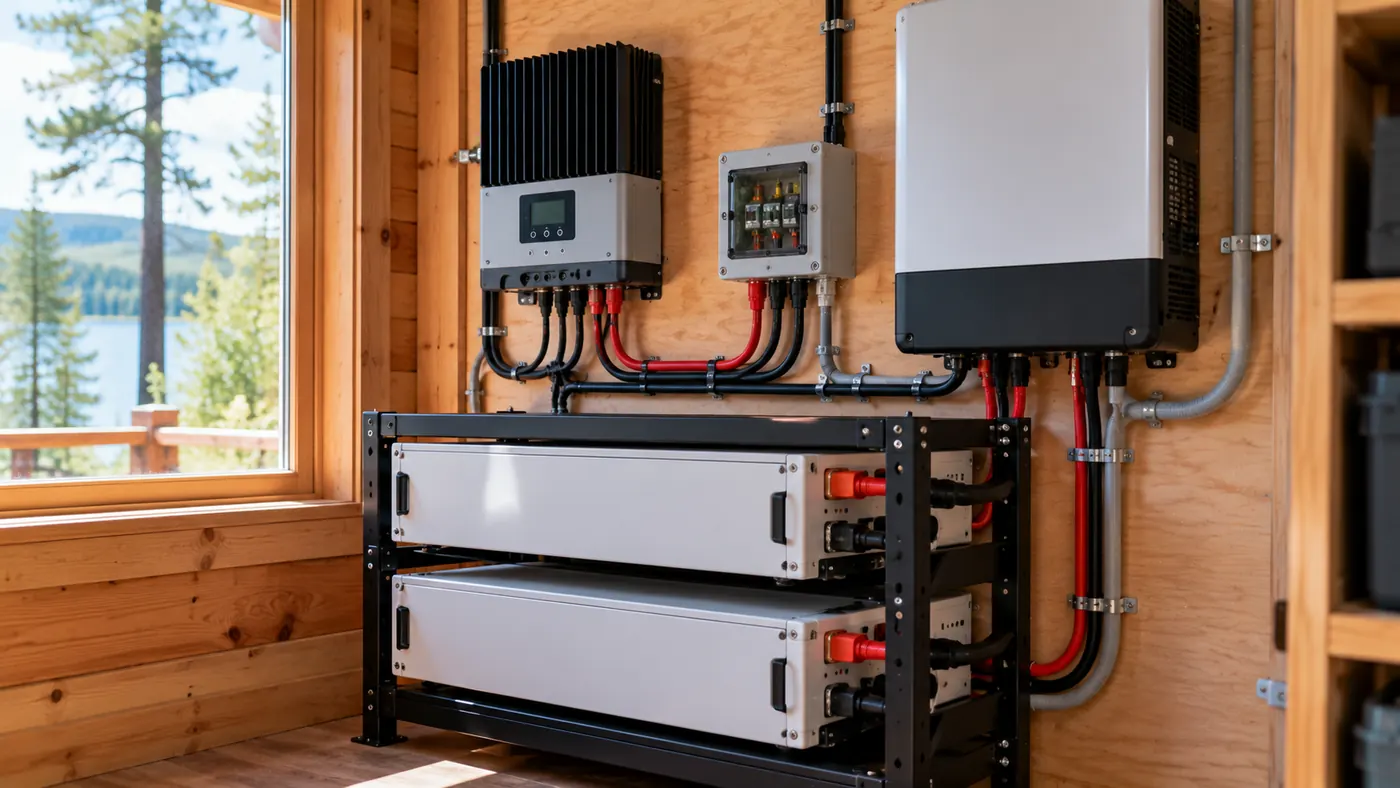
Battery size depends on how many hours or days you want to run without sun. This site assumes lithium iron phosphate (LiFePO4) batteries with 90% usable capacity. Lead-acid banks are usually planned at 50% depth of discharge, so they need almost twice the nameplate size for the same usable energy.
Example: 8 × 2 ÷ 0.90 = 17.8 kWh of LiFePO4
| Storage goal | Energy to store | LiFePO4 at 90% | 48 V 5.12 kWh modules | Lead-acid at 50% |
|---|---|---|---|---|
| Night only (about half the day’s use) | 4 kWh | 4.4 kWh | 1 | 8 kWh |
| 1 full day | 8 kWh | 8.9 kWh | 2 | 16 kWh |
| 2 days | 16 kWh | 17.8 kWh | 4 | 32 kWh |
| 3 days | 24 kWh | 26.7 kWh | 6 | 48 kWh |
A weekend cabin with a generator can live with one day of storage; a remote full-time home usually wants two to three. Check your numbers, including temperature and inverter losses, with the battery bank calculator.
The recharge problem nobody mentions
A big battery is only useful if the array can refill it. Six panels make about 9.3 kWh on an average day, which leaves just 1.3 kWh of surplus after the house takes its 8 kWh. Refilling 16 kWh after a two-day storm would take about 12 sunny days, and the next storm usually arrives first.
If you buy two or more days of storage, grow the array too. Nine 430 W panels (3.87 kW) make about 13.9 kWh a day, leaving 5.9 kWh of surplus, so the same 16 kWh refills in under three good days. Panels are the cheapest part of an off-grid system.
Voltage, controller and inverter at this size
A 48 V battery keeps currents low and is the easiest choice for a cabin or tiny home. Charge controller current is the array watts divided by battery voltage, times 1.25 for safety.
Example: 2,580 W ÷ 48 V × 1.25 = 67 A, so a 70 to 80 A MPPT controller
The nine-panel array works out to about 101 A at 48 V, which fits a 100 A class controller. At 24 V the six-panel array already needs 134 A, which means two controllers. Confirm the voltage window for your panel strings with the charge controller calculator. For the inverter, a 3,000 to 4,000 W pure sine wave model covers most tiny homes and cabins, but check the starting surge of any well pump or compressor on its spec sheet.
Most LiFePO4 batteries will not accept a charge below about 32°F, so in cold climates keep them in heated space or buy a self-heating model.
Summer cabin or year-round home: how much does the season change the array?
An array sized on annual sun hours falls short in December, when many northern sites see 2 to 3 peak sun hours. Size for the season you actually use.
| How you use it | Design sun hours | Array needed | 430 W panels |
|---|---|---|---|
| Summer cabin, May to September | 5.0 or more | 2.0 kW | 5 |
| Year-round, sunny state, generator backup | 4.5 | 2.22 kW | 6 |
| Year-round, mild winter | 3.0 | 3.33 kW | 8 |
| Year-round, northern winter | 2.5 | 4.0 kW | 10 |
| Year-round, no generator, deep winter | 2.0 | 5.0 kW | 12 |
Many full-time owners settle on 8 to 10 panels plus a small generator for the darkest weeks, rather than 12 panels that sit idle all summer. The off-grid solar calculator lets you test different winter sun hours and storage days together.
Does a 2.2 kW grid-tied system make sense for a small home or ADU?
It can, but small systems cost more per watt because permits, design and interconnection cost about the same at 2 kW as at 6 kW. EnergySage marketplace data for 2026 averages about $2.60 per watt and shows the price per watt rising as systems get smaller. For a 2 to 3 kW system, a typical US range in late 2026 is about $2.80 to $4.00 per watt installed.
| Item | Six 430 W panels (2.58 kW) |
|---|---|
| Installed cost at $2.80 to $4.00 per watt | $7,200 to $10,300 |
| Yearly production at 4.5 sun hours | about 3,390 kWh |
| Yearly value at an assumed $0.17 per kWh | about $576 |
| Simple payback | 12.5 to 18 years |
The 30% federal residential clean energy credit ended for homeowner-owned systems installed after December 31, 2025, so do not count it in your budget. State rebates, utility incentives and your net metering rules can still shorten payback. If an ADU shares a meter with the main house, adding panels to a whole-home system is often cheaper.
Renters in an efficient apartment usually cannot put panels on the roof. Community solar subscriptions, where your state offers them, are the usual way to cover an 8 kWh habit without owning hardware.
Did you mean an 8 kW system or an 8 kWh battery?
Kilowatts (kW) measure power, the rate at which panels produce. Kilowatt-hours (kWh) measure energy, the amount you use or store.
- 8 kWh a day: the energy this page covers. About a 2.2 kW array.
- 8 kW system: an array rated at 8,000 W. At this site’s assumptions it makes about 28.8 kWh a day, enough for an average family home. See the 8kW solar system guide.
- 8 kWh battery: storage that holds about 7.2 kWh usable at 90%. That covers one night, not a sunless day.
If your daily number is closer to half of this, the 4 kWh per day system guide walks through a smaller build for sheds and weekend cabins.
Frequently asked questions
Are 6 solar panels enough for 8 kWh a day?
Six 430 W panels (2.58 kW) make about 9.3 kWh a day at 4.5 peak sun hours and 80% efficiency, so yes for an average day in most of the US. In cloudy northern areas or in winter you need 7 to 10 panels. With smaller 200 W panels, plan on about 12 for the same output.
Can a 2 kW solar system produce 8 kWh a day?
Only in sunny places. A 2 kW array makes 2 × sun hours × 0.80 kWh a day, which is 7.2 kWh at 4.5 sun hours and 8 kWh at 5 sun hours. That works in Texas, California and the Southwest on average days, but falls short in the Northeast, the Northwest and most winters.
What size battery do I need for 8 kWh a day off grid?
For nighttime only, about 4.4 kWh of LiFePO4 covers the roughly 4 kWh you use after dark. For one full day without sun you need 8.9 kWh, and for two days about 17.8 kWh. A lead-acid bank needs almost twice those sizes because only about half of it should be used.
Can a tiny house run on 8 kWh a day?
Yes, if it uses a mini-split heat pump instead of resistance heaters and heats water with propane or a heat pump. An all-electric tiny home with induction cooking, a fridge, lights, laundry and electronics fits in about 8 kWh. A tank water heater or baseboard heat alone would use the entire budget.
How much is 8 kWh a day on a monthly bill?
Eight kWh a day is about 240 kWh in a 30-day month and about 2,920 kWh a year. At an assumed $0.17 per kWh, that is roughly $41 a month in energy charges before fixed fees and taxes. Your own rate is printed on your bill and can be much higher or lower.
Is one 5 kWh battery enough for an 8 kWh a day cabin?
A 5.12 kWh LiFePO4 module gives about 4.6 kWh usable, which carries a typical 8 kWh day through the night if you run heavy loads while the sun is up. It will not cover a cloudy day, so pair it with a generator or add a second module for one full day of storage.


