How Much Solar Do I Need for 1,500 kWh a Month?
Short answer
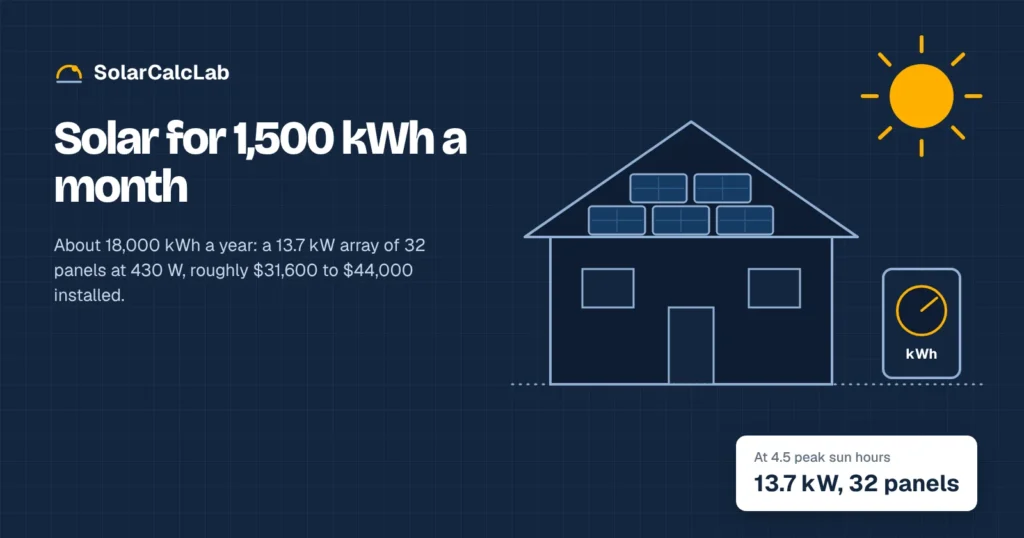
A home using 1,500 kWh a month (18,000 kWh a year) needs about a 13.7 kW solar system at 4.5 peak sun hours and 80% system efficiency. With 430 W panels that is 32 panels, a 13.76 kW array making roughly 18,100 kWh a year. At typical late 2026 prices it costs about $31,600 to $44,000 installed, and at this size the array often runs into the solar backfeed limit of a standard 200 A electrical panel.
A 1,500 kWh bill comes to about $273 a month at the 2026 national average rate. It is roughly two thirds above a typical US home, and it usually means one of two things: a large house in a hot climate, or an ordinary house that has gone electric with a heat pump and an EV in the garage.
The panel count is simple arithmetic. What makes this size worth a closer look is everything around it. Whether you should build for today’s bill or next year’s, whether your electrical panel can accept the solar breaker, and whether an installer’s production estimate is believable all decide if the system pays off. This guide works through each one with real numbers. For bills of other sizes, the main guide on how many solar panels you need uses the same method.
The quick math for 1,500 kWh a month
Start from the yearly total, because net metering and most net billing plans settle over 12 months. 1,500 kWh a month is 18,000 kWh a year, about 49.3 kWh a day. Spread over every hour of the year, the home pulls an average of about 2.05 kW around the clock.
18,000 ÷ (4.5 × 0.80 × 365) = 18,000 ÷ 1,314 = 13.70 kW
Panels = 13,700 W ÷ 430 W = 31.9, so 32 panels (13.76 kW)
The 0.80 factor covers heat, wiring, inverter and soiling losses. Each kilowatt of panels then makes about 1,314 kWh a year at 4.5 sun hours, a figure worth remembering because it lets you check any quote in seconds. The solar panel calculator runs the same formula with your own sun hours and panel.
A different panel only changes the count: 35 panels at 400 W, 31 at 450 W or 28 at 500 W land within about 2% of the same yearly output. Sun hours swing the answer far more.
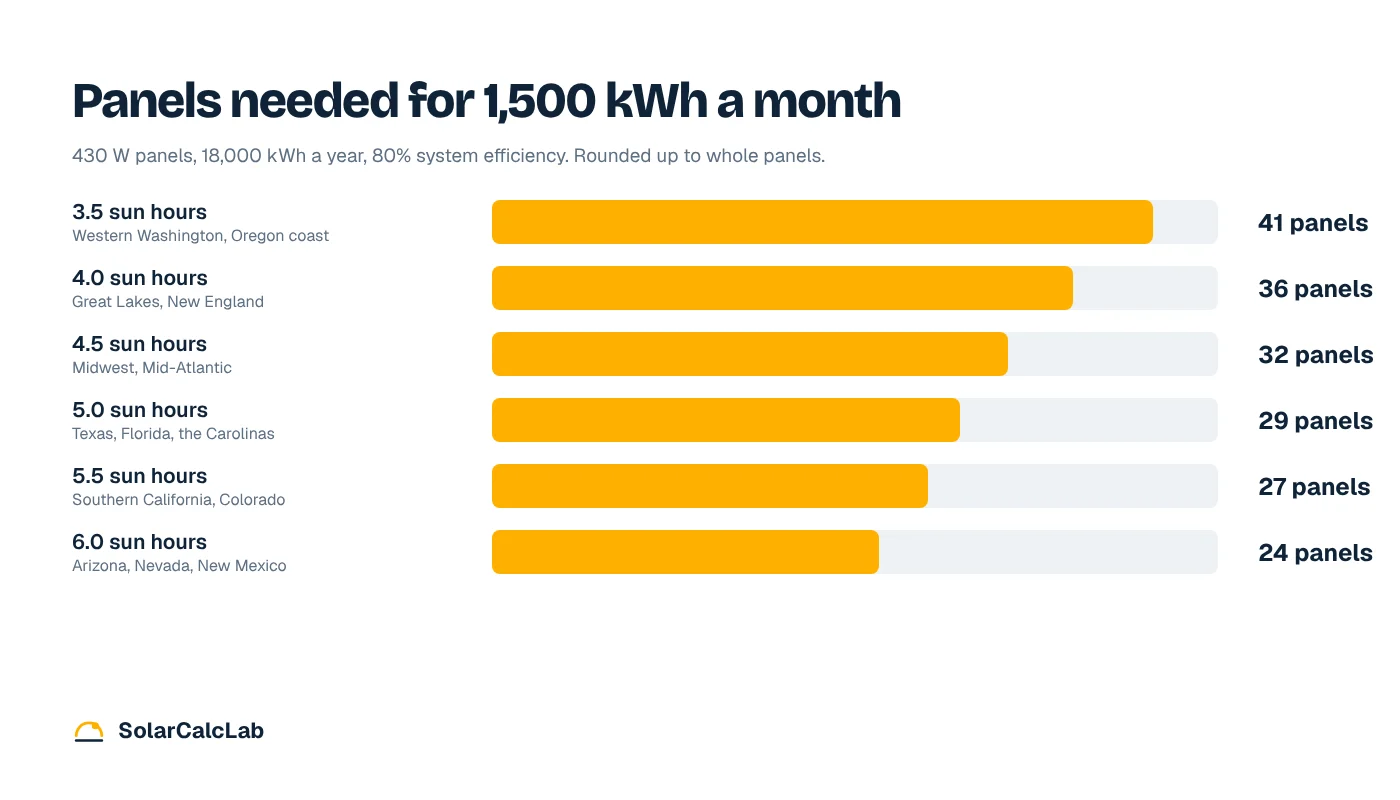
A sunny Southwest roof at 6.0 sun hours needs only 24 panels at 430 W, while a 3.5 sun hour roof in western Washington needs 41.
How you got to 1,500 kWh changes the plan
Two homes with the same bill can need different advice. A large house in Phoenix or Houston with central air reaches 1,500 kWh mostly in summer, and that usage is fairly stable from year to year. A mid-size home in Ohio or New Jersey may have been at 1,000 kWh until it added an EV and replaced a gas furnace with a heat pump. That second home is still changing, and its next 12 months may not look like its last 12.
Here is an illustrative path from 1,000 to 1,500 kWh. The EV line uses 12,000 miles a year at 0.30 kWh per mile. The heat pump line is an assumption, since real figures depend heavily on climate and house size.
| Load | Assumption | Average kWh a month |
|---|---|---|
| Existing home | Gas heat, central air | 1,000 |
| Electric car | 12,000 miles a year at 0.30 kWh per mile | 300 |
| Heat pump replacing gas furnace | Illustrative yearly average; winter months run far higher | 200 |
| Total | 1,500 |
If you have only owned the EV for a few months, your bills undercount it. Estimate the missing months with the EV charging cost calculator before you hand usage data to an installer, or you will size for a house you no longer live in.
Build once, or add panels later?
Adding panels later sounds flexible, but small add-on jobs carry their own permit, design and labor costs. EnergySage’s 2026 quote data shows the price per watt climbing as systems shrink, from $2.54 for a 14 kW system to $2.89 for a 4 kW system, according to its solar panel cost data. Applying those averages:
| Approach | Panels | Price per watt used | Installed cost |
|---|---|---|---|
| 32 panels now (13.76 kW) | 32 | $2.54 | $34,950 |
| 22 panels now for 1,000 kWh (9.46 kW) | 22 | $2.57 | $24,312 |
| Then 10 more later (4.3 kW) | 10 | $2.89 | $12,427 |
| Two-step total | 32 | $36,739 |
The split approach costs about $1,800 more in this example, and that is before any inverter swap. A string inverter sized for 9.5 kW usually has no room for 10 more panels, while microinverters add on cleanly. If the heat pump and EV are certain, size for 1,500 kWh now. If they are only possible, size for today and ask for a layout and inverter choice that leaves room to grow. Our 1,000 kWh a month guide covers the smaller first step in detail.
Will a 200 A panel accept a 13.8 kW system?
This is where 1,500 kWh homes most often get a surprise line on the quote. A 13.76 kW array at a common 1.2 DC to AC ratio pairs with about 11.4 kW of inverter output.
11,400 ÷ 240 × 1.25 = 59.4 A, so a 60 A breaker
Under the National Electrical Code’s 120% rule, used when the solar breaker sits at the opposite end of the busbar from the main breaker, the main breaker plus 125% of the inverter current cannot exceed 120% of the busbar rating. A 200 A panel with a 200 A main leaves room for only 40 A, which caps the inverter at 7,680 W. A 1,500 kWh system needs about half again as much.
| Panel setup | Room for solar breaker | Fits a 60 A solar breaker? |
|---|---|---|
| 200 A busbar, 200 A main | 40 A | No |
| 200 A busbar, main reduced to 175 A | 65 A | Yes, if a load calculation supports 175 A |
| 225 A busbar, 200 A main | 70 A | Yes |
| Supply-side connection ahead of the main | Not limited by the busbar | Usually, subject to utility and local rules |
Reducing the main breaker is the cheapest fix, but an all-electric home with a heat pump, EV charger and electric range may not pass the load calculation at 175 A. Ask the installer which route the quote assumes and whether a panel upgrade is included. You can size the inverter side yourself with the inverter size calculator.
How to check a solar quote for a 1,500 kWh home
Three numbers on any proposal tell you whether it is sized and priced sensibly: the price per watt, the claimed yearly production, and the share of your usage that production covers.
Worked example
Say a homeowner near Chicago, at about 4.4 sun hours, receives this hypothetical quote: 28 panels at 430 W (12.04 kW), $33,700 installed, with an estimated 18,000 kWh a year.
| Check | Quote | Benchmark | What it means |
|---|---|---|---|
| Price per watt | $33,700 ÷ 12,040 W = $2.80 | About $2.56 for a 12 kW system (EnergySage average) | About 9% above average; worth a second quote |
| Yield per kW | 18,000 ÷ 12.04 = 1,495 kWh | 4.4 × 0.80 × 365 = 1,285 kWh | Estimate is 16% higher than a conservative model |
| Usage covered | Claimed 100% | 12.04 × 1,285 = 15,469 kWh, about 86% | Could leave roughly 2,500 kWh a year on the bill |
A higher yield is not automatically wrong. A steep south roof, high-efficiency panels or a lower loss assumption can justify it. But a gap of more than about 10% deserves a question: which irradiance data, tilt, shading and loss figures did the estimate use? The kWh per kWp calculator converts any proposal into yield per kW so you can compare quotes side by side.
What 1,500 kWh of solar costs and how to pay for it
At EnergySage’s $2.54 per watt average for 14 kW systems, a 13.76 kW array comes to about $34,950. A realistic range of $2.30 to $3.20 per watt puts it between about $31,650 and $44,030. There is no federal credit to subtract for a system you buy: the IRS says the residential clean energy credit does not apply to property placed in service after December 31, 2025. State and utility programs still exist in some areas.
Against a $3,276 yearly bill at 18.2 cents per kWh, the EIA’s 2026 forecast average, simple payback is about 10.7 years if every kWh is credited at retail. Exports credited below retail stretch that, and so do fixed monthly charges that solar cannot remove. The solar payback calculator lets you enter your own export rate.
Loan payment vs the bill it replaces
Many 1,500 kWh households finance. Whether the loan payment beats the bill depends mostly on the interest rate. These are example rates on a $34,950 loan, not offers:
| Loan | Monthly payment | Compared with a $273 bill | Total repaid |
|---|---|---|---|
| 6% for 20 years | $250 | $23 lower | $60,095 |
| 8% for 20 years | $292 | $19 higher | $70,161 |
| 6% for 15 years | $295 | $22 higher | $53,088 |
| 10% for 20 years | $337 | $64 higher | $80,947 |
Remember that utility rates usually rise while a fixed loan payment does not, and the customer charge stays on the bill either way. The solar finance calculator compares cash and loan costs over the system’s life.
A quick decision guide for 1,500 kWh homes
- Usage is stable and the roof is open: size for 100% of 18,000 kWh and get at least two quotes that state yield per kW.
- An EV or heat pump arrived this year: rebuild the 12-month total with the new loads before sizing.
- Your utility credits exports well below retail: consider 70% to 85% coverage so more output is used on site. The 2,000 kWh guide shows how partial coverage changes payback.
- The quote includes a panel upgrade: ask whether a main breaker reduction or supply-side connection was considered first.
- Roof space is tight: 32 panels cover about 680 to 740 square feet on their own, so plan on roughly 800 to 950 square feet of clear roof after setbacks, so check the layout early, or compare against our 10kW solar system guide for what a smaller array covers.
Frequently asked questions
How many solar panels do I need for 1,500 kWh a month?
About 32 panels at 430 W where you get 4.5 peak sun hours, using 80% system efficiency. That ranges from about 24 panels at 6.0 sun hours to 41 at 3.5 sun hours. With 400 W panels, plan on 35 at 4.5 sun hours.
Is a 12 kW solar system enough for 1,500 kWh a month?
Only in sunny areas. A 12 kW array makes about 15,770 kWh a year at 4.5 sun hours, roughly 88% of an 18,000 kWh home. It covers the full bill only where you get about 5.1 sun hours or more, such as much of the Southwest.
What does 1,500 kWh of electricity cost per month?
About $273 at the EIA’s 2026 forecast average of 18.2 cents per kWh, or $3,276 a year. Your real bill depends on your utility’s rate and fixed charges, which can make it much higher in states like California or Massachusetts.
Will I need a new electrical panel for solar at 1,500 kWh a month?
Often, but not always. A 13.76 kW array needs a solar breaker of about 60 A, while a standard 200 A panel with a 200 A main allows only 40 A under the 120% rule. A smaller main breaker, a 225 A busbar or a supply-side connection can avoid a full upgrade.
Can I start smaller and add panels later?
Yes, but it usually costs more per watt. In our example, building 22 panels now and 10 later cost about $1,800 more than 32 panels at once, before any inverter change. Microinverters make later additions much easier than a single string inverter.