How Many Solar Panels for a 2,000 Sq Ft House?
Short answer
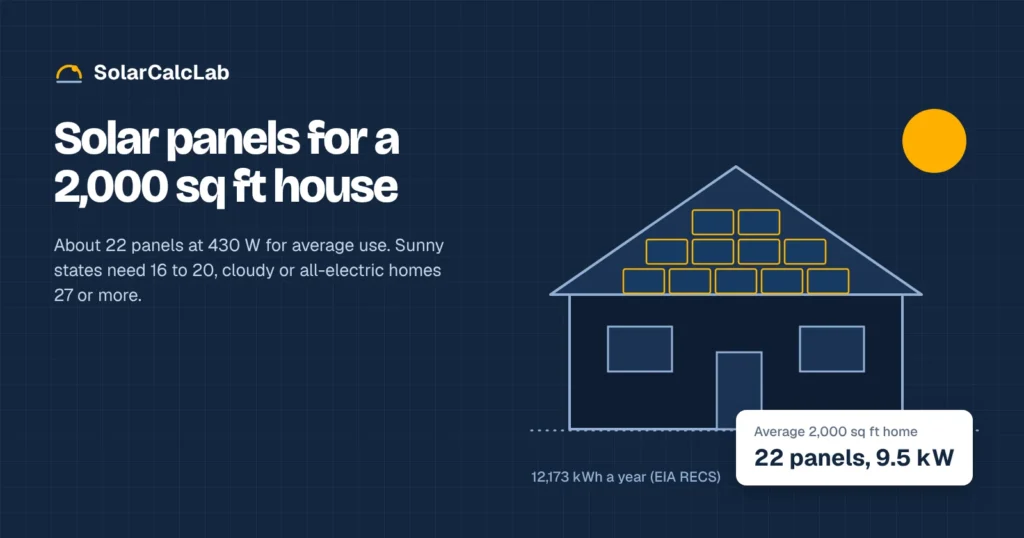
A typical 2,000 square foot house needs about 22 solar panels (430 W each), a 9.5 kW system. That figure comes from EIA survey data: homes of 2,000 to 2,499 square feet use about 12,170 kWh a year, or 1,014 kWh a month. In sunny Phoenix the same home needs about 16 panels, and in Seattle about 27. Electric heating, a pool or an EV can push the count past 30.
Square footage is the number most people know before they know anything else about a house. The problem is that floor area does not use electricity. Air conditioners, heat pumps, water heaters and cars do. So this guide starts from what 2,000 square foot homes actually use, then shows how far your house can drift from that average and how to tell whether the panels will physically fit on your roof.
What does a 2,000 sq ft house use in a year?
The best public source is the federal Residential Energy Consumption Survey (RECS), which measured the electricity use of thousands of US homes and grouped them by size. Table CE2.1 gives average annual electricity per household for each floor area band. We converted each band into a solar system size using 4.5 peak sun hours, a common US middle value, and 80% system efficiency.
| Home size | Avg kWh per year | Avg kWh per month | System size | 430 W panels |
|---|---|---|---|---|
| Under 1,000 sq ft | 6,802 | 567 | 5.2 kW | 13 |
| 1,000 to 1,499 sq ft | 9,407 | 784 | 7.2 kW | 17 |
| 1,500 to 1,999 sq ft | 11,009 | 917 | 8.4 kW | 20 |
| 2,000 to 2,499 sq ft | 12,173 | 1,014 | 9.3 kW | 22 |
| 2,500 to 2,999 sq ft | 13,031 | 1,086 | 9.9 kW | 24 |
| 3,000 sq ft or more | 15,489 | 1,291 | 11.8 kW | 28 |
Two things stand out. First, a 2,000 square foot home uses only about 15% more electricity than the national all-homes average of 10,566 kWh. Second, use grows much more slowly than floor area. A house twice as large does not need twice the solar, because the fridge, lights and laundry stay roughly the same.
Example: 12,173 ÷ (365 × 4.5 × 0.80) = 9.26 kW
Panels = 9,260 W ÷ 430 W = 21.5, rounded up to 22 panels (9.46 kW)
Same house, different city: how sunshine changes the count
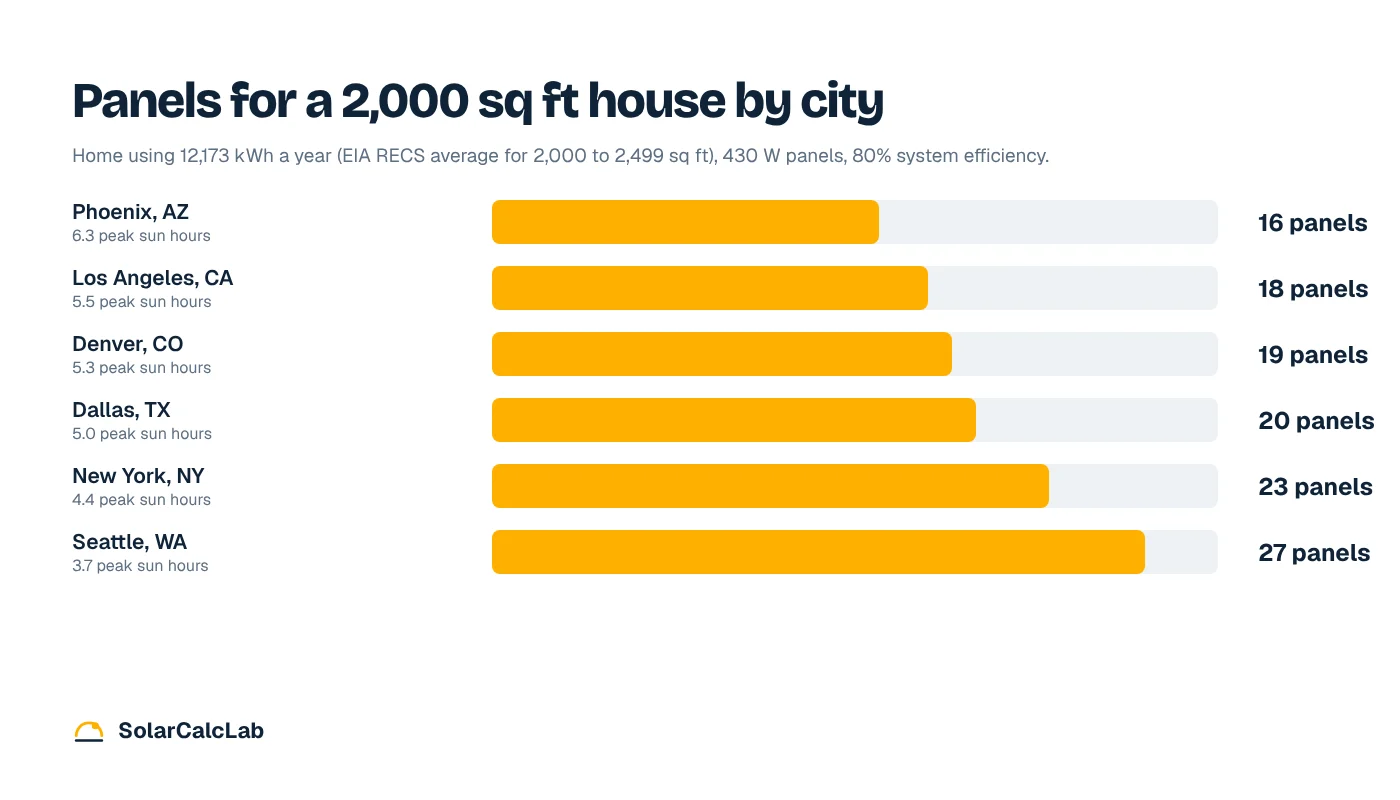
Peak sun hours are the second half of the math. A 2,000 square foot home with average use needs very different arrays depending on where it sits. The chart and table below hold use fixed at 12,173 kWh a year and change only the location.
| City | Peak sun hours | System needed | Panels (430 W) |
|---|---|---|---|
| Phoenix, AZ | 6.3 | 6.6 kW | 16 |
| Los Angeles, CA | 5.5 | 7.6 kW | 18 |
| Denver, CO | 5.3 | 7.9 kW | 19 |
| Dallas, TX | 5.0 | 8.3 kW | 20 |
| New York, NY | 4.4 | 9.5 kW | 23 |
| Seattle, WA | 3.7 | 11.3 kW | 27 |
Real homes in hot cities often use more than the national band average because of air conditioning, so a Phoenix house may land closer to the Dallas or New York row once you plug in its actual bills. Check your own location with the peak sun hours calculator before trusting any of these rows.
Why two 2,000 sq ft homes can need very different systems
The single biggest swing factor is how the house is heated. RECS reports that homes heated mainly with electricity average 13,073 kWh a year, while homes heated mainly with natural gas average 9,035 kWh. That is about 45% more electricity, across all home sizes. Add a heat pump water heater, an electric range or an EV and the gap widens.
Four example households
The rows below are illustrations, not survey figures. They show how the same floor plan moves across the solar sizing range at 4.5 peak sun hours.
| Household | Monthly use | System size | Panels |
|---|---|---|---|
| Gas furnace, gas water heater, mild summers | 750 kWh | 6.9 kW | 16 |
| Average for the size band | 1,014 kWh | 9.5 kW | 22 |
| Heat pump for heating and cooling | 1,250 kWh | 11.6 kW | 27 |
| Heat pump plus one EV (about 300 kWh a month) | 1,550 kWh | 14.2 kW | 33 |
The EV line assumes 12,000 miles a year at 0.30 kWh per mile, which is 3,600 kWh a year. If your home falls near the second row, our walkthrough of solar for 1,000 kWh per month goes deeper on that exact load. The bottom row is closer to the 1,500 kWh per month case, where panel backfeed limits start to matter.
Other things square footage hides
- Number of people. A couple and a family of five in the same house can differ by thousands of kWh a year in laundry, hot water and devices.
- Pools and hot tubs. A pool pump running six to eight hours a day is one of the largest single loads in a sunbelt home.
- Home age and insulation. Leaky ducts and single-pane windows raise AC and heating load, especially in all-electric homes.
Will 22 panels fit on a 2,000 sq ft roof?
This is where the number of stories matters more than the square footage. A single-story 2,000 square foot house has a footprint of about 2,000 square feet. A two-story house of the same size covers only about 1,000.
On a common 6/12 pitch roof, the sloped surface is about 1.12 times the footprint. For a simple gable roof, roughly half of that faces the best direction:
| House type | Footprint | Total roof surface (6/12 pitch) | One gable side |
|---|---|---|---|
| Single story | 2,000 sq ft | about 2,240 sq ft | about 1,120 sq ft |
| Two story | 1,000 sq ft | about 1,120 sq ft | about 560 sq ft |
Twenty-two 430 W panels cover about 460 square feet of module surface at roughly 21 square feet each. Add fire code setbacks from ridges and edges, plus vents and skylights, and plan on about 550 to 650 square feet of clear roof. A single-story home usually fits that on one face. A two-story home often does not, so the installer will spread panels across the south and west faces, or east and west, which lowers output a little and can push the panel count up by one or two.
Hip roofs, dormers and chimneys cut usable area further. Run your own dimensions through the solar panel roof area calculator to see how many modules fit before you request quotes.
Worked example: a two-story home outside Dallas
Say you have a 2,100 square foot two-story house near Dallas with a gas furnace, central AC and a pool. Twelve months of bills add up to 14,400 kWh, which is 1,200 kWh a month and well above the size band average because of the pool and Texas summers.
Panels = 9,860 ÷ 430 = 22.9, so 23 panels (9.89 kW)
Module area = 23 × 21 = 483 sq ft, about 600 sq ft of clear roof with setbacks
The footprint is about 1,050 square feet, so each main gable face offers roughly 590 square feet. That is too tight for all 23 panels on the south face once setbacks are taken out. A realistic layout puts 14 panels south and 9 west. West panels in Dallas produce noticeably less over the year than south panels, so the installer may add one more panel to cover the shortfall.
Typical Texas pricing runs about $2.25 per watt before incentives, according to EnergySage marketplace data, which puts a 9.9 kW system near $22,300. Since the federal Section 25D credit ended for home systems installed after December 31, 2025, a cash or loan buyer in 2026 pays that full amount unless a state or utility program helps.
What a 2,000 sq ft home’s solar system costs
National average quotes for systems around 9 to 10 kW sit near $2.57 to $2.58 per watt. For the 9.46 kW system that covers an average 2,000 square foot home, that works out to:
| Price per watt | Where you might see it | 9.46 kW system |
|---|---|---|
| $2.25 | Texas, Arizona | about $21,300 |
| $2.46 | North Carolina | about $23,300 |
| $2.58 | National average for 10 kW | about $24,400 |
| $2.93 | Illinois | about $27,700 |
Prices are before any state rebate. A two-story roof with steep pitch, a needed main panel upgrade or a split array on several faces can push the price per watt higher. The solar panel cost calculator lets you change size and price per watt to match your quotes, and the 9 kW to 10 kW range is also covered in our 10kW solar system guide.
A quick way to size your own 2,000 sq ft house
- Use bills if you have them. Add up 12 months of kWh from your utility account. This beats any square footage estimate.
- No bills yet? Start from 12,200 kWh a year if you heat with gas, and use a rough 14,000 to 15,000 if the home is all electric, since electrically heated homes average 13,073 kWh across all sizes. Ask the seller for past usage.
- Add planned loads. An EV, a heat pump conversion or a hot tub should be in the number now, not after the system is built.
- Divide by your sun. Use the formula above, or the how many solar panels calculator, which does the same math with your location.
- Check the roof. Confirm the count fits on good faces before you compare quotes.
If you want the full usage based method with more examples, see how many solar panels do I need. For a smaller, gas heated 2,000 square foot home in a sunny state, a 6kW solar system may be all you need.
Frequently asked questions
How many kWh does a 2,000 square foot house use per month?
US homes of 2,000 to 2,499 square feet average about 1,014 kWh a month (12,173 kWh a year) in the EIA’s RECS survey. Gas heated homes in mild climates can use 700 to 800 kWh, while all-electric homes with an EV can top 1,500 kWh.
What size solar system do I need for a 2,000 sq ft home?
About 9.3 kW at 4.5 peak sun hours for average use, which rounds to 22 panels at 430 W, or 9.46 kW. In very sunny areas 6.5 to 8 kW can be enough, and in cloudy areas or all-electric homes 11 kW or more is common.
Can a 2,000 sq ft house run entirely on solar?
Yes, a grid tied system can produce as much as the house uses over a year if the roof has room. Running with no grid at all is different: you would also need a large battery bank and usually extra panels for winter, which raises the cost a lot.
Do two-story homes need more panels than single-story homes?
Not if use is the same, but they have about half the roof area. That can force panels onto east or west faces, which produce less, so the installer may add a panel or two to make up the difference.
Is square footage a good way to size solar?
Only as a starting point when you have no bills. Heating fuel, AC use, household size and an EV move the answer far more than floor area. Twelve months of actual kWh from your utility gives a much more reliable system size.