How Many Watts Does a Washing Machine Use?

Short answer
Most washing machines draw about 100 to 500 watts while washing, with brief peaks of roughly 800 to 1,100 W when the motor starts or ramps up to spin. The motor itself uses only about 0.1 to 0.3 kWh per load. The real energy goes into hot water: a warm wash on an electric water heater adds roughly 1.1 kWh, so a load costs about 4 cents in cold water and 24 cents in warm at 18.2 cents per kWh.
Ask how much power a washer uses and you can get three different answers that all sound right. The nameplate on the back may list 10 or 12 amps, which suggests well over 1,000 watts. A plug-in meter shows a few hundred watts most of the time. And your electric bill reflects something the washer never measures at all: the hot water it pulls from the tank.
Each number matters for a different reason. Running and peak watts decide whether an inverter or generator can handle the machine. Energy per load decides what laundry costs. This guide separates them, then shows what each means for a solar or battery setup. For the wattage of everything else in the house, see our appliance wattage chart.
Washer watts through a single cycle
A washer is not a steady load. Power rises and falls as the cycle moves from fill to wash to spin, and the pattern depends on the motor. Older top loaders with an agitator and a belt-driven induction motor draw the most while washing. Most current front loaders and many high-efficiency top loaders use a direct-drive variable-speed motor that sips power during the wash and pulls harder only when spinning up.
| Stage | What is running | Older agitator top loader | Direct-drive front loader or HE top loader |
|---|---|---|---|
| Fill | Water valves, controls | 10 to 20 W | 10 to 20 W |
| Wash | Motor turning the drum or agitator | 400 to 900 W | 80 to 300 W |
| Drain | Pump | 40 to 100 W | 40 to 100 W |
| Spin ramp-up | Motor accelerating a wet load | 600 to 1,100 W briefly | Up to about 800 W briefly |
| Steady spin | Motor at speed | 350 to 450 W | 300 to 450 W |
| Sanitize or steam (some models) | Internal heating element | Rare | About 1,000 W while heating |
These are typical ranges, not figures for any one model. The nameplate amps are a maximum used for safety listing and circuit sizing, so they overstate normal use. If you want the real number for your machine, plug it into an inexpensive watt meter, run a normal cycle and read the kWh total at the end.
Converting watts to amps
Washers in the US run on 120 V, so amps equal watts divided by 120. A 500 W wash draws about 4.2 A, and a 1,000 W spin peak about 8.3 A. The National Electrical Code requires at least one 20 amp branch circuit for laundry outlets in a home, which leaves plenty of margin for the washer alone. You can check other loads with the watts to amps calculator.
The energy you do not see: hot water
The washer’s motor is a small part of the story. According to ENERGY STAR, water heating consumes about 90% of the energy it takes to operate a clothes washer. That energy shows up on your bill as water heater use, not as washer use, which is why a plug-in meter makes the washer look cheaper than it is.
You can estimate it with basic physics. Heating one pound of water by 1°F takes one BTU, a gallon weighs 8.34 pounds, and one kWh equals 3,412 BTU.
Warm wash, 7 gallons hot heated from 55°F to 120°F: 7 × 8.34 × 65 ÷ 3,412 = 1.11 kWh
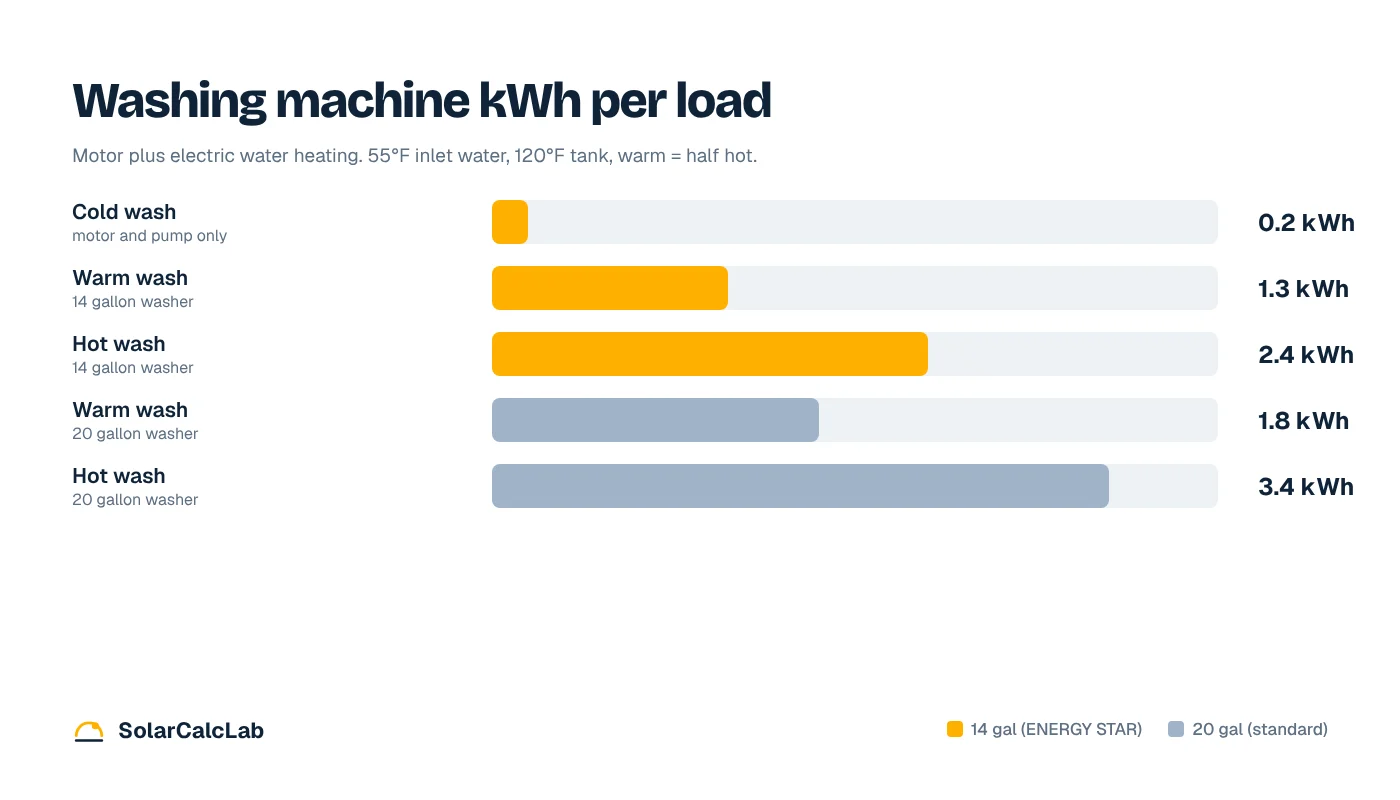
The table assumes an electric tank heater, 55°F incoming water and a 120°F setting, and treats warm as half hot and half cold. An ENERGY STAR full-size washer uses about 14 gallons a load; a standard machine about 20.
| Wash setting | 14 gallon washer | 20 gallon washer |
|---|---|---|
| Cold | 0 kWh | 0 kWh |
| Warm (half hot) | 1.11 kWh | 1.59 kWh |
| Hot | 2.22 kWh | 3.18 kWh |
Add about 0.2 kWh for the motor, pump and controls and a warm load lands near 1.3 kWh. That split, roughly 1.1 kWh of heating against 0.15 to 0.2 kWh of motor, matches the ENERGY STAR 90% figure. A gas water heater moves that energy onto your gas bill instead. For what your tank uses overall, see our guide to how many watts a water heater uses.
What the yellow EnergyGuide label tells you
The EnergyGuide label on a new washer gives an estimated yearly kWh that includes water heating with an electric water heater, based on six loads a week (312 a year). Dividing by 312 gives a fair per-load average across a mix of cycles. Here are four current Whirlpool and Maytag labels, repriced at the 2026 average of 18.2 cents per kWh:
| Model (label) | Type and capacity | kWh per year | kWh per load | Cost per year at 18.2¢ |
|---|---|---|---|---|
| Whirlpool WFW5090J | Front load, 2.3 cu ft | 128 | 0.41 | $23 |
| Maytag MVWP585G | Top load, 3.5 cu ft | 149 | 0.48 | $27 |
| Whirlpool WFW6605M | Front load, 5.0 cu ft | 150 | 0.48 | $27 |
| Whirlpool WTW5025S | Top load, 4.5 cu ft | 290 | 0.93 | $53 |
Two things stand out. Capacity is not the main driver: the 5.0 cu ft front loader uses about the same energy as a 3.5 cu ft top loader. And the label averages are well below the warm-wash figure above, because the test mix leans on cold and warm cycles and modern machines use less hot water than their fill volume suggests. Use the label to compare models and the formula to estimate your own habits.
What a washer costs to run
ENERGY STAR puts the average American family at about 300 loads a year. At 18.2 cents per kWh, with an electric water heater:
| How you wash (14 gallon machine) | kWh per load | Cost per load | kWh for 300 loads | Cost per year |
|---|---|---|---|---|
| All cold | 0.2 | 4¢ | 60 | $11 |
| All warm | 1.31 | 24¢ | 394 | $72 |
| All hot | 2.42 | 44¢ | 727 | $132 |
Switching from warm to cold saves about $61 a year in this example, more than the gap between most washer models. Running full loads helps too, since ENERGY STAR notes a washer uses about the same energy whatever the load size. To price your own cycle, enter the kWh and your rate in the electricity cost calculator, or turn a meter reading into kWh with the watts to kWh calculator.
The washer also affects the next machine in line. A faster final spin leaves less water in the clothes, and a dryer uses about 2 to 4 kWh a load removing it, ten times or more what the washer motor used. Our breakdown of how many watts a dryer uses covers that side of laundry day.
Running a washing machine on an inverter, battery or solar
Because the motor needs so little energy, a washer is one of the easier laundry loads to run off grid or during an outage. The limits are the start-up peak and the water heating.
Inverter size
Size the inverter for the peak, not the average. Motors can pull two to three times their running watts for a moment when starting under load. For a washer that runs at 500 W, plan for 1,000 to 1,500 W of surge. A 1,500 W to 2,000 W pure sine wave inverter handles most household machines with room for a few lights. Variable-speed washers use electronic motor drives that can misbehave on a modified sine wave, which our pure sine vs modified sine guide explains. The inverter size calculator adds up surge and running watts for you.
If the washer stops partway through on backup power
- It stops when spin starts: the inverter is hitting its surge limit. Use a larger inverter or turn off other loads during spin.
- The display flickers or resets: battery voltage is sagging under the peak. Charge the battery or check cable size and connections.
- It runs but buzzes or errors out: the inverter may be modified sine wave. Electronic controls prefer a pure sine output.
- It stops on a sanitize cycle: the internal heater adds about 1,000 W on top of the motor. Pick a normal cycle on battery.
Battery and solar
A cold load at about 0.2 kWh is light work. A 1 kWh portable power station, after roughly 90% inverter efficiency, covers about four cold loads if its inverter can handle the surge. Warm and hot washes are a different matter only if the water heater runs on the same battery, which most backup setups avoid. The battery backup calculator shows how laundry fits beside the fridge and lights.
For a grid-tied solar home, the washer barely registers. Even 300 warm loads a year, about 394 kWh, need only about 0.3 kW of panels at 4.5 peak sun hours, less than one 430 W panel. Running laundry at midday simply uses more of your own solar instead of exporting it.
Frequently asked questions
Does a washing machine use a lot of electricity?
The machine itself does not. The motor, pump and controls use about 0.1 to 0.3 kWh per load, around 2 to 5 cents at 18.2 cents per kWh. Warm and hot washes cost more because of the water heater, adding about 1.1 to 2.2 kWh per load with an electric tank.
Can a 1,000 watt inverter run a washing machine?
Sometimes, but it is a gamble. A modern front loader running at 100 to 300 W may work, yet spin ramp-up can approach 800 W and an older top loader can briefly exceed 1,000 W. A 1,500 to 2,000 W pure sine inverter is the safer choice.
Is a front loader or top loader cheaper to run?
Front loaders usually are. ENERGY STAR says certified front loaders use about 50% less energy and water than top loaders with an agitator, and about 25% less than top loaders with an impeller. On the labels above, two front loaders used 128 and 150 kWh a year, against 149 and 290 kWh for two top loaders.
How much does washing in cold water save?
With an electric water heater, switching a 14 gallon washer from warm to cold saves about 1.1 kWh a load, roughly 20 cents. Over 300 loads that is about $61 a year at 18.2 cents per kWh. ENERGY STAR notes that moving from hot to warm alone cuts energy use about in half.
How many amps does a washing machine draw?
Usually about 1 to 5 amps while washing on 120 V, with short peaks around 7 to 9 amps during start-up or spin on some machines. The nameplate often lists a higher maximum. A dedicated 20 amp laundry circuit easily covers a washer.