50Ah Battery: Watt Hours, Runtime and Charging
Short answer
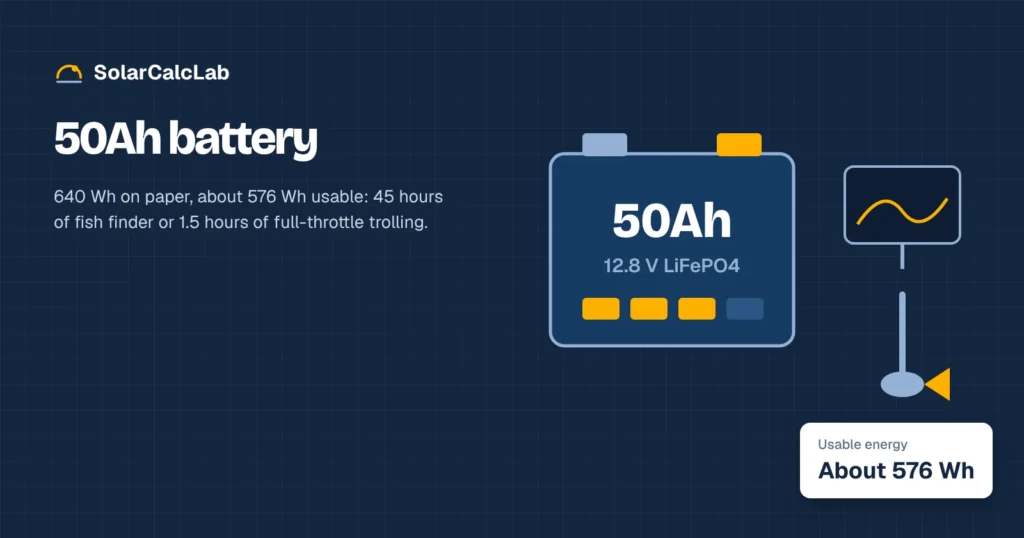
A 12 V 50Ah lithium (LiFePO4) battery holds 640 Wh, and about 576 Wh of that is usable. That runs a 1 A fish finder for roughly 45 hours, a kayak trolling motor for about 1.5 hours flat out or 3 hours at a 15 A cruise, and a 40 W CPAP (no heated humidifier) for about two nights. A 12 V 50Ah AGM gives only about 300 Wh if you stop at 50%. Most 50Ah lithium batteries cap the load at 50 A, about 576 W through an inverter.
A 50Ah battery is a small-job battery. It is light enough to carry down to a kayak launch with one hand, small enough to fit in a cooler-sized battery box, and big enough to run electronics for a full weekend. Where people get burned is asking it to do a 100Ah job: an all-day trolling motor session or a microwave through an inverter.
Here is what a 50Ah battery can actually carry, and where it runs out.
How many watt hours is a 50Ah battery?
Battery energy is amp hours times voltage. Nearly every 50Ah lithium battery sold in the US is a 12.8 V LiFePO4 pack with four cells in series, so the math is simple.
50 Ah × 12.8 V = 640 Wh
Usable at 90% depth of discharge = 640 × 0.90 = 576 Wh (45 Ah)
Lead-acid tells a different story. A 12 V 50Ah AGM is rated 600 Wh, but pulling it below about 50% shortens its life fast, so the working figure is closer to 300 Wh. You can check any combination of voltage and capacity with the Ah to Wh converter.
| 50Ah battery type | Rated energy | Usable energy | Typical weight |
|---|---|---|---|
| 12.8 V LiFePO4 | 640 Wh | About 576 Wh (90%) | 11 to 15 lb |
| 12 V AGM | 600 Wh | About 300 Wh (50%) | Usually 30 lb or more |
| 25.6 V LiFePO4 (24 V) | 1,280 Wh | About 1,150 Wh | Roughly double the 12 V pack |
The weight gap matters more at this size than at any other. The lithium 50Ah models we checked in November 2026 list 11.3 to 14.7 lb, so you get about twice the usable energy of an AGM at well under half the weight. For a kayak, that is the whole reason the battery exists.
What a 50Ah battery runs, and for how long
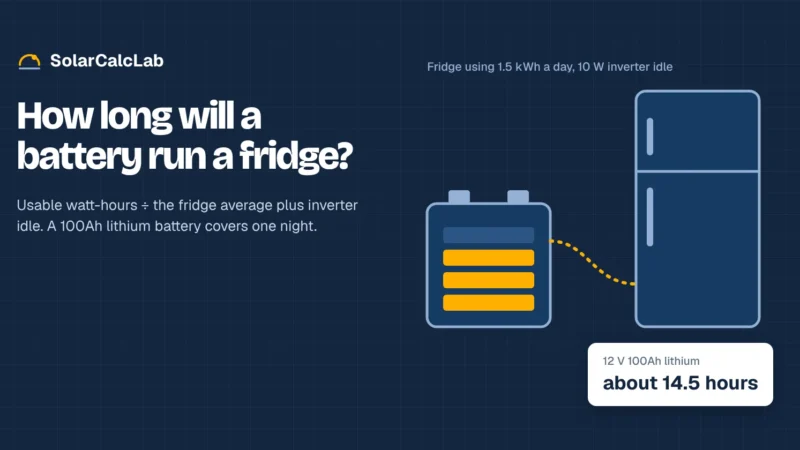
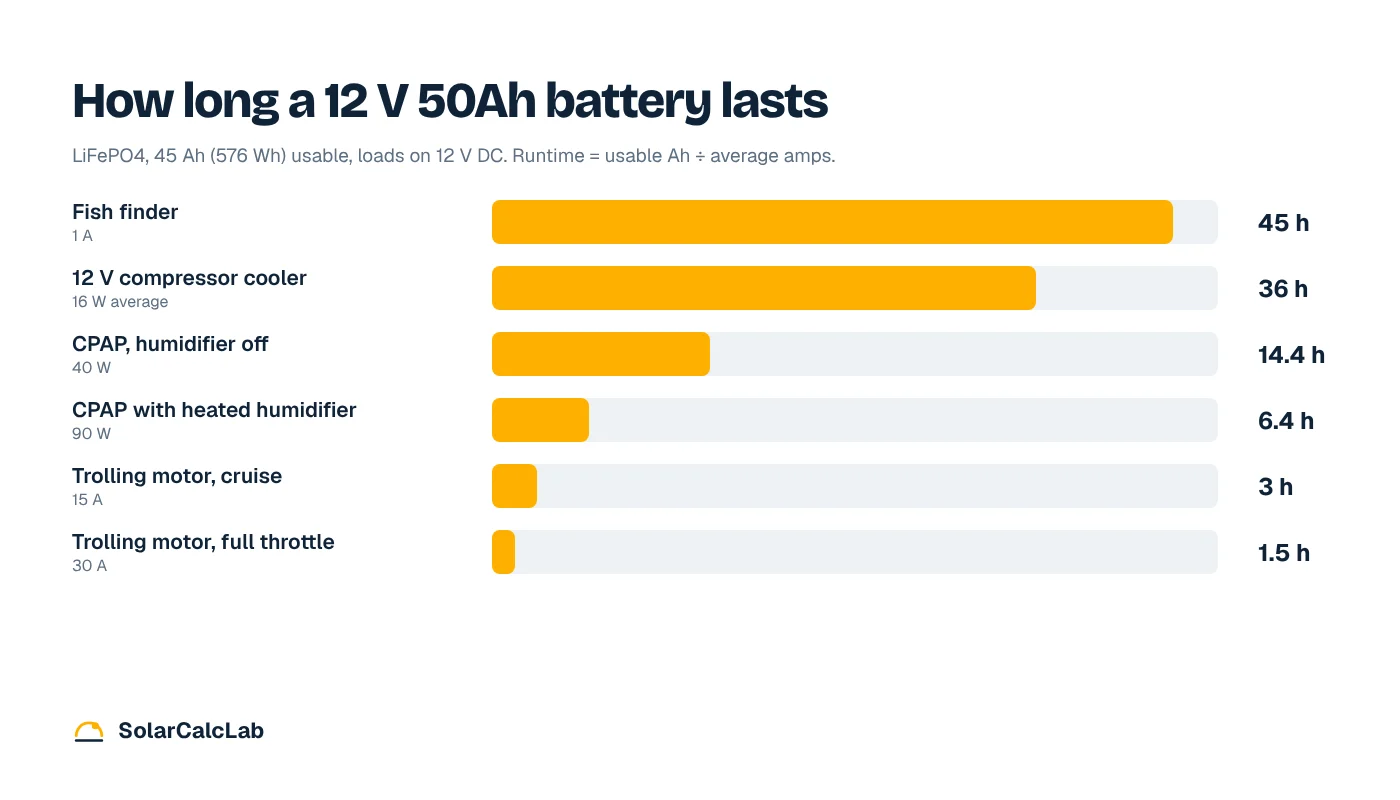
Runtime is usable amp hours divided by the average current. At 12 V, a device’s amp draw is its watts divided by about 12.8. These examples assume a fully charged LiFePO4 battery with 45 Ah usable and loads running directly on 12 V DC, with no inverter in the way.
Example: 45 Ah ÷ 1 A fish finder = 45 hours
| Load (12 V DC) | Average draw | Runtime on 12 V 50Ah LiFePO4 |
|---|---|---|
| Fish finder with GPS | 1 A | About 45 hours |
| 12 V compressor cooler (40 W, running 40% of the time) | 16 W, about 1.25 A | About 36 hours |
| CPAP, humidifier off | 40 W, about 3.1 A | About 14 hours (two nights) |
| CPAP with heated humidifier | 90 W, about 7 A | About 6.4 hours (one short night) |
| Trolling motor at cruise | 15 A | About 3 hours |
| Trolling motor, full throttle | 30 A | About 1.5 hours |
Your own device’s label or manual gives the real draw, and it often differs from these round figures. Plug it into the battery life calculator with your numbers and it will show the hours directly.
The trolling motor question
Most people shopping for a 50Ah battery have a kayak or a jon boat with a 30 to 55 lb thrust motor. This is where the size is either perfect or frustrating, and the difference is how you drive.
Worked example: a morning on a small lake
Say you fish from 6 to 11 a.m. You run the motor at a slow troll around 8 A for 3 hours, push at full throttle (about 30 A) for 20 minutes to get across the lake and back, and keep a 1 A fish finder on the whole time.
- Trolling: 8 A × 3 h = 24 Ah
- Full throttle: 30 A × 0.33 h = 10 Ah
- Fish finder: 1 A × 5 h = 5 Ah
- Total: 39 Ah out of 45 Ah usable
That fits, with about 6 Ah to spare. Add a headwind on the way home or another half hour at full speed and you are paddling. A 50Ah battery suits a few hours of mixed use on a 30 lb motor. A 55 lb motor run hard, or a full day on the water, belongs on a 100Ah battery, which our 100Ah solar battery guide covers.
Check the BMS before you buy
A lithium battery’s battery management system (BMS) cuts power above its current limit. The 50Ah LiFePO4 models we looked at list a 50 A continuous limit, with short surge allowances that vary by brand. A 55 lb thrust motor at full throttle can draw around 50 A, which sits right at that limit. Read the spec sheet: Renogy, for example, lists 50 A continuous discharge on its 12 V 50Ah LiFePO4 battery.
Can a 50Ah battery run an inverter?
Yes, but only a small one. The BMS limit, not the capacity, decides the ceiling.
50 A × 12.8 V × 0.90 ≈ 576 W
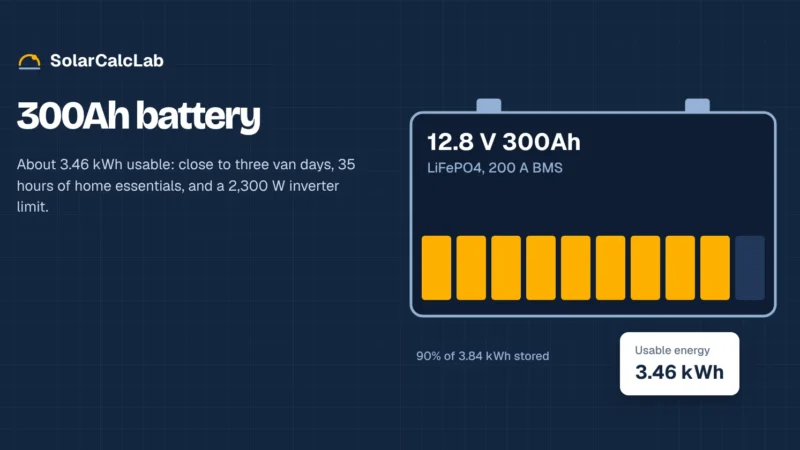
So a 300 to 500 W pure sine inverter is the right match. That covers a laptop, a TV, phone and camera chargers, or a small fan. It will not run a microwave, coffee maker, hair dryer or space heater, all of which pull 900 W or more. If those are on your list, size the inverter first with the inverter size calculator, then pick a battery that can feed it, such as a 300Ah battery with a 200 A BMS.
Also remember that running AC through an inverter costs about 10% of the energy, plus the inverter’s own idle draw. A laptop that charges at 60 W on 12 V DC directly will drain the battery noticeably faster through an inverter.
Charging a 50Ah battery
With a plug-in charger
Lithium charge time is close to amp hours divided by charger amps, plus about half an hour of top-off at the end.
| Charger | Empty to full (LiFePO4) | Notes |
|---|---|---|
| 10 A (0.2C) | About 5 to 5.5 hours | The rate most brands list as recommended |
| 20 A | About 2.5 to 3 hours | Fine for most 50Ah packs; check the max charge current |
| 5 A | About 10 hours | Overnight trickle, easy on the battery |
Use a charger with a lithium (LiFePO4) profile, around 14.4 V. An old lead-acid charger with a desulfation or equalize mode can trip the BMS. The battery charging time calculator handles partial charges and other charger sizes.
With solar
Refilling from 20% to 100% means putting back 512 Wh. A panel’s real daily output is roughly its rating times peak sun hours times about 0.75 for heat, wiring and controller losses.
| Panel | 4 peak sun hours | 5 peak sun hours | Days to refill 512 Wh |
|---|---|---|---|
| 100 W | 300 Wh/day | 375 Wh/day | About 1.4 to 1.7 days |
| 200 W | 600 Wh/day | 750 Wh/day | Under one day |
A 100 W panel keeps up with light daily use, like a fish finder and cooler at camp. If you drain the battery every day, 200 W is the safer match. Your location changes the answer a lot, so look up local figures with the peak sun hours calculator.
Cold weather
Standard LiFePO4 batteries block charging below about 32°F (0°C) to protect the cells, though most still discharge well below freezing. Ice anglers can usually run a fish finder at 10°F, but they cannot recharge on the frozen lake unless the battery has a built-in heater. Charge at home, or buy a self-heating model.
Is 50Ah the right size for you?
A 50Ah lithium battery is the right pick when weight and space matter more than runtime:
- Kayak or canoe with a 30 to 40 lb thrust motor and trips of 3 to 4 hours.
- Electronics only: fish finder, depth sounder, nav lights, bilge pump on a small boat.
- Ice fishing flasher and lights for several trips per charge.
- CPAP for a weekend camping trip with the humidifier off.
- A small solar setup for a shed light, trail camera or gate opener.
Step up to 100Ah or more when you want all-day trolling, a heated CPAP humidifier for more than one night, a 12 V fridge for a multi-day trip, or any inverter above 500 W. Two 50Ah batteries can be paralleled to share the weight between two trips to the car, but wire them correctly; our guide to batteries in series vs parallel covers how. For a home backup or full RV system, start with how much battery storage you need instead.
Price check
Listed prices for 12 V 50Ah LiFePO4 batteries ran from about $170 to $470 in November 2026, depending on brand, Bluetooth monitoring and low-temperature protection. Budget brands such as Redodo’s 12 V 50Ah sat near the bottom of that range. A 50Ah AGM usually costs less up front, but you get half the usable energy and far fewer cycles.
Frequently asked questions
How long will a 50Ah battery last on a trolling motor?
On a 12 V 50Ah lithium battery with 45 Ah usable, about 1.5 hours at a constant 30 A full-throttle draw, about 3 hours at 15 A and about 5.5 hours at a slow 8 A troll. Most trips mix speeds, so add up amp hours for each part of the day.
Is a 50Ah lithium battery as good as a 100Ah AGM?
Close. A 12 V 100Ah AGM is rated 1,200 Wh, but only about 600 Wh is usable if you stop at 50%. A 50Ah LiFePO4 gives about 576 Wh usable at roughly a quarter of the weight. The AGM can deliver higher bursts of current, so it may suit a large motor better.
How many watts can a 50Ah battery power?
Most 12 V 50Ah lithium batteries have a 50 A BMS limit, so the continuous ceiling is about 640 W at the battery, or about 576 W of AC through an inverter. Total energy is 640 Wh, so a 100 W load runs for close to 6 hours.
What size solar panel do I need for a 50Ah battery?
A 100 W panel refills about 300 to 375 Wh a day in average US sun, enough for light use. For a battery you drain most of the way every day, use 200 W, which can recharge it in a single sunny day.
How long does it take to charge a 50Ah battery?
A lithium 50Ah battery charges from empty in about 5 to 5.5 hours on a 10 A charger and about 2.5 to 3 hours on a 20 A charger. An AGM takes longer because the final stage of charging slows down.