2kWh Battery: What It Can Run and For How Long
Short answer
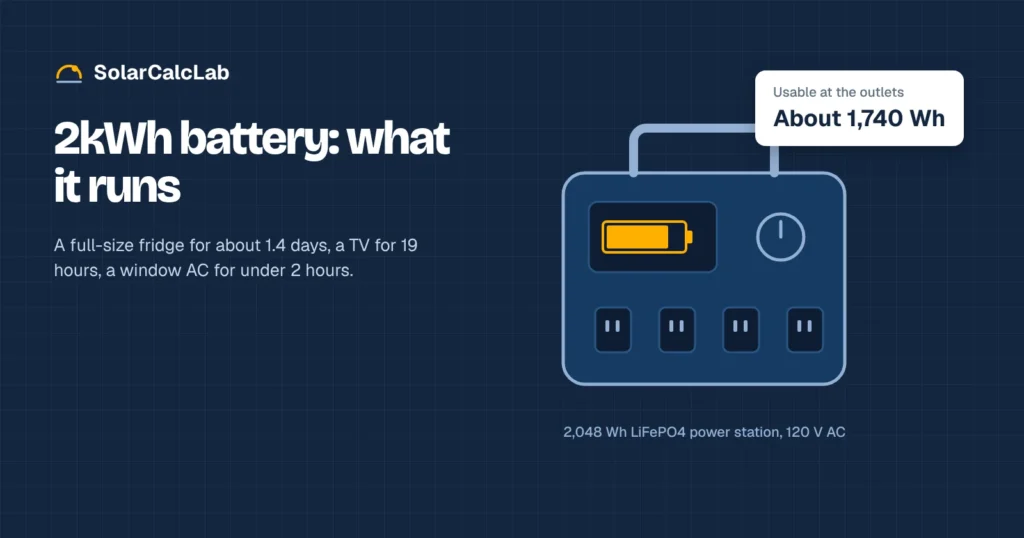
A 2kWh battery, usually sold as a 2,048 Wh portable power station, delivers about 1,700 to 1,750 Wh through its AC outlets once inverter losses are counted. That runs a full-size refrigerator for about 1.4 days, a 90 W TV for 19 hours, a 10,000 BTU window AC for under 2 hours, or a 1,500 W space heater for a little over an hour. A 400 W solar panel refills it in about a day and a half of good sun.
Two kilowatt-hours is the biggest size most people still call portable. It is the class where power stations stop being phone chargers with handles and start running real appliances: a fridge through an outage, a microwave at a campsite, a miter saw at a job with no outlet.
The useful question is not just how long a 2kWh battery lasts, but which jobs it handles alone and which ones need solar or a second battery. This guide works through three real days of use, then covers output limits, recharging and what a 2 kWh unit costs right now.
How much of the 2,048 Wh do you actually get?
The number on the box is the cell capacity. What reaches your appliance is smaller, because the built-in inverter turns battery DC into 120 V AC, and that conversion wastes some energy as heat. DC outputs such as USB-C and the 12 V car socket skip most of that loss.
2,048 Wh × 0.85 = about 1,741 Wh
Runtime (hours) = usable Wh ÷ appliance watts
We use 85% for the AC side and 95% for DC loads. Efficiency drops further on tiny loads, because the inverter’s own idle draw becomes a large share of the total. A 15 W router on AC can lose more to the inverter than it uses itself, so plug small electronics into USB or 12 V ports whenever you can.
2kWh in other forms
You can also build 2 kWh from loose batteries. The math is volts times amp-hours:
| Battery | Capacity | Typical use |
|---|---|---|
| 12.8 V 160 Ah LiFePO4 | 2,048 Wh | Van or small RV house battery |
| 12.8 V 150 Ah LiFePO4 | 1,920 Wh | Most common “near 2 kWh” 12 V size |
| 25.6 V 80 Ah LiFePO4 | 2,048 Wh | 24 V boat or cabin systems |
| 51.2 V 40 Ah LiFePO4 | 2,048 Wh | Small 48 V setups, golf carts |
| 2,048 Wh power station | 2,048 Wh | Outages, camping, job sites |
A bare 12 V battery needs its own inverter, charger and charge controller, so it only beats a power station on price if you already own some of those parts. To convert other sizes, the Wh to Ah converter handles any voltage.
Runtime for common loads
These figures use 1,741 Wh of AC energy and steady draw. Appliances that cycle, like fridges, are shown at their daily average rather than their running watts.
| Load | Average watts | Runtime on 2 kWh |
|---|---|---|
| Wi-Fi router and modem | 15 W | About 116 hours |
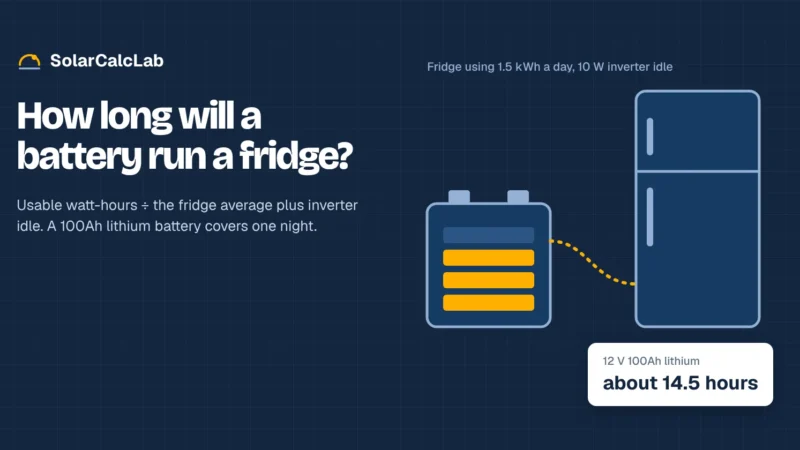
| Full-size refrigerator (1.2 kWh a day) | 50 W average | About 35 hours |
| CPAP with heated humidifier | 60 W | About 29 hours |
| 55 inch LED TV | 90 W | About 19 hours |
| Gaming PC and monitor | 300 W | About 5.8 hours |
| Space heater on low | 750 W | About 2.3 hours |
| 10,000 BTU window AC | 900 W | About 1.9 hours |
| Microwave (1,000 W cooking power) | 1,300 W | About 1.3 hours of cooking |
| Space heater on high | 1,500 W | About 1.2 hours |
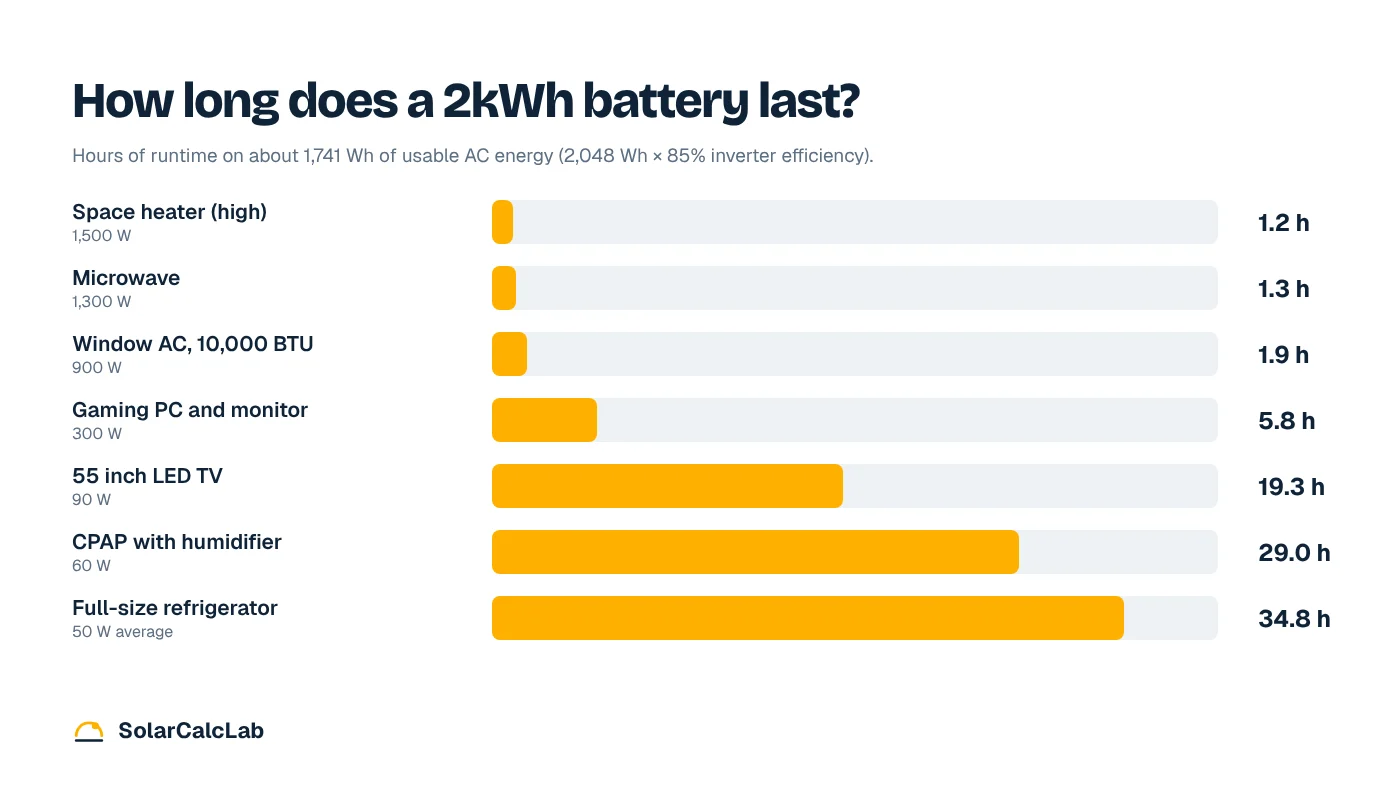
The pattern is simple: heaters, microwaves and room air conditioners drain 2 kWh in an hour or two, while electronics and a cycling fridge run for a day or more. Your own wattages may differ, so check the nameplate or use our appliance wattage chart. For a specific device and battery, the battery life calculator gives the runtime directly.
Three real days on a 2kWh battery
Runtime tables hide the hard part: several loads sharing one battery over a full day. Here are three typical days, added up.
Day 1: a 24-hour power outage at home
Say you want to keep a full-size fridge, the internet, some lights, phones and the TV going for one day:
- Refrigerator: 1,200 Wh
- Router and modem, 24 hours at 15 W: 360 Wh
- Ten 8 W LED bulbs for 5 hours: 400 Wh
- Phone charging: 50 Wh
- TV, 3 hours at 90 W: 270 Wh
That totals 2,280 Wh, about 540 Wh more than the battery delivers. Trim it and the day fits: turn the router off overnight (180 Wh for 12 hours), run six bulbs for 4 hours (192 Wh), skip the TV and cut phone charging to 30 Wh. Now the total is 1,602 Wh, leaving about 140 Wh of margin. The fridge is the anchor of an outage plan, and our guide to how many watts a refrigerator uses shows how much that number swings between an old top-freezer and a new Energy Star model.
Day 2: a boondocking weekend in a small RV
Here the loads run on DC through the 12 V socket, so you get about 1,946 Wh instead of 1,741:
- 12 V compressor fridge averaging 45 W: 1,080 Wh
- LED lights, 20 W for 5 hours: 100 Wh
- Roof fan, 30 W for 8 hours: 240 Wh
- Laptop, 60 W for 3 hours: 180 Wh
- Phones: 30 Wh
That is 1,630 Wh a day, so the battery alone lasts about 1.2 days. With a 400 W panel making roughly 1,500 Wh in 5 peak sun hours, you are close to break-even and can stay out as long as the weather holds. Without solar, you go home Saturday night.
Day 3: a trim carpenter with no outlet on site
- Miter saw, 1,800 W for 30 minutes of actual cutting: 900 Wh
- Circular saw, 1,400 W for 15 minutes: 350 Wh
- Tool battery charger, 100 W for 3 hours: 300 Wh
- Jobsite radio, 20 W for 8 hours: 160 Wh
The total of 1,710 Wh uses nearly the whole battery. The point that surprises people is that saws barely run: an 8-hour day might include only 30 to 45 minutes of blade time. That is why a 2 kWh station can replace a small generator for finish work but not for a framing crew running saws all day.
Output limits: what a 2kWh battery cannot start
Capacity tells you how long. The inverter rating tells you what can run at all. Current 2 kWh stations are typically rated 2,000 to 2,400 W continuous with a short surge of roughly 4,000 to 4,800 W. That covers a microwave, a hair dryer, a coffee maker, a window AC and most corded tools.
It does not cover:
- 240 V appliances. Dryers, ranges, central AC and most well pumps need 240 V. Single power stations output 120 V only, unless a model specifically pairs two units.
- Two big loads at once. A 1,500 W space heater plus a 1,300 W microwave is 2,800 W, which trips a 2,400 W inverter.
- Central air conditioning. A 3 ton unit draws 3,000 W or more running and far more at start, and it would drain 2 kWh in well under an hour anyway.
Once you need a 240 V circuit or a whole night of heavy loads, look at a home battery instead. Our 5kWh battery guide covers the next step up, and the 1kWh battery guide shows what you give up by going smaller and lighter.
How fast does a 2kWh battery recharge?
| Charging source | Input | Time from empty |
|---|---|---|
| Wall outlet, fast-charge mode | About 1,200 to 1,600 W | About 1.3 to 1.7 hours |
| 800 W of solar, 5 peak sun hours | About 3,000 Wh a day | Under one day |
| 400 W of solar, 5 peak sun hours | About 1,500 Wh a day | About 1.4 days |
| 200 W of solar, 5 peak sun hours | About 750 Wh a day | About 2.7 days |
| Car 12 V socket | About 100 W | About 23 hours of driving |
Solar figures assume 75% of the panel’s rating reaches the battery after heat, angle and wiring losses, which is realistic for a portable panel propped on the ground. Most current 2 kWh stations accept roughly 600 to 800 W of solar input, and some accept more. Peak sun hours change a lot by location and season, so check yours with the peak sun hours calculator, then run your panel and battery through the solar panel charging time calculator.
What does a 2kWh battery cost?
Prices in this class move with constant sales. In early November 2026, brand stores listed 2,048 Wh LiFePO4 power stations from about $670 to $1,200 for the station alone, or roughly $0.33 to $0.59 per Wh.
When comparing models, look past capacity:
- Continuous output. 2,400 W runs a microwave and a fridge together. 1,800 W may not.
- Solar input limit. An 800 W input refills in a day. A 400 W input caps you at about 1.4 days, even with more panels.
- Expansion. If you might want 4 kWh, buy a model with an expansion port now.
- Cycle rating. LiFePO4 units in this size are often rated for 3,000 to 6,000 cycles before capacity falls to about 70% to 80%, which is many years of weekend use.
If you are not sure 2 kWh is the right size, total your loads in the solar generator calculator, or read our guide to how much battery storage you need for a whole-home view.
Frequently asked questions
Is 2,000Wh the same as 2kWh?
Yes. One kilowatt-hour is 1,000 watt-hours, so 2,000 Wh equals 2 kWh. Many power stations are rated 2,048 Wh, slightly more than 2 kWh, which matches a pack of 16 LiFePO4 cells in series (51.2 V) at 40 Ah.
How many 100Ah batteries make 2kWh?
A 12.8 V 100 Ah LiFePO4 battery holds 1,280 Wh, so you need two of them (2,560 Wh) to reach at least 2 kWh. A single 12.8 V 160 Ah battery gives 2,048 Wh, and a 25.6 V 80 Ah battery gives the same.
Can a 2kWh power station run a window air conditioner?
Yes, a 10,000 BTU window unit drawing about 900 W will run for roughly 1.9 hours on 1,741 Wh of usable energy. A unit that cycles on and off with the thermostat lasts longer, depending on how hot it is outside. Overnight cooling needs solar or a larger battery.
Can I take a 2kWh power station on a plane?
No. Under FAA lithium battery rules, passengers may carry batteries up to 160 Wh with airline approval, and a 2,048 Wh unit is far above that limit in both carry-on and checked bags. You would need to ship it as hazardous material or rent one at your destination.
Will a 2kWh battery run a space heater overnight?
No. A 1,500 W heater on high empties it in about 1.2 hours, and even the 750 W low setting lasts only about 2.3 hours. For warmth during an outage, an electric blanket at 50 to 100 W runs all night on a fraction of the battery.