16 Gauge Wire Amp Rating: Safe Load and Common Uses
Short answer
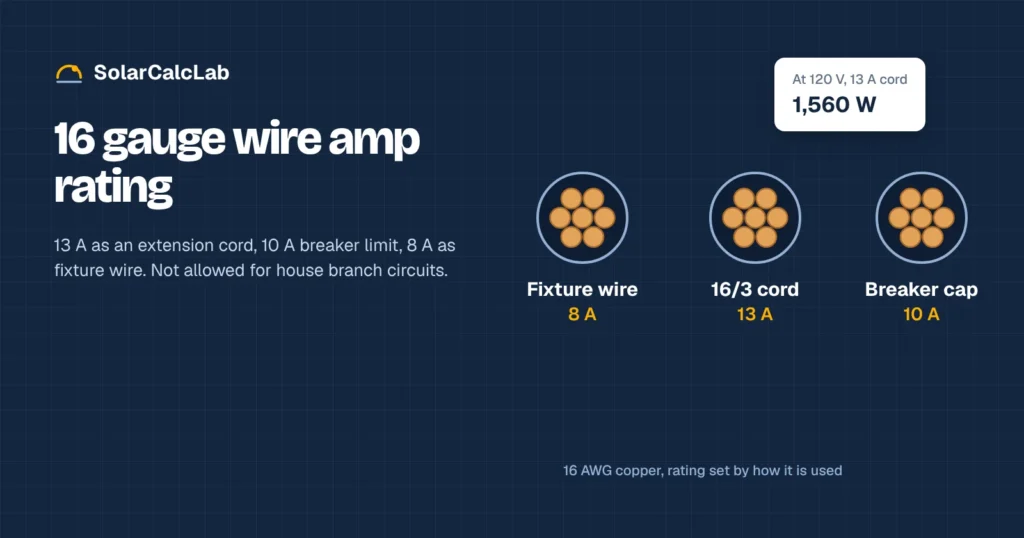
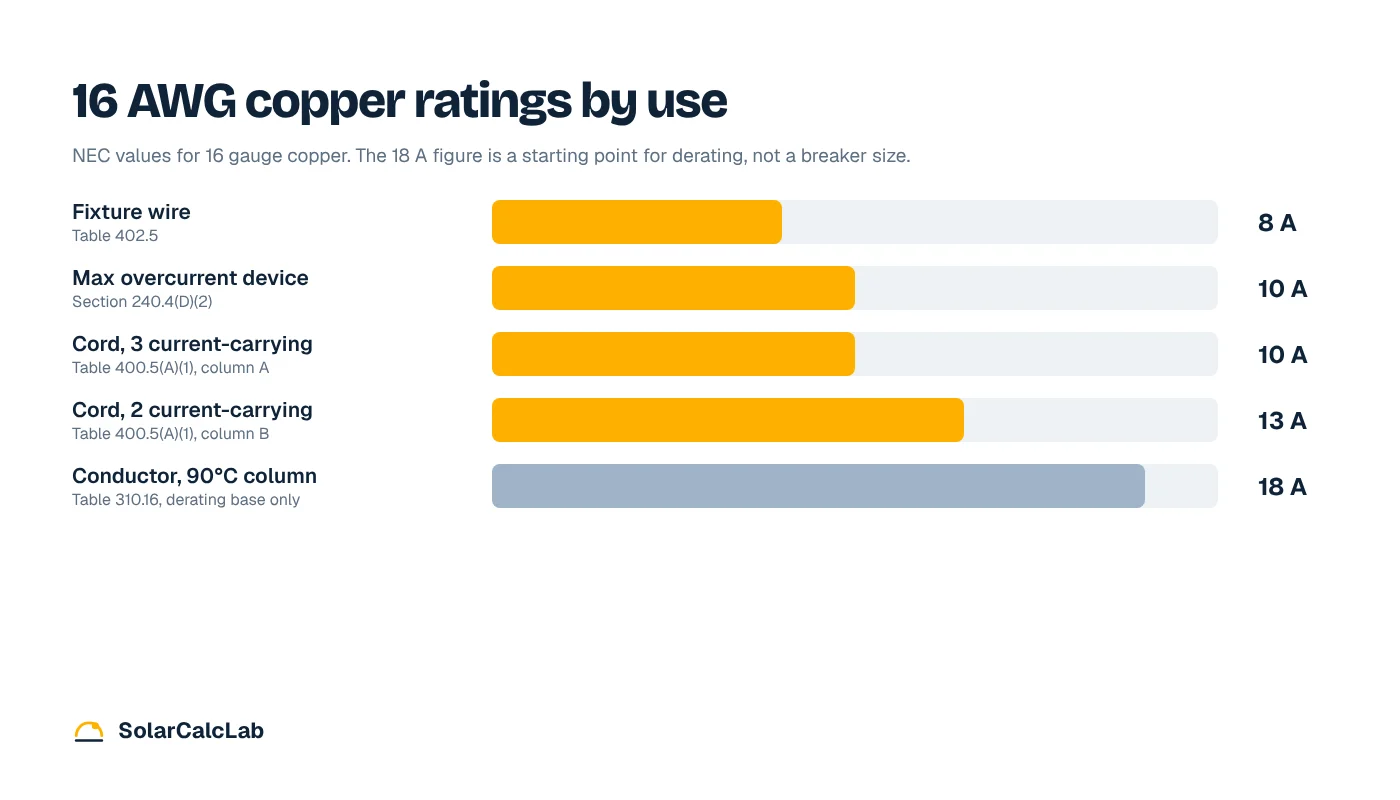
16 gauge copper wire carries 13 amps as a two-conductor extension cord, 10 amps when three conductors carry current, and 8 amps as fixture wire inside a light. NEC Table 310.16 lists 18 amps at 90°C, but Section 240.4(D)(2) limits 16 AWG to 10 amp protection. It is not allowed for house branch circuits, which start at 14 AWG. At 120 V, 13 amps is about 1,560 watts.
Sixteen gauge sits just below the smallest wire an electrician pulls through walls, so it lives in a different world: extension cords, lamp cords, speaker runs, LED strips, doorbell transformers, car accessories and small solar panels. Each of those has its own rule, which is why the 16 gauge wire amp rating you find online ranges from 8 to 22 amps.
The right number depends on what kind of 16 AWG wire you are holding and what it is connected to. This guide sorts that out with the code tables, then turns to the question that matters more for most 16 gauge jobs: how far you can run it before voltage drop or heat becomes a problem.
16 AWG ratings by type of wire
The values below come from Tables 310.16, 400.5(A)(1) and 402.5 and Section 240.4(D)(2) of NFPA 70, the National Electrical Code. All are for copper.
| 16 AWG use | Code reference | Rating | Watts at 120 V |
|---|---|---|---|
| Extension or appliance cord, 2 current-carrying conductors | Table 400.5(A)(1), column B | 13 A | 1,560 W |
| Cord with 3 current-carrying conductors | Table 400.5(A)(1), column A | 10 A | 1,200 W |
| Fixture wire inside a luminaire | Table 402.5 | 8 A | 960 W |
| Insulated conductor, 90°C column | Table 310.16 | 18 A (base for derating only) | Not used for branch circuits |
| Maximum overcurrent protection | Section 240.4(D)(2) | 10 A, with conditions | 1,200 W |
The “16/3” on a cord jacket means three 16 AWG conductors, but one of them is the green ground. Only two carry current, so a 16/3 extension cord still falls under column B at 13 amps. Cord makers usually print this as 13 A, 125 V, 1,625 W, because they calculate watts at 125 V rather than 120 V.
Why 16 gauge is not used for house circuits
Section 310.3(A) sets 14 AWG copper as the minimum for general wiring, and a 15 amp breaker is the smallest standard branch circuit in a home. The 10 amp limit in 240.4(D)(2) applies only where the code specifically allows 16 AWG, such as listed cords, fixture wire, motor control circuits and certain power-limited circuits. For anything inside your walls, start with the 14 gauge wire amp rating guide.
Extension cords: when 16 gauge is enough
A 16 gauge cord is the common light-duty size, sold in 25, 50 and 100 foot lengths. The amp rating sets the heat limit, but length decides how much voltage reaches the tool. Using 4.99 ohms per 1,000 feet for stranded 16 AWG copper, from NEC Chapter 9, Table 8:
Example: 2 × 50 ft × 10 A × 0.00499 Ω/ft = 5.0 V, which is 4.2% of 120 V
| Cord length | 5 A load (600 W) | 10 A load (1,200 W) | 13 A load (1,560 W) |
|---|---|---|---|
| 25 ft | 1.2 V (1.0%) | 2.5 V (2.1%) | 3.2 V (2.7%) |
| 50 ft | 2.5 V (2.1%) | 5.0 V (4.2%) | 6.5 V (5.4%) |
| 100 ft | 5.0 V (4.2%) | 10.0 V (8.3%) | 13.0 V (10.8%) |
The 25 foot cord handles its full 13 amp rating with under 3% drop. At 50 feet, keep loads near 10 amps or less. A 100 foot 16 gauge cord is really a 5 amp cord if you care about the tool getting full voltage: fine for a string trimmer or work light, poor for a circular saw. To stay within 3% at 13 amps, a 16 AWG cord can be about 28 feet long; at 10 amps, about 36 feet. Check any combination in the voltage drop calculator.
Loads that should not go on a 16 gauge cord
- Space heaters. A 1,500 W heater draws 12.5 A, just under the 13 A rating, for hours at a time. On a 50 foot 16 gauge cord, the cord itself turns about 78 watts into heat. Heater manufacturers tell you to plug directly into a wall outlet, and that is the right call.
- Window air conditioners and other compressor loads, which pull a high inrush current on start.
- Circular saws, table saws and air compressors on cords longer than 25 feet. Low voltage makes motors run hot.
- Anything with a 15 A plug rating that runs at or near full load. Use a 14 or 12 gauge cord.
A cord that feels warm along its length, or a plug that is hot to the touch, is overloaded or damaged. Unplug it, check the load in the watts to amps calculator, and switch to a heavier gauge.
16 gauge wire for 12 V and 24 V DC
On low-voltage DC, the amp rating almost never limits 16 AWG. Voltage drop does, because the same loss in volts is ten times more significant at 12 V than at 120 V. A 3% limit is a common target for lighting and electronics.
Example at 12 V and 5 A: (0.03 × 12) ÷ (2 × 5 × 0.00499) = 7.2 ft
| System voltage | 3 A load | 5 A load | 8 A load |
|---|---|---|---|
| 12 V | 12.0 ft | 7.2 ft | 4.5 ft |
| 24 V | 24.0 ft | 14.4 ft | 9.0 ft |
Example: a 60 W LED strip
A 60 W strip pulls 5 A at 12 V. Fed from a power supply 10 feet away on 16 AWG, it loses 2 × 10 × 5 × 0.00499 = 0.50 V, or 4.2%, and the far end of the strip looks dimmer. The same 60 W strip in a 24 V version pulls 2.5 A and loses only 0.25 V, about 1.0%. Choosing the 24 V strip fixes the problem without changing the wire.
Car, RV and boat accessories
Dash cams, USB sockets, LED interior lights and small pumps under about 5 A are typical 16 gauge loads in vehicles. Fuse the wire at the source so the fuse protects the wire, not just the device. For a fridge, inverter or anything that runs over 8 to 10 feet at 12 V, step up a size or two; the wire size calculator picks the gauge from current, distance and voltage.
Small solar panels
A 50 W panel with a short circuit current around 3.1 A needs a conductor rated for 3.1 × 1.25 × 1.25 = 4.8 A under Section 690.8. 16 AWG covers that current, but outdoor PV wiring must be a listed type such as PV wire or USE-2, and most panel leads already come as 10 or 12 AWG. Use the solar cable size calculator to check a longer run to the controller.
16 gauge speaker wire: how far is fine?
Speaker wire carries audio current, not a steady load, so the amp rating is not the concern. Resistance is. A common rule is to keep the wire’s round-trip resistance under 5% of the speaker’s impedance, so the amplifier’s power reaches the speaker and the bass stays tight.
At room temperature, 16 AWG copper measures about 4.02 ohms per 1,000 feet. Applying the 5% rule:
| Speaker impedance | 5% of impedance | Maximum one-way run on 16 AWG |
|---|---|---|
| 8 ohms | 0.40 Ω | about 50 ft |
| 4 ohms | 0.20 Ω | about 25 ft |
That covers most living room and bookshelf setups. For in-ceiling speakers wired back to a closet rack, or for 4 ohm car and subwoofer runs past 25 feet, use 14 or 12 AWG. Check the math with the Ohm’s law calculator if your speakers are rated at 6 ohms.
Quick decision guide
- Lamp, fan or electronics on a 25 foot cord: 16 gauge is fine.
- Power tool, heater or 50 foot plus cord with a load near 10 A: go to 14 or 12 gauge.
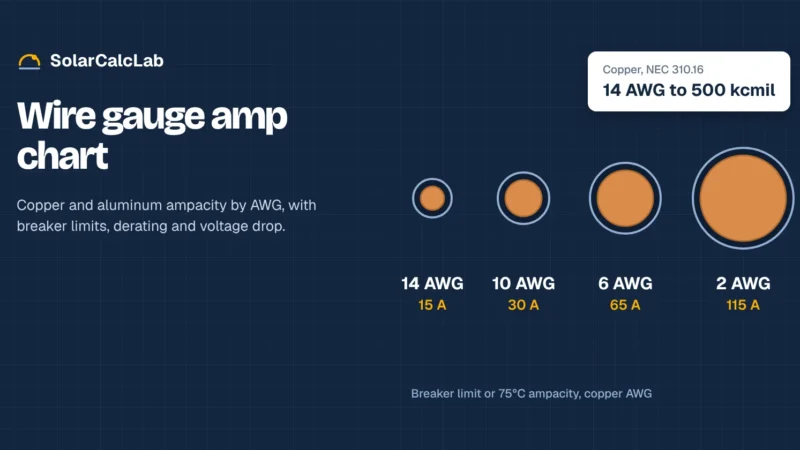
- Wiring inside walls on a 15 or 20 amp breaker: never 16 gauge. Use 14 or 12 AWG, as shown in the wire gauge amp chart.
- 12 V DC load under 5 A within about 7 feet: 16 gauge works.
- Speakers within 50 feet at 8 ohms: 16 gauge works.
Frequently asked questions
How many amps can 16 gauge wire handle?
As a two-conductor extension or appliance cord, 16 AWG copper is rated 13 amps under NEC Table 400.5(A)(1). With three current-carrying conductors it is 10 amps, and as fixture wire it is 8 amps. Where the code allows 16 AWG in other circuits, protection is limited to 10 amps.
Can a 16 gauge extension cord handle 15 amps?
No. A 16 gauge cord is rated 13 amps, about 1,560 watts at 120 V. A load that draws a full 15 amps needs a 14 gauge cord, and a 12 gauge cord is better if the cord is longer than 50 feet.
How many watts can 16 gauge wire carry?
At 120 V, a 16 gauge cord carries about 1,560 watts at its 13 amp rating, while the package usually says 1,625 W because it uses 125 V. At 12 V DC the limit is set by voltage drop, so a 5 amp load (60 watts) can run about 7 feet before losing 3%.
Is 16 gauge wire good for speakers?
Yes, for 8 ohm speakers up to about 50 feet and 4 ohm speakers up to about 25 feet. Past those distances, the wire’s resistance takes more than 5% of the speaker’s impedance, and thicker 14 or 12 gauge wire is the better choice.
Can I use 16 gauge wire for a light fixture?
Yes, inside the fixture. 16 AWG fixture wire is rated 8 amps under Table 402.5 and can be tapped to a 15 or 20 amp branch circuit within the length limits of Section 240.5(B)(2). The branch circuit wiring in the wall must still be at least 14 AWG.